Drishawmaddhom Shilpi ShomaJ-ANNOUNCE
July Uprising: Drishawmaddhom Shilpi Shomaj announces cultural drive
Cultural collective Drishawmaddhom Shilpi Shomaj on Sunday announced a broad cultural campaign titled ‘36 Days That Shook the Heart: July Uprising and Cultural Constitution’ at Bangladesh Shilpakala Academy (BSA), commemorating the historic July 2024 Uprising and envisioning continued cultural resistance.
As part of this initiative, it was announced that a daylong programme will be held on August 2 at the Bangladesh National Museum in the capital.
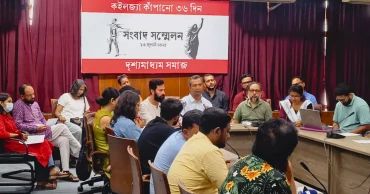
The announcement was made at a press conference at the Conference Room of National Theatre Hall at BSA.
The event began with a minute of silence and the national anthem in memory of those martyred in the July Uprising.
The keynote was jointly delivered by Akram Khan, Krishnendu Chattopadhyay, Fariha Shams Sewti, and Sarkar Protik, while the programme was announced by Zahin Faruq Amin and Dhrubo Hasan; and the event was moderated by Taslima Azmeri Haque Badhon, Tanvir Noor, Shaheen Dill-Riaz, Munem Wasif, Dr Samina Luthfa, Asaduzzaman Asad, Dr Anon Siddika, Musfiqur Rahman Manju, Krishnokoli Islam, Mohammad Ali Haider, and Bithi Ghosh.
‘July Reawakening’: BSA's drone show, cultural event to mark first anniversary at Shaheed Minar on July 14
Several others including Habibur Rahman, Barkat Hossain Palash, Jagannmoy Pal, Mitu Rahman, Rafi Uddin, and Shadab Shahrokh Hai were present .
A short video was presented during the event, which concluded with a Q&A session. The collective quoted Ahmed Sofa’s assertion that “true courage is the ability to envision distant possibilities,” framing it as a call to cultural and political imagination.
Drishawmaddhom Shilpi Shomaj recounted its emergence during the mass uprising, when artists, performers, and cultural activists gathered to demand democratic reforms.
Their protest, centred at Farmgate and the Shaheed Minar, became a defining moment in Bangladesh’s cultural-political landscape. The movement later contributed to flood relief, reconstruction, and social mobilization.
The group placed the July Uprising within the longer arc of Bangladesh’s democratic history—from the 1947 Partition and 1952 Language Movement to the 1971 Liberation War and the 1990 pro-democracy uprising. They asserted that history must not be confined to the past, but mobilized for democratic transformation in the present and future.
One year on, the collective reflected on both progress and unresolved challenges. Though the authoritarian regime fell, fascist systems persist. Speakers raised concerns about delayed justice, unfinished reforms, and a lack of clarity in democratic commitments.
The group also addressed what it described as "cultural fascism"—state and social pressures that silence dissenting voices, censor creativity, and demand conformity from the arts. In contrast, they upheld cultural resistance as a way to reimagine democracy and social justice through fearless expression.
The series of events will feature theatre, music, live graffiti, poetry, film screenings, and exhibitions of protest art. The day-long events will feature some of initiatives under the ‘36 Days’ campaign, which aims to deepen reflection on the uprising and foster artistic solidarity for a just and inclusive Bangladesh.
1 year ago