dhaka-housing boom
Will the housing boom in Dhaka bury it alive?
Afzal Hossain, a resident of a condominium in Shantinagar, enjoys the convenience of daily services within his high-rise building and he dreams of buying another flat in a similar complex for his children in the future like many in the city’s middle class.
Owning one or more flats is not Afzal’s alone aspiration; it has become a hallmark dream for many upper-middle-class families in Dhaka.
Since the 90s, hundreds of housing companies have emerged in the capital, focusing on constructing tall buildings to meet this demand, while also aiming for maximum profit.
Landowners have joined the trend, hoping to secure partial ownership of such projects, even if they lack the means to build themselves.
According to the Bangladesh Portal, Dhaka Metropolitan Area spans 360 square kilometres. Following administrative realignment in 2016 by the National Implementation Committee for Administrative Reform (NICAR), the combined area of Dhaka’s two city corporations stands at 270 square kilometres.
This area constitutes less than 1% of Bangladesh’s total land but is home to nearly 20 million people, pushing population density to over 50,000 people per square kilometre.
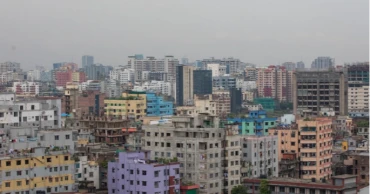
To accommodate this massive housing demand, towering buildings have continuously sprung up over the last three decades.
Rajuk data estimates around 200,000 buildings in Dhaka city, though urban planners believe the actual number exceeds 600,000 across the two city corporations and is rising annually.
Though Dhaka remains far from ideal planning, the Ministry of Housing and Public Works, through Rajuk, took an initiative to draft a Detailed Area Plan (DAP) aimed at saving the city from becoming unlivable. But the plan remains stalled amid debates and numerous revision drafts.
A critical aspect of the DAP is regulating building height based on road width and plot size.
Narrow roads should limit building size accordingly. Yet, housing developers have resisted the Floor Area Ratio (FAR) limits set by the plan.
In May, Rajuk was pressured by developers who protested demanding increased FAR. Environmental activists and planners claim these changes favor developers at the city’s expense.
Land Prices Soar Amid Housing Pressure
Fifty years ago, land prices in upscale Gulshan ranged between Tk 5,000 to Tk 8,000 per katha (approx. 720 sq ft). Today, prices have skyrocketed to Tk 50-80 million per katha depending on location in gulshan.
Sabbir Hossain, a Gulshan resident, said, “My father bought four and a half kathas of land for Tk 10,000 per katha in the early 80s. We built our house there. The current market value is over Tk 80 million.”
Decades ago, Baridhara land was less sought after and sold cheaply. Today, it ranks as the most expensive residential area in the capital according to government rates -- officially over Tk 75 million per katha, while actual market prices reportedly reach Tk 100-150 million.
In some cases, prices have increased by hundreds of thousands of percent compared to post-independence values.
Commercial land prices are also soaring. In Motijheel, prices range between Tk 30-60 million per katha; in Banani, Tk 40-70 million; and in Shantinagar, Tk 30-50 million.
Vacant plots in these prime areas are nearly nonexistent, with most privately owned land occupied by housing company apartments. Developers are now eyeing comparatively affordable land in peripheral areas of Dhaka.
For example, a decade ago, land prices in northern Badda’s Shadhinota Sarani area ranged from Tk 200,000 to Tk 300,000 per katha, rising to Tk 1-1.5 million ten years ago.
With the arrival of housing companies, prices reached Tk 3-3.5 million and currently land sells for Tk 5-6 million per katha.
Sultan Mia, a longtime resident of the area, recalled, “There used to be ponds and forests here, with paddy fields further inside. Near the road, many had tin-shed houses.”
Today, a few tin houses remain, but the area is dominated by 8-10 story high-rises, mostly built by housing companies.
Landowners, unable to afford multi-story construction themselves, often rent out land to developers who promise them half ownership in tall buildings, a proposition many accept eagerly.
The crowded neighbourhoods of Beribadh, Badda and Vatara lack wide roads, playgrounds, or parks. High-rises keep rising as middle-class buyers flock here, leading to increased traffic congestion and strained living conditions.
Poor drainage, crumbling roads plague Chuadanga Municipality
RAJUK’s Role: Saving or Sacrificing Dhaka?
On Sunday (Aug 10), the Ministry of Housing and Public Works is expected to finalise revisions to the DAP following intense pressure from housing developers.
A meeting held August 3 ended without announcements, but sources indicate major amendments favouring the sector.
Several Rajuk officials confirmed the revised plan will likely increase the floor area ratio significantly, enabling taller buildings.
Alongside this, the city’s building regulations are expected to undergo substantial changes to ease construction permissions.
Developers and landowners alike seek approval to build higher, arguing there is strong demand for flats and questioning why the government should hinder this.
Rajuk officials declined to comment directly.
Attempts to reach Rajuk Chairman Reazul Islam went unanswered, and Chief Engineer Nurul Islam and Chief Urban Planner Ashraful Islam were unavailable for comment due to health reasons.
A senior Rajuk official, speaking on condition of anonymity, revealed, “Housing developers are exerting strong pressure to double or more the floor area ratio in the revised DAP. Besides, exemptions will be granted to developers in other aspects.”
He said increased FAR will be allowed in high-demand areas such as Rampura and Badda and also in peripheral zones like Savar, Aminbazar, Hemayetpur and Tongi.
Developers vs. Planners
The Real Estate and Housing Association of Bangladesh (REHAB) demands uniform FAR policies across Dhaka, calling the current area-wise variations discriminatory.
MA Awal, REHAB’s Vice President-1 and Managing Director of Haveli Property Development, said, “DAP must be universal. Having different FAR in different areas is unfair. Giving higher FAR in Basundhara and lower in Mirpur discriminates against Mirpur residents.”
Asked about the logic of allowing tall buildings on narrow roads, Awal responded, “Every small road in Dhaka connects to a major road. It is incorrect to compare government-planned areas like Gulshan-Baridhara with private projects.”
Contrary to planners’ concerns about Dhaka losing livability, Awal dismissed these as propaganda.
He argued environmental degradation is widespread and blaming the housing sector is unjustified.
Bangladesh Institute of Planners (BIP) President Adil Mohammed Khan rejected developers’ claims, stating, “Their talk of discrimination serves business interests. Urban planning requires schools, parks, and playgrounds, not just roads. Narrow roads limit building size and height—this is urban planning’s basic grammar. Denying this endangers Dhaka’s livability while protecting the housing business.”
Khan warned that planners may take legal action if the revised DAP undermines planned development.
He emphasised the urgency of decentralising Dhaka to ease population pressure, warning that failure to do so will leave the city increasingly unlivable.
1 year ago