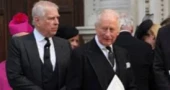
Prince Andrew loses British royal title
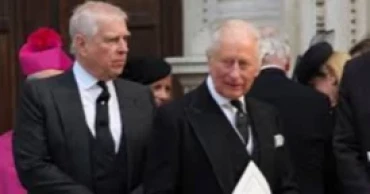
King Charles III strips Prince Andrew of titles to safeguard the monarchy
No one stands above the monarchy — not even the king’s own brother.
That principle has now brought an end to Prince Andrew’s royal status.
As controversy surrounding Andrew’s ties to convicted sex offender Jeffrey Epstein continued to mount, and as lawmakers questioned his rent-free stay at the Royal Lodge near Windsor Castle, King Charles III took decisive action on Thursday to protect the institution’s reputation.
In a statement from Buckingham Palace, the king announced that Andrew had been stripped of all his royal titles and honors, including his birthright as “prince.” From now on, he will be known simply as Andrew Mountbatten-Windsor. He has also been ordered to vacate Royal Lodge, the 30-room residence he has occupied for more than two decades.
Read more: Princess Kate says sorry for manipulated family photo, saying she was experimenting with editing
“The monarchy needed to draw the thickest possible line between Andrew and the rest of the royal family,” said Craig Prescott, a constitutional law expert at Royal Holloway, University of London. “And that’s exactly what the king has done.”
A Decisive Break
The king’s move followed an earlier, less formal agreement that Andrew would cease using his titles — a step that failed to stem a surge of negative headlines. The continued media scrutiny and calls from Parliament for further sanctions threatened to trigger a public debate about Andrew’s conduct.
Charles’s decision comes as he, at 76 and undergoing treatment for cancer, seeks to strengthen the monarchy and stabilize it for his heir, Prince William.
“This was clearly about putting the royal house in order, both now and for the future,” said George Gross, a royal historian at King’s College London. “It makes things easier for Prince William — and it always felt inevitable.”
Scandal Still Looms
While the king’s actions may protect the monarchy’s image, they do not resolve Andrew’s legal and reputational troubles.
Renewed attention to his past was sparked by the release of a memoir from Virginia Giuffre, who claimed she was trafficked by Epstein and coerced into having sex with Andrew when she was 17. Giuffre, who had been living in Australia, died by suicide earlier this year.
Read more: Prince Harry says William called Meghan “difficult, rude and abrasive” before physical attack
Her brother, Sky Roberts, praised her efforts to expose both Epstein and Andrew, and called for the prince’s prosecution. Andrew has consistently denied all allegations.
Historian Andrew Lownie, author of Entitled: The Rise and Fall of the House of York, told the BBC that he expects further revelations and possible investigations into Andrew’s conduct, including potential abuses of public office.
“I don’t think it’s over — but at least the palace is taking firm action,” Lownie said.
A Troubled Past
Andrew, 65, the late Queen Elizabeth II’s second son, served over 20 years in the Royal Navy before becoming a full-time royal in 2001. His career and reputation have long been clouded by controversy.
In 2007, he sold a home near Windsor Castle for 20% above its £15 million asking price to Timur Kulibayev, the Kazakh president’s son-in-law, raising concerns about potential influence-peddling. His connections to figures linked to Libya’s Moammar Gadhafi also prompted his removal as the UK’s special trade envoy.
Read more: Harry and Meghan slam British tabloids in new Netflix series
Despite these scandals, Andrew was long protected by the queen, who was said to have had a soft spot for her son. That protection crumbled after his disastrous 2019 BBC interview, in which he failed to express sympathy for Epstein’s victims and offered implausible denials. Public backlash forced him to give up all official duties and charity roles soon after.
Now, King Charles has completed the separation by severing Andrew’s remaining royal ties. He will be relocated to the king’s private Sandringham estate after vacating the Royal Lodge — a long-disputed residence he had refused to surrender.
A Monarchy in Transition
Experts say the decision reflects a broader shift in how the royal family is adapting to modern accountability.
Craig Prescott noted that while public criticism of the monarchy was muted during Queen Elizabeth II’s reign, Charles faces greater scrutiny and a more demanding public.
“This marks a transition toward a monarchy that functions more like a public institution — subject to oversight and public expectation,” Prescott said. “There was both public and parliamentary pressure for the king to act, and he has done so.”
Read more: Kate, Princess of Wales, says she has cancer and is undergoing chemotherapy
10 months ago