Kashmir Medical
India shuts Kashmir medical college after Muslim students dominated first MBBS batch
India has shut down a medical college in Indian-administered Kashmir following protests by right-wing Hindu groups over the admission of a large number of Muslim students into its first batch.
The National Medical Commission (NMC), the federal regulator for medical education, revoked the recognition of Shri Mata Vaishno Devi Medical Institute (SMVDMI) on January 6. The institute is located in Reasi district, a mountainous region overlooking the Pir Panjal range that separates Jammu from the Kashmir Valley.
Of the 50 students admitted to the five-year MBBS programme in November, 42 were Muslims, mostly from Kashmir, seven were Hindus and one was a Sikh. This was the first MBBS batch launched by the private college, which was founded by a Hindu religious trust and partly funded by the government.
Across India, admissions to both public and private medical colleges are conducted through a centralised entrance exam known as the National Entrance Examination Test (NEET), organised by the federal education ministry’s National Testing Agency. More than two million students sit for the exam each year, competing for around 120,000 MBBS seats.
Read More: ‘Goodwill prevails’ as Bangladesh, India prioritise cooperation over confrontation
Public colleges are usually preferred due to lower fees, but they require higher scores. Students who meet the minimum qualifying threshold but fall short of public college cut-offs typically enrol in private institutions.
One such student was 18-year-old Saniya Jan* from Baramulla district in Kashmir. After qualifying NEET, she opted for SMVDMI as it was relatively close to her home, around 316 kilometres away. “It was a dream come true – to be a doctor,” Saniya told Al Jazeera.
Her parents travelled to Reasi to drop her off when classes began in November. “My daughter has been a topper since childhood. I have three daughters, and she is the brightest. She really worked hard to get a medical seat,” her father, Gazanfar Ahmad*, told Al Jazeera.
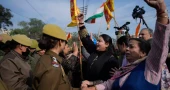
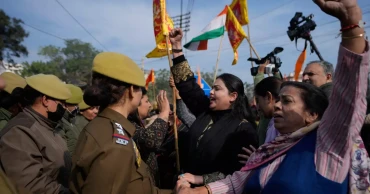
However, soon after the academic session started, local Hindu groups began protesting after learning about the religious composition of the batch. They demanded the cancellation of Muslim students’ admissions, arguing that since the college was largely funded through offerings at the Mata Vaishno Devi Temple, Muslims had “no business being there”.
Demonstrations continued for weeks, with protesters gathering daily outside the college gates and raising slogans.
Lawmakers from Prime Minister Narendra Modi’s Bharatiya Janata Party (BJP) wrote to Kashmir’s lieutenant governor, urging that admissions be reserved exclusively for Hindu students. The lieutenant governor serves as the federally appointed administrator of the region.
Their demands later escalated to calls for the college’s closure.
Amid the growing agitation, the NMC announced on January 6 that it had withdrawn the college’s authorisation for failing to “meet the minimum standard requirements” set by the government. The regulator cited deficiencies in faculty, bed occupancy, patient flow, libraries and operating theatres. The following day, the college’s letter of permission to operate was also revoked.
However, several students told Al Jazeera they did not observe any major shortcomings.
Read More: Indian smuggled goods worth Tk 81 lacs seized in Sylhet, 1 held
“I don’t think the college lacked resources,” said Jahan*, who provided only her second name. “We have seen other colleges. Some of them only have one cadaver per batch, while this college has four of them. Every student got an opportunity to dissect that cadaver individually.”
Rafiq, another student, said that even government medical colleges in Srinagar lacked similar facilities. “Even they don’t have the kind of facilities that we had here,” he said.
Saniya’s father also said that the campus appeared well-run when he visited.“The college was good. The faculty was supportive. It looked like no one cared about religion inside the campus,” he said.
Political analyst Zafar Choudhary questioned how the regulator had approved the college in the first place if it lacked proper infrastructure. “Logic dictates that their infrastructure would have only improved since the classes started. So we don’t know how these deficiencies arose all of a sudden,” he told Al Jazeera.
He also criticised the demands made by Hindu groups. “There is a system in place that determines it. A student is supposed to give preference, and a lot of parameters are factored in before the admission lists are announced. When students are asked for their choices, they give multiple selections rather than one. So how is it their fault?” he asked.
Al Jazeera contacted SMVDMI executive head Yashpal Sharma for comment, but he did not respond. The college has not issued any public statement since losing its authorisation.
Meanwhile, students have returned home.
Salim Manzoor*, another student, noted that in Muslim-majority Kashmir there are medical colleges where Hindu students are enrolled under minority quotas.
The BJP has denied claiming that Muslim students were unwelcome but said public sentiment around the temple trust must be respected. “This college is named after Mata Vaishno Devi, and there are millions of devotees whose religious emotions are strongly attached to this shrine,” BJP spokesperson Altaf Thakur told Al Jazeera. “The college recognition was withdrawn because NMC found several shortcomings. There’s no question of the issue being about Hindus and Muslims.”
Kashmir Chief Minister Omar Abdullah said students would not be made to “suffer due to NMC’s decision” and would be accommodated in other institutions. “These children cleared the National Entrance Examination Test, and it is our legal responsibility to adjust them. We will have supernumerary seats, so their education is not affected. It is not difficult for us to adjust all 50 students, and we will do it,” he said.
He also criticised the BJP and allied groups. “People generally fight for having a medical college in their midst. But here, the fight was put up to have the medical college shut. You have played with the future of the medical students of [Kashmir]. If ruining the future of students brings you happiness, then celebrate it.”
National Conference legislator Tanvir Sadiq said the university had received more than $13 million in government funding since 2017, making all Kashmiris stakeholders. “This means that anyone who is lawfully domiciled in [Indian-administered Kashmir] can go and study there. In a few decades, the college would have churned out thousands of fresh medical graduates. If a lot of them are Muslims today, tomorrow they would have been Hindus as well,” he said.
Nasir Khuehami of the Jammu and Kashmir Students’ Association warned that the controversy risks communalising education. “The narrative that because the college is run by one particular community, only students from that community alone will study there, is dangerous,” he said.
Back in Baramulla, Saniya remains uncertain about her future. “I appeared for a competitive exam, which is one of the hardest in India, and was able to get a seat at a medical college,” she said.
“Now everything seems to have crashed. I came back home waiting for what decision the government will take for our future. All this happened because of our identity. They turned our merit into religion.”
4 months ago