environmental concern

Dhaka’s air at risk as Savar brick kilns defy closure orders
Despite the government’s declaration of Savar upazila as a ‘degraded airshed’, brick kilns in the area continue operating openly, raising serious concerns over air pollution in Dhaka.
The move, intended to protect the capital’s northern entry points, appears to have little effect on kiln owners, who are finding ways to circumvent official orders.
On August 17, 2025, the government formally designated the entire Savar upazila as a ‘degraded air shed’ under the Air Pollution (Control) Rules, 2022, explicitly banning all brick-burning and brick-manufacturing activities.
The decision followed mounting evidence that emissions from kilns in Savar significantly worsened air quality in Dhaka, especially during the dry season, posing grave health risks to the city’s densely populated residents.
Read more: Illegal brick kilns in Khulna: A silent peril to environment and public health
Yet, local residents and environmental activists report that many brick kiln owners treat the government’s circular as mere paperwork. Although authorities demolished chimneys of several kilns late last year, many have been rebuilt and resumed operations.
According to the latest data up to June 2025, Savar hosts 86 brick kilns, including 59 licensed and 27 unlicensed facilities.
In the Turag River area near Ashulia Bazar, brick burning remains widespread.
Ashulia Bricks and MCB Bricks, in particular, have continued production since the start of the season.
During a recent visit to Ashulia Bricks, hundreds of workers were observed manufacturing raw bricks, transporting them, and stacking finished products near the kiln. On the opposite side, others were removing fired bricks from the furnace.
Read more: Tk 20 crore fines imposed in nationwide anti-pollution drives
When contacted, Ashulia Bricks manager Md Madhu Mia defended the operation, saying, “The government has done its job and we are doing ours. We have already spent a lot of money on labour and other sectors. If we shut down the kiln, recovering that investment would be impossible. That’s why we were compelled to continue. We have communicated with various parties and they assured us.”
9 months ago
Bangladesh suspends Vannamei shrimp fry imports amid disease concerns
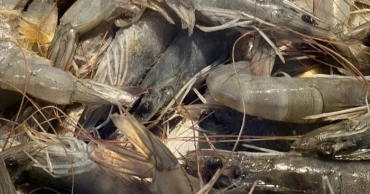
The Ministry of Fisheries and Livestock on Thursday (January 15, 2026) suspended all new and existing approvals for importing shrimp fry for Vannamei farming, citing risks of disease transmission and environmental pollution linked to the exotic species.
In a media release issued in the afternoon, the ministry said the decision was taken following a high-level meeting held on January 7, chaired by Fisheries and Livestock Adviser Farida Akhter, to review the environmental, social and economic impacts of Vannamei shrimp farming in Bangladesh and determine future actions.
Read more: Safe, quality shrimp production must be prioritised: Adviser Farida
The meeting noted that Vannamei shrimp is an import-dependent species and that the import of its fry poses risks of disease outbreaks, environmental degradation, and adverse impacts on indigenous species, including Bagda (black tiger shrimp) and Galda (freshwater prawn).
In this context, participants opined that unregulated expansion of Vannamei shrimp farming would not be appropriate.
The discussion emphasised keeping Vannamei shrimp farming limited to controlled, intensive and environmentally compliant systems. It was also decided that the activities of already approved Vannamei farmers would be closely monitored, with on-site evaluations to ensure full compliance with stipulated farming conditions.
Until such evaluations are completed, all forms of new and existing approvals for importing Vannamei shrimp fry will remain suspended, the media release said.
The meeting further decided to undertake necessary research to assess the environmental, social and economic impacts of Vannamei shrimp farming. Future policy and administrative decisions will be taken based on the findings of these studies.
At the same time, the ministry underscored the need to prioritise the expansion of domestic shrimp farming by boosting the production of indigenous Bagda and Galda shrimp, rather than relying on imported species, and to take up suitable projects to support this goal.
Read more: Human chain demands enforcement of law to stop saline shrimp farming in cropland
Fisheries and Livestock Secretary Abu Tahir Muhammad Zaber, Additional Director General of the Department of Fisheries Md Zia Haider Chowdhury, senior ministry officials, and fisheries officers from relevant districts, also attended the meeting.
9 months ago