Experts call for city government roadmap
Experts call for city government roadmap in election manifestos to address urban crisis
Urban experts have urged political parties to clearly outline their plans for forming a strong and effective city government in their manifestos for the upcoming national elections, saying it is crucial for ensuring sustainable solutions to the growing urban crisis.
They said one of the main reasons behind the deteriorating condition of cities, including Dhaka, is poor coordination among service-providing agencies and the limited authority of city mayors.
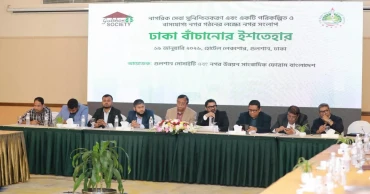
The observations were made at a dialogue titled “Manifesto to Save Dhaka”, organised by the Urban Development Journalists Forum Bangladesh and Gulshan Society at a city hotel on Monday.
Gulshan Society President Barrister Sadat Omar presented the keynote paper at the programme, chaired by Urban Development Journalists Forum President Matin Abdullah.
Dhaka North City Corporation Administrator Mohammad Azaz said the City Corporation’s authority is currently limited mainly to waste management and street lighting.
“As the City Corporation does not have its own police force, sustained eviction drives are not possible,” he said.
He also said although around Tk 19–22 crore is collected every month from traffic law violation fines in Dhaka North City, the City Corporation does not receive any share of the amount, which goes directly to the central treasury. Meanwhile, the City Corporation has to spend hundreds of crores of taka on traffic signals and infrastructure development.
According to him, meaningful change in city governance is not possible unless a full-fledged city government is formed by bringing WASA, RAJUK and the police under the City Corporation. Ensuring urban safety and social justice for climate refugees and migrants will be among the key challenges ahead, he added.
BNP Chairperson’s Adviser Bir Muktijoddha Abdus Salam said there is currently no effective coordination among RAJUK, City Corporation and other service providers.
He criticised the previous government for dividing Dhaka city for political reasons and said the country’s institutions have been weakened over the past 17 years. “A strong and elected government is needed to overcome this situation,” he said, urging people to give an elected government sufficient time to work.
“To protect Dhaka, the Buriganga, Shitalakshya, Turag and Balu rivers must be saved, and for that a long-term master plan is essential,” he added.
He said BNP has set 10 priority goals for Dhaka’s development, which will be included in its future manifesto. These include ensuring a clean city, dedicated healthcare, youth skills and employment, improved roads and footpaths, a drug-free society, protection of the underprivileged, stronger security, modern waste management, better educational institutions and improved citizen services.
Jamaat-e-Islami’s Dhaka-17 candidate Dr SM Khaleduzzaman said city development should not be left to politicians alone.
“We must build our city together. Do not elect representatives who fail to keep their promises,” he said, adding that Dhaka, once envisioned around the Buriganga River, has become uninhabitable due to mismanagement and poor political decisions.
He said Jamaat-e-Islami would prioritise environmental restoration and seek active participation from city dwellers.
Ariful Islam Adib, senior joint convener of the National Citizen Party, said their manifesto would focus on 10 key issues to save Dhaka, including an integrated city government system.
“There are many organisations — City Corporation, RAJUK, WASA, DESA — but coordination among them is lacking. An integrated governance system is essential,” he said, adding that sustainable economy, health, education, women’s safety, road safety and preservation of cultural heritage would also be priorities.
Bangladesh Institute of Planners (BIP) General Secretary Dr Musleh Uddin Hasan said cities are being developed as “cities for concrete and cars” rather than for citizens.
“Dhaka is facing a severe public space crisis as playgrounds and water bodies are disappearing. Community engagement and political commitment are crucial to address this,” he said.
Environmental expert and Manarat International University Vice-Chancellor Professor Abdur Rab said around 40 million people in the country live in polluted areas.
He stressed area-based development, increased greenery and protection of wetlands, noting that a city should have at least 25–30 percent wetlands. Rivers, canals and water bodies must be rescued from encroachment, he added.
Dr Farhad Halim Donor, executive director of Ziaur Rahman Foundation; architect Rafiq Azam; engineer and planner Md Nurullah; Gulshan Society Vice-President Syed Almas Kabir; and Urban Development Journalists Forum General Secretary Hasan Emon, among others, also spoke at the dialogue.
8 months ago