Bicycling
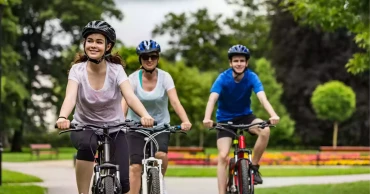
Bicycling could cut emissions in Global South with policy support: Study
After collecting feedback from bicyclists and other stakeholders across four cities in Bangladesh, India and Ghana, a new study shows policymakers devising ways to cut emissions in their countries must meet people where they are and not rely on the same policies that have worked in richer countries.
In many high-income countries, bicycling on city streets is becoming more common— being promoted and invested in both for its health benefits and its benefits to our environment and climate.
The new study published in Nature Cities shows that policies that address the needs of bicyclists are far less common in low- and middle-income countries.
Read More: Europa likely unsuitable for life despite hidden ocean, study finds
This, despite the fact that 49 of the top 50 countries with the most polluted air are located in the Global South and 82 percent of CO2 emissions over the remainder of the century are projected to occur there.
The study evaluates the current state of bicycling in the Global South and what can be done to increase its use as a tool for reducing emissions and improving air quality.
“There is enormous potential for bicycling to be used as a way to reduce harmful pollution and greenhouse gas emissions from the transportation sector in low- and middle-income countries,” says Kavi Bhalla, one of the study’s co-authors and an Associate Professor in the Department of Public Health Sciences at the University of Chicago’s Biological Sciences Division.
“But just because certain policies work to boost bicycling in cities in the United States or Europe doesn’t mean the same policies will be successful in countries in the Global South, where the context is much different. Our study digs into that local context so policymakers can better design policies to fit their local needs.”
Read More: Rising medicine prices threaten healthcare for marginalised communities, warns study
Bhalla and his co-authors including those from Bangladesh studied bicycling in four similar low- and middle-income cities: Delhi and Chennai (India), Dhaka (Bangladesh), and Accra (Ghana).
The locations they chose are all rapidly densifying and expanding cities with flat terrain, heterogeneous traffic, and marked by very hot summers and seasonal flooding. The authors gathered both “in the moment” feedback and interview testimony from more than 550 bicyclists and other stakeholders.
They discovered that bicycling is a mode of everyday transportation for some. But the typical rider was a low-income man cycling a long distance to work each day, with fewer low-income women also riding bicycles to travel shorter distances and on quieter neighborhood roads.
But the conventional belief was, once someone could afford an automobile, they would no longer use a bicycle.
Those who did bicycle faced harsh and risky road conditions. Along with needing to cope with extreme heat, heavy rains and flooding, they also needed to navigate roads that were built to accommodate high-speed automobiles.
In the few areas where separated bicycle lanes existed, they were often either blocked by parked cars or vendors, taken over by motorcyclists escaping roadway traffic, or built in affluent neighborhoods where few people actually bicycle.
It is of little surprise that roadways were built without bicyclists in mind. Planning documents rarely acknowledged that people bicycled at all, and when they did it was often in reference to recreational use within beautification projects.
Additionally, the responsibility of bicycling infrastructure is spread among many different agencies, while bicycle distribution policies were aimed at improving access to school for low-income girls.
Bicycling cultures persist despite these barriers, sustained by informal and precarious support systems. Non-profit organizations provide tools like air pumps and water at basic public comfort stations. Meanwhile, small street-side bicycle repair shops, often no more than footpath stalls, provide maintenance and sell second-hand bicycles.
Yet, many have downsized over the past decade and must regularly negotiate with police and regulatory authorities simply to continue occupying public space.
“What we saw was not a lack of bicycling, but a lack of institutional support,” says Rahul Goel, one of the study’s co-authors and an assistant professor at the Indian Institute of Technology (IIT), Delhi.
“Bicycling continues largely because of informal systems that keep bicycling viable from day to day. These systems are essential, yet they are increasingly fragile and invisible to policymakers, even as motorized traffic and regulatory pressures make cycling harder to sustain.”
Drawing on this analysis, the study concludes that large-scale increases in bicycling could meaningfully reduce greenhouse gas emissions and other pollution from the transport sector in low- and middle-income countries.
However, rather than importing models from high-income settings, the authors argue that policies should start by addressing the everyday needs, constraints, and risks experienced by current bicyclists.
“If we begin by making bicycling safer and more workable for those who already rely on it, we can create conditions that make bicycles a viable option for many more people and help prevent a shift toward private motor vehicles as incomes rise,” says Smruthi Bala Kannan, who led the work as a post-doctoral researcher at the University of Chicago before joining the Madras Institute of Development Studies as an Assistant Professor.
Read More: Bangladesh solar power projects fail to draw investors for rigid terms: Study
8 months ago