Poster-free election
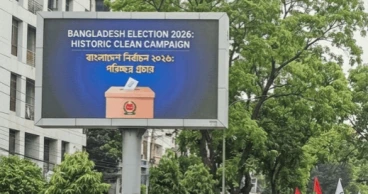
New Politics: Poster-free election reshapes Bangladesh’s campaign scenario
For the first time in Bangladesh’s electoral history, a national election campaign is unfolding without the familiar clutter of posters on walls, electric poles and roadside trees, marking a striking departure from the visual chaos that traditionally signals the onset of election season.
Streets that once announced the arrival of polls through layers of colourful faces, slogans and party symbols now appear unusually bare, altering not only the cityscape but also the mood and rhythm of campaigning ahead of the 13th parliamentary election.
The dramatic shift follows the Election Commission’s decision to ban all forms of posters under the revised electoral code, a move aimed at curbing environmental damage and visual pollution that has long accompanied electioneering across the country.
While the decision has drawn praise from environmentalists and urban residents for restoring cleaner public spaces, it has also sparked confusion among voters accustomed to identifying candidates through posters and dealt a severe blow to the country’s printing industry, which traditionally relies heavily on election-time orders.
A Silent Campaign
Traditionally, a festive atmosphere is created with the beginning of the election campaign which is largely absent this year.
With posters, loud mike announcements and other overt campaign tools restricted, many voters say the election atmosphere feels distant—almost unfamiliar.
“Without posters, it doesn’t even feel like a national election,” said Ruhul Amin, a resident of New Market area in Dhaka.
From posters to punchlines: How Bangladesh’s politics got 'Meme-ified'
“Posters and festoons were a common feature. Now, people who don’t actively follow politics or media are struggling to recognise the candidates,” he said.
Campaigning officially began just after midnight on January 21 and will continue until 7:30am on February 10. Yet, four days into the campaign, most areas in the capital remained virtually unchanged.
Printing Presses Fall Silent
If the streets appear quiet, the silence is even louder inside printing presses.
At Fakirapool and Banglabazar—two hubs of Dhaka’s printing industry—machines that would normally be running round the clock during election season are idle.
Owners say they have not received any order due to the restriction.
“Usually, elections mean business worth several crores of taka. This time, it’s zero. We’ve already bought paper worth lakhs expecting orders that never came,” said a printing press owner at Banglabazar requesting anonymity. “
What New Rules Say
The Election Commission amended the electoral code and issued a gazette on November 10 last year imposing a ban on the use of posters and the misuse of artificial intelligence (AI) and social media in election campaigns.
According to the new code of conduct, no one also can carry out election campaigns in religious places of worship like mosques, temples, pagodas and churches as well as the government offices or educational institutions.
Candidates may still distribute leaflets, handbills and use festoons or billboards but with strict conditions.
In party campaigns, only the party chief’s photograph may be displayed, no other leader or candidate can appear in visuals.
The new code also tightens controls on technology and noise. The use of drones and quadcopters for campaigning has been fully banned.
Helicopters may be used only by party general secretaries or equivalent leaders but dropping leaflets from the air is prohibited.
Election campaign: Code of conduct published in gazette, banning posters-drones, AI-social media misuse
Microphone use is allowed only between 2 pm and 8 pm with sound levels capped at 60 decibels.
Besides, slips cannot be distributed within 180 metres of a polling centre and must not exceed 12cm by 8cm in size.
The slips cannot contain the candidate’s name, photograph, position or electoral symbol.
Voters Divided
Shafiqul Islam, a resident of Bashundhara residential area, said he is mostly learning about the election through television. “I haven’t seen the usual posters or mike announcements. The campaign feels less lively.”
“Poster-free elections are good in one way. The city stays clean. But since this is the first time, it feels different. I’m relying on the news media to know who belongs to which party,” said Naim, a resident of Banasree area.
While urban voters may adapt through digital and media platforms, less-connected or less-engaged voters could find it harder to identify candidates, especially independents, said another voter of Malibagh area.
Election Commission Secretary Akhtar Ahmed said the decision was taken after consulting political parties. “We sought opinions from all political parties. Only one party opposed the ban while the majority supported it,” he told UNB.
He said that environmental concerns played a key role. “There were strong objections from environmentalists and the Ministry of Environment. Considering those concerns and the views of most parties, posters were banned.”
7 months ago