weaving skills into self-reliance
How women in Naogaon turn weaving skills into self-reliance
A quiet transformation is unfolding across villages in Naogaon as thousands of rural women are finding employment through the weaving and embroidery of traditional caps popularly known as “Kuppia.”
What began as a small initiative more than a decade ago has now grown into a thriving cottage industry, providing livelihoods for nearly 50,000 women in the district and generating significant foreign currency through exports to the Middle East.
According to officials of the Bangladesh Small and Cottage Industries Corporation (BSCIC), around 90 percent of workers involved in the export-oriented cap weaving sector in Naogaon are women, most of whom work from their homes while managing household responsibilities.
UNFPA hosts Open Mic to amplify public voices for women’s and girls’ rights
Their meticulously embroidered caps are exported mainly to Oman, where the headgear is widely worn by men and recognised as part of the country’s traditional attire.
The caps are also shipped to Saudi Arabia, Bahrain, Kuwait, Qatar, and even to African countries such as Tanzania and Morocco.
Local entrepreneurs estimate that the industry brings in at least Tk 100 crore in foreign currency annually, while exports from Naogaon alone may reach around Tk 800 crore this year if the current demand continues.
A village-based industry
The cap-making clusters are concentrated mainly in Mahadevpur, Manda and Niamatpur upazilas.
In Mahadevpur, villages under Chandash, Mahadevpur Sadar and Uttargram unions have become hubs of embroidery work.
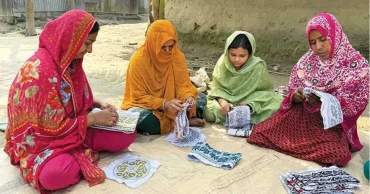
Women artisans receive pieces of cloth marked with design outlines and then stitch intricate patterns using colourful threads.
Once completed, the caps are collected by agents and supplied to traders who sell them to exporters based in Chattogram, Feni, Noakhali and Cumilla.
Each cap features distinctive hand-stitched designs such as chain, dewan, button, beadwork and fishbone patterns, requiring varying levels of skill and time.
From a single piece of cloth, artisans can produce 90 to 100 caps, depending on the design.
Income from home
For many rural women, cap embroidery has become a crucial source of supplementary income.
In Khoshalpur village of Mahadevpur upazila, 40-year-old homemaker Asha Begum was seen sitting in her courtyard with several other women, carefully stitching patterns on a cap.
“I learned sewing in my childhood. After getting married and moving here about 10 years ago, I saw many women doing this work,” she said. “I joined them and now earn around Tk 700 to Tk 800 a week during my spare time.”
According to her, around 80 to 90 women in the village are currently engaged in cap embroidery.
Another artisan, Julekha Begum of Kunjabon Eidgahpara village, said workers are paid based on the type and quality of design.
“Depending on the work, we get between Tk 16 and Tk 1,500 per cap. But compared to the labour involved, the payment is still quite low,” she said.
2 months ago