iceberg
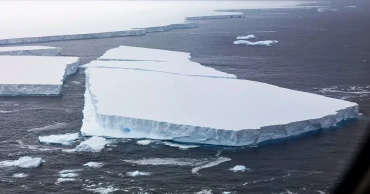
Historic iceberg A23a breaks apart, nears end after 40 years
One of the world’s oldest icebergs, known as A23a, is in its final weeks after an extraordinary 40-year journey that has fascinated scientists.
Once the largest iceberg on Earth, A23a covered more than twice the area of Greater London. Over the past year, it has melted, fractured, and broken apart, leaving only fragments that are now slowly disappearing in warmer waters far from Antarctica.
Scientists have closely monitored A23a to understand how Antarctic ice may respond to climate change. “It’s been an extraordinary journey, but it is on its last legs now,” said Prof. Mike Meredith of the British Antarctic Survey.
A23a broke off from the Filchner Ice Shelf in 1986, the same year as the Chernobyl disaster and Whitney Houston’s first Grammy. Initially about 4,000 sq km (1,540 sq miles), it stayed anchored in the Weddell Sea for over three decades before moving again in 2020. Today, it is considered the oldest iceberg tracked by satellites.
Despite its longevity, A23a began shrinking rapidly in 2025. By mid-year, it lost its title as the world’s largest iceberg. Mechanical forces in the South Atlantic, combined with warming waters, caused large chunks to break off, forming new icebergs named A23g, A23h, and A23i.
By late December, meltwater collected on its surface, accelerating its breakup. Scientists described this process as “hydrofracturing,” where water seeps into cracks, widening them and triggering calving events.
Although iceberg melting is natural, A23a’s disintegration provides clues about the stability of Antarctic ice shelves, which play a key role in controlling sea-level rise. Icebergs act as “travelling natural laboratories,” helping scientists predict how ice shelves may respond to warming conditions.
In its final stretch, A23a has traveled over 700 km (435 miles) northeast in the South Atlantic, exposed to surface waters nearing 10°C. Satellite images show further fragmentation, suggesting the iceberg may soon completely vanish. By March 5, its area had shrunk to roughly 180 sq km (70 sq miles).
Source: BBC
7 months ago