US strikes military sites
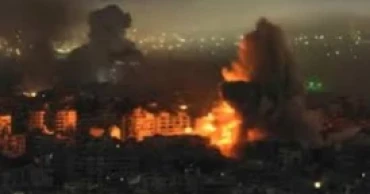
Trump says US strikes military sites on Iran’s Kharg Island as war escalates
US President Donald Trump announced that American forces carried out airstrikes on military targets on Kharg Island, a strategic location in Iran’s oil export network. At the same time, a US official revealed that about 2,500 additional Marines and an amphibious assault ship are being deployed to the Middle East as the conflict with Iran approaches its second week.
Trump said the strikes “destroyed” several targets on Kharg Island, which hosts Iran’s main oil export terminal. He warned that the island’s oil facilities might also be targeted if tensions continue. A day earlier, Iranian parliament speaker Mohammad Bagher Qalibaf warned that any attack on such sites would trigger a stronger Iranian response.
Earlier on Friday, a powerful explosion shook Ferdowsi Square in Tehran, where thousands of people had gathered for the annual Quds Day rally supporting Palestinians and condemning Israel. Israel had previously warned it might strike the area. Despite the blast, no casualties were reported.
The rally, attended by some Iranian officials, and Israel’s warning to target it highlighted the determination on both sides as the war continues to impact the global economy. Iran has been launching missile and drone attacks against Israel and Gulf countries while also blocking the Strait of Hormuz, a key route for about one-fifth of the world’s oil trade. Meanwhile, U.S. and Israeli aircraft have continued striking military and other facilities throughout Iran.
The conflict has also worsened the humanitarian situation in Lebanon, where Israeli strikes against Iran-supported Hezbollah militants have killed nearly 800 people and forced around 850,000 to flee their homes.
In an interview with Fox News, Trump said the war would end “when I feel it in my bones.” He also expressed doubt that civilians in Iran could easily overthrow the government, noting the power of the Basij, which has previously helped suppress nationwide protests.
Additional U.S. Military Deployment
According to a U.S. official speaking anonymously to The Associated Press, parts of the 31st Marine Expeditionary Unit and the amphibious assault ship USS Tripoli (LHA-7) have been ordered to the Middle East.
Marine Expeditionary Units can conduct amphibious assaults but are also trained to protect embassies, evacuate civilians, and provide disaster relief. Officials said the deployment does not necessarily mean a ground invasion is planned.
The unit and the Tripoli are normally stationed in Japan and had been operating in the Pacific Ocean. Satellite imagery recently showed the ship traveling alone near Taiwan, meaning it could take more than a week to reach waters near Iran.
Earlier in the week, the U.S. Navy already had 12 ships in the Arabian Sea, including the aircraft carrier USS Abraham Lincoln (CVN-72) and eight destroyers. If the Tripoli joins them, it would become the second-largest U.S. vessel in the area.
The exact number of U.S. troops in the Middle East is unclear, though Al Udeid Air Base alone usually hosts about 8,000 American personnel.
U.S. Strikes and Iranian Warning
Trump stated on social media that the U.S. strikes on Kharg Island targeted only military facilities and avoided oil infrastructure for now. However, he warned that if Iran or others interfere with shipping through the Strait of Hormuz, he may reconsider and attack Iran’s oil facilities.
Qalibaf had earlier warned that attacks on Iran’s southern islands would push the country to “abandon all restraint,” emphasizing their importance to Iran’s economy and security.
Explosion During Tehran Rally
The explosion at Ferdowsi Square occurred while thousands of demonstrators marked Quds Day, chanting slogans against Israel and the United States. Israel had posted a warning in Persian on X shortly before the blast, advising people to leave the area. However, many Iranians likely did not see the message because the government had largely shut down internet access.
Videos showed people chanting “God is greatest” as smoke rose over the area. At the time of the explosion, Iran’s judiciary chief Gholamhossein Mohseni Ejei was being interviewed on state television. His security guards surrounded him as he raised his fist and declared that Iran would never retreat despite missile attacks.
Scale of Military Operations
Israel said its air force had launched another round of strikes in Iran, hitting more than 200 targets within 24 hours, including missile launchers, air defenses, and weapons factories.
In Washington, D.C., U.S. Defense Secretary Pete Hegseth said that over 15,000 enemy targets have been struck since the war began—an average of more than 1,000 per day. He also attempted to reassure reporters that the disruption of shipping in the Strait of Hormuz was being managed.
U.S. Aircraft Crash
The U.S. military confirmed that all six crew members aboard a Boeing KC‑135 Stratotanker refueling aircraft were killed when it crashed in Iraq, raising the U.S. death toll in the conflict to at least 13 service members.
Mike DeWine, governor of Ohio, said three of the victims served in the Ohio Air National Guard. U.S. Central Command said the crash was not caused by hostile or friendly fire and involved two aircraft, one of which landed safely.
The KC-135 crash marked the fourth publicly acknowledged aircraft loss during U.S. operations against Iran. The previous week, three U.S. fighter jets were accidentally shot down by friendly fire from Kuwait.
Regional Attacks Continue
Iran has continued launching attacks on oil facilities and other infrastructure across Gulf countries. In Oman, two people were killed when drones crashed in the Sohar region.
A U.S. official also said the Navy destroyer USS Oscar Austin (DDG‑79) intercepted an Iranian ballistic missile over Turkey. It was the third such interception above the NATO member state in the past two weeks.
Fighting in Lebanon
The conflict has intensified between Israel and Hezbollah in southern Lebanon. An Israeli strike hit a medical center in Burj Qalaouiyah, killing 12 medical workers, including doctors, nurses, and paramedics, according to the Lebanese Health Ministry.
Another strike in the coastal city of Sidon earlier killed at least eight people. Overall, the ministry said 773 people—including more than 100 children and 18 paramedics—have died since the fighting between Israel and Hezbollah began about 10 days ago.
4 months ago