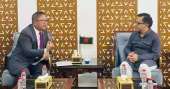
Commerce Minister Khandakar Abdul Muktadir
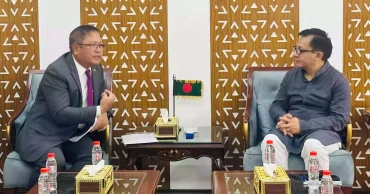
Muktadir, Myanmar envoy discuss boosting trade, Rohingya repatriation
Commerce Minister Khandakar Abdul Muktadir and Myanmar Ambassador to Bangladesh Kyaw Soe Moe on Sunday discussed ways to expand bilateral trade, strengthen shipping connectivity and expedite the safe return of forcibly displaced Rohingyas.
During a meeting at the Ministry of Commerce, the two sides discussed expanding bilateral trade, increasing exports and imports, strengthening maritime transport links, importing liquefied natural gas (LNG) and creating greater opportunities for mutual investment.
The minister said Bangladesh remains committed to strengthening relations with neighbouring countries based on mutual respect, trust and economic cooperation.
He said issues relating to trade, transport, investment and border connectivity that involve other ministries will be reviewed through inter-ministerial coordination.
Muktadir said the geographical proximity of Bangladesh and Myanmar and existing opportunities could be utilised to significantly increase bilateral trade.
"Bangladesh and Myanmar will work together to make the economic relationship more meaningful and dynamic after resolving issues of mutual interest through dialogue," he said.
Ambassador Kyaw Soe Moe expressed Myanmar's interest in increasing bilateral trade and said resuming the long-suspended border trade will benefit businesses and people in both countries.
He suggested that, if necessary, border trade could initially be resumed on a limited or temporary basis.
The meeting also explored opportunities to increase trade in agricultural and fisheries products, rice, pharmaceuticals and frozen food, while stressing the importance of strengthening business-to-business (B2B) engagement.
The issue of the safe, voluntary, sustainable and dignified repatriation of the forcibly displaced Rohingya population sheltered in Bangladesh also featured prominently in the discussions.
The Myanmar ambassador said the verification process of the repatriation lists submitted by Bangladesh is ongoing and that initiatives will be taken to move forward with repatriation once the security situation and conditions on the ground become favourable.
The Bangladesh side emphasised the need to create conditions conducive to an early repatriation and called for effective and visible progress on the issue.
Both sides agreed to hold regular institutional dialogues and meetings of the Joint Committee, and also discussed holding the next joint meeting in Bangladesh.
The meeting further underscored the importance of establishing direct maritime and shipping links between the two countries and finalising a proposed agreement on the matter at the earliest.
Both sides expressed optimism that direct shipping connectivity will reduce transportation costs and transit time while significantly boosting bilateral trade.
Both sides expressed their commitment to elevating bilateral trade, investment, connectivity and regional cooperation to a new level.
Commerce Secretary Md Ataur Rahman Khan, Additional Secretary (FTA) Ayesha Akther, and Myanmar Embassy Counsellor Myat Lwin were also present at the meeting.
2 months ago
Govt working to cut logistics costs to curb food inflation: Commerce Minister
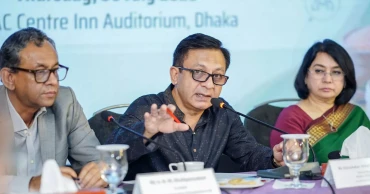
Commerce Minister Khandakar Abdul Muktadir on Thursday said the government is prioritising a reduction in logistics costs, describing them as one of the biggest obstacles to bringing down Bangladesh's persistently high food inflation.
“While logistics cost stands at around 10 percent of GDP in other countries of the world, it is 16 percent in Bangladesh. If we can rein in logistics costs, food inflation can be brought down,” the commerce minister said at an event on Bangladesh's food chain, organised by the Centre for Policy Dialogue (CPD) at the BRAC Centre in the captial.
Noting that inflation which has been rising since the post-Covid period and currently stands above 9 percent, was brought under control by other countries around six months ago but Bangladesh has failed to do so due to the complexity of its market system, he said.
“Our market system is quite complex. Alongside logistics costs, we need to bring down input costs and unaccountable financial transactions such as extortion as much as possible,” he said.=
The minister said every government in Bangladesh has focused on the agriculture sector separately, but there has been a lack of coordination among them.
“Since the famine of 1974, every government in Bangladesh has received the same message that staying in power requires paying attention to the agriculture sector. Since then, almost every government has worked for farmers. But due to a lack of coordination in this work farmers have not always received the maximum benefit,” he said.
Muktadir said accurate information does not reach farmers in Bangladesh which causes them losses.
“A farmer who cultivated potatoes extensively over the past few years and got a good yield but did not get a fair price in the market, why does he still grow potatoes in excess of demand the following year and incur losses? This is a question. The major reason is that market information does not reach the farmer. He cannot understand what would be profitable for him to cultivate,” he said.
The minister also said Bangladesh’s agriculture sector has seen very little scientific and planned work, with most agricultural activities being carried out in a “natural way,” stressing the need to bring this under a proper plan.
Muktadir stressed the need for improving farmers’ living standards and bringing the entire market system under an integrated plan.
CPD Executive Director Fahmida Khatun presided over the event.
2 months ago
31st Dhaka Int’l Trade Fair likely to open on January 1 next
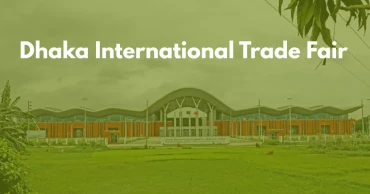
The 31st Dhaka International Trade Fair (DITF) is likely to begin on January 1, 2027 as the Export Promotion Bureau (EPB) on Tuesday set a tentative date for the annual event.
The decision was taken at the 149th board meeting of the EPB, held at its conference room with Commerce Minister Khandakar Abdul Muktadir in the chair.
The meeting also approved a steering committee for organising the DITF 2027, alongside the tentative start date of January 1.
DITF renamed to DTF to combat deception by local agents
In addition, the board decided in principle to lease out the fair venue, the Bangladesh-China Friendship Exhibition Centre in Purbachal.
The meeting approved the international trade fair calendar for the 2026-27 fiscal year to be managed by the EPB. Under the calendar, Bangladesh has been approved to participate in 50 international fairs across 27 countries, focusing on 12 priority sectors.
Commerce Secretary Md Ataur Rahman Khan, EPB Vice Chairman Mohammad Hasan Arif, and Additional Secretary (FTA) of the Commerce Ministry Ayesha Akther, along with EPB board members, were present at the meeting.
2 months ago
Bangladesh earned $44.17bn from exports in FY25: Commerce Minister
Commerce Minister Khandakar Abdul Muktadir on Thursday said Bangladesh exported 812 products to 202 destinations across the globe during the 2024-25 fiscal year, with the United States, Germany and the United Kingdom remaining among the country’s largest export markets.
Replying to a written question from treasury bench MP Selina Sultana (women seat-35), the minister said Bangladesh’s major export destinations also include Spain, France, the Netherlands, Poland, India, Italy, Canada, Japan, Denmark, Australia, Sweden, Belgium, China, Türkiye, South Korea, Mexico and Russia.
He said the country’s principal export items during the July-June period of FY2024-25 were woven garments, knitwear, home textiles, frozen and live fish, agricultural products, jute and jute goods, leather and leather products, footwear, and engineering products.
The commerce minister informed the House that Bangladesh earned US$44,167.84 million from exports of these products during FY2024-25.
He added that the export earnings from these products accounted for 91.48 percent of the country’s total export income during the fiscal year.
3 months ago

Bangladesh's trade deficit widened to $24.17 billion in FY25: Minister
Commerce Minister Khandakar Abdul Muktadir on Tuesday told Parliament that Bangladesh's trade deficit widened to US$ 24.17 billion in the fiscal year 2024-25, as the increase in import expenditure outpaced growth in export earnings.
He disclosed the information while responding to a question from BNP lawmaker from reserved women seat Nilufar Chowdhury Moni.
The minister said the country earned $55.19 billion from exports during FY25, while import expenditure rose to $79.36 billion, resulting in a trade gap of $24.17 billion.
The figures show a reversal of the narrowing trend observed in the previous fiscal year, when the trade deficit stood at $21.50 billion, he said.
Export earnings increased by about 8 percent from $51.11 billion in FY24 to $55.19 billion in FY25. However, import payments grew at a faster pace, rising from $72.62 billion to $79.36 billion during the same period.
The data indicates that Bangladesh's trade deficit has fluctuated considerably over the past five fiscal years, largely reflecting changes in global commodity prices, domestic demand and international trade conditions.
In FY21, the country's export earnings stood at $45.37 billion against import expenditure of $61.61 billion, leaving a trade deficit of $16.24 billion.
The deficit widened sharply to a record $28.14 billion in FY22 as imports surged to $89.11 billion, while exports reached $60.97 billion.
In FY23, export earnings declined to $53.93 billion and imports fell to $78.30 billion, reducing the trade gap to $27.18 billion.
The deficit narrowed further to $21.50 billion in FY24 as import expenditure dropped significantly to $72.62 billion, while exports amounted to $51.11 billion.
Despite the increase in export receipts in FY25, the faster growth in imports widened the trade imbalance once again, highlighting the continued pressure on the country's external sector.
According to the data, Bangladesh's exports have increased by nearly 22 percent over the past five years, from $45.37 billion in FY21 to $55.19 billion in FY25, while imports rose by almost 29 per cent during the same period, from $61.61 billion to $79.36 billion.
The minister said Bangladesh's exports continue to be concentrated in a number of key international markets, with the United States, Germany, the United Kingdom, Spain, France, Poland, the Netherlands, Japan, Canada and India remaining the country's principal export destinations.
He said Bangladesh exports a wide range of products to these destinations, reflecting the country's growing industrial and manufacturing capacity beyond its traditional ready-made garments (RMG) sector.
According to Muktadir, knitwear and woven garments remain the leading export items in most of the major markets. Other significant export products include leather and leather goods, agricultural and agro-processed products, home textiles, jute and jute goods, cotton and cotton products, and engineering products.
He said Bangladesh is also exporting footwear, excluding products classified under specific tariff headings, as well as jute yarn and twine, frozen and live fish, chemical products, hats and caps, shrimp, paper and paper products, plastic goods and tents.
The export basket has further expanded to include pharmaceutical products, dried and processed food items, knitted fabrics, electrical products, raw jute, wigs and human hair products, the minister added.
3 months ago
Bangladesh’s trade deficit rose by $ 8 billion in 5 years: Minister
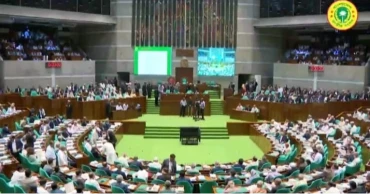
Commerce Minister Khandakar Abdul Muktadir on Monday told Parliament that the country’s trade deficit increased by nearly US$ 8 billion over the five fiscal years, reaching US$ 24.16 billion in FY25 from $ 16.24 billion in FY21 for what he described as wrong policies of the previous governments.
“The country’s trade deficit has widened due to wrong policies pursued by the previous governments,” he said, replying to a starred question from ruling party lawmaker Jashim Uddin Ahmed (Chattogram-14).
The commerce minister said the global energy crisis, hike in prices due to the Russia-Ukraine war, the dollar crisis and international market conditions have also played an important role in the rise of the trade deficit.
“In particular, the trade deficit has increased due to high import costs for energy, food, industrial raw materials and slow export growth,” he said.
Muktadir also placed the statistics of the trade gaps of the five fiscal years from 2020-2021 to 2024-2025.
According to official statistics presented by him, Bangladesh’s trade deficit stood at $16.24 billion in FY21, then rose sharply to $28.13 billion in FY22 before declining slightly to $27.18 billion in FY23, dropping further to $21.50 billion in FY24, and finally increasing to $24.16 billion in FY25.
The country’s export volume was $ 45.36 billion in FY21, $ 60.97 billion in FY22, $ 53.92 billion in FY23, $ 51.11 billion in FY24 and $ 55.19 billion in FY25.
Meanwhile, the import volume was $ 61.60 billion, $ 89.10 billion, $ 78.29 billion, $ 72.61 billion and $ 79.35 billion, respectively.
To narrow the trade deficit, the commerce minister outlined a series of measures undertaken by the government through strengthening export performance.
He said although Bangladesh exported goods to 202 countries and territories during FY2024-25, the ready-made garments (RMG) sector accounted for about 84 percent of total export earnings. To reduce dependence on a single export item, the government has taken initiative to extend RMG-like incentives to other promising export sectors, he said.
Partial export-oriented companies in eight sectors – leather and leather goods, jute and jute products, agricultural products, pharmaceuticals, ICT and software services, light engineering products, frozen foods and fish, and plastic products – have also been provided bond facilities against bank guarantees, Muktadir added.
He said the government has launched the “One District, One Product” programme, modelled after successful programmes in Japan and Thailand, to diversify exports and accelerate region-based export activities. “Under the programme, 14 products have been identified from 64 districts,” he said.
The minister also highlighted the government’s initiatives to sign free trade agreements (FTA) with several countries, including Malaysia, Türkiye and New Zealand.
Besides, the 3rd round of negotiation between Bangladesh and Singapore is scheduled to be held in Dhaka in August 2026 to sign an FTA between the two countries, he said.
4 months ago
Minister seeks WB support to sharpen Bangladesh’s trade negotiation skills
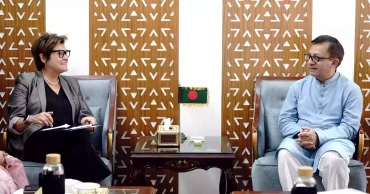
Commerce Minister Khandakar Abdul Muktadir on Wednesday called on the World Bank (WB) to extend support in developing trade negotiation skills among Bangladesh's trade officials, emphasising that human resource development is as critical as infrastructure investment in strengthening the country's global competitiveness.
"To ensure effective participation in the international trading system, it is essential to build skilled manpower in trade negotiation, trade law, WTO regulations and modern trade management," he said during a meeting with WB Operations Manager Gayle Martin at the Commerce Ministry.
The meeting covered ongoing collaboration between the ministry and the global lender, focusing on capacity building, skilled human resource development and modernisation of the trade sector.
The minister specifically sought WB assistance in three areas: trade negotiation skill development for ministry officials, establishing a strong resource pool for the Bangladesh Foreign Trade Institute (BFTI), and building practical expertise in trade law and WTO affairs.
He also pointed out that despite large-scale projects being implemented under various donor agencies and government funding, adequate initiatives to enhance the capacity of project directors have remained largely absent.
World Bank Operations Manager Gayle Martin described the EC4J project, currently being implemented by the Commerce Ministry, as a successful initiative and assured continued support. "World Bank programmes in Bangladesh place special emphasis on job creation, productivity enhancement and value creation to generate long-term positive impact on the national economy."
Commerce Ministry Secretary (Routine Duty) Md Abdur Rahim Khan was also present at the meeting.
5 months ago
Muktadir talks tough against artificial crisis, market manipulation
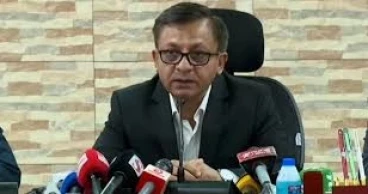
Commerce Minister Khandakar Abdul Muktadir on Tuesday warned that the government will not tolerate any attempt to create artificial crisis or manipulate market, saying no group or individual will be allowed to hold the market hostage.
“This is a country of 180 million people. No group or individual can take the market hostage,” he said while speaking to reporters after a meeting of the task force on commodity prices and market situation at the Ministry of Commerce.
Fuel price hike ‘modest’, unlikely to accelerate inflation: Muktadir
The minister said the current global situation, particularly the conflict in the Middle East, has created pressure on fuel and supply chains. “The government is closely monitoring the situation and the import flow remains stable.”
Responding to a question about soybean oil supply, he said although the supply of bottled oil is somewhat limited, loose oil is available in sufficient quantity. “The government is also monitoring any attempt to charge prices beyond the fixed rate and will take necessary action.”
On inflation, Muktadir said any unreasonable price hike or creation of artificial shortages is unacceptable.
Addressing traders, he said the market cannot be influenced through speculation and prices must be set based on the actual impact of increased fuel costs.
The minister urged businesspeople and other stakeholders to have confidence in the government, adding that efforts are underway to introduce a stable pricing mechanism to ensure a more balanced market in the future.
5 months ago