governance, economy, justice system
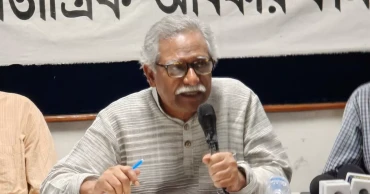
Speakers raise concerns over governance, economy, justice system
Speakers at an event have expressed concern over what they described as persistent governance, economic, and institutional shortcomings, warning that key reform initiatives in Bangladesh remain stalled or inadequately addressed.
They expressed the concern at a programme titled "Two and a Half Months of the BNP Government: Review, Concerns and Demands," organised by the Democratic Rights Committee at the Sagar-Runi Auditorium of the Dhaka Reporters Unity in the capital.
The event was chaired by economist Anu Muhammad.
At the programme reviewing the current political situation and reform agenda, they pointed to issues spanning public policy, education, energy, justice, and international relations, urging stronger accountability, structural change, and long-term planning to address mounting national challenges.
Anu Muhammad called for fair prices for agricultural products based on production costs, a new wage structure, reasonable electricity tariffs for the agriculture and fisheries sectors.
He renewed calls for justice in several unresolved high-profile cases including the killings of Toki, Tonu and journalist couple Sagar-Runi as well as the shooting of Limon.
He said the government must thoroughly review the actions of the interim administration and publish a white paper examining agreements signed during that period, along with allegations of terrorism, corruption and abuse of power.
Anu Muhammad said the current government appears reluctant to undertake such a review, possibly out of concern that it could expose its own past involvement in similar activities.
He also expressed concern over the state of the judiciary, particularly judicial independence and accountability, citing a recent incident in which a judge allegedly intimidated a teacher as an example of troubling judicial overreach.
Writer and researcher Altaf Parvez said around 1.9 million people in Assam and four million in West Bengal have been labelled as 'Bangladeshi' and stripped of their voting rights, creating what he described as a "time bomb" for Bangladesh.
He also expressed disappointment over the government's handling of international relations, particularly with India, saying that despite improved bilateral ties, key issues such as border killings and renewal of the Ganges Water Treaty remain unresolved.
Other speakers included Dhaka University professor Samina Luthfa, lawyer Jyotirmoy Barua, lawyer Manjur Al Matin and Dhaka University Assistant Professor Moshahida Sultana Ritu.
Altaf Parvez said the BNP government's two-and-a-half-month tenure should be assessed alongside the preceding 18 months, making it effectively a 21-month review.
He argued that the current government is neither colonial nor a conventional elected administration, but one born out of a "people's uprising" following the events of August 8, 2024.
According to him, the public has every right to regularly review the government's performance, especially at the grassroots level, given the long history of movements by workers, indigenous communities, minorities and students over the past 15 years demanding fair elections and political reforms.
He alleged that although the BNP had pledged to implement the July Charter in its manifesto, it later declined to join the constitutional reform council, effectively stalling the reform process.
Raising concerns over recent economic decisions, Altaf criticised an ordinance allowing banks to return to their original shareholders, including individuals accused of corruption and money laundering.
He also questioned the decision to purchase ten Boeing aircraft for $4 billion at a time when Bangladesh was seeking a $1 billion IMF loan tranche amid a foreign debt burden of $114 billion.
Such a move, he warned, could destabilise the country's macroeconomy and national budget.
Professor Samina Luthfa said campuses have increasingly become centres of political control rather than academic excellence.
Even when one student organisation's influence declined, another quickly replaced it, perpetuating the cycle of political occupation.
This environment, she said, fostered organised violence that later became popularly known as "mob rule."
Over the past 21 months, no education reform commission has been formed, despite repeated calls, she said.
She noted that Bangladesh allocates only about 1.7 percent of its GDP to education, based on 2023-24 figures, far below UNESCO recommendations.
She called for gradually increasing the allocation to 7 percent over the next four years.
Moshahida Sultana Ritu called for a comprehensive overhaul of Bangladesh's energy policy, including renegotiation of costly power deals, reduction in diesel prices and accelerated development of locally driven solar initiatives.
She sharply criticised existing Independent Power Producer (IPP) agreements, particularly capacity charges, saying they have imposed an enormous financial burden on the public.
She also recommended allowing capacity charge payments in local currency rather than US dollars to reduce pressure on foreign exchange reserves.
Moshahida warned that rising diesel prices have triggered widespread inflation by increasing transportation, food and agricultural production costs."A reduction in diesel prices is essential to protect farmers, ensure food security and prevent further economic hardship," she said.
Highlighting the importance of a sustainable energy transition, she urged the government to prioritise solar power and formulate a realistic, locally tailored renewable energy roadmap.
Her recommendations included expanding solar-powered irrigation pumps, facilitating affordable financing for rooftop solar and solar pump projects, and expediting solar installations on land already acquired for Special Economic Zones.
She emphasised that Bangladesh must move away from short-term, reactive energy policies and instead pursue long-term planning rooted in local expertise and public participation.
Advocate Manjur Al Matin said Megh, the son of slain journalist couple Sagar and Runi, lost his parents 14 years ago, yet justice remains elusive.
Referring to the Tonu murder case, he noted that an arrest was made a decade after the killing, offering at least a glimmer of hope.
He criticised repeated delays in legal proceedings, mentioning a recent six-month extension granted for investigation in the Sagar-Runi murder case.
Justice, he said, is one of the fundamental pillars of any civilised society, and its absence inevitably leads to social decay.
Manjur also underscored the importance of judicial independence, particularly the establishment of a separate secretariat for the judiciary.
On the appointment of High Court judges, Manjur rejected the government's argument that constitutional constraints prevent reform.
He noted that a government with a two-thirds parliamentary majority has ample power to amend the constitution if it genuinely seeks change.
He criticised the government's failure to enact stronger laws to address these issues and expressed concern that the repeal of certain legal protections had only worsened the situation.
5 months ago