India's relations with Bangladesh
India moves to restore relations with Bangladesh through reactivating bilateral mechanisms
After weathering a "testing time" in its relations with Bangladesh, India is now willing to engage with the new government in Bangladesh by gradually reactivating all the bilateral mechanisms, pursuing a relationship that keeps 'people at the center' of everything.
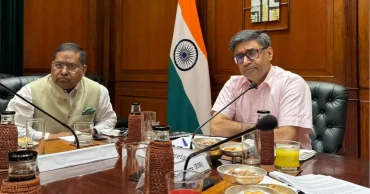
"We weathered a testing time (Interim regime)," Indian Foreign Secretary Vikram Misri told a visiting Bangladesh media delegation at the Ministry of External Affairs, noting that they now see a "strong" government in place in Bangladesh with a strong people's mandate.
He said the new government in Bangladesh is perfectly capable of conducting its work domestically and internationally.
The Indian Foreign Secretary said they are getting down to reactivating all tools of bilateral relations and contacts are being made at various levels.
Bangladesh and India have over forty bilateral mechanisms including on water, trade, border management, and consular issues.
MEA Spokesperson Randhir Jaiswal, Joint Secretary (Bangladesh & Myanmar) B. Shyam, Diplomatic Correspondents Association, Bangladesh (DCAB) President AKM Moinuddin, and General Secretary Emrul Kayesh were also present at the interactive session held on Monday.
Members of the media delegation wanted to know about a range of issues including visas, energy, connectivity, LoC projects, water sharing, the status of Dhaka's request for extradition of former Prime Minister Sheikh Hasina and suspects in the Sharif Osman Hadi killing case and regional cooperation - SAARC and BIMSTEC issues.
Foreign Secretary Vikram Misri said they look forward to a 'constructive, positive, pragmatic, and forward-looking' relationship with Bangladesh, stressing that there is a vast menu of activities underway to engage meaningfully.
Bangladesh and India are scheduling a series of meetings in the coming weeks and months as they seek to re-engage following a period of strained relations during the interim government that took office after the fall of the Awami League administration on August 5, 2024.
Most of these mechanisms remained dormant during the interim government.
After the formation of the government by BNP, India demonstrated positive gestures to improve relations.
Bangladesh resumed issuing all categories of visas. India has yet to fully resume visas for Bangladeshis.
Misri has not made a specific comment on this but said that India is working on the matter and it will be known in the coming days.
Asked about the Bangladesh-India Ganga/Ganges Water Treaty, which is expiring in December this year, he said the Joint River Commission will be discussing these issues.
"We have the JRC... we will have to engage in a timely and constructive manner. We have three decades of successful cooperation (Ganga Treaty)," he said.
Bangladeshi experts say the treaty needs to be ‘reviewed and reformed comprehensively’ before going for a renewed treaty by engaging economists, urban planners, sociologists, and environmentalists in the planning, as Dhaka shares the ‘risk’ of not sharing it appropriately.
“MoFA (Ministry of Foreign Affairs) has to do a lot of homework and data sharing is key. We need to keep in mind that the situation in 1996 and 2026 is not the same. This can't be seen only from engineering or diplomatic prisms; they should include economists, urban planners, and sociologists in the planning,” international affairs expert Prof Shahab Enam Khan told UNB.
There were also trade restrictions on both sides during the interim government, and political rhetoric played out negatively on both sides.
The situation began changing after the elections in February.
Foreign Minister Khalilur Rahman visited India recently.
Misri said Bangladesh and India have more than 4,000 kilometers of border and share 54 transboundary rivers."We want to progress and modernise our economic partnership with Bangladesh," he said.
He agreed that bilateral relations faced challenges during the period of the interim government and that they could not be improved despite efforts.
However, now that Bangladesh has an elected government, India is re-engaging with Bangladesh.
"Meetings are being scheduled. Results will be known in the coming weeks and months," Misri said.
An official of the Bangladesh foreign ministry said a BGB-BSF level meeting will be held in late May.
Misri said the present world situation demands more cooperation among neighbouring countries, and India and Bangladesh have been working towards this end.
India's energy cooperation with Bangladesh - whether power or diesel - today is benefiting the people of Bangladesh, he said, assuring continued support in this regard.
Asked about the trade restrictions, Misri said India stands ready to take forward the discussions as the livelihoods of people in both countries are affected.
Trade will be something that will come up first in the discussions, he said, adding that "We want mutual benefits on both sides."
Asked about the projects under the Indian Line of Credit (LOC), Misri said Bangladesh has reviewed the LOC projects and both sides will discuss the projects that Bangladesh prioritises and India will consider financing accordingly, he said.
Asked if the victory of the BJP in West Bengal elections will work positively for the signing of the Teesta deal, he said foreign policy operates from the capital.
Asked how India looks at the BNP government's initiatives in activating SAARC while maintaining relations with Pakistan, Misri said it is up to Bangladesh how it maintains relations with other countries.
However, India hopes that Bangladesh does not do anything that negatively affects the positive agenda of India.
Misri rejected the notion that India engineered elections in Bangladesh and stressed that the bilateral relationship has always been people-centric and will always be so.
Responding to allegations that India maintained close ties with the Awami League, Misri said, “We have always worked with the government elected by people.”
He said people of a country may not be happy with any government but a foreign country cannot do anything about it.
The Indian FS said the relationship is built with the country, people, and the government, not with a particular political party.
"We have always respected people's desire in Bangladesh," he said.
India reiterated its intent to work closely with the people and the government of Bangladesh to strengthen people-centric cooperation in all domains, aligned with their respective national development priorities and based on mutual interest and mutual benefit.
India emphasised the need to leverage the geographical proximity between the two countries into tangible economic opportunities and wants to develop future-oriented economic engagement.
As the two largest economies of the region and close neighbours with a focus on building connectivity, India and Bangladesh are uniquely positioned to lead regional economic integration and build resilient and future-ready supply chains.
India reaffirmed the shared commitment to unlock new avenues of cooperation and elevate the economic partnership with Bangladesh to the next level.
On April 6, outgoing Indian High Commissioner to Bangladesh Pranay Verma paid a courtesy call on Prime Minister Tarique Rahman and discussed bilateral engagement with a focus on people-centric cooperation in multiple domains aligned with the national development priorities of the two countries.
The discussions focused on enhancing cooperation in a wide range of areas including public health, financial inclusion, women‘s empowerment, rural development, bilateral trade and investment, ease of doing business, technology partnerships, and power and energy cooperation.
The High Commissioner underlined that India-Bangladesh cooperation should transform their geographical proximity into new opportunities by strengthening economic and connectivity linkages and by enhancing cultural and people-to-people exchanges.
He conveyed India’s intent to work together with the Government and the people of Bangladesh in a positive, constructive, and forward-looking manner based on mutual interest and mutual benefit.
5 months ago