sun
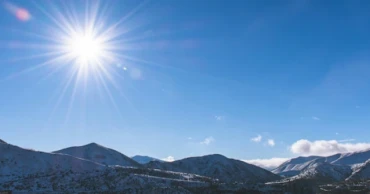
Scientists solve 200-year-old mystery of the Sun’s turning blue
Nearly 200 years ago, the Sun appeared blue in Earth's atmosphere, baffling scientists for generations. Researchers have now identified a massive volcanic eruption in 1831 as the cause.
The eruption released vast amounts of sulfur dioxide into the atmosphere, triggering global cooling and unusual climatic conditions that year.
A study published in the journal “Proceedings of the National Academy of Sciences (PNAS)” pinpointed the Zavaritskii volcano on Simushir Island—an uninhabited and contested territory between Russia and Japan—as the source of the event.
Scientists drill nearly 2 miles down to pull 1.2 million-year-old ice core from Antarctic
Scientists from the University of St Andrews, Scotland, examined ice core records from 1831 to support their findings. The lack of eyewitness accounts or written records of the eruption, due to the island's remoteness and sparse habitation, made the investigation challenging.
Study co-author Will Hutchison described a breakthrough moment when volcanic ash samples from Simushir matched those extracted from the ice core. "Analysing the two ashes together was a genuine eureka moment," Hutchison said in a statement.
By closely studying the chemistry of the ice at a high temporal resolution, the team confirmed that the eruption occurred in spring-summer 1831. They verified its explosive nature and recovered microscopic ash particles to further validate their conclusions.
While the mystery of the 1831 eruption and its atmospheric effects has been unraveled, Hutchison emphasized the difficulty of monitoring such remote events even today. "If an eruption like this happened now, we might not be much better prepared than in 1831," he noted, highlighting the challenges of predicting and responding to massive climate-altering eruptions.
Volcanic eruptions of this magnitude have had significant global impacts in the past. In 1815, the eruption of Mount Tambora in Indonesia led to "a year without summer," as 24 cubic miles of gases, dust, and rocks were ejected into the atmosphere. This event caused global temperatures to drop by 1°C in the Northern Hemisphere.
Scientists warn of a one-in-six chance of a similarly large eruption occurring this century, with potential economic damages in the trillions. Any cooling effect from such an event would likely be short-lived, as the planet remains on a warming trajectory due to greenhouse gas emissions.
Source: with inputs from Indian media
1 year ago

India launches spacecraft to study the sun after successful landing near the moon's south pole
India launched its first space mission to study the sun on Saturday, less than two weeks after a successful uncrewed landing near the south polar region of the moon.
The Aditya-L1 spacecraft took off on board a satellite launch vehicle from the Sriharikota space center in southern India on a quest to study the sun from a point about 1.5 million kilometers (930,000 miles) from earth.
Read : Chandrayaan-3 a glowing testament to what India can achieve with passion: Indian Cabinet
The spacecraft is equipped with seven payloads to study the sun's corona, chromosphere, photosphere and solar wind, the Indian Space Research Organization said.
India became the first country to land a spacecraft near the moon's south pole on Aug. 23 — a historic voyage to uncharted territory that scientists believe could hold vital reserves of frozen water. After a failed attempt to land on the moon in 2019, India joined the United States, the Soviet Union and China as only the fourth country to achieve this milestone.
The sun study, combined with India's successful moon landing, would completely change the image of ISRO in the world community, said Manish Purohit, a former ISRO scientist.
Read : Pakistan vs India 1st ODI in Asia Cup 2023: Match Preview
The Aditya-L1 was headed for the L1 point of the Earth-Sun system, which affords an uninterrupted view of the sun, ISRO said. "This will provide a greater advantage of observing solar activities and their effect on space weather in real-time."
Once in place, the satellite would provide reliable forewarning of an onslaught of particles and radiation from heightened solar activity that has the potential to knock out power grids on Earth, said B.R. Guruprasad, a space scientist, in an article in The Times of India newspaper. The advanced warning can protect the satellites that are the backbone of global economic structure as well as the people living in space stations.
Read : Bangladesh’s development, growing capabilities stood to add value to G20 discussions: India
"Those seven payloads are going to study the sun as a star in all the possible spectrum positions that we have visible, ultraviolet, and X-ray. … It's like we're going to get a black and white image, the color image and the high-definition image, 4K image of the sun, so that we don't miss out on anything that is happening on the sun," Purohit said.
3 years ago
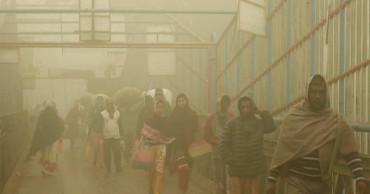
Foggy weather may persist till Thursday
The foggy weather which has been around since Wednesday morning is likely to persist until Thursday, the Met Office said.
6 years ago