low prices
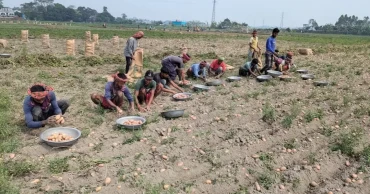
Munshiganj’s potato farmers grapple with low prices despite bumper harvest
Despite achieving a bumper potato harvest this year, farmers in Srinagar upazila of Munshiganj district are facing severe financial losses due to low market prices.
The situation has left many growers worried, particularly as storage constraints and transportation issues add to their woes.
Abundant Yield, Financial Struggles
This season, potato cultivation in Srinagar upazila has covered 1,950 hectares of land, with an estimated production of 58,500 metric tonnes.
While the yield has been satisfactory, farmers are struggling to secure fair prices for their produce in the wholesale market.
Wholesale potato prices currently range between Tk 15-17 per kg, while retail prices vary from Tk 22-25 per kg.
But, with the production cost per maund (approximately 37.32 kg) standing at Tk 800-900, many farmers find it difficult to sell their harvest without incurring losses.
One of the primary concerns among farmers is the unavailability of sufficient cold storage facilities.
With only three operational cold storage units in the upazila, offering a combined storage capacity of 14,000 metric tonnes, many growers have been left with no option but to store their produce under the open sky.
The looming threat of rain has further heightened their anxiety, as exposure to moisture could lead to spoilage.
Potato farmers in Faridpur struggle with cold storage woes amid sweltering heat
Market Syndicates and Rising Costs
Farmers have alleged that market syndicates are exploiting the situation.
They claim that while they were compelled to buy seeds and other agricultural inputs at inflated prices, the same syndicates are now driving down the market value of potatoes.
The cultivation cost for 140 decimals (approximately 1.4 acres) of land is estimated to be around Tk 3,75,000.
Though farmers had hoped to produce at least 400 maunds per 140 decimals, the actual yield has been closer to 350 maunds on average, making it even more difficult to achieve profitability.
Adding to their concerns, storage space in local cold storage facilities is being occupied by potatoes brought in from other districts.
According to farmers, only a small portion of Atpara Cold Storage has been reserved for local growers, exacerbating the storage crisis.
Storage and Transportation Challenges
Among the three cold storages in Srinagar upazila, AN Khan Cold Storage in Sondharadia of Tantor has a capacity of 3,000 metric tonnes, Al-Amin Ice and Cold Storage in Chawkbazar has a capacity of 5,000 metric tonnes, and Srinagar Cold Storage in Atpara can store 6,000 metric tonnes of potatoes.
Potato farmers in Gaibandha suffer losses as cold storage crisis deepens
Despite these facilities, a large number of farmers from eastern Srinagar, including Kukutia and Tantor, have been compelled to store their produce in cold storage units at Naopara Bazar in neighbouring Lohajang upazila.
Meanwhile, labour shortages during Ramadan and ahead of Eid-ul-Fitr have added to farmers’ struggles, as hiring workers has become increasingly difficult and expensive.
Besides, the scarcity of bicycles and trolleys for transportation has made it even harder to move potatoes from remote areas to markets.
Transporting potatoes to cold storage facilities via battery-operated easy bikes now costs Tk 50-70 per sack, depending on the distance.
This year, local cold storage authorities have set a storage charge of Tk 300 per 50-kg sack.
Official Response
Srinagar Upazila Agriculture Officer, Mohsina Jahan Toron, acknowledged the challenges but emphasised the positive side of the season’s harvest.
"Favourable weather conditions have led to a promising potato yield this year," she said.
She also said the upazila’s three operational cold storages have a combined capacity of 14,000 metric tonnes, with approximately 7,000 metric tonnes of potatoes stored so far.
A Season of Uncertainty
For potato farmers in Srinagar, this season has been a mix of success and struggle.
While the bumper harvest should have been a cause for celebration, low prices, storage limitations, and transportation difficulties have turned it into a season of uncertainty.
Potato farmers in Thakurgaon protest against increased rent for cold storage
Many growers now face the difficult decision of whether to sell at a loss or risk their produce going to waste.
As the holy month of Ramadan progresses and Eid approaches, the demand for potatoes is expected to rise.
But, unless market conditions improve and farmers receive better prices for their crops, the long-term sustainability of potato cultivation in the region remains in question.
1 year ago

Floating vegetable farmers in Pirojpur devastated by low prices
Farmers engaged in vegetable farming — on floating beds made of hyacinth and bamboo — in Nazirpur and Nesarabad upazilas of Pirojpur district are devastated by low prices of their produce.
Though the farmers keep themselves engaged in cultivating vegetables, taking advantage of the availability of hyacinth in the region, anxiety over low prices has gripped them.
According to the district’s Department of Agricultural Extension (DAE), farmers in the region have been farming vegetables, using the floating method, for over a century.
Some 3,200 farmers of the upazilas cultivate several varieties of vegetables including papaya, gourd, pumpkin, beans, okra, tomato, eggplant and cabbage.
Read More: Climate change: Shrimp farming endangered in Khulna
The vegetable seedlings produced on the beds are usually sold at upazilas of the district and other parts of the country but this year the sales are not seeing a momentum due to poor response from buyers.
Though it was targeted to produce 86,50,000 saplings on 175 hectares of land, it exceeded the target due to favourable weather.
Earlier, a bunch of 100 saplings was sold at Tk 250 to 300 but the price is now Tk 150 to 200. The sale of saplings goes on from June to November every year.
Some areas including Deulbari-Dobra, Kalardoyania and Malikhai under Nazirpur upazila and most parts of Baldiya union under Nesarabad upazila remain under 5 to 8 feet water round the year, causing no production of any crop.
Read more: Bumper T-Aman yield, good price delight Sirajganj farmers
The farmers said they usually take loans from local money lenders for usury and lands as sublease for cultivating vegetables and producing saplings.
The farmers are bound to take loans from the lenders with a high usury because of failure to manage loans from the banks during the Robi, Kharif-1 and 2 seasons.
They are deprived of bagging a good profit due to the high interest on the loans, they said.
Hoping assistance from the government, the farmers said they don’t get the desired prices by selling produce due to natural disasters, damages of crops, low price, disadvantages in marketing and lack of preservation.
Read More: Tulip farming opens new opportunity for farmers in Tetulia, Jashore
Local farmer Jamal Hossain said he is used to cultivating vegetables on the floating beds made of hyacinth and bamboo in the water bodies taken on sublease.
“I have 15 to 16 beds where I cultivate several types of vegetables including beans, papaya, tomato, chili and gourd,” he said.
“We have not been getting a reasonable price due to lack of dealers caused by the Covid-19 pandemic,” he claimed, adding that an amount of Tk 7,000 to 10,000 is needed to cultivate vegetables and produce saplings on a 60-hand long bed.
Dr Md Nazrul Islam Sikdar, deputy director of the district’s DAE, told UNB that some 60 to 70 percent farmers of Gaokhali, Monohorpur, Delbari and Malikhali areas under Nazipur upazila have been involved with vegetable farming on floating beds.
Read more: Vegetable farming on floating beds gets popular in Sylhet
“We inform the farmers on maintaining quality and visit their croplands to give training,” he said.
Urging high officials of the agricultural ministry to take measures to offer loans on easy conditions, the farmers said that it will be difficult to keep vegetable cultivation on floating beds going unless loans from banks are made easy.
3 years ago

Germany's Merkel meets food industry to discuss low prices
German Chancellor Angela Merkel met food industry representatives on Monday to address concerns about the effect of rock-bottom supermarket prices on farmers and others.
6 years ago