German Chancellor
German chancellor in China to push fair trade, seek help on Ukraine war
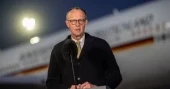
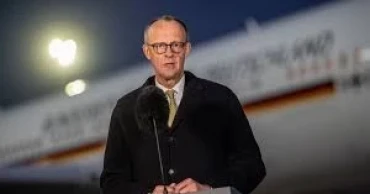
German Chancellor Friedrich Merz arrived in Beijing on Wednesday for a two-day visit aimed at pushing for fair trade conditions for German firms and seeking China’s support to help end the war in Ukraine.
Speaking before leaving Berlin, Merz said Europe wants a partnership with China that is “balanced, reliable and fair.” He noted that his trip follows recent visits by French President Emmanuel Macron and British Prime Minister Keir Starmer, and comes ahead of a planned visit by U.S. President Donald Trump in April.
This is Merz’s first visit to China since taking office last May. He has been advocating a stronger and more self-reliant Europe amid rising global tensions, including U.S. tariffs and calls for Europe to take greater responsibility for its own security.
Merz said major global crises, including the war involving Russia, cannot be resolved without Beijing’s involvement, noting that China’s voice carries weight in Moscow. Many European governments, however, are frustrated that China has not done more to pressure Russia to end the conflict. Beijing says its stance on the war is neutral and hopes all sides will reach a lasting peace agreement.
Economically, Merz is expected to raise concerns about trade imbalances and market access. A surge in Chinese exports has put pressure on factory jobs in Europe. Germany’s imports from China rose sharply last year, while its exports to China declined.
European leaders are urging Chinese firms to invest and build factories in Europe. They also want Beijing to reduce excess manufacturing capacity in sectors like electric vehicles and solar panels, which has pushed global prices down, and to ease restrictions faced by foreign companies in the world’s second-largest economy.
In a commentary, China’s state-run Xinhua News Agency said both countries, as major economies, share responsibility to keep global supply chains stable and oppose protectionism.
7 months ago
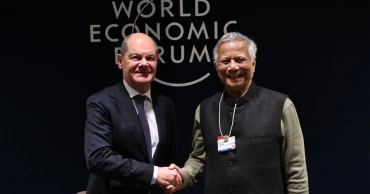
Will support you, German Chancellor tells Dr Yunus on Bangladesh's transition to democracy
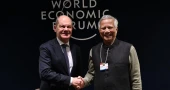
Chief Adviser Prof Muhammad Yunus began his extensive engagements here on Tuesday with his first meeting German Chancellor Olaf Scholz who conveyed to Dr Yunus that Germany would do its best to support Bangladesh in its transition to democracy.
"You can be rest assured that we will support you," the German Chancellor said when he met Dr Yunus on the sidelines of the World Economic Forum annual meeting in the Swiss city.
The Chief Adviser briefed him on the reform agenda of the interim government and discussed issues of mutual interest.
Dr Yunus invited more German investment in Bangladesh. "We can be your factory," he said.
He also sought Scholz's support in creating a safe zone for Rohingyas in Myanmar's Rakhine State under the supervision of the United Nations, said Chief Adviser's Deputy Press Secretary Abul Kalam Azad Majumder.
Beijing extends loan repayment period, considers Dhaka's request for interest rate cut
The Chief Adviser said he was leading a consensus commission in an effort to facilitate consensus building among the political parties on major reform reports submitted by six commissions.
He said after the consensus is reached, the political parties will sign a ‘July Charter’ that will uphold the democratic spirits of the student-led uprising in July and August.
The two leaders spoke about a wide range of issues, including the circumstances that led to the July uprising, Bangladesh's relationship with its neighbours, the Rohingya crisis, and the security situation in Myanmar.
The Chief Adviser explained to the German chancellor how young people joined the July uprising to bring an end to years of misrule in Bangladesh.
A student as young as 12 years old wrote a letter to his mother before joining the uprising and embraced martyrdom, the Chief Adviser told Scholz.
Prof Yunus called for greater business links between the two nations and urged him to send a team of German businessmen to Dhaka to explore business opportunities in Bangladesh.
He said that Bangladesh still holds the idea of SAARC and would continue its endeavour to revive the platform.
The Chief Adviser also explained to the German Chancellor how hydroelectric power from Nepal can benefit multiple South Asian countries, helping all in their transition to renewable energy.
Malaysia extends repatriation programme for undocumented Bangladeshis
The Chief Adviser also met Timor-Leste President Jose Ramos-Horta on the sidelines of the World Economic Forum and discussed issues of mutual interest.
Dr Yunus arrived at Zurich International Airport, Switzerland in the afternoon to attend the annual meeting of the World Economic Forum (WEF) in Davos where he started engaging with the global leaders on pressing issues in addition to his bilateral meetings.
Permanent Representative of Bangladesh to the UN in Geneva Ambassador Tareq Md Ariful Islam received the Chief Adviser at the airport upon his arrival.
Dhaka, Beijing discuss economic partnership expansion
The Chief Adviser and his delegation members arrived at the Zurich International Airport at 12:27pm (Zurich time) by an Emirates flight.
The Chief Adviser is scheduled to hold a number of meetings on the first day, including his joining in the opening dinner at Kurpark Village.
1 year ago

Germany boosts defense budget above 2% of GDP
German Chancellor Olaf Scholz says Germany is committing 100 billion euros ($112.7 billion) to a special fund for its armed forces, raising its defense spending above 2% of its GDP.
Also read: NATO leaders meet to reassure allies near Russia, Ukraine
Scholz told a special session of the Bundestag in Berlin on Sunday that it was clear “we need to invest significantly more in the security of our country, in order to protect our freedom and our democracy.”
Germany had come under criticism for not investing adequately in its defense budget and not doing enough to respond to Russia's invasion of Ukraine.
Also read: Biden hits Russia with sanctions, shifts troops to Germany
On Saturday evening, the German government announced it would be sending weapons and other supplies directly to Ukraine to help troops against invading Russia forces.
4 years ago

Merkel: Europe ‘on thin ice’ amid delta virus variant rise
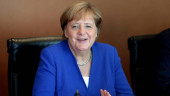
German Chancellor Angela Merkel said Thursday that Europe is “on thin ice” in its battle against the coronavirus, as the highly contagious delta variant threatens to undo progress made in reducing infections.
In what may be her last government declaration to the German parliament, Merkel said the further response to the pandemic would be a main topic of discussion among European Union leaders at a meeting in Brussels on Thursday.
She noted that the number of COVID-19 cases in the 27-nation bloc continue to decline, while vaccination rates climb.
“But even though there is reason to be hopeful, the pandemic isn’t over, in particular in the world’s poor countries,” she said. “But in Germany and Europe we’re also still moving on thin ice.”
“We need to remain vigilant,” Merkel added. “In particular the newly arising variants, especially now the delta variant, are a warning for us to continue to be careful.”
EU health officials predicted Wednesday that the delta variant will make up 90% of all cases across the bloc by the end of August, showing the need for as many people to be fully vaccinated as possible.
In Germany, the delta variant now makes up about 15% of new cases, according to the country’s disease control agency.
The country has pressed for EU countries to form a joint position on quarantine for travelers from areas where variants of concern are particularly prevalent. This includes England, where the delta variant — first detected in India — already makes up a majority of cases.
5 years ago
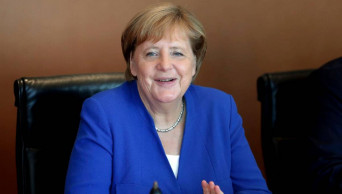
Germany's Merkel faces balancing act in Beijing
Beijing, Sept 6 (AP/UNB) — German Chancellor Angela Merkel has arrived in Beijing, where she faces the challenge of balancing human rights concerns and economic discussions with one of Germany's largest trading partners.
7 years ago