Dharla river
Dredging breathes new life into Dharla River, erosion fears ease for riverside residents
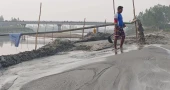
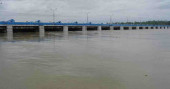
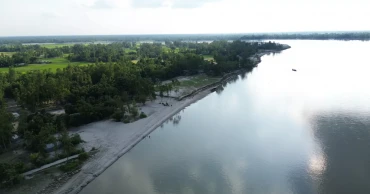
Once known for relentless riverbank erosion and declining navigability, the Dharla River in Kurigram is slowly regaining its vitality as an ongoing dredging project deepens the riverbed and stabilises its flow.
For decades, riverside communities lived under constant threat as the shifting course of the Dharla devoured homes and farmland.
But with dredging now underway along a key stretch of the river, the once-volatile waterway is gradually becoming calmer and more predictable, said locals.
Originating in India’s Cooch Behar district, the transboundary Dharla River enters Bangladesh through Chengrabandha in Patgram and Mogolhat in Lalmonirhat before flowing through Kurigram’s Fulbari, Sadar and Ulipur upazilas.
The river stretches about 60 kilometres and averages around 1.2 kilometres in width before eventually merging with the Brahmaputra at Buraburi in Ulipur.
Years of heavy sedimentation and frequent shifts in the river’s course triggered severe erosion along its banks, forcing many families to abandon their homes and farmlands.
To restore navigability and manage sediment buildup, the Bangladesh Inland Water Transport Authority (BIWTA) launched a project titled Improvement and Restoration of Navigability of the Old Brahmaputra, Dharla, Tulsai and Punarbhaba Rivers.
Dredging began on December 14, 2023, covering around 25 kilometres of the river from Pateshwari in Bhogdanga union of Kurigram Sadar upazila to Kaliganj in Begumganj union of Ulipur.
The project is being implemented at a cost of Tk 263.21 crore and is scheduled to run until June 30, 2027.
6 months ago
Silt-borne fertility transforms northern Bangladesh
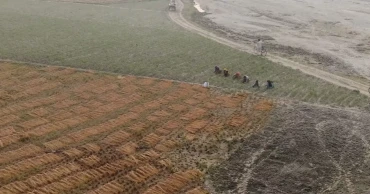
As floodwaters receded across northern Bangladesh, the newly deposited silt has turned the sandy river islands of the Teesta, Dharla, Saniyazan and Brahmaputra—known locally as chars—into fertile land, sparking a surge in cultivation.
According to the Department of Agricultural Extension, the northern rivers contain nearly 786 char areas and communities living there have begun to rebuild their livelihoods following the recent floods.
Agriculturist Sirajul Islam, Additional Director of the Rangpur agricultural region, says this year’s cultivation target for the chars has been set at 36,911 hectares, with an expected output of 362,000 tonnes of various crops.
“Char residents are likely to recover through this year’s harvest. A single crop can sustain many families for an entire year,” he explains.
A Season of Intense Activity
Across the Teesta’s char zones in Lalmonirhat, Rangpur, Kurigram, Gaibandha and Nilphamari, farmers are working round the clock, Sirajul Islam said.
Read more: Overuse of chemical fertilisers threatens soil health in northern Bangladesh
Large tracts have already been planted with potatoes, aubergines, chillies, onions, ginger, garlic, beans, coriander, carrots, cabbages, radishes, gourds, wheat, sesame, linseed, mustard and maize, he said.
Growers say they anticipate good yields from almost all varieties this season.
In Ichli char of Gangachara, Rangpur, farmer Hossain Mia has planted potatoes on three bighas of land, aubergines on another three bighas and coriander on 20 decimals.
“If the yields are satisfactory, I expect to earn around Tk 1.5 lakh after covering costs,” he said.
Local growers Habibur, Rahim and Khairul echo similar expectations, noting that each of them could make Tk 60,000 to Tk 70,000 in profit if the season is favourable.
Storage and Market Access Remain Major Obstacles
Abdullah Al Hadi, Chairman of Lakshmitari Union Parishad, describes the Teesta’s chars as a “growing agricultural zone”, with fresh produce already reaching local markets.
Many more farmers have begun cultivating again.
Read more: Sand syndicates tighten grip on Bangladesh's northern region
He, however, highlights a persistent challenge: the lack of storage, processing facilities and proper market access.
“This is the biggest frustration for char farmers. Without cold storage, transportation and processing facilities, they are deprived of fair profits,” he said.
He believes the region requires two to three cold storages, while Gangachara currently has only one. Poor connectivity also prevents farmers from transporting goods easily to nearby markets.
Power of Nutrient-Rich Silt
Agriculture officer Tushar Kanti explains that the silt deposited on the Teesta’s chars has made the soil exceptionally fertile.
Many crops are flourishing even without chemical fertilisers. Maize, wheat, potatoes, chillies, onions, garlic, mustard, sesame, linseed and a wide range of vegetables are being grown in abundance, he said.
Read more: Hidden hands in the fields: Dealers blamed for artificial fertiliser shortage in north
Dr Tuhin Wadud, Professor at Begum Rokeya University and a long-time researcher on char lands, says that the post-flood silt left behind on these islands is “extremely fertile”.
As a result, he said, farmers in the region often witness bumper harvests following floods. But he points out that limited transport links continue to hinder farmers from securing fair prices.
He believes dredging the Teesta and other major rivers could bring long-term benefits: “If the rivers were properly excavated, more char lands would emerge, offering northern communities significant economic opportunities.”
Prospects Worth Tk 200 Crore
Agricultural officials estimate that crops from more than 786 char areas across eight northern districts could generate Tk 200 crore in revenue this season.
Field officers from the agricultural department are providing technical assistance and financial incentives, and officials say support has already been extended to char farmers affected by the floods.
Read more: Polyshade tomato farming reviving Narail’s rural economy
10 months ago
Sand syndicates tighten grip on Bangladesh's northern region
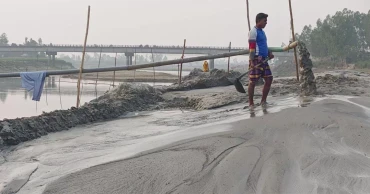
Once vibrant lifelines for northern Bangladesh, the Teesta, Dharla and Jamuneswari rivers are now being ruthlessly stripped of sand by illegal dredging syndicates operating under the shadow of political protection and administrative inaction.
Despite a standing government ban on sand extraction from these ecologically sensitive rivers, dredgers continue to roar day and night, turning riverbeds into pits as deep as 60 to 70 feet in some areas and transforming others into barren, desert-like highlands.
Locals allege that the trade in stolen sand thrives not just because of political shelter, but also due to police complicity and the negligence of local administrations.
“Police and administration officials take commissions at night. Everyone gets their share,” said one sand lifter in Badarganj upazila, requesting anonymity.
During a recent visit to the Rajarampur Kashiganj area in Rangpur’s Badarganj upazila, dredgers were seen extracting sand openly from the Jamuneswari River.
Legal notice served to stop sand extraction from Kalidas Pahalia in Feni
Local residents claimed the operation has continued for nearly six years — first under the influence of local Awami League leaders and now reportedly under a local BNP leader’s patronage, after ‘managing’ the police.
“Even when the UNO raids in the morning, dredgers return by afternoon with police help,” said a villager.
Local administration officials, however, insist that they are actively working to stop illegal dredging.
“Sand extraction is completely prohibited. Mobile courts are being conducted wherever we receive reports,” said Rangpur Divisional Commissioner Shahid Islam.
Gongachara Upazila Nirbahi Officer (UNO) Mahmudul Hasan Mridha said several dredgers were recently seized and destroyed during operations in the Teesta.
26 dredging machines seized for illegal sand extraction from Feni River
11 months ago

15,520 hectares of croplands inundated in Kurigram
About 15,520 hectares of cropland have gone underwater in Kurigram district till Monday morning as the water level in the rivers has started rising again.
The water level in Dharla river has increased by 10 cm and in Brahmaputra river by 5 cm in the last 24 hours.
Read: Flood in Kurigram getting worse
Kurigram Water Development Board Executive Engineer Md Ariful Islam said water level in the Dharla River has risen to 34 cm above the danger level and 23 cm in the Brahmaputra river’s Chilmari Point on Monday morning. However, increased water has reduced erosion.
The low-lying areas and sandbars of the district have gone under water.
Till Monday, 15,520 hectares of crops have been submerged in the district. Of these, Aman is planted 15,115 hectares, vegetables are 270 hectares and seedbed is 95 hectares.
5 years ago

Kurigram flood situation improves
The overall flood situation in Kurigram has improved as the water level in many rivers including Brahmmaputra is receding.
6 years ago
.jpg)
50,000 people marooned in Kurigram
Rainfall in recent days and water from the upstream have caused Teesta, Dharla and Brahmaputra rivers to burst their banks and inundate new char areas in Kurigram, leaving around 50,000 people marooned.
6 years ago
Upstream water, rain trigger floods in Lalmonirhat, Kurigram
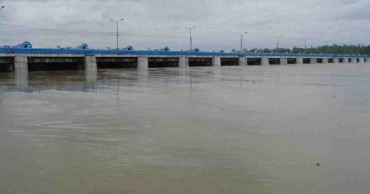
Floods triggered by onrush of water from the upstream and heavy rains have inundated low-lying areas in different upazilas of Lalmonirhat and Kurigram districts, rendering several thousand people marooned.
6 years ago

Flood situation still unchanged; 7 die in 24 hrs
Thousands of flood-hit people saw no respite from their sufferings as the overall flood situation remained nearly unchanged across the country on Friday.
6 years ago

Flood situation turns grim in parts of Bangladesh
The overall flood situation in Kurigram, Natore, Bogura and Sherpur districts have deteriorated further due to rise in water levels in various rivers, cutting off road communications at places and leaving thousands of people marooned.
6 years ago
.jpg)
Public sufferings mount as flood situation worsens in Faridpur, Kurigram;
Sufferings of the flood-hit people has been intensified with deterioration of overall flood situation in Faridpur and Kurigram districts.
6 years ago