Teesta
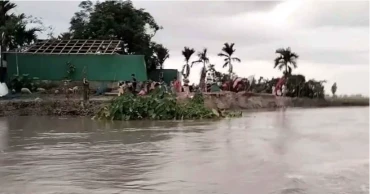
10,000 stranded as Teesta embankment breaches flood villages in Rangpur
Around 10,000 people have been stranded after breaches in two embankments along the Teesta River flooded several villages in Gangachara upazila of Rangpur.
The breaches developed at the volunteer-built embankments in Ward No. 8 of Nohali Union following a sudden rise in the Teesta's water level, allowing floodwater to enter nearby villages.
A visit to the area found that nearly 150 metres of the embankments have already been washed away by the river.
Vast tract of cropland have gone underwater, while floodwater has inundated villages, disrupting normal life.
The erosion has also put more than 100 homesteads, educational institutions, mosques, a temple, roads and other infrastructures at risk.
Residents of Char Baghdhogra, Char Kachari, Chilakhal, Binbinia and Mukutpara said families, particularly children, elderly people and livestock, are facing severe hardship, with many taking shelter at relatives' houses.
Monayem Hossain, a local resident said hundreds of people lose their homes to river erosion every year but no permanent solution has been implemented.
"The embankment has already lost about 150 metres to the river. If the main embankment is breached, thousands of people will lose their homes. A few thousand geo bags will not be enough. A permanent embankment project is urgently needed," he said.
Abdul Karim, another resident, said several houses have already disappeared into the river before their eyes.
"My house could be the next. If I lose my homestead, I will have nowhere to go. If no one gives me a place to relocate, I will have to move to Dhaka with my family and earn a living by pulling a rickshaw," he said.
Mominul Islam, another affected resident, said repeated erosion has already washed away homes, farmland, a mosque, a madrasa and schools.
"We do not want relief. We want a permanent embankment to protect us," he said.
Executive Engineer of the Rangpur Water Development Board (WDB) Robiul Islam said 4,500 geo bags have already been allocated to protect the embankment, and dumping work is underway.
"More geo bags will be supplied if necessary. We are treating the matter with utmost importance," he said.
Gangachara Upazila Nirbahi Officer (UNO) Mosammat Jesmin Akter said the affected area has been inspected and the Water Development Board has been requested to take immediate measures to prevent further erosion.
2 months ago

No progress on Teesta feasibility study before or during interim govt: Shama Obaed
State Minister for Foreign Affairs Shama Obaed Islam on Wednesday said the feasibility study on the Teesta River Comprehensive Management and Restoration Project (TRCMRP) will continue from where it left off, stressing that no progress was made on it during the interim government or before its tenure.
"The feasibility study is in the same state as when it was started. There has been no progress. It was not carried out during the interim period, nor was it done before the interim period," she told reporters while responding to a question at the Ministry of Foreign Affairs.
Shama Obaed said China has agreed to provide Bangladesh with the technical support needed to conduct the feasibility study.
"Besides Teesta, we have challenges in river management across the country. China also wants to help and support us in that area. That is the assistance China wants to provide," she said.
Bangladesh and China have agreed to expedite a joint feasibility study on the Teesta River Comprehensive Management and Restoration Project (TRCMRP).
If the feasibility study justifies the project, China will extend adequate support for its implementation.
Seeking deeper cooperation with Bangladesh in integrated water resources management, China has decided to provide support "within its capacity" for the TRCMRP.
The Chinese side will also support experts from both countries in expediting the feasibility study of the project and related work, according to a joint statement shared by the Ministry of Foreign Affairs.
The two sides agreed to deepen cooperation in areas such as integrated water resources management, water resources planning, hydrological forecasting, flood prevention and disaster reduction, river dredging, and related technology sharing.
Shama Obaed said Prime Minister Tarique Rahman's visit to China has certainly taken Bangladesh-China relations to a new height.
"Bangladesh's relations with China have always been good. China has always been a strong partner in our economic and social development. In the coming days, it will invest even more," said the State Minister.
She expressed hope that Chinese investment in Bangladesh will increase further.
"New investments will come, and we are certainly reviewing the proposals made by the Chinese government, including the two-plus-two meeting and the Bangladesh-China-Myanmar Economic Corridor," she said.
Shama Obaed said the government has maintained from the very beginning that Bangladesh's foreign policy will safeguard the interests of its people while keeping their needs at the forefront.
3 months ago
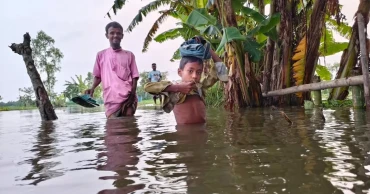
Floodwaters recede but erosion worsens along Teesta, 20,000 families stranded
Although water levels of the Teesta River have started receding thousands of people in northern Bangladesh remained stranded while fresh riverbank erosion is threatening homes, roads, embankments and critical infrastructure in five districts.
At least 20,000 families are still marooned in low-lying and char areas of Rangpur, Lalmonirhat, Kurigram, Gaibandha and Nilphamari as floodwaters from the Teesta, Dharla and Dudhkumar rivers continue to fluctuate, according to Bangladesh Water Development Board (BWDB) officials.
Riverbank erosion has intensified in several areas, displacing dozens of families and putting key flood protection structures and roads at risk.
BWDB Superintending Engineer for Rangpur region Ahsan Habib said at least 65 families have already lost their homes to river erosion over the past two days across the five northern districts.
He also said water levels could rise again over the next few days, prompting authorities to use loudspeakers to alert residents in vulnerable char areas to remain prepared.
According to the Flood Forecasting and Warning Centre, heavy to very heavy rainfall is expected over the next two days in Rangpur Division and upstream areas in India's West Bengal, followed by moderate to heavy rainfall for another three days.
BWDB officials said the Teesta River may rise again and flow above the danger level within the next three days.
Earlier this season, the Teesta first crossed the danger mark on June 23 before receding the following day. Water levels rose above the danger level again on June 29.
In Rangpur's Gangachara upazila, strong currents have damaged the Teesta Bridge protection embankment and groynes built along the river's right bank.
Floodwaters have inundated vast low-lying areas of Kolkonda and Lakkhitari unions, leaving many families stranded and cutting off communication with char villages.
Jute fields, groundnut farms and Aman seedbeds have gone underwater.
Severe erosion has also been reported along the Teesta in Lalmonirhat and Kurigram, while the Dharla and Dudhkumar rivers continue to erode riverbanks, forcing riverside residents into uncertainty.
Local residents said nearly 150 metres of a bridge protection embankment at Mahipur have already been washed away.
The erosion now threatens the Second Teesta Road Bridge, the Rangpur-Kakina regional highway and thousands of nearby homes.
Road sections approaching the bridge have developed large cracks, sinkholes and subsidence, creating risks for commuters and vehicles.
Upazila Engineer Shah Md Obaidur Rahman said officials have been instructed to inspect the damage and repair work would begin as soon as possible.
Hundreds of homes, educational institutions, rural roads and cropland across the five districts remain under knee-deep water.
Residents say they are struggling with shortages of food, safe drinking water and livestock feed, while farmers fear extensive damage to Aman rice seedbeds and vegetable fields.
Additional Director of the Department of Agricultural Extension in the Rangpur region Sirajul Islam said preliminary estimates show that floodwaters have inundated about 320 hectares of Aman paddy, eight hectares of black gram, 860 hectares of seed groundnuts and 790 hectares of vegetable fields.
A detailed assessment of crop losses is being prepared, he added.
Abdul Halim, a farmer from Char Shankardah village, said the water had risen overnight, submerging homes."Now the water is receding, but we're worried about river erosion," he said.
Rahima Begum, who has taken shelter in a flood shelter, said she was struggling to care for her children and livestock after floodwater entered her house.
"We have not received any relief yet," she said.
Farmer Salam Uddin of Kolkonda said his one-and-a-half acres of farmland remained underwater."We're also facing a shortage of cattle feed, and our Aman seedbeds may be destroyed," he said.
In Kaunia upazila, residents of riverside char villages said they remained on alert as water levels continued to fluctuate.
Meanwhile, in Kurigram's Ulipur and Nageshwari upazilas, about 200 metres of flood protection embankment have reportedly been washed away by the Teesta's strong current.
Across the river from Baraibari ferry ghat in Gangachara stands a nearly seven-kilometre earthen embankment built not by the government but by local villagers through donations and voluntary labour.
For the past three years, the embankment has protected nearly 12,000 families in five villages from flooding.
Now, rising water and strong currents have begun eroding sections of the structure, raising fears that if a supporting embankment collapses, the main embankment may also fail.
Local residents said they built the embankment themselves after repeated appeals to the Water Development Board for permanent protection went unanswered following devastating floods three years ago.
The BWDB has placed around 200 geo-bags along vulnerable sections in an effort to slow the erosion.
Local representatives criticised what they described as delayed preventive measures.
Lakkhitari Union Parishad Chairman Abdullah Al Hadi said timely placement of geo-bags could have prevented much of the current damage.
He said bamboo piling installed earlier as a temporary protection measure had collapsed during the first strong flow of the monsoon, rendering a project worth around Tk 1.4 million ineffective.
Balapara Union Parishad Chairman Ansar Ali warned that if upstream flows continue to increase, more riverside villages could be flooded.
Rangpur Divisional Commissioner Shahidul Islam said the administration was closely monitoring the situation.
He said authorities were preparing lists of affected families and relief assistance would begin shortly.
Local residents, however, say emergency relief alone will not solve the recurring crisis.
They are demanding permanent rehabilitation of erosion victims and long-term river management projects to protect communities along the Teesta from repeated floods and riverbank erosion.
3 months ago
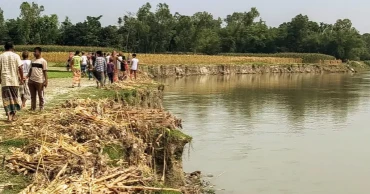
Kurigram residents face fresh displacement as Teesta devours land
Severe erosion along the Teesta River has once again put vast areas of Kurigram at risk, swallowing cropland and homesteads and pushing thousands of riverbank residents into deep uncertainty.
Farmland is disappearing almost daily, leaving farmers without livelihoods and families fearing the loss of their homes.
“We are losing land every day. Now our homes are also at risk. We don’t know where we will go with our families,” said Mahbub Hossain, a resident of Palashpur village under Nazimkhan union.
“We cannot even sleep properly due to the erosion. Every year we hear promises of work, but nothing changes in reality,” said housewife Rahima Begum.
Farmers said the loss of cultivable land has cut off their only source of income.
“My farmland has gone into the river. There is no way to earn anymore. We urgently need a permanent solution,” said Moksed Ali.
Originating in India’s Sikkim, the Teesta travels about 315 kilometres before entering Bangladesh, flowing through Nilphamari, Rangpur, Lalmonirhat, Kurigram, and Gaibandha before meeting the Brahmaputra in Gaibandha.
Around 115 kilometres of the river lie within Bangladesh.
According to the Kurigram office of the Bangladesh Water Development Board (BWDB), nearly 45 kilometres of the Teesta riverbank in the district are erosion-prone.
Several vulnerable stretches have already been identified including 400 metres in Ramhari area under Ghoriyardanga union, 500 metres in parts of Nazimkhan union, 1,000 metres in Chaprarpar under Thetarai union of Ulipur upazila, 500 metres in Saduar Damarhat, and 700 metres in Bajra area.
Despite recurring losses over the years, residents alleged that no effective long-term measures have been taken, said locals.
Temporary efforts such as dumping sand-filled geo-bags, have failed to provide lasting protection.
Shafiqul Islam Bebu, president of the Kurigram District Char Development and Implementation Council, said countries like the Netherlands have comprehensive systems to support erosion victims, including housing and rehabilitation.
“In our country, there is no such structured support. A legal framework is urgently needed to ensure compensation for those affected,” he said.
BWDB Executive Engineer Md Rakibul Hasan said the situation is being monitored closely.
“We have identified the vulnerable areas. As an emergency measure, around 100,000 geo-bags filled with sand will be placed to prevent further erosion,” he said.
However, locals said similar assurances are given every year without yielding durable solutions.
As a result, fresh waves of displacement continue, with families losing their homes and land to the relentless river.
5 months ago
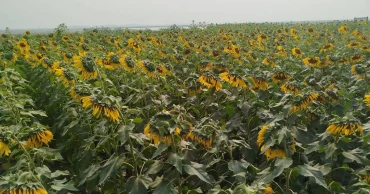
Golden Shift on Teesta: Sunflowers replace tobacco in Lalmonirhat’s char lands
A quiet but striking transformation is unfolding on the sandy char lands of Govardhan, on the banks of the Teesta River in Mohishkhocha Union under Aditmari Upazila.
Where tobacco once stood as the dominant crop, fields are now awash with the bright yellow of blooming sunflowers, signalling a new economic possibility for farmers in Lalmonirhat.
For the first time, sunflower is being cultivated commercially in the area under an agricultural development project aimed at reducing tobacco farming and increasing edible oil production.
The change is not merely visual; it is financial.
Farmers say the numbers speak for themselves. Cultivation costs range between Tk 6,000 and Tk 7,000 per bigha, while seeds are selling for around Tk 30,000 per bigha.
With limited irrigation, just two or three rounds, and proper fertiliser application, growers are earning around Tk 30,000 per bigha, making the crop an attractive alternative to tobacco.
Abu Bakkar Siddique, one of the pioneering farmers behind the initiative, described the current season as particularly successful.
“The yield has been very good this year,” he said, adding, “People are coming from far and wide to see the sunflower fields. Many are interested in cultivating it themselves because the costs are low and the profits are higher.”
Yet Bakkar cautioned that sustained success will depend on proper marketing arrangements.
“If marketing support is ensured, the banks of the Teesta could become green and golden, free from tobacco,” he added.
Agriculture officials are actively backing the transition. Under the Agricultural Technology Extension Project, the Department of Agricultural Extension is distributing free seeds and fertilisers to participating farmers.
The broader objective is to discourage tobacco cultivation, long associated with health and environmental concerns, and to boost domestic edible oil production.
Pradeep Kumar Roy, Deputy Assistant Agriculture Officer in Aditmari, said the char area had previously been synonymous with tobacco farming.
“With the initiative of farmer Abu Bakkar and support from the Agriculture Office, profitable sunflower cultivation is now taking place,” he said, confirming that the department has provided seeds, fertilisers, pesticides and technical advice.
Currently, sunflowers are being grown on five bighas of land in Mohishkhocha and Durgapur unions under the project, according to Omar Faruk, Upazila Agriculture Officer in Aditmari.
He expressed optimism that the crop could emerge as a strong substitute for tobacco while helping meet the country’s growing demand for edible oil.
“We are providing free support to discourage tobacco cultivation. Sunflower is not only profitable, but it is also very beneficial for human health," Faruk said.
Beyond its economic promise, the sunflower bloom has brought an unexpected social impact, he said.
Sunflower cultivation in Khulna: Salinity no longer a barrier
With few recreational facilities in the char area, the vibrant fields have drawn visitors from various places.
Many arrive to admire the sweeping yellow landscape; others leave with practical knowledge about a crop that could reshape the region’s farming future.
Officials hope the success in Govardhan char will inspire wider adoption across the Teesta basin, turning what was once a tobacco stronghold into a landscape defined by sustainable cultivation and renewed rural optimism.
7 months ago

Bangladesh holds the right to decide on Teesta project; China to accept any decision: Ambassador Yao
Chinese Ambassador to Bangladesh Yao Wen today (July 04, 2024) said that it is solely Bangladesh’s sovereign right to decide on the Teesta project, and that this decision must be respected.
“Whatever project regarding the Teesta river is truly on Bangladesh’s side to make a decision. And the decision has to be respected,” he told diplomatic correspondents at a DCAB Talk, responding to a question on the Teesta river that Bangladesh shares with India.
Diplomatic Correspondents Association, Bangladesh (DCAB) hosted the event at Jatiya Press Club ahead of Prime Minister Sheikh Hasina’s visit to China next week. DCAB President Nurul Islam Hasib and General Secretary Ashiqur Rahman Apu also spoke at the event.
The Chinese ambassador stated that the visit will outline a new blueprint for practical cooperation in various fields and provide an opportunity for the two countries to coordinate their positions on regional and international affairs.
Ambassador Yao mentioned that China had made its proposal on Teesta following Bangladesh's request and is open to accepting any decision. “We are open. It’s purely on Bangladesh to decide what to do at the next stage.”
PM Hasina’s upcoming visit to boost China-Bangladesh cooperation on bilateral, regional and global issues, says Ambassador
India also expressed interest and announced that a technical team would soon visit Bangladesh to discuss the Teesta river conservation and management issues.
On June 25, Prime Minister Sheikh Hasina stated that the government would accept the financing proposal for the Teesta Masterplan Project based on what is most beneficial for the country.
“We have undertaken the Teesta project. China and India have given separate proposals (for financing it). We must accept the proposal which will be more beneficial for the people of our country,” she said at a press conference at her official residence, Ganabhaban, regarding the outcome of her recent visit to India.
Addressing a separate question, Ambassador Yao emphasized the importance of good relations between Bangladesh and its neighbouring countries.
“You know, it is a success of your national foreign policy. So, we want to see good relations. And also, we want our relations to be playing a positive role and be viewed positively by the other countries. So that is a win-win cooperation and will benefit all parties,” he said.
He dismissed any notion of tension between India and China regarding this project, stating, “I don't see any tension. We want to see the project start very soon. Since I know almost 30 million people need this project, we just want to see if it can be studied and completed very soon.”
Regarding the development of southern Bangladesh, the ambassador mentioned that it is a proposal from the Bangladesh side and that China could play a significant role in aiding this development.
“It is a good opportunity for China to get involved in the internal development of Bangladesh and we will have a very active and positive approach to that proposal,” he said.
Ambassador Yao also praised Bangladesh’s humanitarian efforts in sheltering over 1 million Rohingya refugees.
“China is actively pursuing all parties involved in the Myanmar conflict to achieve a ceasefire and engage in dialogue, thus paving the way for the repatriation at an early date,” he said.
The envoy added that China is ready to support Bangladesh in the multilateral arena, jointly safeguarding the legitimate rights and interests of developing countries, and promoting regional and international peace and stability.
PM’s upcoming China visit a reflection of maintaining balanced diplomacy: Foreign Minister
He highlighted cooperation opportunities in areas such as education, media, infrastructure, trade promotion, investment, agricultural imports from Bangladesh, and the digital economy during Prime Minister Sheikh Hasina's upcoming visit.
Ambassador Yao noted that the Bangladesh-China relationship is at its best and is embracing tremendous development opportunities.
“Next year, our two countries will celebrate the 50th anniversary of the establishment of diplomatic relations. How to further elevate bilateral relations, expand the scope of exchanges, tap the potential for cooperation, and make the relationship between our two countries and peoples better, deeper, and closer is a task that requires joint efforts from both sides,” he said.
He emphasized that Prime Minister Sheikh Hasina’s visit to China will be a milestone in bilateral relations, building on past achievements and forging ahead.
“This visit will surely inject vibrant impetus into bilateral relations and cooperation in various fields, promoting new achievements in the strategic partnership of cooperation between China and Bangladesh, and elevating the relationship to a new height,” he said.
The envoy highlighted that Prime Minister Sheikh Hasina's visit to China is highly anticipated by all. “This visit is expected to take the helm for the growth of the China-Bangladesh relationship for the next five years or even longer.”
During the visit, Prime Minister Sheikh Hasina will meet with Chinese leaders, sign a number of cooperation documents, and jointly announce major cooperation achievements. Through this visit, both sides will firmly support each other and further deepen communication at all levels, he mentioned.
Read more: Experts highlight Bangladesh’s need for China in its dev journey, strategic gains anticipated from PM Hasina’s upcoming visit
2 years ago

Teesta riverbank erosion in Lalmonirhat: Fear of losing homes grips locals
Residents of areas along the Teesta river in Aditmari upazila of Lalmonirhat district are living in fear of losing their homes and crops as erosion has taken a serious turn.
Several thousand families living on the riverbanks were facing waterlogging issues due to the torrential rainfall last week. Several hundred hectares of cropland were damaged during this period.
But when the floodwater started to recede, panic gripped them as erosion took a serious turn in seven to eight points along the left side of the river.
Over the past few days, 25-30 houses, croplands and several establishments were washed away due to the erosion, forcing many families to live under the open sky.
Rising river waters trigger flooding, erosion concerns in Kurigram
Many have shifted their valuables including furniture on the roadside and near the flood protection dam.
Meanwhile, residents of Gobordhan and Garibullatari villages under Mahishkhocha union of the upazila saw severe erosion at the dead night on Tuesday near the embankment. A number of establishments including a mosque have gone into the river.
The families of Rabiul, Bhuttu and Yeakub Ali are living under the open sky as their homesteads were washed away due to the erosion.
Locals said if the authorities do not take any steps immediately, the embankment would also go into the river.
Villagers spend sleepless nights as Madhumati river banks erosion intensifies in Faridpur
They also demanded constructing a permanent dam along the riverbank.
Sunil Kumar, executive engineer of Lalmonirhat Water Development Board, said erosion occurred in seven-eight points along the riverbanks while erosion at spur dam-2 took a serious turn.
They have informed the matter to the high official concerned, he said.
After visiting the affected areas, GR Sarwar, Upazila Nirbahi Officer of Aditmari upazila, said a list of affected people is being prepared and assistance will be provided as per the list.
Teesta erosion worsens in Kurigram; 50 homes swept away
3 years ago

Teesta flowing 20cm above danger level in Lalmonirhat, several hundred families stranded
Low-lying areas in Lalmonirhat district have been flooded as the Teesta River is flowing 20 cm above the danger level at Dalia point due to continuous rainfall for the last few days until Monday (August 14, 2023) and the onrush of upstream water.
The water flow at Dalia point of Teesta Barrage, the country's largest irrigation project, was recorded at 52.35 cm at 6:00 am on Monday, 20 cm above the normal level of 52.15 cm.
Read: Untimely Teesta River erosion perplexes people in Lalmonirhat
People living near the barrage and on the river’s banks said the water flow of the river increased due to heavy downpour and the onrush of upstream water for the last few days.
All sluice gates were opened to control the water flow of the river, they said.
They said several hundred families have already been stranded and low-lying areas of the left banks of the river inundated after the river swelled.
Mominur Rahman, a resident from Mahiskhoca union under Gobordhan area, said they have to take boats to go to others' houses due to flood.
Read: Flood situation improves in Bandarban
Amsar Ali, who lives on the left river bank, said they are passing nights amid fear as the water is increasing in the river alarmingly.
Asfa-Ud-Doula, executive engineer of Water Development Board at Teesta Barrage’s Dalia Zone, said the low-lying areas on the banks of the river were inundated and all gates of the Teesta Barrage were opened to control the flow of water.
Read more: Flood situation in Ctg, Feni, Bandarban and Cox`s Bazar may improve in 24 hrs: FFWC
3 years ago

Rise in Teesta water may cause short-term flood in Lalmonirhat, Nilphamari in 24 hours: FFWC warns
Water in the Teesta river may cross the danger level at Dalia point over 24 hours, causing a short-term flood in the low-lying areas of Lalmonirhat and Nilphamari districts.
Flood Forecasting and Warning Centre (FFWC), in its regular bulletin, said the Brahmaputra-Jamuna and the Ganges-Padma rivers are in a rising trend, which may continue over 48 hours and water in the Dhalai river may cross danger level at Kamalganj point for a short period over 24 hours, starting from 9 am on today (July 05, 2023).
All gates of Teesta Barrage opened due to increase in water level
Besides, major rivers in the northeastern region of the country are in a falling trend except Khowai, Someswari and Dhalai, which may continue over 48 hours, the bulletin said.
Flood submerges 10 villages in Sunamganj, rain continues
The ongoing flood situation in Sunamganj and Netrokona districts may remain unchanged in 24 hours, it said.
Heavy rains may trigger short-term flood in Sylhet, Sunamganj
3 years ago
.jpg)
Teesta mainly depends on India: PM Hasina tells ANI
Prime Minister Sheikh Hasina has said resolving the Teesta water sharing issue mainly depends on India.
"It's (Teesta) a long-standing problem. So, it should be solved. But it depends mainly on India," she told multimedia news agency - Asian News International (ANI) ahead of her four-day state visit to India.
The full version of the interview will be telecast on Sunday morning with text stories.
A 37-second teaser of the interview was put on ANI's Twitter account on Saturday.
Recalling earlier discussions, Prime Minister Sheikh Hasina during her meeting with Indian counterpart Narendra Modi in March last year reiterated Bangladesh’s long-pending request for concluding the interim agreement on the sharing of the waters of the Teesta river.
She underscored that to alleviate the sufferings and save the livelihoods of millions of people dependent on the Teesta river basin, it is necessary that Bangladesh receives its fair share of the Teesta waters, the draft agreement of which has already been agreed upon by both Governments in January 2011, according to the 2021 joint statement.
Read: Hasina’s India visit to strengthen Dhaka-Delhi multifaceted relationship: MEA
Indian Prime Minister Narendra Modi reiterated India’s “sincere commitment and continued efforts” to conclude this agreement, in consultation with the relevant stakeholders.
Responding to a question on Hindu temples’ vandalism, the Prime Minister told ANI that some incidents sometimes take place. “But immediately we take action."
Bangladesh is hosting over 1.1 million Rohingyas. Responding to a question, she said it is a big burden. “India is a vast country, you can accommodate."
At the invitation of Indian Prime Minister Narendra Modi, his Bangladesh counterpart Sheikh Hasina will pay a visit to New Delhi from September 5 to 8.
Hasina will visit India after three years since she last visited in 2019 before the Covid-19 pandemic broke out.
4 years ago