Rab
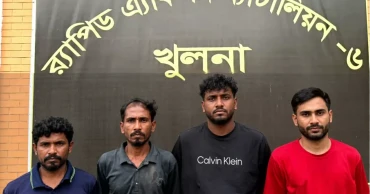
Listed criminal Momi, three associates arrested in Khulna
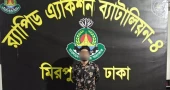
Rapid Action Battalion (RAB) arrested a listed criminal, Momi, and three of his associates from the Dattabari area of Khulna city on Wednesday.
The arrestees are Md Mehedi Hasan Momi, son of Shamim Jamaddar of Dattabari Pabla area; Jamil Hossain, son of Md Nasir Uddin; Md Liton Sardar, son of Mannan Sardar; and Sujoy Roy, son of Bimal Roy. All are residents of the Dattabari area.
They were apprehended during a raid on a house at around 11am, according to a press release issued by RAB-6.
RAB said acting on a tip-off, a team conducted the raid at the rented house of a tenant at Jafar Sheikh's house on Tarun Sena Road in Ward 5 of Dattabari under Daulatpur Police Station.
Momi is a listed criminal of Daulatpur Police Station, it said.
The RAB press release said multiple cases have been filed against Momi and his associates at different police stations in connection with arms, drugs, attempted murder and theft.
The arrestees were later handed over to the concerned police stations, RAB said.
1 month ago
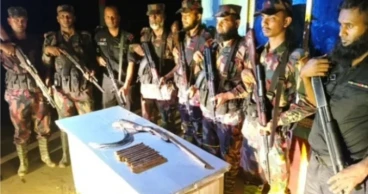
Single-shot gun, detonators, explosives recovered along Sylhet border
Border Guard Bangladesh (BGB) and Rapid Action Battalion (RAB) recovered a single-shot gun, 11 detonators and 11 explosive devices during a joint operation in a bordering area of Zakiganj upazila of Sylhet on Saturday night.
The operation was conducted around 10:00pm in the Sonasar area under Barothakuri union, around 1.5 kilometres inside Bangladesh from the zero line, within the jurisdiction of the Biyabail Border Outpost (BOP) of the Zakiganj Battalion BGB (19 BGB).
According to a press release issued by Lt Col Md Zubayer Anwar, commanding officer of the BGB battalion, in the early hours of Sunday, the joint forces recovered the gun, detonators and explosive devices abandoned in the Sonasar Brick Field area. No one was arrested during the operation.
BGB suspects that the items were smuggled into Bangladesh from across the border.
The border force said the operation was part of its ongoing efforts to strengthen border security and prevent the infiltration of drugs, illegal firearms and other contraband through enhanced intelligence surveillance, regular operations and heightened vigilance.
3 months ago
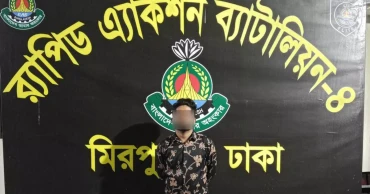
RAB arrests ‘notorious criminal’ Akash over Pallabi shooting
The Rapid Action Battalion (RAB) has arrested alleged notorious criminal Md Akash alias “Tan Akash” in connection with the shooting that took place in the Pallabi area of the capital on June 10.
According to the elite force, infighting erupted among members of the “Langra Rubel” group on Avenue-5 of Mirpur-11 under Pallabi Police Station on the day over establishing dominance in the locality.
During the clash, Akash, “Gal Kata” Rabbi, Al-Amin, Rapper Parvez and several others allegedly displayed foreign firearms and opened fire, injuring Hridoy, also known as “Gondar," according to a press release issued by the RAB headquarters on Tuesday afternoon.
The suspects also allegedly abducted a man named Abdullah during the incident, spreading widespread panic in the area.
Following the incident, RAB-4 launched an investigation to uncover the circumstances surrounding the incident and identify those involved.
Based on intelligence inputs and information technology-based surveillance, it tracked down Akash and arrested him from Hemayetpur in Savar in the early hours of Tuesday.
During preliminary interrogation, the elite force came to know that Akash has allegedly been involved in various criminal activities, including murder, extortion, robbery and drug-related offences, in Pallabi and surrounding areas of Dhaka.
RAB said around 13 cases, including ones filed on murder charges, extortion, robbery and drugs, are currently pending against Akash at different police stations in the capital.
The arrested accused was handed over to police for legal action, the release added.
4 months ago
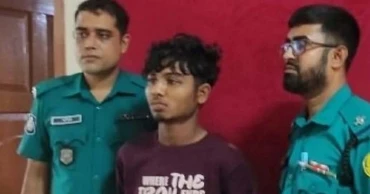
RAB man stabbed dead by ‘drug dealer’ in Sylhet
A member of Rapid Action Battalion (RAB) was stabbed to death allegedly by a drug dealer in the Keane Bridge area of Sylhet city on Friday afternoon.
The deceased was identified as Emon Acharya, a RAB-9 member. Police arrested the accused identified as Asadul Alam Bappi after the incident.
According to RAB-9 sources, Emon Acharya was injured around 12:00pm when Bappi stabbed him during an operation.
He was taken to Sylhet MAG Osmani Medical College Hospital where doctors declared him dead.
Additional Deputy Commissioner (Media) of Sylhet Metropolitan Police Mohammad Manjurul Alam said a group of people was involved in drug consumption and selling near the Keane Bridge when police chased them. The suspects fled the scene.
He said RAB member Emon, who was in plainclothes, tried to catch one of the suspects.
However, the accused stabbed him in his desperate attempt to flee, leaving the RAB man injured.
After the attack, the suspect reportedly fled and later took a child hostage at knifepoint inside a house in the Topkhana area.
Police later arrested him from there, Manjurul said.
4 months ago

RAB to be restructured as people-friendly, responsible force: Salahuddin
Home Minister Salahuddin Ahmed on Monday said the government will restructure the Rapid Action Battalion (RAB) as a people-friendly and responsible force in the future.
He made the announcement while addressing a programme as the chief guest at the RAB headquarters in Uttara, marking the force’s 22nd founding anniversary.
The Home Minister said the government has undertaken a series of reform initiatives aimed at transforming RAB into a professional, modern, responsible and people-oriented institution.
“These initiatives include enhancing the operational capability and professional skills of RAB members, providing specialised training on the minimum use of force in line with international standards, human rights compliance, and the use of artificial intelligence in crime prevention,” he said.
Salahuddin also announced that a specialised training centre for RAB will soon be established at Jungle Salimpur in Chattogram to further strengthen the force’s operational capacity.
He said the government is also working to adopt time-befitting strategies to address evolving crime patterns, strengthen public engagement to restore confidence, and uphold the principles of human rights, rule of law and professional ethics to help build a safe and stable society.
“To ensure transparency and accountability, the government has taken initiatives to formulate a specific and comprehensive law for RAB,” the Home Minister added.
He said no institution remained unaffected during the Awami League “fascist regime” when the elite force was used for political interests, harming its image, but stressed that an entire institution should not be blamed for the unlawful activities of a few officials. “The institutions must continue their work while upholding their own reputation and dignity. There will be no political interference from the government in this regard,” he said.
Salahuddin wants to demonstrate to the world that all its institutions are accountable and committed to the rule of law.
He also said the government is considering changing the existing name of RAB.
Replying to a question, the Home Minister said RAB is essentially a combined elite force comprising members from Bangladesh Police (44 percent), the Armed Forces Division (44 percent), as well as Ansar, Border Guard Bangladesh (BGB), and civil staff.
Responding to a question about the withdrawal of US sanctions imposed on the force, he said, “During the previous fascist regime, Sheikh Hasina used this force like a puppet to fulfil her desire to establish a one-party rule and to achieve political objectives. Due to the unlawful and misguided activities of a small number of officers, the entire institution has suffered today. However, the whole institution cannot bear responsibility for the crimes of an individual or a few specific officers.”
Salahuddin added that directives have already been issued to take strict legal action against the accused officers under the legal frameworks of their own forces.
He also expressed hope that once the force is reformed, reorganised, or renamed under the new law, the United States government will reconsider the sanctions issue.
Explaining the rationale behind the legal reforms, the Home Minister said for the past 20 years, RAB had not operated under any specific independent law but had instead functioned on an ad hoc basis under a special provision of the Armed Police Battalion Act. “An elite force cannot continue for such a long time under an interim structure,” he said.
To address this legal gap, he said, the Ministry of Home Affairs has already formed a high-level law formulation committee comprising experts, which is being directly supervised by the minister himself.
He said the proposed new law will clearly define the force’s authority and responsibility while ensuring strict provisions for transparency and accountability.
Responding to another question regarding investigations and trials over enforced disappearances and crimes against humanity committed during the previous government, Salahuddin said the earlier commission on enforced disappearances had no specific legal authority to take punitive measures, which created legal complications.
The government is currently working to amend and strengthen the law related to the International Crimes Tribunal (ICT), he said, adding that once the reforms are completed, all crimes related to enforced disappearances, threats of disappearance and missing persons could be tried through a specific legal process under the special tribunal, ensuring justice directly for victims and their families.
5 months ago
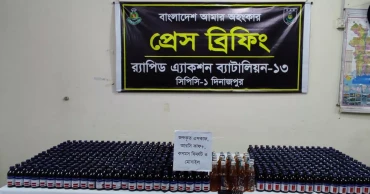
One arrested with drugs in Dinajpur
An alleged drug dealer has been arrested along with narcotic syrups and foreign liquor at Jagirpara village in Dinajpur Sadar upazila.
The arrestee was identified as Md Jewel Babu, 25, son of late Abu Tahanur of the village.
A team of Dinajpur CPC-1 camp of Rapid Action Battalion-13 conducted a drive at the village on Wednesday afternoon based on a tip-off.
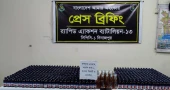
During the raid, a total of 581 bottles of narcotic syrups of two brands were recovered from a house owned by Raihan Kabir alias Babu, a fugitive accused in another case.
Besides, the elite force recovered 25 bottles of foreign liquor and arrested Jewel at that time.
5 months ago

Rab arrests accused in ASP Fazlul Karim murder case
Members of Rapid Action Battalion (RAB)-3 have arrested one of the accused in sensational murder Additional Superintendent of Police (ASP) Fazlul Karim Khan murder case from Demra area of the capital.
The arrestee was identified as Md Shafiqul Islam Badsha, also known as Guja Badsha, 55.
According to RAB-3, he was arrested during a special drive conducted on April 13 at around 9:10 am at a flat in New Town Residential Area under Demra Police Station.
Sanad Barua, Senior Assistant Director (Media) of RAB-3 Headquarters, disclosed the information at a media briefing on Wednesday.
During interrogation and investigation, it was revealed that on August 29, 2013, a group of assailants entered the third floor of ASP Fazlul Karim’s residence on WAPDA Road in West Rampura and killed him before fleeing the scene.
Although a case was filed against 25 accused, including the arrestee law enforcers had failed to capture Guja Badsha for years.
RAB officials said the accused was a notorious terrorist in Rampura and Hatirjheel areas and had long been involved in drug and arms trading, extortion, and other criminal activities.
Following intelligence inputs, RAB-3 initiated shadow investigation and finally succeeded in arresting him.
The RAB official said the accused has a total of 14 cases filed against him with Rampura and Hatirjheel thana including cases related to murder, extortion, under the Special Powers Act, and the explosives Substance Act. Several arrest warrants are also pending against him.
6 months ago
No specific threat ahead of Pahela Baishakh: RAB
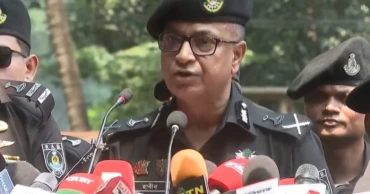
Rapid Action Battalion (RAB) Director General Md Ahsan Habib Palash on Monday said there is no specific security threat centering the Pahela Baishakh celebrations but the elite force remains fully prepared to face any sabotage.
He made the remarks while briefing reporters after visiting security arrangements at Ramna Batamul in the capital.
To ensure a festive and peaceful environment, RAB has deployed all its 15 battalions across the country.
A total of 308 patrol teams including 181 pickup patrol units and 127 motorcycle patrol teams will remain active in the field until the end of Baishakhi programmes.
Plainclothes intelligence surveillance has also been intensified, he said.
In Dhaka, special security measures have been taken at key venues including Shahbagh, TSC, Suhrawardy Udyan, Rabindra Sarobar, Hatirjheel, Manik Mia Avenue, Bangla Academy and Ramna Batamul.
Checkposts and observation posts have been set up alongside strengthening regular patrols.
To prevent any possible sabotage, bomb disposal units and dog squads are conducting sweeping operations and remain on standby.
Adequate reserve forces, control rooms, foot patrols and CCTV monitoring have also been ensured nationwide.
Strict monitoring is ongoing to prevent the spread of rumours, provocative or false information.
Special measures have also been taken to ensure women's safety and prevent eve-teasing and harassment at celebration venues, he added.
He called upon all to immediately inform law enforcement agencies if any suspicious activity or security concern is noticed
Expressing optimism, he said this year’s Pahela Baishakh will be celebrated in a peaceful and festive atmosphere like previous years.
6 months ago

Sundarbans drive: 61 robber gang members held in 18 months
A total of 61 members of various robber gangs have been detained in joint operations over the past 18 months.
Captain Mohammad Mesbaul Islam, Zonal Commander of Coast Guard West Zone Headquarters, said on Sunday that they launched drives titled ‘Operation Restore Peace in the Sundarbans’ and ‘Operation Mangrove Shield,’ to curb robber activities in the Sundarbans.
During the drives, members of several groups including Karim-Sharif, Nana Bhai, Chhota Suman, Alif, and Asabur, were detained.
Authorities also recovered 80 firearms and 599 rounds of ammunition during the drives.
Besides, 78 fishermen and three tourists were rescued.
The Coast Guard sources said 944 kg of venison, 900 traps, and a large quantity of illegal goods linked to 29 poachers were seized as part of wildlife protection efforts.
Illegal nets worth around Tk 1,806 crore and a significant amount of fish fry were also seized.
Security surveillance has intensified across the Sundarbans including Harbaria, Kaikhali, Koyra, Nalian, Mandarbari, and Shyamnagar in Satkhira, as part of ongoing anti-poaching operations.
Personnel from the Navy, RAB, Coast Guard, Police, Forest Department, and other agencies are participating in the joint drive.
6 months ago
RAB yet to receive tribunal request over enforced disappearance, crossfire cases: DG
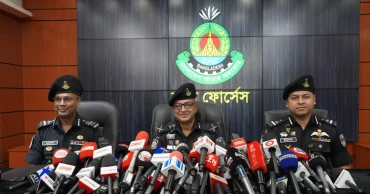
Newly appointed Director General of Rapid Action Battalion (RAB) Md Ahsan Habib Palash on Sunday said the force has not yet received any request from the International Crimes Tribunal regarding allegations of enforced disappearances and crossfire incidents but pledged full cooperation if approached.
Any request related to judicial proceedings would be duly honoured, he said a media briefing at the RAB Media Centre in the capital’s Karwan Bazar.
Responding to a question about the Chief Prosecutor’s remarks on summoning and examining RAB’s crossfire records, the DG said, “If any cooperation is sought in relation to the judicial process, RAB will provide it. We will share whatever information we have and if any information is unavailable, we will inform accordingly. However, the tribunal has not yet contacted us.”
On reported domestic and international calls for disbanding RAB, he said such decisions lie with the government. “RAB’s responsibility is to carry out its assigned duties properly and build public trust through its work,” he added.
Addressing allegations that the force was used for political purposes in the past, the DG said recent activities suggest a decline in major irregularities. “If managed properly, RAB can play a constructive role,” he said.
On tackling piracy and separatism, he said intelligence surveillance has been strengthened and operations are being conducted based on gathered information.
Without directly commenting on militancy, he said RAB continues to work against all forms of terrorism and will maintain that effort in the future.
Expressing concern over the rise of juvenile gangs, he said the problem is increasing across the country. “Police and RAB are working jointly, but bringing juveniles under the law often remains challenging,” he noted, urging journalists to support efforts through investigative reporting.
Regarding the possible renaming or restructuring of RAB, he said it is entirely a policy matter for the government. “Our priority is to perform our duties. Internal investigations into allegations of human rights violations are ongoing, and no one will be spared,” he said.
On US sanctions, the DG acknowledged that the situation stemmed from past shortcomings. “If those are addressed, we hope such sanctions will not continue in future,” he added.
6 months ago