Vietnam
Heavy rain floods northern Vietnam, disrupts travel and daily life
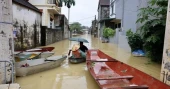
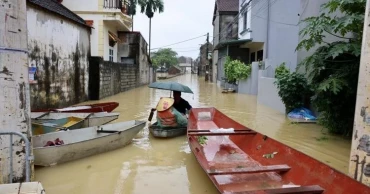
Heavy rain triggered flooding across parts of northern Vietnam on Thursday, inundating homes, disrupting travel and pushing several rivers above dangerous levels, authorities and state media reported.
Rain has fallen across northern and north-central parts of the country throughout the week, with some areas receiving more than 50 centimeters (19.7 inches), according to the disaster prevention department.
More than 2,000 homes have been flooded, while key transport routes have been blocked and more than 1,000 households have been cut off.
Ninh Binh and Thanh Hoa provinces, which cover both lowland and hilly areas south of Hanoi, have been among the worst affected.
Vietnam is one of the world’s most climate-vulnerable countries and frequently experiences flooding. A series of major storms last year prompted the government to explore new ways to prepare for and manage floods.
In Thanh Hoa, authorities asked students to stay home because flooding had made travel unsafe, state media reported.
Floodwaters have submerged or damaged about 10,014 hectares (24,745 acres) of rice fields and other crops, with the biggest losses reported in Ninh Binh, Thanh Hoa and Nghe An provinces. Thousands of livestock and poultry have also died.
“The flood happens every year,” Ninh Binh resident Tran Ngoc Tai told national broadcaster VTV, adding that residents had prepared food and drinking water.
Hanoi streets floodedSeveral streets in Hanoi were deeply flooded Thursday morning, with water reaching nearly a meter (3.2 feet) in some areas.
The flooding disrupted traffic and made it difficult for residents to travel to work, take children to school or leave their homes.
Some areas received more than 15 centimeters (5.9 inches) of rain from Wednesday night through Thursday morning, state media said.
Many high schools and universities in Hanoi remained closed or moved classes online Thursday afternoon as widespread flooding continued.
Rising water levels in the Bui River on Hanoi’s southwestern outskirts also threatened nearby homes. Authorities deployed hundreds of soldiers to help residents move their belongings to higher ground, state media reported.
More rain forecast for southern VietnamA cold air mass moving south is expected to bring five days of heavy rain to southern Vietnam, including flood-prone Ho Chi Minh City, starting Thursday, according to the Southern Regional Hydro-Meteorological Center.
Forecasters expect widespread rainfall through Sept. 21 and authorities have warned of possible flooding in low-lying areas and along waterways.
Ho Chi Minh City is expected to receive 10 to 20 centimeters (4 to 8 inches) of rain, with some areas receiving even more.
Vietnam experienced several major floods in 2025.
Tropical Storm Wipha brought heavy rain and flooding in July, followed by further flooding and landslides in August when Tropical Storm Kajiki hit the country.
Typhoon Bualoi killed at least 26 people in September.
In October, the historic central cities of Hue and Hoi An were flooded, along with large parts of northern Vietnam.
1 month ago
Rights group says Vietnam intensifying crackdown on dissent with broad laws
Vietnam is increasingly using broadly worded laws to arrest activists, critics and ordinary citizens seen as challenging the ruling Communist Party, according to a new report released Monday by human rights organization The 88 Project.
The report says the government arrested at least 56 people on politically related charges in 2025, marking the third straight year of rising arrests. That figure is twice the number recorded in 2022. The group noted that the actual number is likely much higher because it only counted cases where those arrested were publicly identified and their cases could be tracked.
According to the report, the government under Communist Party General Secretary To Lam has stepped up its use of criminal laws to silence dissent. To Lam, the country's former top security official, became party chief in 2024 and was also elected president earlier this year.
The report says many of the arrests are linked to growing concerns within Vietnam's leadership over the possibility of a so-called "color revolution," referring to mass protest movements that brought political change in countries such as Ukraine and the Philippines.
It also points to similarities with neighboring China, where authorities have long faced criticism for suppressing dissent through broad legal powers. Despite occasional tensions over territorial disputes in the South China Sea, China and Vietnam agreed earlier this year to strengthen cooperation on political security and preventing so-called color revolutions.
Ben Swanton, co-director of The 88 Project, said Vietnam has become far less tolerant of criticism under To Lam's leadership.
"The country has become a police state that allows no dissent," Swanton said, adding that the current situation marks a sharp decline from the relatively more open environment of the 2010s, when civil society groups had greater space to engage in public policy discussions.
Vietnam's Foreign Ministry did not respond to requests for comment on the report.
A key concern highlighted in the report is the growing use of Article 331 of Vietnam's penal code, which allows authorities to sentence people to up to seven years in prison for "abusing democratic freedoms" in ways deemed harmful to the state.
Human Rights Watch previously said the government has expanded the use of Article 331 beyond political activists to include ordinary people who publicly criticize government officials or raise concerns over issues such as land rights, religious freedom, Indigenous rights and corruption.
The report notes that among those charged under Article 331 last year were three men behind the YouTube channel "Nguoi Da Tin" accused of posting videos containing what authorities described as distorted information.
The 88 Project also documented several politically related arrests in 2025, including a Montagnard activist who was arrested in Thailand and sent back to Vietnam, a writer accused of spreading anti-state propaganda, and a man who helped residents in Ha Tinh province seek compensation after losing land to a highway project.
The report concludes that Vietnamese authorities are imposing increasingly harsh punishments not only on journalists and human rights defenders but also on political exiles and citizens using legal means to challenge government decisions.
3 months ago
An internal document shows Vietnamese military preparing for possible US war
An internal Vietnamese military document has revealed deep concerns within Hanoi’s defense establishment about a potential American “war of aggression,” even as Vietnam maintains its highest-ever level of diplomatic relations with Washington.
The document, prepared by Vietnam’s Ministry of Defense in August 2024 and titled “The 2nd U.S. Invasion Plan,” portrays the United States as a “belligerent” power and urges vigilance against what it describes as possible US-led attempts to destabilise Vietnam’s socialist system, according to a report released on Tuesday by The 88 Project, a human rights organisation focused on Vietnam.
The disclosure comes roughly a year after Vietnam and the United States elevated their relationship to a Comprehensive Strategic Partnership, placing Washington on par with Hanoi’s ties to China and Russia. The internal assessment highlights what analysts describe as a dual-track approach in Vietnam’s foreign policy: outward diplomatic engagement alongside persistent internal suspicion.
Beyond fears of direct military conflict, the document underscores a long-standing anxiety within Vietnam’s Communist leadership about so-called “color revolutions,” mass uprisings that have toppled governments elsewhere, including Ukraine’s Orange Revolution in 2004 and the Philippines’ People Power movement in 1986. Vietnamese planners warn that external forces could exploit issues such as democracy, human rights, ethnicity and religion to engineer political change.
According to the document, while the risk of an immediate war against Vietnam is considered low, the US and its allies are seen as willing to use unconventional warfare or manufacture pretexts for intervention against countries that fall outside Washington’s strategic orbit, particularly as part of efforts to counter China’s influence in Asia.
Ben Swanton, co-director of The 88 Project and author of the analysis, said the concerns outlined in the document reflect a broad consensus within Vietnam’s government rather than the views of a marginal faction. He noted that Hanoi does not see the US as a true strategic partner and has no intention of joining any anti-China alliance.
Vietnam’s Foreign Ministry did not respond to requests for comment on the report or the document. The US State Department declined to address the contents directly but reiterated that the bilateral partnership is intended to promote shared prosperity and regional stability.
Analysts say the document offers rare insight into internal debates within Vietnam’s leadership, particularly tensions between reform-minded officials and more conservative, military-aligned figures who remain deeply shaped by memories of the Vietnam War and wary of foreign interference. While Western diplomats often view China as Hanoi’s primary security concern, the document suggests that regime stability and the threat of internal unrest remain paramount.
The assessment also reflects Vietnam’s delicate balancing act. China remains its largest overall trading partner, while the United States is its biggest export market, binding Hanoi economically to both powers even as strategic mistrust persists.
Observers say the return of US President Donald Trump for a second term has both eased and complicated Vietnamese concerns. While Washington has softened its emphasis on democracy and human rights, recent US actions abroad have reinforced fears among Vietnamese conservatives about American willingness to violate national sovereignty.
Overall, analysts suggest Vietnam’s leadership continues to engage the United States pragmatically, but with enduring caution rooted in history, ideology and fears of political destabilisation.
8 months ago
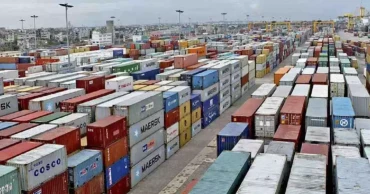
Bangladesh secures 20% US tariff rate, matching key apparel competitors
Bangladesh secured a 20% US tariff rate—comparable to its key apparel-sector competitors such as Sri Lanka, Vietnam, Pakistan and Indonesia, which received rates between 19% and 20%.
As a result, Bangladesh's relative competitiveness in apparel exports remains unaffected, according to Chief Adviser's press wing.
By contrast, it said, India received a 25% tariff after failing to reach a comprehensive agreement with the US.
“We negotiated carefully to ensure that our commitments aligned with our national interests and capacity,” said Dr Khalilur Rahman, Bangladesh’s National Security Advisor and lead negotiator.
“Protecting our apparel industry was a top priority, but we also focused our purchase commitments on U.S. agricultural products. This supports our food security goals and fosters goodwill with U.S. farming states,” he said.
“Today, we successfully avoided a potential 35% reciprocal tariff. That’s good news for our apparel sector and the millions who depend on it. We’ve also preserved our global competitiveness and opened up new opportunities to access the world's largest consumer market,” Dr Rahman added.
Now US could collect over $1 billion in tariffs from Bangladeshi goods: CPD study
President Donald Trump today announced new tariff rates—up to 41%—on imports from 70 countries, just ahead of the August 1 deadline for finalising bilateral trade agreements.
These agreements extend beyond tariff adjustments to include domestic policy reforms that the Trump administration views as contributing to trade imbalances.
They also address broader economic and national security concerns.
As part of the negotiations, countries were required to make explicit commitments to purchase US goods to help narrow trade deficits.
Given the scope of issues involved, the negotiation process has been complex and time-consuming.
Tariff relief was tied not only to reductions in duties on US exports but also to a country’s willingness to address U.S. concerns on non-tariff barriers, trade imbalances, and security matters, said the Chief Adviser’s press wing on Friday.
BNP urges US to keep tariffs on Bangladesh at reasonable level
President Trump's executive order made clear that each country’s tariff rate would reflect the depth of its commitment across all these areas.
1 year ago
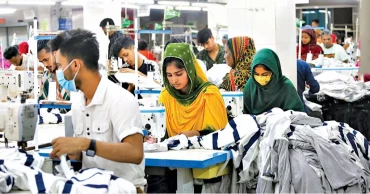
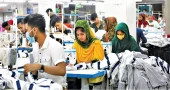
Bangladesh holds 2nd spot in apparel export as Vietnam gains ground
Despite holding its position as the world’s second-largest apparel exporter, Bangladesh faces growing competition from Vietnam, which is emerging as a formidable rival in the global market.
According to the World Trade Organization (WTO) data for 2024, Bangladesh secured $38.48 billion with a growth rate of 0.21%, while Vietnam emerged as a strong contender with a notable growth rate of 9.34%, amounting to $33.94 billion in exports.
The global apparel market has reached a total size of $557.50 billion, showing a 7.08% growth from the previous year's $520.62 billion, according to the WTO data for 2024.
China, leading the market, achieved $165.24 billion in exports, marking a modest growth of 0.30%. Following closely, Bangladesh secured $38.48 billion with a growth rate of 0.21%.
Vietnam emerged as a strong contender with a notable growth rate of 9.34%, amounting to $33.94 billion in exports.
Turkey contributed $17.91 billion to the market, while India, Cambodia, Pakistan, Indonesia, and the USA recorded export figures of $16.36 billion, $9.89 billion, $9.28 billion, $8.73 billion, and $7.00 billion, respectively.
Growth percentages varied across these countries, with figures ranging from 24.19% to -4.42%.
Bangladesh's apparel export to US rose to $7.34 billion in a decade: US Report
Market share analysis reveals China holding the largest share at 29.64%, followed by Bangladesh at 6.90%. Vietnam, Turkey, India, Cambodia, Pakistan, Indonesia, and the USA captured market shares of 6.09%, 3.21%, 2.94%, 1.77%, 1.66%, 1.57%, and 1.26%, respectively.
Despite the challenges posed by the COVID-19 pandemic, the global apparel market has shown signs of recovery and growth. But, new challenges and issues continue to emerge, shaping the dynamics of the industry.
Mohiuddin Rubel, former director, Brand BGMEA and Managing Director, Bangladesh Apparel Exchange told UNB that Bangladesh’s competitors increased in the global market.
Apparel makers highlight importance diplomacy, branding eyeing 100 bln dollar industry
The US tariff imposed for Bangladesh would be increased if the tariff barrier continues, he said.
1 year ago
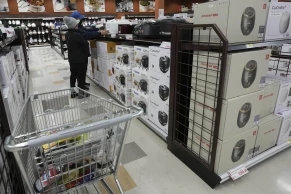
Trump announces 35% tariff on Bangladeshi goods, to be effective Aug. 1
US President Donald Trump on Monday slapped a 35% tariff on Bangladeshi goods, 2% lower than his initial rate announced three months ago, but significantly higher than close rival Vietnam (in the field of RMG), which recently secured a trade deal with the US under which its goods will be charged a tariff of 20%.
Trump made the much-anticipated announcement on his Truth Social account, by publishing his letter dated July 7 to Chief Adviser Muhammad Yunus at 2.36am (Tuesday) Bangladesh time. He posted identical letters to other world leaders revealing the tariff rates for their respective countries, which said the new rates would be effective from August 1.
Apart from Bangladesh, it was learned on Monday that imports from Myanmar and Laos would be taxed at 40%, Cambodia and Thailand at 36%, Serbia at 35%, Indonesia at 32%, South Africa and Bosnia and Herzegovina at 30% and Japan, South Korea, Kazakhstan, Malaysia and Tunisia at 25%. More letters may be forthcoming.
The letters warned Trump’s counterparts to not retaliate by increasing their own import taxes, or else the Trump administration would further increase tariffs.
“If for any reason you decide to raise your Tariffs, then, whatever the number you choose to raise them by, will be added onto the 35% that we charge,” Trump wrote in the letter to Yunus.
Trump to put 25% tariffs on Japan and South Korea, new import taxes on five other nations
A Bangladeshi delegation remains in Washington for last-ditch talks with the US Trade Representative's office, but Trump’s word could be final for now. He did however add: “If you wish to open your heretofore closed Trading Markets to the United States, and eliminate your Tariff and Non Tariff, Policies and Trade Barriers, we will, perhaps, consider an adjustment to this letter.”
Meanwhile, the AP reports that following a now well-worn pattern, Trump plans to continue sharing the letters sent to his counterparts on social media and then mail them the documents, a stark departure from the more formal practices of all his predecessors when negotiating trade agreements.
The letters are not agreed-to settlements but Trump’s own choice on rates, a sign that the closed-door talks with foreign delegations failed to produce satisfactory results for either side, according to AP.
BRICS summit overshadowed by Middle East tensions, condemns tariffs
1 year ago
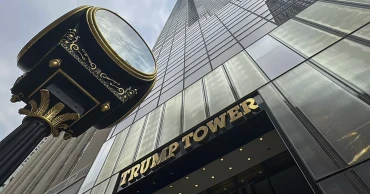
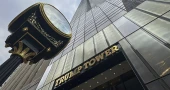
Vietnam approves Trump Organization's $1.5 billion golf, real estate project
Vietnam has approved a $1.5 billion proposal by the Trump Organization and its Vietnamese partner to build golf courses, hotels and real estate projects in the Southeast Asian country, state-run media reported Friday.
The project spanning 990 hectares (2,446 acres) in northern Vietnam's Khoai Chau district will include a golf course the size 336 American football fields, residential areas, commercial spaces and parks. The decision approving the investment was signed by Deputy Prime Minister Tran Hong Ha, the VN Express newspaper reported.
Vietnam is heading into negotiations with the U.S. in a bid to avoid the 46% tariffs on its exports announced by President Donald Trump's administration. Vietnam also has been facing heat from Washington for not doing enough to prevent the diversion of Chinese goods through its borde
The investment project was announced by Vietnamese real estate developer Kinhbac City, which partnered with Trump’s family business in October.
Work on the project will start this year and continue till 2029.
The Trump Organization did not immediately respond to a request for comment Friday.
1 year ago
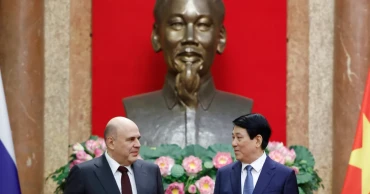
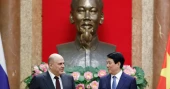
Russia will help Vietnam to join BRICS bloc of developing nations
Russia will facilitate Vietnam's participation in the BRICS bloc of developing economies as a “partner country,” the countries said in a joint statement on Wednesday after Russian Prime Minister Mikhail Mishustin’s two-day visit to Hanoi.
“The Russian side welcomed Vietnam’s active participation in BRICS events in 2024 and expressed its readiness to create favorable conditions if Vietnam joins BRICS as a partner country,” the statement said, AP reports.
BRICS was formed by Brazil, Russia, India and China in 2009, with South Africa added in 2010, as a counterweight to the Group of Seven leading industrialized nations. Last year, the bloc added Iran, Egypt, Ethiopia and the United Arab Emirates. Saudi Arabia has been invited to join. Turkey, Azerbaijan and Malaysia have formally applied to become members, and a few others have expressed interest.
Vietnam's Southeast Asian neighbor Indonesia was admitted as a full BRICS member this month.
Russia forms an emergency task force over oil spill
But Vietnam remains reticent to join the bloc, said Nguyen Khac Giang, a visiting fellow in the Vietnam Studies Program at Singapore’s ISEAS–Yusof Ishak Institute.
“Hanoi is still cautious of what the Trump administration will think about BRICS and the potential consequences of becoming a full member in the worst-case scenario. Meanwhile, the benefits are not that substantial for Hanoi to take such a risk,” he said.
Vietnam needs support from the US to advance its economic ambitions and diversify its defense ties.
Russia has been trying to bolster ties in Asia to offset its growing international isolation over its war in Ukraine.
NKorean troops in Ukraine gain battlefield experience, cementing alliance with Russia
During Mishustin’s visit to Hanoi, the countries agreed to expand their cooperation on nuclear power.
“Russia is ready to participate in building a national nuclear power industry in Vietnam,” the joint statement said.
1 year ago
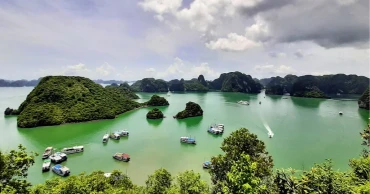
Discover Ha Long Bay: Your Ultimate Travel Guide to Vietnam’s Natural Wonder
Vietnam's Ha Long Bay, a mesmerizing natural wonder and UNESCO World Heritage Site, is a paradise for travelers. Known for its emerald-green waters, dramatic limestone islands, and lush landscapes, this iconic destination offers unforgettable experiences for nature enthusiasts and adventure seekers alike.
Location, Significance, and History of Name
Ha Long Bay is situated in northeastern Vietnam, stretching across Quang Ninh Province and covering an area of about 1,553 km², including nearly 2,000 limestone islets. Administratively, it spans Ha Long City, Cam Pha City, and Van Don District. Recognized as a UNESCO World Heritage Site, the bay is famed for its breathtaking limestone karst formations and unique biodiversity.
"Ha Long" translates to "Descending Dragon," rooted in Vietnamese legend. According to folklore, dragons descended from heaven to aid the Vietnamese in defending their land by spitting jewels that formed the bay's islands.
The bay’s mythical and geological allure has fascinated people for centuries. Historically, it was referred to by names like An Bang and Luc Thuy. Its name emerged in the 19th century, appearing on French maritime maps, and has since become synonymous with natural beauty and cultural significance.
Read more: Trip to Bali: A Comprehensive Travel Guide
Top Places to Visit in Ha Long Bay
.
Bai Chay Beach
Bai Chay Beach is a bustling seaside destination offering soft golden sands, calm azure waters, and a vibrant atmosphere. Perfect for relaxation and water activities, this beach is ideal for swimming, jet-skiing, and sunbathing.
Nearby, you will find numerous restaurants and entertainment venues catering to tourists. In the evenings, the beach comes alive with colorful lights and street performances, making it a lively spot for visitors of all ages to enjoy.
Read more: Shopping in Hong Kong: What to Buy, Where to Buy from
Thien Cung Cave (Heavenly Palace Cave)
Thien Cung Cave is an awe-inspiring natural wonder, renowned for its intricate stalactites and stalagmites. Covering 10,000 square meters, the cave features fantastical formations illuminated by colorful lights, creating a magical ambiance.
1 year ago

China's Premier Li talks trade in Vietnam despite differences over South China Sea
China agreed Sunday to assist Vietnam on cross-border railway development and take steps to expand agricultural imports from its smaller neighbor, Vietnam’s official media said.
Premier Li Qiang, on an official visit to Vietnam, pledged that China would further open its market to high-quality fruits, seafood and other Vietnamese products, a state media report said.
China is Vietnam’s largest trading partner and second-largest export market after the U.S. Trade between the two countries reached $172 billion in 2023. Vietnam’s top leader, To Lam, signaled the importance of the relationship when he made China his first overseas visit after assuming his post last year.
Li came to Vietnam from neighboring Laos, where he had pushed back against calls at a meeting of Southeast Asian leaders to respect international law in territorial disputes in the South China Sea.
China looking forward to work closely with Bangladesh: Envoy
Vietnamese Prime Minister Pham Minh Chinh told Li that both sides should respect each other’s legitimate rights and interests, resolve disputes through peaceful means and properly address issues related to fishers and their vessels, the state media report said.
Vietnam condemned China two weeks ago for what it described as an assault by Chinese law enforcement personnel that injured several Vietnamese fishers near the Paracel Islands in the South China Sea.
The islands have been under the de facto control of China since 1974, when Beijing seized them from Vietnam in a brief but violent naval conflict.
U.S. Secretary of State Antony Blinken told the Southeast Asian leaders gathered in Laos last week that the U.S. is concerned about China’s “increasingly dangerous and unlawful” activities in the South China Sea, which Beijing claims virtually in its entirety.
In their talks on Sunday, Chinh and Li agreed to deepen exchange and cooperation in diplomacy, national defense and public security, the state media report said.
They also witnessed the exchange of 10 cooperation agreements, including the establishment of a working group to develop cross-border economic cooperation zones and the implementation of QR-code, cross-border payment services.
The railway agreements covered a technical plan and feasibility studies to improve train connectivity between Vietnam and China.
On trade, Chinh asked for greater access for a range of products including tropical fruits, meat products, farm-raised spiny lobster and plant-based traditional medicines.
Li said that China stands ready to resolve trade issues and work with Vietnam on quarantine and customs procedures, according to the Vietnamese report.
2 years ago