Deer poaching

Tigers return but hunger lurks in Sundarbans
The recent rescue of a Royal Bengal Tiger after it was caught in a deer snare has once again drawn attention to rampant poaching and the widespread use of deadly traps deep inside the Sundarbans, posing a growing threat to the forest’s apex predator.
On January 4, the Forest Department rescued an injured tiger after it became ensnared in a deer trap in the Chandpai range. The animal is currently undergoing treatment at the Khulna Wildlife Rescue and Rehabilitation Centre.
Although the increased movement of tigers of all ages in Sharankhola and Chandpai ranges of the Sundarbans has sparked optimism among wildlife experts. Yet this hopeful picture is shadowed by a growing crisis: a sharp decline in deer, the tiger’s primary prey.
The mangrove forest is once again showing signs of revival, with the number of Royal Bengal Tigers rising over the past six years.
The latest Forest Department survey in 2024 recorded 125 adult tigers, marking an almost 10 percent increase compared to 2018 and a 17.92 percent rise since 2015.
Announcing the tiger 2024 survey result EnvironmentAdviser Syeda Rizwana Hasan at a press conference said the tiger population density in the Sundarbans is now 2.64 tigers per 100 square kilometres.
Rampant deer poaching, especially during new moon and full moon nights, is eroding the very food base that sustains the apex predator of the Sundarbans.
Experts say about 80 percent of a tiger’s diet comes from spotted deer while the remaining 20 percent consists of wild boar, jungle cats and monkeys.
The widespread and regular hunting of deer has severely reduced prey availability in the forest.Wildlife specialists warn that if this trend continues, the gains made in tiger conservation could be reversed.
Nirmal Kumar Pal, forest officer of the Wildlife and Nature Conservation Division in Khulna, confirmed increased tiger movement in the Chandpai and Sharankhola ranges.
To Save Tigers in Bangladesh, Deer Farming Must End
“Eighty percent of a tiger’s food comes from deer with the rest from wild boar, jungle cats and monkeys,” he said, underscoring the link between prey decline and tiger behaviour.
Silent Traps in Deep Forests
Poachers are increasingly using leaf traps and sedative tablets deep inside the forest to hunt deer.
As a result, the Chandpai, Sharankhola, Satkhira and Khulna ranges are experiencing an acute prey shortage.
According to wildlife experts a fully grown tiger needs at least 50 to 60 kilograms of meat per week and when food becomes scarce, tigers are more likely to cross rivers and canals and stray into human settlements, increasing the risk of conflict.
The publication Sundarban notes that according to a 2023 survey, the forest had 131,604 spotted deer.
Conservationists said this number is already below what is required to sustainably support the growing tiger population.
Thousands of Traps Seized
Forest Department records reveal the scale of the challenge.
From May to December last year alone, the Sundarbans East Forest Division recovered more than 61,400 traps of various kinds. In the western division, officials seized 3,148 feet of traps over the past two years.
During the same period, authorities recovered 1,148 kilograms of deer meat from poachers. A total of 72 cases were filed naming 192 accused.
Farewell to our Friend of Tigers, Dutch ambassador Andre Carstens
Rezaual Karim Chowdhury, divisional forest officer of the Sundarbans East Division, said areas such as Bishwaspara, Charduani, Gangpara and Sharankhola in Patharghata upazila saw comparatively higher numbers of seized traps.
“Similarly, large quantities of traps have been recovered from Kalabagi and Baniakhali under the Sundarbans West Division,” he added.
A Threat Recognised, But Unresolved
Professor MA Aziz of Jahangirnagar University’s Department of Zoology and a noted tiger expert warned that leaf traps pose a major threat not only to deer but also to tigers themselves. “This issue is clearly mentioned in the Tiger Action Plan (2018–2027),” he said.
He noted that deer hunting has become a secondary source of income for many forest-dependent people.
“Demand for deer meat in local markets rises during new moon and full moon nights, leading to increased poaching,” he said, adding, “The forest no longer has the number of deer it needs. At the same time, tigers risk losing limbs or even their lives after getting caught in traps.”
As the number of tiger inches upward, experts stress that protecting prey species is now the most urgent task.
Without ensuring a healthy deer population, they warn, the Sundarbans’ fragile success story could quickly turn into another conservation setback where more tigers roam the forest, but with too little food to survive.
8 months ago
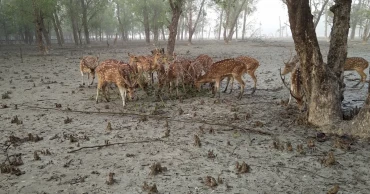
Poaching surge threatens deer population in Sundarbans
In the heart of the Sundarbans, where diverse wildlife roam freely, a silent crisis is unfolding — a disturbing surge in illegal deer poaching is sweeping across the world’s largest mangrove forest and Unesco World Heritage Site.
In the past three months alone, Forest Department officials and the Coast Guard personnel have recovered 641 kilogrammes of venison and detained 22 people involved in poaching operations across various areas, according to officials.
Wildlife experts and local residents are alarmed, warning that this unchecked poaching could severely disrupt the Sundarbans' delicate ecological balance — potentially leading to the disappearance of its iconic Royal Bengal Tigers, which depend heavily on deer as their primary food source.
However, the poaching rings — sophisticated and persistent — show no signs of slowing down.
According to data provided by the Eastern and Western Divisions of the Sundarbans Forest Department and the Mongla Coast Guard West Zone, several joint operations were conducted between January and March.
These efforts led to the seizure of a slaughtered deer, another dead deer, two hides, two heads, eight legs, 160 traps, four trawlers, five boats, a microbus, seven mobile phones, and the arrest of 22 individuals.
Deer poaching in Sundarbans rising at alarming rate amid lax monitoring
So far, 25 separate cases have been filed.
Despite periodic crackdowns, organised poaching rings continue unabated.
Poachers typically enter the forest illegally, set traps or use poisonous bait to capture spotted deer, slaughter them on site and then transport the meat to nearby villages for sale.
Venison is reportedly sold for Tk 1,000 to Tk 1,200 per kilogramme in both local and distant markets, including capital Dhaka, over 250 kilometres away.
Local voices echo the alarm.
Jamal Gazi, a fisherman and community patrol group (CPG) member from Sharankhola upazila, claims that nearly 100 active deer poachers operate in the area, often under the protection of influential figures.
Gazi, a long-time advocate for forest conservation, says he has received threats for his stance.
“Despite our appeals, the poaching continues. We are risking our lives to save the forest, but they [poachers] are well-organised and well-connected," he said.
“Poachers don’t need to invest to obtain deer — they enter the forest, kill the animals, and sell the meat for a significant profit. That’s why they are increasingly motivated,” said Dr Anwarul Islam, wildlife expert and Chief Executive Officer (CEO) of WildTeam.
“The deer is the tiger’s primary food source. If deer vanish from the Sundarbans, so will the tiger,” he warned.
Forest officials said surveillance and patrols are being stepped up, particularly in high-risk zones such as Dacope, Chandpai, Sharankhola and Mongla.
Kazi Muhammad Nurul Karim, Divisional Forest Officer (DFO) of the Eastern Sundarbans, stated that patrols have been intensified and no compromise will be made with anyone found colluding with poachers.
DFO AZM Hasanur Rahman of the Western Division admitted the challenges persist.
“We’re conducting regular operations and inspecting suspicious trawlers and boats at various forest points,” he said, noting that his division alone had seized 255 kilogrammes of venison and recovered both a slaughtered and a dead deer in the past three months.
'Festival of poaching' endangers bird life in Bagerhat beel
Residents and wildlife experts are calling for a multipronged strategy to address the crisis.
This includes stricter enforcement of wildlife protection laws, stronger political will, public awareness campaigns, and rehabilitation schemes offering alternative livelihoods to former poachers.
“We must involve local communities in conservation efforts. People need to realise that deer are tiger food — not human food. Without reducing demand, we cannot cut off supply,” said Dr Anwarul Islam.
He emphasised the need for a national awareness campaign with a clear message: “Say No to Venison.”
The Sundarbans — spanning 6,017 square kilometres, including 4,143 square kilometres of land and 1,873 square kilometres of water — is home to an estimated 136,604 spotted deer and 125 Royal Bengal Tigers.
As poaching networks grow more sophisticated, officials and conservationists fear time is running out — for the deer, for the tigers, and for the Sundarbans itself.
With additional support from Julfekar Dehan.
1 year ago

Poaching the Sundarbans spotted deer: Undaunted by pandemic
Poaching of the famed spotted deer has by now become a fixture violating the Sundarbans ecosystem, beyond the reach of state-led, often multilateral initiatives to clamp down on this transnational criminal enterprise.
6 years ago

30 kg deer meat, two heads seized in Bagerhat
Forest Department officials in a drive seized 30kg deer meat, eight legs of deer and two heads from two boats at Charakhali canal in Sundarbans east zone in Mongla upazila on Sunday.
6 years ago