BRICS Summit
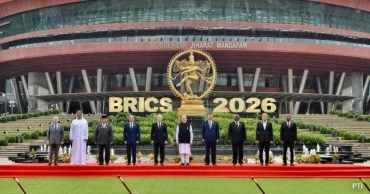
BRICS leaders voice concern over Middle East, condemn unilateral sanctions
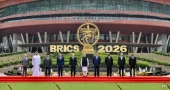
BRICS leaders on Saturday expressed concern over escalating tensions in the Middle East and condemned unilateral sanctions not authorized by the UN Security Council.
The leaders, including Iranian President Masoud Pezeshkian, voiced concern over “deliberate attacks” on civilian infrastructure and peaceful nuclear facilities under UN safeguards, stressing that nuclear safety and security must be protected during armed conflicts.
The joint statement called for the elimination of such sanctions, saying they undermine international law and the principles of the UN Charter.
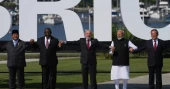
The summit, hosted by India, brought together Russian President Vladimir Putin, Chinese President Xi Jinping, Pezeshkian and leaders of the other BRICS members.
Indian Prime Minister Narendra Modi said BRICS “is not against anyone” and called for turning the bloc’s unity into concrete outcomes. He also proposed a BRICS seafarers’ network to improve the safety and welfare of maritime workers amid disruptions to maritime trade.
Putin called for expanding the UN Security Council to give greater representation to Asia, Africa and Latin America, while Xi said China would work with BRICS members to promote peace in the Middle East.
India also used the summit to seek better ties with China. Modi and Xi met on the sidelines, with Xi calling for a “strategic and long-term” approach to bilateral relations. Modi stressed that peace along the disputed border was essential for broader ties.
The conflicts in Ukraine and the Middle East, along with US-China tensions, have tested BRICS’ ability to maintain unity among members with differing geopolitical interests.
28 days ago
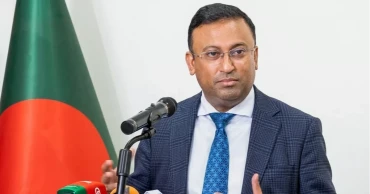
No scope for Bangladesh to join BRICS Summit; PM wasn’t invited: Humaiun Kobir
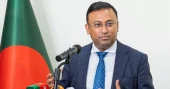
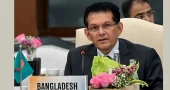
State Minister for Foreign Affairs Humaiun Kobir on Thursday said there is no scope for Bangladesh to send a government representative to the BRICS Summit, as Prime Minister Tarique Rahman was not invited to the summit and the invitation was instead extended to the BIMSTEC Chair.
“How shall we go? Has anyone from the Bangladesh government been invited? Our Prime Minister was not invited. Who told you that our Prime Minister was invited? The BIMSTEC Chair was invited. Then why are you asking this question?” he told reporters, ruling out the possibility of Prime Minister Tarique Rahman attending the BRICS Summit.
Responding to a question at the Foreign Service Academy, Kobir said Prime Minister Tarique Rahman’s first visit to India cannot be a multilateral visit.
He said the government is working on arranging a bilateral visit to India when the timing is conducive, stressing that Bangladesh is placing greater emphasis on a bilateral visit by the Prime Minister and discussions.
Kobir said such a bilateral visit will take place when the environment is conducive and mutual respect is maintained. “There is no need to rush things.”
Responding to a question about the renewal of the Ganges Water Treaty, the State Minister said, “Wherever our national interest is involved, we will act with importance and competence. We will prioritise the interests and well-being of our country.”
In April 2025, Bangladesh assumed the chairmanship of the regional grouping - Bay of Bengal Initiative for Multi-Sectoral Technical and Economic Cooperation (BIMSTEC) - for the next two years, reaffirming its commitment to advancing regional cooperation and development.
BIMSTEC consists of seven member countries, namely Bangladesh, Bhutan, India, Myanmar, Nepal, Sri Lanka and Thailand.
On August 4, India confirmed that an invitation had been extended to Prime Minister Tarique to attend the BRICS Summit as the BIMSTEC Chair, while a separate bilateral invitation has been in place since February this year.
“You would be aware that a formal invitation to Bangladesh Prime Minister Tarique Rahman to visit India was extended when he assumed office in February 2026,” said Ministry of External Affairs (MEA) Spokesperson Randhir Jaiswal during a media briefing in New Delhi recently.
As far as the BRICS Summit is concerned, he said India has separately extended an invitation to the Bangladesh Prime Minister in his capacity as the current Chair of BIMSTEC to attend the outreach session of the 18th BRICS Summit in New Delhi.
“The invitation has been extended as per the standard practice being followed in BRICS for the outreach sessions. Other heads of regional groups have also been invited in a similar manner,” the MEA spokesperson said.
BRICS member states and United Nations Secretary-General António Guterres will attend the 18th BRICS Summit to be held in New Delhi, India, on September 12-13.
The United Nations in India confirmed his participation in a post on its verified Facebook page on Wednesday.
As BRICS Chair 2026, India will host the 18th BRICS Summit at Bharat Mandapam in New Delhi.
The Summit will bring together leaders of BRICS member and partner countries, as well as outreach invitees.
India’s BRICS Chairship is guided by the theme: “Building for Resilience, Innovation, Cooperation and Sustainability,” reflecting Prime Minister Narendra Modi’s vision of a people-centric approach rooted in the spirit of “Humanity First.”
In addition to these areas, the leaders will exchange views on strengthening intra-BRICS cooperation on common priorities and share perspectives on global and regional matters of mutual importance.
Under India’s Chairship this year, over 350 meetings and high-level engagements have been held in over 25 cities across India to further strengthen the BRICS strategic partnership across three fundamental pillars: political and security, economic and financial, and cultural and people-to-people exchanges, said the host country.
Through these engagements, as well as business-to-business and people-to-people initiatives, India’s BRICS Chairship has contributed to advancing BRICS cooperation through practical and development-oriented outcomes.
India is a founding member of BRICS and has previously held its Chairship three times, in 2012, 2016 and 2021. India assumed its fourth BRICS Chairship on January 1, 2026.
The year 2026 also marks a significant milestone as BRICS completes 20 years since its establishment.
1 month ago
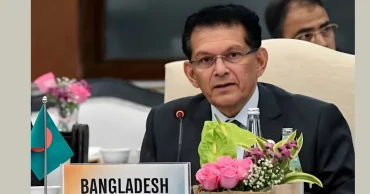
BRICS Summit: No decision yet on PM's India visit
Foreign Minister Dr Khalilur Rahman on Monday said the government has not yet decided whether Prime Minister Tarique Rahman will attend the BRICS Summit's outreach session in New Delhi next month.
He also urged the media to understand the difference between the two separate invitations from the Indian side.
“First of all, I am not an astrologer. So, I cannot predict on which exact day it will happen. Secondly, the BIMSTEC invitation was not extended to the prime minister personally. It was addressed to the chairperson of BIMSTEC,” he told reporters at the Ministry of Foreign Affairs.
Dr Khalilur was briefing reporters after Indian High Commissioner to Bangladesh Dinesh Trivedi paid a courtesy call on the Prime Minister at the Secretariat.
The Foreign Minister said Bangladesh had received two invitations from India - one from Indian Prime Minister Narendra Modi for a bilateral visit and another for the BIMSTEC chairperson to attend the BRICS Summit.
During the courtesy meeting with the Prime Minister, the High Commissioner conveyed greetings from Prime Minister of India Narendra Modi and the intent to work together with the government and people of Bangladesh in a positive, constructive and forward-looking manner.
They exchanged views on matters of mutual interest and discussed avenues for further strengthening bilateral relations between India and Bangladesh with a people-centric approach.
The High Commissioner also paid a courtesy call on Home Minister Salahuddin Ahmed.
The discussions focused on furthering bilateral relations and covered areas of common interest, including security cooperation between the two countries.
The High Commissioner conveyed India's willingness to strengthen people-centric cooperation in all domains, based on mutual interest, mutual benefit and mutual sensitivities.
On August 4, India confirmed that an invitation had been extended to Prime Minister Tarique to attend the BRICS Summit as the BIMSTEC Chair, while a separate bilateral invitation has been in place since February this year.
India will host the 18th BRICS Summit in New Delhi on September 12-13, focusing on global cooperation, trade and sustainable development.
"You would be aware that a formal invitation to Bangladesh Prime Minister Tarique Rahman to visit India was extended when he assumed office in February 2026," said Ministry of External Affairs (MEA) Spokesperson Randhir Jaiswal during a media briefing in New Delhi recently.
As far as the BRICS Summit is concerned, he said India has separately extended an invitation to the Bangladesh Prime Minister in his capacity as the current Chair of the Bay of Bengal Initiative for Multi-Sectoral Technical and Economic Cooperation (BIMSTEC) to attend the outreach session of the 18th BRICS Summit in New Delhi.
"The invitation has been extended as per the standard practice being followed in BRICS for the outreach sessions. Other heads of regional groups have also been invited in a similar manner," the MEA spokesperson said.
BIMSTEC comprises seven countries in the Bay of Bengal region - Bangladesh, Bhutan, India, Myanmar, Nepal, Sri Lanka and Thailand.
In April last year, Bangladesh assumed the chairmanship of the regional grouping for the next two years, reaffirming its commitment to advancing regional cooperation and development.
2 months ago
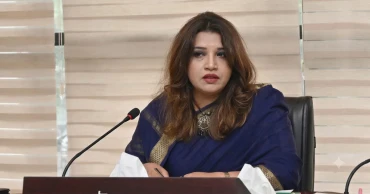
India invites PM Tarique to attend BRICS Summit
India, which is going to host the 18th BRICS Summit in New Delhi on September 12-13, has invited Prime Minister Tarique Rahman to attend the important event that will focus on global cooperation, trade, and sustainable development.
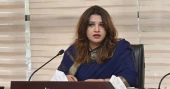
Talking to reporters at the Ministry of Foreign Affairs on Thursday, State Minister for Foreign Affairs Shama Obaed Islam said the Ministry of Foreign Affairs received the invitation letter from the Indian side and forwarded it to the Prime Minister's Office (PMO).
Responding to a question, the State Minister said Bangladesh, as a democratic state with a democratically elected government, wants to see peace and stability in the region.
“This is our position, and we want peace and stability to be maintained in our region,” she said.
The State Minister said they expect India, as a large democratic state with a democratic government, will look into its people’s issues and will move towards a solution.
India's BRICS chairship is guided by the theme "Building for Resilience, Innovation, Cooperation and Sustainability," reflecting a people-centric and humanity-first approach articulated by Indian Prime Minister Narendra Modi at the 2025 Rio Summit.
The 17th BRICS Summit was held on July 6-7, 2025, in Rio de Janeiro, Brazil, under the theme "Strengthening Global South Cooperation for a More Inclusive and Sustainable Governance."
BRICS member countries are Brazil, China, Egypt, Ethiopia, India, Indonesia, Iran, Russia, Saudi Arabia, South Africa, and the UAE, while partner countries are Belarus, Bolivia, Cuba, Kazakhstan, Malaysia, Nigeria, Thailand, Uganda, Uzbekistan, and Vietnam.
The BRICS agenda has expanded considerably from its initial focus on economic issues of mutual concern and is structured around three core pillars - political and security; economy and finance; and cultural and people-to-people exchanges.
BRICS cooperation continues to broaden its scope across a wide range of global issues, including the fight against terrorism, climate change, food and energy security, the international economic and financial situation, telecommunications, agriculture, labour and employment, international financial architecture, trade, and the WTO.
Responding to another question, Shama Obaed said the Foreign Ministry does not yet have any specific information about the phone call between President Mohammed Shahabuddin and convicted former Prime Minister Sheikh Hasina during a recent foreign visit.
However, if any information comes, the government will definitely investigate the matter, she said.
There is speculation that President Shahabuddin may resign before August 5, citing physical illness as the reason.
Asked about the international acceptance of Bangladeshi passports and visa complications in various countries, Shama Obaed said there has been no downgrading of Bangladeshi passports.
“We have formed the government only four and a half months ago. There were visa-related problems even before that," she said.
Shama Obaed said visas are closed for Bangladeshi workers in some countries, especially the United Arab Emirates and Malaysia, and the Ministry of Foreign Affairs has held several meetings with the Ministry of Home Affairs and the Ministry of Expatriates' Welfare to resolve this issue.
Many Bangladeshis try to go abroad through illegal means instead of legal channels, using fake documents obtained through brokers, and the government is dealing with these problems seriously.
The government is in regular contact with the relevant countries to resolve the visa-related problems of Bangladeshis in various countries.
2 months ago
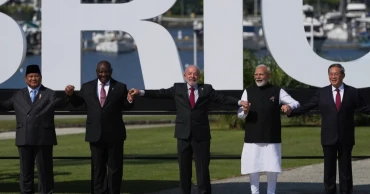
BRICS summit overshadowed by Middle East tensions, condemns tariffs
The BRICS group of developing nations on Sunday condemned rising global tariffs and military attacks on Iran but stopped short of naming US President Donald Trump or directly criticizing member states like Russia. The group’s joint declaration also condemned Israel's military actions in the Middle East while mentioning the ongoing war in Ukraine only once.
The two-day summit, hosted in Rio de Janeiro, was overshadowed by the absence of key leaders. Chinese President Xi Jinping skipped a BRICS summit for the first time since taking power in 2012. Russian President Vladimir Putin addressed the meeting via videoconference, continuing to limit his international travel due to an arrest warrant related to Russia's invasion of Ukraine.
In an apparent swipe at the US, the group expressed “serious concerns” over tariff hikes, stating they are “inconsistent with WTO (World Trade Organization) rules” and could “threaten reduce global trade, disrupt global supply chains, and introduce uncertainty.”
Responding on his social media platform, Trump warned of new tariffs, saying any nation aligning with “the Anti-American policies of BRICS” would face an additional 10% tariff.
Brazilian President Luiz Inácio Lula da Silva, hosting the summit, criticized NATO's plan to raise military spending to 5% of GDP by 2035 — a position later reflected in the BRICS declaration.
“It is always easier to invest in war than in peace,” Lula said at the summit’s opening session, which continues Monday.
Iranian presence and condemnation of Middle East violence
Iranian President Masoud Pezeshkian, expected to attend, stayed away following last month’s attacks on Iran. His foreign minister, Abbas Araghchi, represented the country instead.
The BRICS declaration condemned the attacks on Iran but avoided mentioning the US or Israel, the countries believed to have carried them out.
In his address, Araghchi urged BRICS leaders to push for strong international condemnation of Israel. He also called for accountability from Israel and the US for alleged human rights violations.
“The aftermath of the war will not be limited to one country,” Araghchi warned. “The entire region and beyond will be damaged.”
BRICS leaders voiced “grave concern” over the humanitarian crisis in Gaza, called for the release of hostages, and urged a return to negotiations in support of a two-state solution.
However, in a later statement on Telegram, Araghchi expressed Iran’s reservations about the two-state proposal, saying it “will not work, just as it has not worked in the past.”
Separately, Russia's foreign ministry used Telegram to name the US and Israel directly, condemning their “unprovoked military strikes” against Iran.
Russia spared criticism, Ukraine mentioned once
Despite Russia’s role in the Ukraine conflict, the BRICS declaration mentioned Ukraine only once, while condemning “in the strongest terms” recent Ukrainian attacks on Russian territory.
“We recall our national positions concerning the conflict in Ukraine as expressed in the appropriate fora, including the U.N. Security Council and the U.N. General Assembly,” the declaration said.
João Alfredo Nyegray, an international business and geopolitics professor at the Pontifical Catholic University in Parana, said BRICS missed an opportunity to present itself as a unified alternative to global instability.
BRICS summit opens in Brazil amid Trump tariff concerns
“The withdrawal of Egypt’s President Abdel Fattah al-Sisi and the uncertainty about the level of representation for countries like Iran, Saudi Arabia, and the UAE are confirming the difficulty for the BRICS to establish themselves as a cohesive pole of global leadership,” Nyegray said. “This moment demands high-level articulation, but we are actually seeing dispersion.”
Trump tariffs loom as Brazil treads carefully
While Lula advocated for reform of global institutions, Brazil avoided provocative topics to shield its economy from Trump’s threats of higher tariffs.
Trump has already warned of 100% tariffs on BRICS nations if they attempt to undermine the US dollar. At last year’s BRICS summit hosted by Russia, the Kremlin pushed for alternatives to US-controlled payment systems to bypass sanctions imposed after the invasion of Ukraine in 2022.
Brazil deliberately steered the summit toward less controversial topics like boosting trade among members and global health cooperation, according to Ana Garcia, a professor at the Federal Rural University of Rio de Janeiro.
“Brazil wants the least amount of damage possible and to avoid drawing the attention of the Trump administration to prevent any type of risk to the Brazilian economy,” Garcia explained.
Expansion and divisions within BRICS
Founded by Brazil, Russia, India, China, and South Africa, BRICS expanded last year to include Indonesia, Iran, Egypt, Ethiopia, and the United Arab Emirates.
The group also created a new “strategic partner” category that includes Belarus, Cuba, and Vietnam.
Brazil placed institutional development on the summit agenda to integrate new members and strengthen internal unity.
Despite internal challenges, the summit remains significant for member states, particularly amid global tensions and Trump’s tariff policies, said Bruce Scheidl, a researcher with the University of Sao Paulo’s BRICS study group.
“The summit offers the best opportunity for emerging countries to respond, in the sense of seeking alternatives and diversifying their economic partnerships,” Scheidl said.
Protests and domestic backdrop
Earlier Sunday, a pro-Israel group staged a protest on Rio’s Ipanema beach by placing dozens of rainbow flags, criticizing Iran's policies toward LGBT+ individuals. On Saturday, Amnesty International protested Brazil’s plans for offshore oil exploration near the Amazon River’s mouth.
For Lula, the summit also provided a temporary respite from domestic political challenges, including declining popularity and tensions with Congress.
The event served as a platform to advance environmental protection commitments ahead of November’s COP 30 climate talks in the Amazonian city of Belém.
1 year ago
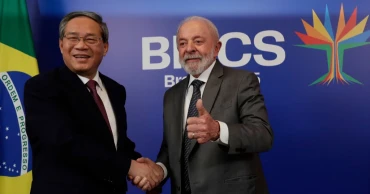
BRICS summit opens in Brazil amid Trump tariff concerns
Brazil is hosting a two-day summit of the BRICS bloc of developing economies, where topics like Israel’s attack on Iran, the humanitarian crisis in Gaza, and U.S. President Donald Trump’s trade tariffs are expected to be addressed cautiously.
Analysts say the lack of unity within the expanded BRICS, which doubled its membership last year, could limit its ability to emerge as a powerful alternative in global affairs. They also believe the summit’s moderate agenda reflects an effort to avoid drawing unwanted attention from Trump’s administration.
Brazilian President Luiz Inácio Lula da Silva has placed issues such as artificial intelligence and climate change at the center of the summit, though several key leaders are absent.
In his opening speech on Sunday, Lula warned, “We are witnessing the unparalleled collapse of multilateralism,” adding that the meeting is taking place “in the most adverse global scenario” of all four times Brazil has hosted the summit. He called on BRICS nations to promote peace and mediate conflicts.
“If international governance does not reflect the new multipolar reality of the 21st century, it is up to the BRICS to contribute to its renovation,” Lula said.
Notably absent from the summit is China’s President Xi Jinping, marking the first BRICS summit he has missed since taking power in 2012. Russian President Vladimir Putin is also absent but will join via videoconference, avoiding travel due to an international arrest warrant related to the invasion of Ukraine. Iran’s President Masoud Pezeshkian and Egypt’s Abdel-Fattah el-Sissi are also missing from the gathering in Rio de Janeiro.
Three joint statements expected
This year’s restrained approach marks a sharp contrast with last year’s summit in Kazan, Russia, where the Kremlin pushed to develop alternatives to U.S.-dominated financial systems to bypass Western sanctions following the Ukraine invasion.
A source familiar with the summit’s negotiations said some members are pushing for stronger language regarding Gaza and Israel’s attack on Iran. The source requested anonymity as they were not authorized to discuss the talks publicly.
“Brazil wants to keep the summit as technical as possible,” said Oliver Stuenkel, a professor at the Getulio Vargas Foundation think tank.
Observers now expect only a vague final declaration on Russia’s war in Ukraine and other Middle East conflicts. According to Stuenkel, the absence of Putin and Xi, who have advocated for a stronger anti-Western stance, makes it easier for Brazil and India to steer the summit toward non-alignment.
A Brazilian government official told The Associated Press that the summit is expected to produce three joint statements and a final declaration, “all of which less bounded by current geopolitical tensions.” The official spoke anonymously as they were not authorized to speak publicly.
João Alfredo Nyegray, a geopolitics professor at the Pontifical Catholic University in Parana, noted that the BRICS summit could have presented an alternative to global instability but is unlikely to do so.
“The withdrawal of Egypt’s President Abdel Fattah al-Sisi and the uncertainty about representation from Iran, Saudi Arabia, and the UAE confirm the difficulty for the BRICS to establish themselves as a cohesive global leadership pole,” Nyegray said. “This moment demands high-level articulation, but we are actually seeing dispersion.”
Turkey sends firefighting planes to Syria as raging wildfires devastate border regions
Avoiding Trump’s tariffs
Brazil, which currently chairs the bloc, has set six strategic priorities: global healthcare cooperation; trade, investment, and finance; climate change; governance for artificial intelligence; peace and security; and institutional development.
The country has opted to focus on less controversial areas, such as strengthening trade and health cooperation, especially after Trump’s return to the White House, said Ana Garcia, a professor at the Federal Rural University of Rio de Janeiro.
“Brazil wants the least amount of damage possible and to avoid drawing the attention of the Trump administration to prevent any type of risk to the Brazilian economy,” Garcia explained.
While Lula on Sunday called for reforming Western-led global institutions, a central policy for the bloc, Brazil is eager to avoid becoming a target for Trump’s tariffs — a situation it has so far mostly avoided. Trump has warned he would impose 100% tariffs against the bloc if it takes steps to undermine the U.S. dollar.
‘Best opportunity for emerging countries’
Founded by Brazil, Russia, India, China, and South Africa, the BRICS group expanded last year to include Indonesia, Iran, Egypt, Ethiopia, and the United Arab Emirates. The bloc also created a new category for 10 “strategic partner” countries, including Belarus, Cuba, and Vietnam.
With this rapid expansion, Brazil has placed institutional development on the summit agenda to better integrate new members and improve cohesion.
Despite the absence of key leaders, the summit remains important for emerging economies, especially amid the instability fueled by Trump’s tariff policies, said Bruce Scheidl, a researcher at the University of São Paulo’s BRICS study group.
“The summit offers the best opportunity for emerging countries to respond, in the sense of seeking alternatives and diversifying their economic partnerships,” Scheidl said.
For Lula, the summit provides a temporary respite from domestic political challenges, including falling approval ratings and clashes with Congress.
It also gives Brazil the opportunity to advance climate negotiations ahead of COP 30, the United Nations climate conference scheduled for November in Belém, in the heart of the Amazon.
1 year ago
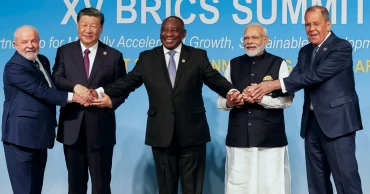
Iran, Saudi Arabia and Egypt are among 6 nations set to join the BRICS economic bloc
Iran and Saudi Arabia are among six nations invited Thursday (August 24, 2023) to join the BRICS bloc of developing economies.
United Arab Emirates, Argentina, Egypt and Ethiopia are also set to join the bloc from 2024.
The announcement was made at the BRICS summit in Johannesburg by South African President Cyril Ramaphosa, whose country is the current BRICS chair.
Also read: China to support Bangladesh in joining BRICS: XI tells Hasina during talks
BRICS is currently made up of the emerging economies of Brazil, Russia, India, China and South Africa. Those five members agreed at this week's summit to expand the bloc.
It's the second time that BRICS has decided to expand. The bloc was formed in 2009 by Brazil, Russia, India and China. South Africa was added in 2010. The BRICS bloc represents around 40% of the world's population and contributes more than a quarter of global GDP.
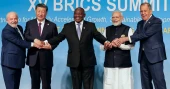
Three of the group's other leaders are attending the summit and were present alongside Ramaphosa for the announcement, including Brazilian President Luiz Inácio Lula da Silva, Indian Prime Minister Narendra Modi and Chinese President Xi Jinping.
Also read: BRICS: China, Russia and other emerging economies turn to main summit agenda in South Africa
Russian President Vladimir Putin did not travel to the summit after the International Criminal Court issued an arrest warrant for him in March for the abduction of children from Ukraine. He has participated in the summit virtually, while Russia was represented at the announcement in Johannesburg by Foreign Minister Sergey Lavrov.
3 years ago

China to support Bangladesh in joining BRICS: XI tells Hasina during talks
China will always stay beside Bangladesh in its needs that included supporting it in joining the BRICS and ensuring permanent solution to the Rohingya crisis.
Chinese President Xi Jinping on Wednesday (August 23, 2023) evening gave the assurance in a bilateral meeting with Bangladesh Prime Minister Sheikh Hasina at the Hotel Hilton Sandton here on the sidelines of the 15th BRICS Summit.
The Chinese president also gave assurance of cooperation in making Bangladesh a developed, prosperous Sonar Bangla and taking initiative to quicken the signing of the Preferential-free Trade Agreement with Bangladesh and reducing the imbalance in China-Bangladesh trade.
Also read: Unhindered democracy spurs Bangladesh’s advancement: PM Hasina
Foreign Minister AK Abdul Momen briefed reporters after the bilateral talks between the two leaders.
During the meeting, he said, both the leaders invited one another to visit their respective countries at their convenient time and they have agreed to this respect.
“I will always support you (Sheikh Hasina) as you can join the BRICS,” Momen quoted the Chinese president as saying l.
Regarding the Rohingya issue, Xi wants to resolve the Rohingya issue through tripartite engagement of China, Bangladesh and Myanmar and assured that they will always support Bangladesh to this end.
Also read: Join our journey of becoming a trillion-dollar economy: PM Hasina tells South African businesses
“China will help Bangladesh in bringing a permanent solution to the Rohingya issue. ---we don’t want instability in the region,” he was quoted as saying by the foreign minister.
Bangladesh prime minister said that her government wants to repatriate Rohingyas to their homeland citing that they are becoming threats for the peace of the region as many of them are engaged in illegal drugs and arms trading.
Also read: PM Hasina reaches Johannesburg to attend BRICS summit
“Peace is imperative for development,” she said.
Xi also expressed his country’s keenness to help Bangladesh in the development of energy, renewable energy and infrastructure.
“China will help you materialise your dream to build a developed and prosperous ‘Sonar Bangla’ at the quickest possible time.”
Hasina also sought the Chinese president’s help in quick implementation of some Chinese funded projects which are now being stuck for fund crisis while the Chinese leader is assured of looking into the matters.
Read more: BRICS Summit 2023 unveils potential geopolitical paradigm shift: Modern Diplomacy
During the talks, the prime inister stressed the need for reducing the trade gap between Bangladesh and China citing that Bangladesh has currently imported Chinese goods worth about 20 billion US dollars every year while China imported Bangladeshi goods worth only 700 million US dollars.
The Chinese president in reply said they must address the issue and said that China has given duty and quota free access to 98 percent Bangladeshi products to the Chinese market.
Hasina said that the trade gap between Bangladesh and China will be reduced if some Chinese investments come to Bangladesh.
She also stressed the need for signing the Preferential Trade Agreement (PTA) between the two countries.
“We will take measures to quicken the signing of the Preferential Trade Agreement between the countries,” Xi said in reply.
Read more: BRICS Summit: Hasina, Modi likely to hold meeting on the sidelines
Momen said that Bangladesh has expressed its eagerness to export fresh fruits such as mango, jackfruit, guava, fresh vegetables and cattle and poultry feeds to China.
The Chinese leader assured them that they must consider it, Momen said.
Bangladesh premier invited the Chinese President to visit Bangladesh to witness the opening of the Padma Rail Bridge to be held in October next.
In reply, the Chinese president said that he will definitely come to Bangladesh.
“But the time of visit will be fixed through talks between foreign ministers of both the countries.”
Read more: 2023 BRICS Summit: Lot of interest in how new members are chosen and which countries would be eligible
Xi Jingping also invited Bangladesh PM to visit China and in reply Sheikh Hasina said she will visit China.
“But it may take time as she will be busy with the election campaign as the national election is knocking the door, the foreign minister said.
Sheikh Hasina urged the Chinese President to widen the scope for Bangladeshi students to study in China while Xi assured of looking into the matter.
Foreign Minister AK Abdul Momen, Prime Minister's Private Industry and Investment Adviser Salman Fazlur Rahman, PM's daughter and Thematic Ambassador of Climate Vulnerable Forum and Chairperson of the National Advisory Committee for Autism and Neurodevelopmental Disorders Saima Wazed, PM's Principal Secretary Md Tofazzel Hossain Miah and Senior Secretary of Foreign Affairs Masud Bin Momen, were present in the meeting.
Read more: Developed countries should be happy that BRICS would like to help developing nations: Momen
3 years ago
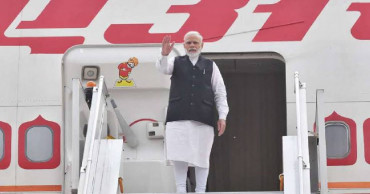
Modi leaves for Brazil to attend BRICS Summit in Brazil
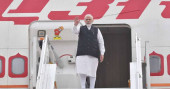
Indian Prime Minister Narendra Modi left for Brazil on Tuesday to attend the 11th BRICS Summit to be held on Nov. 13-14.
6 years ago