Rohingya response
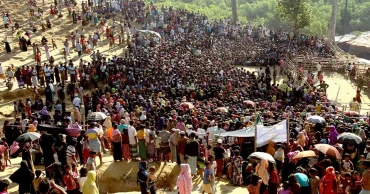
Cutting Rohingya assistance could have severe, costly consequences: UNHCR
UNHCR, the UN Refugee Agency, and humanitarian partners have asked the world not to forget Rohingyas in Bangladesh, noting that maintaining only minimum levels of humanitarian assistance risks generating "more complex, severe and costly" consequences.
"The international community has rallied to support the hyper-prioritized appeal, now 60 per cent funded. Maintaining only minimum levels of humanitarian assistance risks generating more complex, severe and costly consequences," said UNHCR spokesperson Babar Baloch while responding to a question at a press briefing at the Palais des Nations in Geneva.
UN food relief agency steps up aid for Rohingays amid heavy rains
This year, the world will mark nine years since the large-scale forced displacement of Rohingya refugees from Myanmar into Bangladesh.
"With our partners, UNHCR, the UN Refugee Agency, is calling on the international community not to forget the 1.2 million refugees in Bangladesh, most of them in camps in Cox’s Bazar," said the UNHCR spokesperson.
For decades, Rohingya people have been driven from their homes in Myanmar’s Rakhine State, with Bangladesh providing protection to successive movements of refugees since the late seventies.
The largest influx came in August 2017, when some 750,000 Rohingya were forced to flee across the border.
The generous support from Bangladesh and the international community has been critical in meeting their basic needs and providing protection.
Bangladesh is now hosting over 1.3 million Rohingyas in Cox’s Bazar and Bhasan Char.
UNHCR’s call comes amid growing global instability and rising humanitarian pressures, which have forced difficult prioritization and threatened essential services for vulnerable populations.
Last month in Bangladesh, the United Nations and partners, coordinating with the government of Bangladesh, called for renewed international support – appealing for $710.5 million to meet the most urgent needs of Rohingya refugees and local host communities.
Despite growing needs, this hyper-prioritized appeal is 26 per cent less than last year.
Since 2017, humanitarian funding for the Rohingya refugee response has allowed Bangladesh to sustain life-saving assistance and make major progress in refugee education, health and protection.
However, significant humanitarian needs persist and, without continued international solidarity, the plight of Rohingya families will deteriorate, said the UNHCR spokesperson.
Amid sharp reductions in humanitarian and development support, Rohingya refugees remain largely reliant on aid.
"Limited economic opportunities and reduced assistance continue to impact households," said the official, noting that the situation is more acute for vulnerable groups, including women and girls, people with disabilities, and older people, and some 150,000 new arrivals who fled renewed violence in Rakhine State since early 2024.
As targeted violence, persecution and conflict inside Myanmar’s Rakhine State continue, hopes for a return to Myanmar are fading, the UN Agency said.
More refugees are faced with desperate choices, including dangerous and often deadly sea journeys in search of opportunities in the region.
"2025 was the deadliest year on record for such voyages, with nearly 900 Rohingya refugees reported missing or dead in the Andaman Sea and Bay of Bengal," said the UN official.
Against this backdrop, the appeal focuses on the most critical humanitarian needs. Investment in resilience and self-reliance is crucial to preserving dignity and hope and reducing long-term dependence on aid.
Until the conflict and violence stop, the international community must continue to stand in solidarity with refugees from Myanmar, including Rohingya refugees, and their host communities, providing humanitarian assistance and renewing efforts to allow voluntary, safe and dignified return, UNHCR said.
4 months ago

UNHCR's joint response plan to be launched Tuesday
The 2021 Joint Response Plan (JRP) of US$943 million for the Rohingya Humanitarian Crisis will be launched on Tuesday.
The US$943 million plan seeks to meet the needs of more than 880,000 Rohingya refugees and 472,000 Bangladeshis in the surrounding host communities in Cox’s Bazar District.
Most Rohingya refugees, some 740,000, fled violence in Myanmar’s Rakhine State in 2017.
UNHCR, the UN Refugee Agency, has called for renewed international commitment, support and solidarity for Rohingyas ahead of next Tuesday’s donor conference.
It is not clear yet whether Bhasan Char is included under the JRP or not.
The 2021 JRP brings together the efforts of the Government of Bangladesh, and 134 UN agencies and NGO partners to target almost 1.4 million people this year, said UNHCR spokesperson Andrej Mahecic in Geneva recently.
Also read: UNHCR calls for strong global support for Rohingyas
Jointly co-hosted by the Government of Bangladesh, the International Organization for Migration (IOM) and UNHCR, the virtual 2021 JRP launch event will highlight the most immediate needs and ongoing humanitarian response.
The virtual 2021 JRP launch event is scheduled to run from 10:00am to 12:00 pm CEST Geneva (2:00pm – 4:00pm GMT+6 in Dhaka; 3:00pm – 5:00pm GMT+7 in Bangkok) on Tuesday (May 18). The event will be live streamed.
Last year, the United Nations appealed for more than US$1 billion to meet the needs of the Rohingya refugees and host communities in Cox’s Bazar District.
At the end of 2020, this appeal was just 59.4% funded.
"We stress that the international community must not only maintain support for refugees and their hosts, but also adapt to new and emerging needs and pursue the search for durable solutions," said the Spokesperson.
More than 880,000 Rohingya refugees and 472,000 Bangladeshis in the surrounding host communities in Cox’s Bazar District are brought under the plan.
Also read: Don’t worry about Rohingya relocation to Bhasan Char: Dhaka to UNHCR
Most Rohingya refugees, some 740,000, fled violence in Myanmar’s Rakhine State in 2017.
With the refugee crisis in its fourth year, Bangladesh needs robust and sustained international support to ensure the safety and wellbeing of stateless Rohingya refugees, saidMahecic.
This must not become a forgotten crisis. Both Rohingya refugees and Bangladesh, having generously hosted them for decades, must see the world standing with them, said the Spokesperson.
Adding to the complexity of this crisis, the COVID-19 pandemic has compounded vulnerabilities for refugees and host communities alike.
To date, the Government of Bangladesh, with the support of the humanitarian community, has effectively managed the COVID-19 response and the spread of the disease in the Rohingya camps and surrounding areas, though the trajectory of the virus remains unpredictable, UNHCR said.
A coordinated and inclusive response has saved lives. However, it is critical to ensure the continued delivery of all humanitarian assistance and protection services.
Also read: Redouble efforts to find solution to Rohingya crisis: UNHCR
The needs of Rohingya refugees reach beyond subsistence and physical safety. Refugees, like any other people, cannot be allowed to wait for years without access to education and options for a decent life and a meaningful future.
In order to mitigate the risks of people taking dangerous onward journeys, more must be done to ensure that refugees have hope in Bangladesh, and of a future back home in Myanmar.
Otherwise, they may increasingly risk such journeys by land or sea to find a solution elsewhere.
The search for durable solutions must remain focused on the voluntary, safe, dignified and sustainable return of Rohingya refugees to their homes in Myanmar, when conditions allow them to do so.
However, the ongoing crisis and political instability in Myanmar have added new layers of complexity to this challenge.
5 years ago

Rohingya response: Cox's Bazar NGOs for transparency, localisation
Local NGOs working in Cox's Bazar sought transparency and localisation of Rohingya response management ahead of the launching of the Joint Response Plan (JRP) 2021 on May 18.
The $943 million plan brings together the efforts of the government of Bangladesh, and 134 UN agencies and NGO partners, targeting 880,000 Rohingya refugees and 472,000 Bangladeshis in the surrounding host communities in Cox's Bazar, the UN said Friday.
However, opinions of the locals had little reflection in the document prepared by UN agencies, Cox's Bazar CSO NGO Forum said Sunday.
Read Bangladesh to demand 10pc of funds for Rohingyas in Bhasan Char: FM
In the last four years, the Inter Sectoral Coordination Group (ISCG) rarely came up with any statistics on how much fund had gone to host communities, how much had been used for local procurement and the number of local staff employed, Rezaul Karim Chowdhury, co-chair of the CCNF, Rezaul Karim Chowdhury said.
"During the preparation of JRP plan 2021, we provided written comments on behalf of local and national NGO representatives and also organised a virtual webinar on May 5, where lawmakers, local government and UN representatives had participated. But opinions of the locals have little reflection in the document."
"Moreover there is no outline about response management if no repatriation takes place in the next five to 10 years," Rezaul added.
Read EU scales up assistance for fire victims in Cox’s Bazar
He was addressing the conference "Joint Response Plan 2021, Rohingya Response Management and Strategy: Hardly Fit for the Purpose and Futuristic" organised by CCNF.
Bimal Chandra Dey Sarker, chief Executive Mukti Cox's Bazar, said: "The UN agencies prepared the Localization Task Force in 2019 to prepare a localisation road map. The report was finalised and submitted in November 2020, but yet to be published."
Abu Morshed Chowdhury, the co-chair of CCNF, said: "There are three lines of coordination management – ISCG, Refugee Relief and Repatriation Commissioner and Office of the Deputy Commissioner – now. But there should be a single line authority for coordination."
Read Congressman Deutch lauds Hasina's role over Rohingya issue
5 years ago

“Don’t undermine local NGOs in Rohingya response”
Speakers at a conference has the urged the United Nations (UN) not to undermine the local NGOs regarding the humanitarian response to Rohingya camps.
6 years ago