internet shutdown
ISPs threaten service shutdown unless extortionists arrested in 24 hours
Internet service providers (ISPs) on Wednesday warned that countrywide internet services could face disruption if the authorities concerned fail to arrest within the next 24 hours those behind a spate of attacks, vandalism, looting, and extortion targeting ISP offices, network infrastructure and staff.
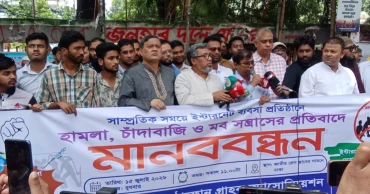
The warning came at a human chain organised by the Bangladesh Mobile Phone Consumers Association (BMPCA) in front of the Jatiya Press Club, protesting the recent wave of attacks on ISP establishments across the country.
Speaking at the programme, Internet Service Providers Association of Bangladesh (ISPAB) President Aminul Hakim said suspects behind an incident in Chattogram remained at large 24 hours after it occurred, leaving ISP owners and employees fearful.
He warned that if the extortionists are not arrested within the next 24 hours, service could collapse on its own as providers struggle to maintain uninterrupted operations.
ISPAB Secretary General Nazmul Karim Bhuiyan said the association's mandate is not street agitation, but that ISPs have been forced onto the streets to demand their own security after extortionists went unarrested despite the presence of law enforcement in Chattogram.
He said a decision on tougher action would be taken if steps are not taken within 24 hours, urging the government not to force them into further programmes.
Speakers at the human chain said the continued attacks, vandalism, looting, land-grabbing and extortion against ISPs are disrupting not only entrepreneurs but the daily lives, education, healthcare, business, freelancing, e-commerce, mobile banking and government digital services of millions of internet subscribers, describing internet connectivity as essential digital infrastructure rather than merely a commercial service.
BMPCA President Mohiuddin Ahmed said deliberately disrupting internet service is a serious offence, and attacks, vandalism, looting, extortion or destruction of networks that deprive the public of internet access should be treated with equal severity.
The human chain placed a five-point- maximum security for internet infrastructure, data centres, fibre optic networks, towers and ISP offices, swift arrest and exemplary punishment under existing law for those involved in attacks, vandalism, looting, land-grabbing and extortion, treating disruption of internet services causing public suffering and digital economic losses as a serious economic and digital offence, with necessary legal action, coordinated security for ISPs involving law enforcement agencies, local administration and the Bangladesh Telecommunication Regulatory Commission (BTRC); and top priority for internet infrastructure security to keep the digital economy, online education, healthcare, e-commerce, mobile banking and government digital services running smoothly.
Speakers urged the government, law enforcement agencies and relevant authorities to take immediate, strict and effective action against the perpetrators and ensure exemplary punishment.
2 months ago
Iranians manage some overseas calls as internet remains cut after protests
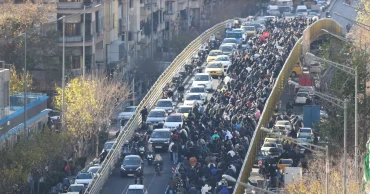
Mobile phones in Iran were able to make some international calls on Tuesday, days after authorities shut down the internet and blocked overseas connections amid a nationwide crackdown on protests.
Several residents in Tehran managed to reach journalists at The Associated Press, though the AP bureau in Dubai said it could not call those numbers back. Iranians said text messaging was still not working, and witnesses reported that internet access remained cut off from the outside world.
Iran imposed the shutdown on Thursday as protests intensified across the country.
US President Donald Trump said Iran wants to negotiate with Washington after he warned of possible military action over Tehran’s handling of the protests. Activists say at least 646 people have been killed during the unrest.
Iranian Foreign Minister Abbas Araghchi told Qatar-based Al Jazeera in an interview aired Monday night that he has continued to communicate with US envoy Steve Witkoff.
The contacts “continued before and after the protests and are still ongoing,” Araghchi said, adding that Washington’s proposals and threats toward Iran are “incompatible.”
White House press secretary Karoline Leavitt said Iran’s public statements differ from the private messages the US administration has received in recent days.
“The president has an interest in exploring those messages,” Leavitt said. “However, the president has also shown he is not afraid to use military options if and when he believes it is necessary, and nobody knows that better than Iran.”
Meanwhile, large pro-government rallies took to the streets on Monday in a show of support for the ruling system after days of protests that directly challenged the leadership of 86-year-old Supreme Leader Ayatollah Ali Khamenei.
Iranian state television broadcast scenes of crowds, appearing to be in the tens of thousands, chanting slogans including “Death to America!” and “Death to Israel!” Others shouted, “Death to the enemies of God!”
What to know about Iran protests as government shuts down internet, phone networks
Iran’s attorney general has warned that anyone taking part in protests will be treated as an “enemy of God,” a charge that carries the death penalty.
8 months ago
Bangladesh’s ICT sector suffered heavy losses for prolonged internet shutdown in 2024
With 2024 nearing its end, one of the year’s most disturbing events remains to be the prolonged internet shutdown during the July mass uprising in Bangladesh, which not only disrupted communication but also caused an estimated loss of Tk 2,000 crore to the nation’s ICT and e-commerce sectors.
The internet shutdown was enforced during the student-led mass movement against the Awami League regime led by former Prime Minister Sheikh Hasina.
The initial disconnection began on July 18 and continued in phases, affecting both mobile and broadband services.
BMCA hails inclusion of internet access as fundamental right
Although broadband internet was restored on July 24 and mobile internet resumed on July 28, social media platforms such as Facebook, YouTube, and TikTok remained inaccessible until July 31.
This period saw a significant blow to Bangladesh’s burgeoning ICT sector. According to the e-Commerce Association of Bangladesh (e-CAB), the first 10 days of the shutdown alone resulted in losses amounting to Tk 1,400 crore.
By the end of the shutdown, the total estimated loss to the e-commerce industry reached Tk 2,000 crore.
The impact extended beyond e-commerce, crippling banks, insurance companies, offices, and airports reliant on internet-based operations. Businesses dependent on digital marketing, content creation, and online transactions faced severe disruptions.
Startups and small-scale digital entrepreneurs were particularly affected, many reporting setbacks from which recovery may take years.
Besides, the decision to restrict access to social media platforms aimed to curb alleged anti-government propaganda. But these actions sparked widespread criticism, both domestically and internationally, for impeding freedom of expression and undermining the digital economy.
Speakers demand recognising internet as fundamental right in Bangladesh
Former ICT State Minister Zunaid Ahmed Palak faced scrutiny for justifying the shutdown with claims of damage to data transmission lines by protesters.
Investigations later revealed no evidence of such incidents, and his statements were dismissed as attempts to deflect criticism.
This extended disconnection has been widely criticised as an unprecedented blow to Bangladesh’s ICT sector, tarnishing its reputation as an emerging digital economy.
Experts have expressed concerns that such measures discourage foreign investment and hinder the sector’s overall growth.
The interim government has since launched an inquiry into the incident, with ICT Advisor Nahid Islam leading efforts to assess the causes and accountability behind the decision. Preliminary findings indicate that the shutdown was implemented under direct orders from the then-Prime Minister.
Internet shutdown was as per Hasina’s directive: Palak
While the internet has long been heralded as a pillar of modern connectivity and economic growth, the 2024 shutdown highlights the fragility of Bangladesh’s digital infrastructure in the face of political crises.
For the ICT sector, rebuilding trust and ensuring uninterrupted services remain paramount to achieving long-term stability.
1 year ago

Internet shutdown was as per Hasina’s directive: Palak
Internet services across the country were shut down during the quota reform movement as per the advice of Sheikh Hasina, said former State Minister for ICT Zunaid Ahmed Palak on Thursday.
Palak revealed this information during an interrogation at the safe house of the International Crimes Tribunal (ICT) investigation agency on Thursday, said ICT prosecutor Tajul Islam while talking to reporters.
While testifying before the ICT investigation agency, Palak admitted that the internet shutdown was an attempt to suppress information about the July-August mass killings. The order to shut down internet services came directly from former Prime Minister Sheikh Hasina, he said.
Zunaid Ahmed Palak hospitalized while on remand
He clarified that the internet was not shut down due to accidents or fires during the uprising.
All domestic and international internet gateways were closed under Sheikh Hasina's directive to prevent information about the genocide from spreading, Palak added.
On December 12, the ICT approved the interrogation of Palak about the shutdown of the internet during the July-August quota reform movement.
Menon, Inu, Palak sent to jail after remand in murder case
Zunaid Ahmed Palak was arrested by the Detective Branch (DB) of police from Nikunja on August 14, and was later shown arrested in 46 cases, and the court granted him a 31-day remand in various cases.
He was last remanded in a case filed by Jatrabari Police Station on November 9.
1 year ago

ISPs suspend decision to impose 3-hour internet shutdown
Internet service providers and cable operators on Saturday suspended their previous decision to block access to the web for three hours across the country.
5 years ago