BRICS
PM’s BRICS decision created a sense of pride: Rizvi
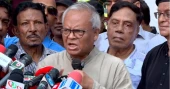
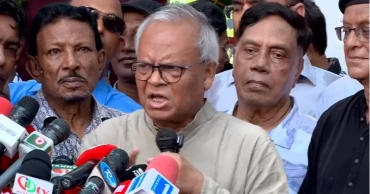
BNP acting Secretary General Ruhul Kabir Rizvi on Wednesday said Prime Minister Tarique Rahman’s decision not to attend the BRICS Summit in India demonstrated Bangladesh’s independence and sovereignty and created a sense of pride among its people.
He said Tarique Rahman was invited to the BRICS Summit in his capacity as the current chair of the Bay of Bengal Initiative for Multi-Sectoral Technical and Economic Cooperation (BIMSTEC), rather than as Bangladesh’s prime minister.
“Tarique Rahman is the prime minister of an independent and sovereign country. You will not invite him as prime minister and expect him to sit on the sidelines. That cannot happen,” Rizvi said.
He said political analysts have also described the prime minister’s decision not to attend the summit as a demonstration of the strength of Bangladesh’s flag, independence and sovereignty.
The BNP leader made the remarks while addressing as the chief guest a human chain and protest rally organised by Bangladesh Jatiyatabadi Muktijoddha Dal and Muktijuddher Projonmo in front of the Jatiya Press Club.
The programme was organised to protest what the organisers described as “a conspiracy against Bangladesh’s independence and sovereignty by fallen autocratic killer Hasina at India’s instigation”.
Rizvi criticised those questioning why Tarique Rahman did not attend the BRICS Summit, saying they have not spoken about what he described as conspiracies against the country.
Referring to the Adani Power Plant in Jharkhand, India, he said the plant supplies 1,300 megawatts of electricity to Bangladesh.
The BNP leader said the plant had announced that one of its units had broken down shortly after Tarique decided not to attend the BRICS summit, questioning the timing of the disruption.
He also criticised India for not extraditing former Prime Minister Sheikh Hasina despite repeated requests from the Bangladesh government.
Rizvi alleged that numerous people accused of killing democracy activists have also taken shelter in India.
Referring to a former major accused in the assassination case of Sheikh Mujibur Rahman, he said the person had fled to India for a long period and was later arrested there and handed over to Sheikh Hasina’s government for trial in Bangladesh.
“If you could hand over that major, why are you not handing over those accused of killing around 1,400 people? Why are those facing trial under Bangladeshi law not being handed over?” the acting secretary general said.
He also alleged that India is plotting against Bangladesh’s political leadership while publicly talking about friendly relations.
“Face to face, you speak very sweetly. But the web of conspiracy you are creating behind the scenes centring on Sheikh Hasina is very clear,” Rizvi said.
He also said several economic indicators are showing positive trends despite the crisis, particularly remittance inflows and foreign exchange reserves.
The BNP leader said the economy is being managed in a planned manner despite the global gas and fuel crisis.
He alleged that some quarters are trying to take the country back to the period before 1971.
Referring to recent developments at Dhaka University Central Students’ Union (DUCSU) and elsewhere, Rizvi warned against what he described as attempts to undermine the achievements of the War of Liberation and democracy.
He said BNP, Bangladesh Jatiyatabadi Muktijoddha Dal and nationalist forces will not allow the achievements of the War of Liberation and democracy to be undermined.
The BNP acting secretary general people who support the War of Liberation will not allow any attempt to reverse the country’s historical course.
24 days ago
BRICS leaders voice concern over Middle East, condemn unilateral sanctions
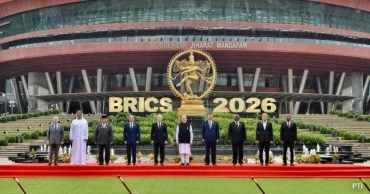
BRICS leaders on Saturday expressed concern over escalating tensions in the Middle East and condemned unilateral sanctions not authorized by the UN Security Council.
The leaders, including Iranian President Masoud Pezeshkian, voiced concern over “deliberate attacks” on civilian infrastructure and peaceful nuclear facilities under UN safeguards, stressing that nuclear safety and security must be protected during armed conflicts.
The joint statement called for the elimination of such sanctions, saying they undermine international law and the principles of the UN Charter.
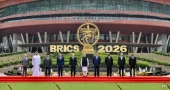
The summit, hosted by India, brought together Russian President Vladimir Putin, Chinese President Xi Jinping, Pezeshkian and leaders of the other BRICS members.
Indian Prime Minister Narendra Modi said BRICS “is not against anyone” and called for turning the bloc’s unity into concrete outcomes. He also proposed a BRICS seafarers’ network to improve the safety and welfare of maritime workers amid disruptions to maritime trade.
Putin called for expanding the UN Security Council to give greater representation to Asia, Africa and Latin America, while Xi said China would work with BRICS members to promote peace in the Middle East.
India also used the summit to seek better ties with China. Modi and Xi met on the sidelines, with Xi calling for a “strategic and long-term” approach to bilateral relations. Modi stressed that peace along the disputed border was essential for broader ties.
The conflicts in Ukraine and the Middle East, along with US-China tensions, have tested BRICS’ ability to maintain unity among members with differing geopolitical interests.
28 days ago
Modi, Xi meet on BRICS sidelines as India, China seek to reset ties
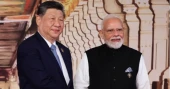
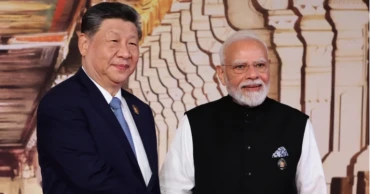
Indian Prime Minister Narendra Modi and Chinese President Xi Jinping met Saturday on the sidelines of the BRICS summit in New Delhi, marking the latest effort by the rival neighbors to repair relations damaged by a deadly border clash six years ago.
Xi said that China views its relationship with India from a "strategic and long-term perspective," calling on both nations to draw on each other's strengths, support one another and pursue common development. Urging "high-quality cooperation," Xi said China and India, as major members of the Global South, should promote a more multipolar world and contribute to global peace and stability.
BRICS world's most influential platform for emerging markets cooperation: Xi
Modi thanked Xi for China's cooperation in hosting the summit, noting that China will host the event next year. The leaders previously held talks in China last year when Modi attended a meeting of the Shanghai Cooperation Organization, a regional political, economic and security bloc founded by Beijing.
The summit marks Xi's first visit to India since 2019 and represents a cautious thaw six years after a 2020 military clash in the cold desert region of Ladakh left at least 20 Indian soldiers and four Chinese dead.
Although both nuclear-armed powers have taken steps to ease tensions, deep mistrust persists over unresolved border disputes, India's substantial trade deficit with China, restrictions on Chinese investment and technology, and competing Asian strategic interests. Additionally, India has significantly expanded military infrastructure along the disputed frontier, while Beijing has constructed roads and defensive positions on its side.
Xi's visit is expected to test whether recent progress can lead to broader diplomatic stabilization. Since their 1962 war, both economies have expanded substantially; however, China has far outpaced India and maintains a large trade surplus, fueling economic rivalry alongside territorial and strategic friction.
Seeking to leverage China's rising labor costs and Beijing's strained ties with the United States and Europe, India is positioning itself as an alternative base for foreign manufacturers. New Delhi also views China's multibillion-dollar Belt and Road Initiative with concern and remains strongly opposed to it. Conversely, India's growing strategic partnership with the U.S. has raised concern in Beijing, which views the alignment as an effort to counter China's rise.
28 days ago
BRICS opens up new possibilities for more dynamic Global South
When the BRICS cooperation mechanism was formally launched in 2006, it opened a new chapter for cooperation among major emerging economies. Two decades on, BRICS has, through the ebbs and flows of the global economy, expanded through multiple rounds of enlargement and broadened the scope of its cooperation.
This evolution has ushered in a new era of greater BRICS cooperation, better reflecting the growing weight and aspirations of the Global South.
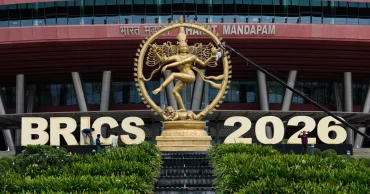
When BRICS leaders prepare to gather for this year's summit in New Delhi, India, the mechanism is playing a greater role in amplifying the collective voice of emerging economies, and expanding practical cooperation amid a changing international landscape beset by raging protectionism and economic fragmentation.
Its growing weight is reflected in its economic and demographic scale. BRICS countries now account for approximately 40 percent of global GDP at purchasing power parity and nearly half of the world's population. Data released by the UN Trade and Development in March showed that the intra-BRICS merchandise trade has expanded more than 13-fold since 2003, and exports reached 1.17 trillion U.S. dollars in 2024.
BRICS, however, is more than an economic force. Its growing significance lies in how countries with different development paths are pooling their strengths in resources, industry and technology to advance shared development.
A prominent area is financing. For many developing economies, access to affordable, long-term funding remains critical to turning development ambitions into reality. The New Development Bank (NDB), headquartered in Shanghai, has helped provide such an option by mobilizing resources for infrastructure and sustainable development projects. Figures released by the bank showed that by the end of the first quarter of 2026, the NDB had approved 42.9 billion dollars in financing for 140 projects.
Covering such areas as infrastructure, clean energy and digital transformation, these projects address the pressing development needs of Global South countries while echoing the priorities highlighted by the theme of the forthcoming BRICS Summit, "Building for Resilience, Innovation, Cooperation and Sustainability."
The ever-evolving BRICS cooperation is also helping developing countries gain new growth momentum. In recent years, BRICS cooperation has been expanding into areas like renewable energy, digital infrastructure, scientific and technological innovation.
A case in point is the BRICS Partnership on New Industrial Revolution Innovation Center in Xiamen, which was established in 2020 to provide a platform for cooperation in digitalization, advanced manufacturing and technological innovation.
These efforts point to the broader value of BRICS: it is not simply giving the Global South a stronger voice, but creating practical opportunities for countries to access financing, technology and cooperation suited to their development needs.
Such collaboration helps explain BRICS' growing appeal to countries seeking greater opportunities to participate and cooperate. As a founding member, China has contributed not only by building platforms for practical cooperation, but also by supporting greater openness and broader participation to promote high-quality cooperation within an expanded BRICS.
Some in the West portray BRICS as a rival bloc seeking to build a parallel order. Yet this claim bears little resemblance to reality. BRICS stands for openness, inclusiveness and mutual benefit, not confrontation or exclusion. That is fundamentally different from the exclusive blocs championed by some Western countries, and a key reason behind the growing vitality of BRICS.
Looking ahead, BRICS is poised to embark on its third "golden decade" after 20 years of growth and transformation. By rising up to the challenges of the times, BRICS countries can help shape a more equal and orderly multipolar world and a more universally beneficial and inclusive economic globalization, and, in doing so, write a new chapter of solidarity and cooperation across the Global South.
28 days ago
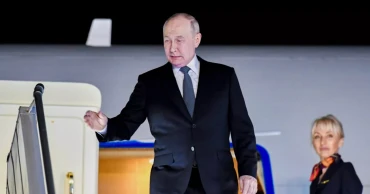
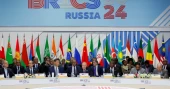
BRICS leaders gather in India as wars, US tensions challenge bloc
Leaders of the BRICS countries gathered in New Delhi on Saturday for a summit focused on trade, investment and major global conflicts, as the group seeks to strengthen its influence in international affairs and promote the interests of emerging and developing nations.
Indian Prime Minister Narendra Modi is hosting Russian President Vladimir Putin, Chinese President Xi Jinping, Iranian President Masoud Pezeshkian and leaders from the other eight BRICS member states.
The summit is taking place amid the ongoing wars in Ukraine and the Middle East, as well as growing tensions between the United States and China. The developments are testing the bloc's ability to reach consensus among members with different geopolitical interests and foreign policy positions.
Authorities have deployed thousands of police and paramilitary personnel across New Delhi, particularly around the summit venue. Traffic restrictions and diversions have also been introduced in several areas of the capital.
BRICS was established in 2006 by Brazil, Russia, India and China, while South Africa joined the group in 2010. The bloc has since expanded to 11 members, collectively representing about half of the world's population and a substantial portion of the global economy. It has increasingly demanded greater representation for developing countries in major international institutions.
The leaders are expected to address economic cooperation, investment, energy, food security, technology, supply chains and reforms to global institutions. Another major issue will be reducing dependence on the US dollar, with member states encouraging the use of national currencies for trade and payments and seeking alternatives to financial institutions dominated by Western countries.
For India, the summit provides an opportunity to demonstrate its strategy of maintaining strong relations with Russia and Iran while simultaneously strengthening ties with the United States and Europe.
New Delhi has sought to preserve its longstanding partnerships with Moscow and Tehran while expanding cooperation with Washington and other Western countries in areas including trade, defence and technology.
India has continued to maintain close relations with Russia and Iran despite the Ukraine war and tensions between Tehran and Washington. At the same time, it has repeatedly called for dialogue and diplomatic efforts to resolve international conflicts. Modi held separate meetings with Putin and Pezeshkian in New Delhi on Friday ahead of the summit.
The summit is also taking place as Iran, one of the expanded BRICS members, remains directly involved in the Middle East conflict. This has created another challenge for the group's unity as member countries hold differing views on the war and on their relationships with the United States.
A major challenge for India as the summit host will be securing a joint declaration from all participating leaders. Differences within the bloc were already visible in May, when BRICS foreign ministers failed to reach agreement on a joint statement concerning the Iran war.
29 days ago
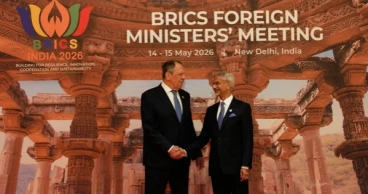
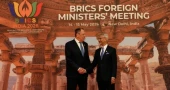
BRICS foreign ministers meet in India amid Iran war, energy concerns and internal divisions
Foreign ministers from BRICS countries began a two-day meeting in New Delhi on Thursday as the expanded bloc grapples with divisions over the Iran war, rising oil prices and wider global economic uncertainty.
The meeting brings together top diplomats from Brazil, Russia, India, China and South Africa, along with newly added member states. It comes at a time when the conflict in Iran has disrupted global energy supplies and pushed up oil prices, while also coinciding with U.S. President Donald Trump’s talks with Chinese leader Xi Jinping in Beijing.
Iranian Foreign Minister Abbas Araghchi and Russian Foreign Minister Sergey Lavrov are attending the discussions. China is represented by its ambassador to India, Xu Feihong, as Foreign Minister Wang Yi remains in Beijing during Trump’s visit.
Indian Foreign Minister Subrahmanyam Jaishankar said the talks would focus on global and regional challenges, as well as ways to strengthen cooperation among member countries.
Opening the meeting, Jaishankar said BRICS could play a stronger role in helping developing countries deal with rising pressures, including high energy, food and fertilizer prices, along with health and financial challenges.
He said the global situation is going through “considerable flux” and added that emerging economies increasingly expect BRICS to act as a “constructive and stabilizing force.”
Originally formed by Brazil, Russia, India and China, BRICS was created as a platform of major emerging economies seen as an alternative to Western-led institutions like the G7. South Africa joined in 2010, and the bloc expanded further in 2024 with Egypt, Ethiopia, Iran and the United Arab Emirates. Indonesia became a full member in 2025.
The grouping has tried to expand its global influence and push for a greater voice for developing countries in international decision-making. It has also gained support in parts of the Global South, where many countries have criticized Western-dominated financial systems.
However, internal divisions remain a major challenge.
India and China continue to compete for regional influence, while member states often differ in their foreign policy alignments with the West. Russia’s war in Ukraine has also exposed deep differences within the bloc.
The expansion of BRICS has further complicated consensus-building, as countries with competing regional interests now sit at the same table.
Tensions have become more visible amid the Middle East conflict. Iran and the United Arab Emirates are both BRICS members despite holding opposing positions in regional disputes.
Iran’s deputy foreign minister said on Wednesday that internal disagreements over the conflict had prevented the bloc from issuing a unified position.
Kazem Gharibabadi told the Press Trust of India that one member country had pushed for language condemning Iran, making consensus difficult.
“We want India’s BRICS chairship to be successful. It is not a good approach to send a signal to the world that BRICS is divided. One country is insisting on condemning Iran,” he said.
4 months ago
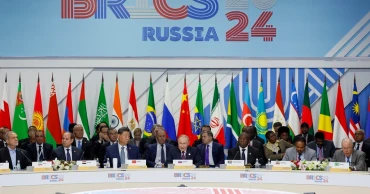
Nigeria joins BRICS as a partner country
Nigeria has been accepted as a "partner country" of the BRICS group of emerging economies, as confirmed by Brazil, the current chair of the bloc, reports AP.
Established in 2009 by Brazil, Russia, India, and China, BRICS expanded in 2010 to include South Africa, positioning itself as a counterbalance to the Group of Seven leading industrialised nations.
Russia will help Vietnam to join BRICS bloc of developing nations
In the previous year, the bloc welcomed Iran, Egypt, Ethiopia, and the United Arab Emirates. Saudi Arabia has been extended an invitation to join, while Turkey, Azerbaijan, and Malaysia have submitted formal membership applications. Several other nations have also shown interest.
Nigeria is now the ninth partner country in BRICS, joining Belarus, Bolivia, Cuba, Kazakhstan, Malaysia, Thailand, Uganda, and Uzbekistan.
“With the world’s sixth-largest population, Africa’s largest, and as one of the continent’s leading economies, Nigeria shares aligned interests with other BRICS members,” Brazil’s government stated on Friday.
“It actively contributes to advancing South-South cooperation and reforming global governance, which are key priorities under Brazil’s current presidency.”
Indonesia becomes full member of BRICS
Last year, President-elect Donald Trump warned of imposing 100% tariffs on BRICS nations if they attempted to weaken the U.S. dollar. In response, BRICS leaders have reiterated their commitment to developing an alternative payment system independent of the dollar.
1 year ago
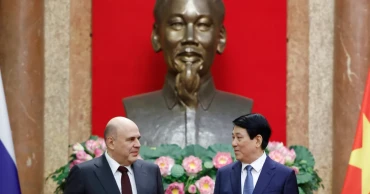
Russia will help Vietnam to join BRICS bloc of developing nations
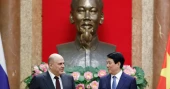
Russia will facilitate Vietnam's participation in the BRICS bloc of developing economies as a “partner country,” the countries said in a joint statement on Wednesday after Russian Prime Minister Mikhail Mishustin’s two-day visit to Hanoi.
“The Russian side welcomed Vietnam’s active participation in BRICS events in 2024 and expressed its readiness to create favorable conditions if Vietnam joins BRICS as a partner country,” the statement said, AP reports.
BRICS was formed by Brazil, Russia, India and China in 2009, with South Africa added in 2010, as a counterweight to the Group of Seven leading industrialized nations. Last year, the bloc added Iran, Egypt, Ethiopia and the United Arab Emirates. Saudi Arabia has been invited to join. Turkey, Azerbaijan and Malaysia have formally applied to become members, and a few others have expressed interest.
Vietnam's Southeast Asian neighbor Indonesia was admitted as a full BRICS member this month.
Russia forms an emergency task force over oil spill
But Vietnam remains reticent to join the bloc, said Nguyen Khac Giang, a visiting fellow in the Vietnam Studies Program at Singapore’s ISEAS–Yusof Ishak Institute.
“Hanoi is still cautious of what the Trump administration will think about BRICS and the potential consequences of becoming a full member in the worst-case scenario. Meanwhile, the benefits are not that substantial for Hanoi to take such a risk,” he said.
Vietnam needs support from the US to advance its economic ambitions and diversify its defense ties.
Russia has been trying to bolster ties in Asia to offset its growing international isolation over its war in Ukraine.
NKorean troops in Ukraine gain battlefield experience, cementing alliance with Russia
During Mishustin’s visit to Hanoi, the countries agreed to expand their cooperation on nuclear power.
“Russia is ready to participate in building a national nuclear power industry in Vietnam,” the joint statement said.
1 year ago
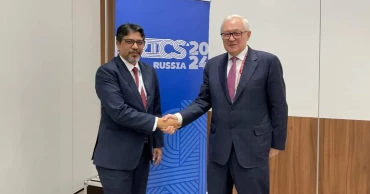
Russia will back Bangladesh's enhanced role in BRICS
Deputy Foreign Minister of the Russian Federation Sergey A Ryabkov has pledged to advance the “matured” relations with Bangladesh to a new height.
The Deputy Foreign Minister thanked the government of Bangladesh for its renewed commitment to remain engaged with the BRICS process. He assured that the Russian government will support Bangladesh for a greater role in the bloc during its future expansion, according to the Ministry of Foreign Affairs.
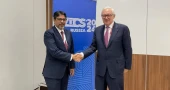
The issues were discussed when Foreign Secretary, Ambassador Md Jashim Uddin, held a bilateral meeting with the Russian Deputy Foreign Minister on the sidelines of the 16th BRICS Summit in Kazan, Russia.
During the meeting, both sides discussed areas of mutual interest and cooperation, with a focus on further strengthening the relations between the two countries.
The discussions also featured holding the next Foreign Office Consultations (FOC) in Moscow, Russia.
The Foreign Secretary highlighted the historical ties between Bangladesh and Russia and underscored the importance of cooperation in the areas of energy and food security between two countries.
1 year ago

Dhaka's interest to join BRICS: Beijing assures its support to Dhaka
Chinese Vice Minister for Foreign Affairs Sun Weidong has appreciated Bangladesh’s interest to join BRICS for which he assured of China’s active support.
In 2006, Brazil, Russia, India and China created the "BRIC" group. South Africa joined in 2010, making it "BRICS". Egypt, Ethiopia, Iran, Saudi Arabia and the United Arab Emirates (UAE) were invited to become members with effect from 1 January 2024.
During the 13th round of bilateral political consultations between Bangladesh and China held in Beijing on June 3, both parties agreed to work jointly for the upcoming visit of Prime Minister Sheikh Hasina to China next month.
Foreign Secretary Masud Bin Momen led the Bangladesh delegation while the Chinese side was led by the Vice Minister for Foreign Affairs Sun Weidong.
The Bangladesh delegation comprised of Ambassador of Bangladesh to China Jashim Uddin, Additional Secretary of ERD Anwar Hossain and officials from the Foreign Ministry and Bangladesh Embassy in China.
Officials from Foreign Ministry of China were present on the other side.
The consultations focused on consolidating bilateral relations, enhancing economic ties, promoting trade and investment and exploring opportunities for cooperation in multilateral platform, according to the Ministry of Foreign Affairs.
The Chinese vice minister underscored the importance of high-level exchanges and people-to-people connectivity.
FTA with China: Bangladesh wants more employment opportunities; investment, says Titu
He conveyed China’s willingness to work together to import mango and other agricultural products from Bangladesh and also to assist skill development of the youth. The Chinese side assured to expedite the repatriation of the Rohingyas sheltered in Bangladesh.
Weidong mentioned that the two countries’ embassies in Dhaka and Beijing may work together for the celebration of 50 years of diplomatic ties between the two countries.
Foreign Secretary Masud mentioned that Bangladesh attaches significant importance to its relations with China based on shared values, mutual respect and common aspirations.
He recalled the visit of the Father of the Nation Bangabandhu Sheikh Mujibur Rahman to China during 1952 and 1957 and expected the book “The New China as I saw” to be published in Chinese language before the upcoming VVIP visit.
2 years ago