Israeli settlement
Palestinians warn Israeli cabinet moves amount to de facto annexation of West Bank
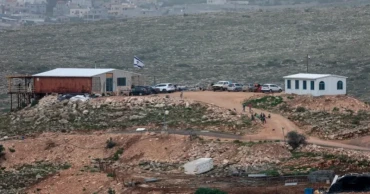
Palestinians, several Arab countries, Israeli anti-occupation groups and the United Kingdom have strongly condemned newly approved Israeli measures in the occupied West Bank, warning that the steps amount to a de facto annexation of Palestinian land.
The measures were announced by far-right Israeli Finance Minister Bezalel Smotrich following approval by Israel’s security cabinet. Smotrich said the decisions would make it easier for Jewish settlers to take over land in the West Bank and declared that Israel would continue efforts to block the creation of a Palestinian state.
All Israeli settlements in the occupied West Bank are regarded as illegal under international law.
The new steps, which are expected to receive final approval from Israel’s top military commander in the West Bank, are designed to expand Israeli control over land administration, including property law, planning, licensing and enforcement.
The announcement came just days before a scheduled meeting in Washington between Israeli Prime Minister Benjamin Netanyahu and US President Donald Trump.According to the United Nations, settlement expansion in the West Bank reached its fastest pace on record last year.
Among the measures is the removal of a long-standing ban on the direct sale of West Bank land to Jewish buyers and the declassification of local land registry records. Until now, settlers were generally limited to purchasing property through registered companies on land administered by the Israeli state.
Israeli ministers described the move as a step to increase transparency and facilitate land acquisition. Israel’s foreign ministry later said the changes corrected what it called discriminatory rules that restricted property purchases by non-Arabs in what Israel refers to as Judea and Samaria.
The cabinet also voted to repeal a requirement for special transaction permits for real estate purchases, a mechanism previously used to maintain oversight and prevent fraud.
Palestinians expressed fears that the changes would intensify pressure on landowners to sell and could lead to forgery and deception.
Palestinian President Mahmoud Abbas described the measures as dangerous, calling them an open attempt to legalise settlement expansion, land confiscation and the demolition of Palestinian property, including in areas under Palestinian Authority administration. He urged the United States and the UN Security Council to intervene immediately.
The Israeli rights group Peace Now warned that the decisions could destabilise the Palestinian Authority and effectively cancel existing agreements, accusing the government of paving the way for widespread land seizure and de facto annexation.
The United Kingdom said it strongly condemned the move and called on Israel to reverse the decision, warning that any unilateral action altering the geographic or demographic character of Palestinian territory would violate international law.
Foreign ministers from Egypt, Jordan, the United Arab Emirates, Indonesia, Pakistan, Turkey, Saudi Arabia and Qatar also issued a joint statement condemning the measures. They said the decisions accelerated illegal annexation efforts and the displacement of Palestinians, warning that such policies would fuel further violence and instability.
Additional steps announced by Smotrich and Defence Minister Israel Katz include transferring building and licensing authority at sensitive religious sites in Hebron exclusively to Israeli bodies. These include areas surrounding the Cave of the Patriarchs, also known as the Ibrahimi Mosque, one of the holiest sites in both Judaism and Islam.
Israeli authorities would also be granted enforcement powers over environmental and archaeological matters in areas administered by the Palestinian Authority. A committee would be revived to allow the Israeli state to make what it described as proactive land purchases in the West Bank to secure land for future settlements.
Under the 1993 Oslo Accords, the Palestinian Authority was given full control over major Palestinian urban areas, known as Area A, which make up about 20 percent of the West Bank. Israel retained full administrative and security control over Area C, which covers about 60 percent of the territory and contains most Israeli settlements.
More than 700,000 Israeli settlers currently live in the occupied West Bank and Israeli-annexed East Jerusalem, territories captured by Israel in the 1967 Middle East war. Palestinians seek these areas for a future independent state along with the Gaza Strip.
While the Trump administration has ruled out formal annexation of the West Bank, it has not moved to halt Israel’s rapid settlement expansion.
Smotrich, himself a settler and leader of a pro-settler party, has pledged to double the settler population. In December, Israel’s cabinet approved plans for 19 new settlements and is preparing to advance construction of the controversial E1 settlement project near Jerusalem, a move that would effectively split the West Bank in two.
The United Nations says more than 37,000 Palestinians were displaced in 2025 alone, alongside record levels of settler violence.
Netanyahu’s governing coalition includes strong pro-settler factions that openly support annexation. The prime minister, who faces elections later this year, has repeatedly said he would not allow the establishment of a Palestinian state, describing it as a security threat.
In 2024, the International Court of Justice issued a non-binding advisory opinion stating that Israel’s occupation of Palestinian territories is illegal and should be brought to an end.
With inputs from BBC
8 months ago
New Israeli settlement Yatziv inaugurated near Beit Sahour
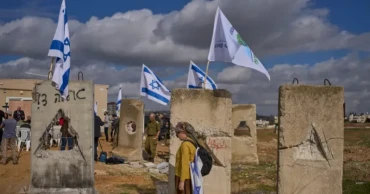
Israeli settlers on Monday inaugurated a new settlement on a hilltop overlooking the Palestinian town of Beit Sahour in the occupied West Bank, marking the formal recognition of what had until recently been an unauthorised outpost.
The settlement, named “Yatziv,” meaning “stable” in Hebrew, was set up with prefabricated homes in November and received official approval last month. The inauguration was held under heavy security, with Israeli soldiers deployed around the site as settlers gathered for the ceremony.
Finance Minister Bezalel Smotrich, who oversees Israeli settlement policy, attended the event and said the new settlement would be permanent. He has led an expanded programme of settlement construction and legalisation of outposts over the past three years.
Settlers have long sought control of the hilltop, citing its location in a chain of settlements surrounding Jerusalem and its historical significance to Jews. The move gained momentum after a deadly stabbing attack on an Israeli at a nearby junction late last year, according to settlement leaders.
On Dec 21, Smotrich approved Yatziv along with 18 other outposts, bringing an end to a two-decade campaign by settlers to establish a presence at the site.
The international community largely considers Israeli settlements in the occupied West Bank illegal under international law. Palestinians say the continued expansion restricts movement and development, undermining prospects for a future Palestinian state. They seek the West Bank, captured by Israel in 1967, as part of such a state.
Palestinian officials say the land belongs to families from Beit Sahour. Mayor Elias Isseid said the new settlement is part of a growing ring of Israeli communities around the town, connected by roads that lead directly to Jerusalem while bypassing Palestinian areas.
In the past, the site had been discussed as a possible location for a Palestinian children’s hospital with international support, but the project was never implemented and the land was later used as a military base.
Yatziv is the latest addition to a series of settlements that have expanded around Beit Sahour in recent years.
8 months ago

With West Bank in turmoil, more Palestinians want to fight
The stuttering blasts of M-16s shattered the quiet in a West Bank village, surrounded by barley fields and olive groves. Young Palestinian men in Jaba once wanted to farm, residents say, but now, more and more want to fight.
Last week, dozens of them, wearing balaclavas and brandishing rifles with photos of their dead comrades plastered on the clips, burst into a school playground — showcasing Jaba’s new militant group and paying tribute to its founder and another gunman who were killed in an Israeli military raid last month.
“I’d hate to make my parents cry,” said 28-year-old Yousef Hosni Hammour, a close friend of Ezzeddin Hamamrah, the group’s late founder. “But I’m ready to die a martyr.”
Similar scenes are playing out across the West Bank. From the northern Jenin refugee camp to the southern city of Hebron, small groups of disillusioned young Palestinians are taking up guns against Israel’s open-ended occupation, defying Palestinian political leaders whom they scorn as collaborators with Israel.
With fluid and overlapping affiliations, these groups have no clear ideology and operate independently of traditional chains of command — even if they receive support from established groups. Fighters from Palestinian Islamic Jihad and other organizations attended last week’s ceremony in Jaba.
In near-daily arrest raids over the past year, Israel has sought to crush the fledgling militias, leading to a surge of deaths and unrest unseen in nearly two decades.
While Israel maintains the escalated raids are meant to prevent future attacks, Palestinians say the intensified violence has helped radicalize men too young to remember the brutal Israeli crackdown on the second Palestinian uprising two decades ago, which served as a deterrent to older Palestinians.
This new generation has grown up uniquely stymied, in a territory riven by infighting and fragmented by barriers and checkpoints.
More than 60 Palestinians have been killed in the West Bank and east Jerusalem since the start of 2023, after Israel’s most right-wing government in history took office. About half were killed in fighting with Israel, according to an Associated Press tally, though the dead have also included stone-throwers and bystanders uninvolved in violence.
At least 15 Israelis have been killed in Palestinian attacks in that time, including two Israelis shot Sunday in the town of Hawara, just south of Jaba. In response, Israeli settlers torched dozens of buildings — a rampage that also left one Palestinian dead.
“It’s like the new government released the hands of soldiers and settlers, said now they can do whatever they want,” said Jamal Khalili, a member of Jaba’s local council.
At the recent memorial service, children with black bands on their foreheads gathered around the gunmen, eager for a glimpse of their heroes.
“The outcome is what you see here,” Khalili added.
Last week, an Israeli military raid in the northern city of Nablus sparked a shootout with Palestinians that killed 10 people. The raid targeted the most prominent of the emerging armed groups, the Lion’s Den.
Israeli security officials claim the military has crippled the Nablus-based Lion’s Den over the past few months, killing or arresting most of its key members. But they acknowledge its gunmen, who roam the Old City of Nablus and pump out slick Telegram videos with a carefully honed message of heroic resistance, now inspire new attacks across the territory.
“The Lion’s Den is beginning to become an idea that we see all around,” said an Israeli military official, who spoke on condition of anonymity to discuss an intelligence assessment. Instead of hurling stones or firebombs, the Palestinians now mainly open fire, he said, using M-16s often smuggled from Jordan or stolen from Israeli military bases.
The official said the army was monitoring the Jaba group and others in the northern cities of Jenin, Nablus and Tulkarem. But he acknowledged the army has difficulty gathering intelligence on the small, loosely organized groups.
The Palestinian self-rule government administers parts of the West Bank, and works closely with the Israeli military against its domestic rivals, particularly the Hamas group, which runs the Gaza Strip.
With young Palestinians increasingly viewing the Palestinian Authority as an arm of the Israeli security forces rather than the foundation for a future state, Palestinian security forces are loathe to intervene against the budding men. Palestinian forces now rarely venture into strongholds like the Old City of Nablus and the Jenin refugee camp, according to residents and the Israeli military.
Jaba men said the Palestinian security forces have not cracked down on them. Residents said the group, founded last September, has rapidly grown to some 40-to-50 men.
Hammour described Palestinian leaders as corrupt and out of touch with regular Palestinians. But, he said, “Our goals are much bigger than creating problems with the Palestinian Authority.”
With the popularity of the PA plummeting, experts say it cannot risk inflaming tensions by arresting widely admired fighters.
The PA “is experiencing a crisis of legitimacy,” said Tahani Mustafa, Palestinian analyst at the International Crisis Group. “There’s a huge disconnect between elites at the top and the groups on the ground.”
Palestinian officials acknowledge their grip is slipping.
“We fear any of our actions against (these groups) will create a reaction in the street,” said a Palestinian intelligence official, speaking on condition of anonymity because he was not authorized to talk to reporters.
With the Israeli military stepping up raids, the West Bank’s power structure faltering and Prime Minister Benjamin Netanyahu’s government expanding settlements on occupied land, frustrated Palestinians say they are not in pursuit of any Islamist or political agenda — they simply want to defend their towns and resist Israel’s 55-year-old occupation.
For 28-year-old Mohammed Alawneh, whose two brothers were killed in confrontations with Israeli forces, two decades apart, the Jaba group is a “reaction.” He said he could support peace if it meant the end of the occupation and the formation of a single state between the Jordan River and the Mediterranean Sea. For now, he said, it’s clear Israel doesn’t want peace.
Hamamrah, the Jaba group’s late commander, threw stones at the Israeli army as a teen and later joined an armed offshoot of Fatah, the party of Palestinian President Mahmoud Abbas, according to his mother, Lamia. After 10 agonizing months in Israeli prison, he became religious and withdrawn. He spoke of taking revenge.
After his death, Lamia discovered he had helped form the Jaba group and that Islamic Jihad had supplied them with weapons, including the gun Hamamrah fired at Israeli troops on Jan. 14.
The army chased him into Jaba, killing Hamamrah along with another gunman, Amjad Khleleyah. Their crushed and bloodstained car now sits in the center of Jaba like a macabre monument.
At his funeral, Lamia said Hamamrah’s friends urged her to show pride in a son who became a fighter and inspired the whole village.
But Lamia wept and wept. Her 14-year-old daughter, Malak, now wants die a martyr, too.
“I’m just a mother who lost her son,” she said. “I want this all to stop.”
3 years ago

Trump-era spike in Israeli settlement growth has only begun
An aggressive Israeli settlement spree during the Trump era pushed deeper than ever into the occupied West Bank — territory the Palestinians seek for a state — with over 9,000 homes built and thousands more in the pipeline, an AP investigation showed.
If left unchallenged by the Biden administration, the construction boom could make fading hopes for an internationally backed two-state solution — Palestine alongside Israel — even more elusive.
Satellite images and data obtained by The Associated Press document for the first time the full impact of the policies of then-President Donald Trump, who abandoned decades-long U.S. opposition to the settlements and proposed a Mideast plan that would have allowed Israel to keep them all — even those deep inside the West Bank.
Although the Trump plan has been scrapped, the lasting legacy of construction will make it even harder to create a viable Palestinian state. President Joe Biden’s administration supports the two-state solution but has given no indication on how it plans to promote it.
The huge number of projects in the pipeline, along with massive development of settlement infrastructure, means Biden would likely need to rein in Israel to keep the two-state option alive. While Biden has condemned settlement activity, U.S. officials have shown no appetite for such a clash as they confront more urgent problems. These include the coronavirus crisis, tensions with China and attempting to revive the international nuclear deal with Iran — another major sticking point with Israel.
At the same time, Israel will likely continue to be led by a settlement hawk. In the wake of yet another inconclusive Israeli election, either Prime Minister Benjamin Netanyahu or one of his right-wing challengers is poised to head the government, making a construction slowdown improbable.
Hanan Ashrawi, a veteran Palestinian spokeswoman, called the Trump administration a “partner in crime” with Netanyahu. She said Biden would have to go beyond traditional condemnations and take “very serious steps of accountability” to make a difference.
“It needs a bit of courage and backbone and willingness to invest,” she said.
According to Peace Now, an anti-settlement watchdog group, Israel built over 9,200 new homes in the West Bank during the Trump presidency. On an annual average, that was roughly a 28% increase over the level of construction during the Obama administration, which pressed Israel to rein in building.
Perhaps even more significant was the location of the construction. According to Peace Now, 63% of the homes built last year were in outlying settlements that would likely be evacuated in any peace agreement. Over 10% of the construction in recent years took place in isolated outposts that are not officially authorized, but quietly encouraged by the Israeli government.
“What we’re seeing is the ongoing policy of de facto annexation,” said Hagit Ofran, a Peace Now researcher. “Israel is doing its utmost to annex the West Bank and to treat it as if it’s part of Israel without leaving a scope for a Palestinian state.”
Israel has also laid the groundwork for a massive construction boom in the years to come, advancing plans for 12,159 settler homes in 2020. That was the highest number since Peace Now started collecting data in 2012. It usually takes one to three years for construction to begin after a project has been approved.
Unlike his immediate predecessors, who largely confined settlement construction to major blocs that Israel expects to keep in any peace agreement, Netanyahu has encouraged construction in remote areas deep inside the West Bank, further scrambling any potential blueprint for resolving the conflict.
Settler advocates have repeatedly said that it would take several years for Trump’s support to manifest in actual construction. Peace Now said that trend is now in its early stages and expected to gain steam.
“2020 was really the first year where everything that was being built was more or less because of what was approved at the beginning of the Trump presidency,” said Peace Now spokesman Brian Reeves. “It’s the settlement approvals that are actually more important than construction.”
Israel captured the West Bank, east Jerusalem and the Gaza Strip — territories the Palestinians want for their future state — in the 1967 Mideast war. It withdrew from Gaza in 2005 but has cemented its control over east Jerusalem — which it unilaterally annexed — and the West Bank.
Nearly 500,000 Israeli settlers live in some 130 settlements and dozens of unauthorized outposts, according to official figures. That amounts to roughly 15% of the total population in the West Bank. In addition, over 200,000 Jewish Israelis live in east Jerusalem, which is also home to over 300,000 Palestinians.
The Biden administration says it is opposed to any actions by Israel or the Palestinians that harm peace efforts. “We believe, when it comes to settlement activity, that Israel should refrain from unilateral steps that exacerbate tensions and that undercut efforts to advance a negotiated two-state solution,” State Department spokesman Ned Price said this month.
Continued settlement growth could meanwhile bolster the case against Israel at the International Criminal Court, which launched an investigation into possible war crimes in the Palestinian territories last month. Israel appears to be vulnerable on the settlement issue because international law forbids the transfer of civilians into lands seized by force.
Israel and its Western allies have rejected it as baseless and biased. Israel is not a member of the court, but any potential ICC warrants could put Israeli officials at risk of arrest abroad.
___
UNPRECEDENTED SUPPORT
The settlements are scattered across the West Bank, running the gamut from small hilltop clusters of tents and mobile homes to full-fledged towns with residential neighborhoods, shopping malls and in one case, a university. Every Israeli government has presided over the expansion of settlements, even at the height of the peace process in the 1990s.
The Palestinians view the settlements as a violation of international law and an obstacle to peace, a position with wide international support. Israel considers the West Bank to be the historical and biblical heartland of the Jewish people and says any partition should be agreed on in negotiations.
The two sides have not held serious talks in more than a decade, in part because the Palestinians view the continued expansion of settlements as a sign of bad faith.
Trump took unprecedented steps to support Israel’s territorial claims, including recognizing Jerusalem as its capital and moving the U.S. Embassy there. His Mideast plan, which overwhelmingly favored Israel, was adamantly rejected by the Palestinians.
Trump’s Mideast team was led by prominent supporters of the settlements and maintained close ties to settlement leaders throughout his tenure.
He remains popular in Efrat, a built-up settlement in the rolling hills south of Jerusalem that is expanding toward the north into the outskirts of the Palestinian city of Bethlehem.
“You keep using the term settlement,” said Moti Kellner, a retiree who has lived in the area since 1986. “Walk around, does this look like something that’s a camp, with tents and settling? It’s a city!” He described Trump’s policies as “very good, if they’re not overturned.”
Efrat’s mayor, Oded Revivi, says Trump’s legacy can be seen more in the increased approval of projects than in actual construction.
“When Trump got elected, the table was basically empty, with no building plans which were approved,” he said. More importantly, he credits Trump with accepting the legitimacy of settlements, “instead of battling with the reality that has been created on the ground.”
___
THE FEAR OF LOSING YOUR PLACE
Thousands of Palestinians work in the settlements, where wages are much higher than in areas administered by the Palestinian Authority, and on a personal basis, many get along well with their Jewish employers and co-workers.
“We do know how to live alongside one another, we do know how to build a peaceful relationship,” says Revivi.
But most Palestinians view the growth of settlements as a slow and steady encroachment — not only on their hopes for a state, but on their immediate surroundings. As the years roll by, they watch as the gated settlements spill down hillsides, roads are closed or diverted, and terraced olive groves and spring-fed valleys come to feel like hostile territory.
Most Palestinians in the West Bank live in cities like Ramallah, Bethlehem, Nablus and Hebron, which are administered by the Palestinian Authority under interim peace agreements signed in the 1990s. Those cities are all largely surrounded by settlements, settlement infrastructure and closed military zones. Hebron has a Jewish settlement in the heart of its Old City.
Palestinians know to steer clear of settlements. Farmers who tend lands near them risk being beaten or pelted with rocks by the so-called Hilltop Youth and other Jewish extremists. Rights groups have documented dozens of attacks in recent months and say the Israeli military often turns a blind eye. Palestinians have also carried out attacks inside settlements, including the killing of a mother of six who was out jogging in December.
Around a kilometer (mile) north of Efrat, in an area administered by the PA, is a cultural and historical site popularly known as Solomon’s Pools, a network of spring-fed stone reservoirs and canals with ruins dating back more than 2,000 years.
Every few months, dozens of settlers — escorted by Israeli troops — break into the site and force out Palestinian visitors or renovation workers, according to George Bossous, CEO of the company that manages the site and an adjacent convention center.
“You always fear that you are losing more and more of your place,” he said. “To live together means you need to take care of everyone and give rights for all.”
Fatima Brijiyah heads the local council in al-Masara, a Palestinian village southeast of Efrat. The 70-year-old grandmother remembers wandering its hills in her youth, when she and her brother would ride on their father’s donkey when he went to fetch water from a nearby well.
The well is still there, but she says it’s too close to the settlement for Palestinians to visit it safely.
“You feel the pain of not being able to go there now, even just to look,” she said. “You feel that everything about the occupation is wrong.”
___
POINT OF NO RETURN?
Some critics say the U.S. focus on managing the conflict instead of resolving it has led to a point of no return. They say that there are so many settlements across the West Bank that it is impossible to create a viable Palestinian state. Others argue that Israel has become a single apartheid state in which millions of Palestinians are denied basic rights afforded to Jews.
Peace Now says that — at least in a logistical sense — a partition deal remains possible.
Under a two-state solution based on past proposals, up to 80% of the settlers could stay where they are. Many of the largest settlements are close to the 1967 lines and could be incorporated into Israel in mutually agreed land swaps.
That means at least 100,000 Jewish settlers, and likely more, would have to relocate or live inside a Palestinian state. Some 2 million Palestinians live inside Israel, where they have citizenship, including the right to vote.
“From a logistical standpoint, it’s very possible,” Reeves said. “From a political standpoint, that’s where the trick is.”
Most experts agree that a negotiated two-state solution would require an Israeli government with a mandate to make historic concessions, a united Palestinian leadership able to do the same and a powerful external mediator like the U.S. that could strong-arm both sides.
None of those three elements exist now or will in the foreseeable future.
Israelis are deeply divided over Netanyahu’s leadership, but a strong majority appears to support the settlements and are opposed to a Palestinian state. Those voters back right-wing parties that won 72 seats in the 120-member Knesset last month.
The Palestinians are geographically and political divided between the Western-backed Palestinian Authority in the West Bank and the Islamic militant group Hamas ruling the Gaza Strip. The Palestinians have not held a vote in more than 15 years, and elections planned for the coming months could be called off.
The last five U.S. presidents have tried and failed to resolve the conflict. The Obama administration scolded Israel over its settlements, while Trump unabashedly supported them. Neither made any headway in resolving the conflict with the Palestinians.
Biden, who has devoted much of his nearly 50-year political career to foreign policy, knows this well. His administration has signaled it hopes to manage the conflict, not resolve it.
“The question is, can there be momentum? There won’t be peace, but can there be momentum in these next four to eight years?” Reeves said.
“If there is, then I think a two-state solution is very much alive. If there’s not, and there’s another 100,000 settlers added, it just makes it that much harder to make peace.”
5 years ago

Palestine lashes out at US position towards Israeli-Palestinian conflict
Palestine on Saturday lashed out at U.S. position towards the Israeli-Palestinian conflict, calling it a "foggy" position.
5 years ago