Boro rice
After flood, Boro season unfolds in Sunamganj
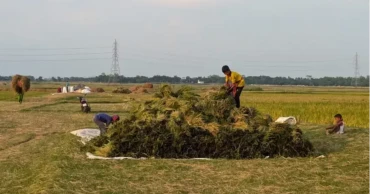
As the vast haor waters slowly recede, life in Sunamganj’s low-lying wetlands is once again defined by urgency, mud and relentless labour by farmers.
Across the district, farmers have plunged into the Boro cultivation season, racing against a narrow planting window that will determine their livelihoods for the year ahead.
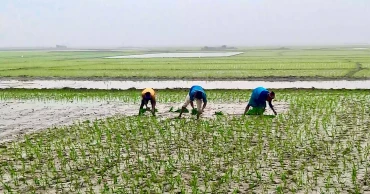
From one upazila to another, the haor landscape has turned vibrant with activity. Knee-deep in muddy water, farmers and agricultural labourers work from dawn to dusk, transplanting paddy seedlings on freshly exposed land. Shantiganj, Tahirpur, Madhyanagar, Dharmapasha, Shalla and Jamalganj are among the upazilas where the seasonal rush is most visible.
According to the District Agriculture Department, seedlings have already been planted on 1.53 lakh hectares of land in Sunamganj.
Read more: Jujube cultivation brings new prosperity to Cumilla’s Shikarpur village
With haor waters withdrawing gradually, farmers are making full use of every available day to ensure timely transplantation and a successful harvest.
Boro cultivation in the haor region typically begins after floodwaters recede, following the preparation of seedbeds in November and December.
This year, soil testing has been completed in advance, and required fertilisers, including urea, TSP, DAP, MOP and gypsum, have been applied as per recommendations.
Farmers are cultivating a mix of high-yielding and hybrid rice varieties, including BRRI dhan-28, BRRI dhan-29, BRRI dhan-89 and BRRI dhan-92. If weather conditions remain favourable, rice ears are expected to emerge in April-May, marking the crucial phase when grains mature ahead of harvest.
Yet the physical toll of the season is unmistakable. Despite the biting winter cold, labourers stand for hours in icy water, trampling mud to plant seedlings by hand. For many, agriculture is the only means of survival, leaving little room for rest.
“I work from 8am till evening for a daily wage of Tk 600 and one meal,” said Ibrahim Mia, a farmer from Khushdar Haor in Lalpur village. “Even in severe winters, we have to trample mud in water. We are poor people and survive through hard labour.”
Like many others, Ibrahim hopes that good yields and fair market prices will reward their effort. “If we get proper prices, farmers will be more motivated,” he said.
Read more: Haor regions to see controlled pesticide use in upcoming Boro season
Officials say the Boro season is not only vital for food production but also creates seasonal employment in the haor belt.
Deputy Director of the Sunamganj District Agricultural Extension Department Mohammad Omar Faruk said Boro remains the district’s main cropping season.
“Workers from different districts have come to Sunamganj to take part in the planting activities,” he said, adding, “They are earning between Tk 600 and Tk 800 per day, which has created temporary employment opportunities in the haor areas.”
He said the Boro cultivation target for the current season has been set at 2,23,505 hectares, with planting already completed on about 1,53,000 hectares.
As farmers push forward against time, cold and uncertainty, the receding haor waters signal both hope and hardship, a familiar rhythm in Sunamganj, where the success of the Boro season shapes food security and livelihoods for thousands.
Read more: Kushtia farmers upset over canal blockage, fear permanent waterlogging
9 months ago
Slow dam construction leaves Sunamganj’s Haor farmers on edge
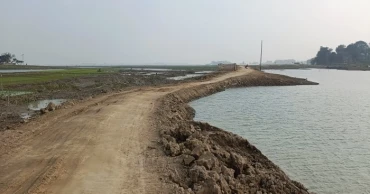
Anxious days are returning for farmers in the haor areas of Sunamganj as work on crop protection dams remains sluggish, even three weeks after the official deadline for starting construction passed.
Although construction has begun in some haors, the overall pace has been slow, fuelling frustration among farmers who depend on the timely completion of embankments to protect their Boro crops from early floods.
Many fear that continued delays could leave vast tracts of farmland vulnerable during the coming monsoon.
According to the Water Development Board, several factors have hindered timely implementation.
Delays in the recession of water from the haors and complications in forming Project Implementation Committee (PIC) have stalled work in multiple upazilas, including Tahirpur, Derai and Shalla.
Fertiliser crunch threatens Kushtia’s onion boom despite high prices
Officials also pointed out that administrative activities were disrupted earlier as officials remained busy with election-related duties.
Despite these setbacks, officials said construction would gain momentum within a few days and that all projects are scheduled for completion by February 28.
Mamun Hawlader, Executive Engineer of the Sunamganj Water Development Board, said that under the KABITA (Kajer Binimoye Taka) policy, a total of 705 projects have been approved for the construction of crop protection dams across 12 upazilas in the 2025–2026 fiscal year.
An allocation of Tk 137 crore has been made to build approximately 500.5 kilometres of embankments.
Although the construction work was formally inaugurated on December 15, progress has been limited.
As of January 6, work had started on only about 400 projects, with overall progress standing at just 15 per cent.
Bumper harvest, plunging prices; Chandpur’s potato market in crisis
Officials said the remaining projects would begin within a week.
A visit to several haor areas revealed that work has yet to begin on most approved projects, while some Project Implementation Committees are still waiting for official work orders.
The slow pace has drawn criticism from the Haor Bachao Andolan.
Leaders of the organisation recently held a press conference expressing concern that, despite the official start date, construction has not commenced in most upazilas.
They also alleged irregularities in the formation of PICs, unnecessary projects and additional allocations, raising doubts over whether the work can be completed within the stipulated timeframe.
Bijon Sen Roy, general secretary of the central committee of the Haor Bachao Andolon, said, “We are very worried about the dam work this time. The progress is very disappointing. If action is not taken now, it could spell bad news for the people of the haor.”
In response, Executive Engineer Mamun Hawlader assured that monitoring has been intensified and that dam construction will be completed on schedule.
According to the Department of Bangladesh Haor and Wetlands Development, Bangladesh has a total of 373 haors as of 2026.
These haors are spread across seven districts in the north-eastern and north-central regions, covering approximately 858,460 hectares.
As haor waters recede, Sunnamganj farmers sow hope in every field
Of them, 95 haors are located in Sunamganj district alone, spanning about 268,531 hectares.
As the agricultural season advances, farmers across Sunamganj continue to watch the embankment work closely, hoping that construction will accelerate before rising waters put their livelihoods at risk.
9 months ago
As haor waters recede, Sunnamganj farmers sow hope in every field
As the floodwaters of Madhyanagar’s haors slowly recede, farmers have embarked on the crucial boro rice planting season, working relentlessly to ensure timely transplantation.
The effort has drawn participation from all sections of haor-side communities. With examinations concluded, students have joined the fields with some delivering midday meals to labourers, while others assist with collecting seedlings to support the planting process.
A field visit to Tanguar Haor, Ghoradoba Haor, Shaldigha Haor and other wetlands in the upazila revealed farmers actively engaged across expansive tracts of land.
Read more: Rice prices keep food inflation high despite slight easing in Nov: GED
According to the Upazila Agriculture Office, the target for this season is the cultivation of boro rice on 13,640 hectares. To date, approximately 2,815 hectares have been successfully planted.
Nazar Hossain, a farmer from Nishchintpur village in Tanguar Haor’s Banshikunda South Union, pointed out that delayed water recession has hindered transplantation across all fields. “Once the water fully recedes, we will be able to complete planting swiftly,” he said.
Similarly, Ghoradoba Haor farmer Abdul Majid said, “We are planting rice in the fields every day. This is the final period for boro transplantation, but the slow receding of water has caused some delay.”
Meanwhile, Noor Alam, Assistant Engineer at the Upazila Water Development Board, reported that work has begun on strengthening the haor-protection embankments. “As water levels drop, we will fully resume construction. We hope the project will be completed efficiently in the near future,” he added.
Upazila Agriculture Officer Ashayad Bin Khalil Rahat emphasised that, under government incentives, high-quality seeds and fertiliser have been distributed to marginal and smallholder farmers to boost production.
Read more: Haor farmers reap early gains as mustard cultivation flourishes in Sunamganj
With the normalisation of water levels, he assured, boro rice transplantation will be completed within the scheduled timeframe.
The ongoing activity, Rahat said, underscores the resilience of haor communities, blending tradition and collective effort to meet seasonal agricultural demands despite climatic uncertainties.
9 months ago

Chapainawabganj farmers set to surpass Boro rice production targets
Farmers in the Chapainawabganj district are poised to surpass their production targets for boro rice this year, aiming to harvest 253,780 metric tonnes, thanks to a surge in interest spurred by last season's bumper yield.
The Department of Agriculture Extension (DAE) has outlined an ambitious plan to cultivate boro rice across 52,200 hectares of land. The cultivation efforts are distributed across various upazilas, with 13,220 hectares in Sadar, 15,720 in Gomastapur, 6,250 in Bholahat, 9,680 in Nachole, and 7,330 hectares in Shibganj.
Farmers like Kawsar Ali from Sadar upazila are busy preparing their fields and sowing boro seeds. Ali, who has dedicated eight bighas of land to boro cultivation, noted the rising costs of production, attributing them to increased labor and irrigation expenses. Similarly, Mayez Uddin pointed out the hike in land plowing costs from Tk 300 to Tk 350, alongside rising labor charges.
Govt to provide Tk 108 crore as incentive to boost Boro production: Ministry
Paddy workers, enduring the winter chill to plant boro, like Madan, highlighted that the current rate of Tk 500 for planting helps cover their household expenses despite the hard work.
Dr. Palash Sarkar, Deputy Director of DAE, remains optimistic about this year's prospects. He mentioned the widespread adoption of the Ufsi boro variety, ensuring there's no shortage of seeds or fertilizers. Furthermore, irrigation has been smooth due to reliable power supply, and farmers have received all necessary guidance from agricultural officials.
With these favorable conditions, Dr. Sarkar anticipates that the boro rice production target will not only be met but exceeded, signaling a successful and productive season ahead for the farmers of Chapainawabganj.
Half of Boro paddy procurement target not achieved yet, Food Minister tells JS
2 years ago

Kurigram farmers worried as cold wave and dense fog threaten seedbeds
Kurigram district in Bangladesh is currently grappling with a mild cold wave and dense fog, posing significant threats to local agriculture. Farmers, particularly those cultivating boro rice, are increasingly concerned about the potential damage to seedbeds and crop fields due to the harsh weather.
Despite efforts such as applying pesticides and covering seedbeds with polythene, farmers remain worried.
Anisur Rahman, a farmer from Bhogdanga in Sadar upazila, reported that although his boro seedlings are ready for planting, the cold and fog have hindered this process.
Mantaj Ali, another local farmer, voiced concerns over his potato field, which is now completely enveloped in fog.
Subal Chandra, an officer at the Kurigram Weather Observatory Centre, noted that the temperature dropped to 12.2 degrees Celsius on Tuesday and similar conditions are expected to persist for the next few days. He also warned of a cold wave hitting the district by the end of the month.
Rainfall threatens mustard crop in Jashore, farmers fear losses
Biplab Kumar Mohonta, deputy director of the Kurigram Department of Agriculture Extension (DAE), explained that the cold weather has delayed boro plantation of 6,500 hectares of seedbeds. He cautioned that temperatures below 13 degrees Celsius could cause seedbed leaves to turn yellow.
The DAE has already advised farmers to take additional measures to protect their seedbeds from damage.
2 years ago
.jpg)
Govt to buy 11.50 lakh mts Boro rice
The government has decided to procure 11.50 lakh metric tonnes of rice (boiled and non-boiled) and 6.50 lakh metric tonnes of paddy during the ongoing Boro season.
Some 10 lakh metric tonnes of boiled rice will be procured at Tk 40 per kg, 1.5 lakh metric tonnes of non-boiled (atap) rice at Tk 39 per kg and 6.50 lakh metric tonnes of paddy at Tk 27 per kg.
Food Minister Sadhan Chandra Majumder came up with the information while talking to reporters at a virtual programme on Monday.
Read Govt plans to import rice to keep market stable: Ministry
The procurement of boro paddy will start from April 28, rice from May 7 and will continue till August 31.
On April 22, the decisions were made at a virtual meeting of the Food Planning and Monitoring Committee, chaired by Food Minister Sadhan Chandra Majumder.
Agriculture Minister Dr Md Abdur Razzaque, Finance Minister AHM Mustafa Kamal, Commerce Minister Tipu Munshi, Health Minister Zahid Maleque, Fisheries and Livestock Minister SM Rezaul Karim, Enamur Rahman, the state minister for disaster management and relief, among others, attended the meeting through a videoconference.
Read Cabinet purchase body approves import of 50,000MT rice
Last year, the government set a target to procure 6 lakh metric tonnes of paddy and 11 lakh tonnes of rice during boro season.
5 years ago