Char
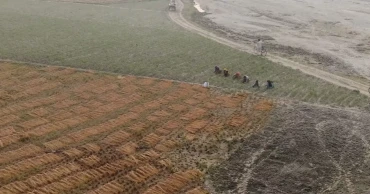
Silt-borne fertility transforms northern Bangladesh
As floodwaters receded across northern Bangladesh, the newly deposited silt has turned the sandy river islands of the Teesta, Dharla, Saniyazan and Brahmaputra—known locally as chars—into fertile land, sparking a surge in cultivation.
According to the Department of Agricultural Extension, the northern rivers contain nearly 786 char areas and communities living there have begun to rebuild their livelihoods following the recent floods.
Agriculturist Sirajul Islam, Additional Director of the Rangpur agricultural region, says this year’s cultivation target for the chars has been set at 36,911 hectares, with an expected output of 362,000 tonnes of various crops.
“Char residents are likely to recover through this year’s harvest. A single crop can sustain many families for an entire year,” he explains.
A Season of Intense Activity
Across the Teesta’s char zones in Lalmonirhat, Rangpur, Kurigram, Gaibandha and Nilphamari, farmers are working round the clock, Sirajul Islam said.
Read more: Overuse of chemical fertilisers threatens soil health in northern Bangladesh
Large tracts have already been planted with potatoes, aubergines, chillies, onions, ginger, garlic, beans, coriander, carrots, cabbages, radishes, gourds, wheat, sesame, linseed, mustard and maize, he said.
Growers say they anticipate good yields from almost all varieties this season.
In Ichli char of Gangachara, Rangpur, farmer Hossain Mia has planted potatoes on three bighas of land, aubergines on another three bighas and coriander on 20 decimals.
“If the yields are satisfactory, I expect to earn around Tk 1.5 lakh after covering costs,” he said.
Local growers Habibur, Rahim and Khairul echo similar expectations, noting that each of them could make Tk 60,000 to Tk 70,000 in profit if the season is favourable.
Storage and Market Access Remain Major Obstacles
Abdullah Al Hadi, Chairman of Lakshmitari Union Parishad, describes the Teesta’s chars as a “growing agricultural zone”, with fresh produce already reaching local markets.
Many more farmers have begun cultivating again.
Read more: Sand syndicates tighten grip on Bangladesh's northern region
He, however, highlights a persistent challenge: the lack of storage, processing facilities and proper market access.
“This is the biggest frustration for char farmers. Without cold storage, transportation and processing facilities, they are deprived of fair profits,” he said.
He believes the region requires two to three cold storages, while Gangachara currently has only one. Poor connectivity also prevents farmers from transporting goods easily to nearby markets.
Power of Nutrient-Rich Silt
Agriculture officer Tushar Kanti explains that the silt deposited on the Teesta’s chars has made the soil exceptionally fertile.
Many crops are flourishing even without chemical fertilisers. Maize, wheat, potatoes, chillies, onions, garlic, mustard, sesame, linseed and a wide range of vegetables are being grown in abundance, he said.
Read more: Hidden hands in the fields: Dealers blamed for artificial fertiliser shortage in north
Dr Tuhin Wadud, Professor at Begum Rokeya University and a long-time researcher on char lands, says that the post-flood silt left behind on these islands is “extremely fertile”.
As a result, he said, farmers in the region often witness bumper harvests following floods. But he points out that limited transport links continue to hinder farmers from securing fair prices.
He believes dredging the Teesta and other major rivers could bring long-term benefits: “If the rivers were properly excavated, more char lands would emerge, offering northern communities significant economic opportunities.”
Prospects Worth Tk 200 Crore
Agricultural officials estimate that crops from more than 786 char areas across eight northern districts could generate Tk 200 crore in revenue this season.
Field officers from the agricultural department are providing technical assistance and financial incentives, and officials say support has already been extended to char farmers affected by the floods.
Read more: Polyshade tomato farming reviving Narail’s rural economy
10 months ago
.jpg)
Separate institutional structure needed for char development: Experts
Experts and politicians on Sunday underscored the need for a separate institutional structure for the development of char areas.
Speaking at the annual Regional Char Convention 2021, they also said the population of the country’s char areas often remains isolated and development benefits do not reach them adequately in many cases for many reasons, including poor infrastructure.
The experts suggested increasing allocation under the social safety net for the marginalised people in the char areas as they are the worst sufferers of the adverse impacts of climate change.
Also read: Proper steps urged for char areas’ development
SHOUHARDO III Program, funded by USAID, in association with the National Char Alliance (NCA) jointly organised the day-long event at Rangpur Dinajpur Rural Service, said a press release.
Dr Atiur Rahman, founding chair of the National Char Alliance and ex-governor of the Bangladesh Bank, emphasised establishing an institutional structure or a forum for the development of Bangladesh’s char regions.
Of the TK 1000 crore of the Social Safety Net, he said, only Tk 217 crore has been allocated for the char regions covering a population of only 94,000. “This allocation has to be increased.”
Deputy Minister for Water Resources AKM Enamul Hoque Shameem highlighted the development interventions by the government, especially by the Water Resources Ministry.
Also read:Call for inclusive approach for development of char regions
About the Mujib Fort (shelters), he said it is an innovative model where both people and cattle can take shelter during natural disasters.
Barrister Shameem Haider Patwary, MP, said, “We need to establish a semi-government Char Foundation/Board for the development of the char region. Uninterrupted policy interventions are also needed in this regard.”
4 years ago
.jpg)
Cyclone Yaas disrupts normal life in 23 chars of Bhola
At least 11,309 family’s lives have become disrupted as cyclone Yaas damaged 23 chars of coastal district Bhola.
District’s relief and rehabilitation officer, Md. Motahar Hossain told UNB at least 1, 70,000 people have been affected by the cyclone.
Meanwhile primary data says, 659 villages of 51 union of the island district have been affected.
Of them 3,579 families are homeless now and 7,370 are facing partial damage.
People of several chars like Dhal char, char Kukri-Mukri, Char Nizam, Kolatolir char, char Jahiruddin, Madanpur, Neyamatpur, Majher char and Rajapur are passing their days in extreme condition.
Also read: Two Satkhira unions bear the brunt of Yaas
However, around 200 thousand people who have been directly affected by the cyclone are yet to receive any significant aid other than dry foods.
In 50 places, 16 protective dams of the flood control dam have been destroyed.
Until Friday, the level of tidal water had lowered but clogged saline water in water bodies made fresh water and cow food scarce. This resulted in a plague of domestic animals in the char region.
District’s livestock Officer Indrajit Kumar said, death of 134 animals have been reported till Saturday.
In southern char areas buffalos are being infected with many diseases but our team is providing necessary treatments, he said.
There is no lack of relief as district administration already provided tin and financial assistance to those who have become completely homeless, said relief and rehabilitation officer, Md. Motahar Hossain.
“Affected are being listed, they will soon be rehabilitated,” he said.
Meanwhile, the restoration work of critically damaged dams to block tidal waves has already started, said Md. Hasanujjaman, executive engineer of Bhola Water Development Board.
5 years ago