Rights groups
Rights groups warn of shrinking democratic space in Bangladesh
Global human rights organisations have expressed concern that the targeting of politicians, activists, major media outlets and cultural institutions in Bangladesh, amid heightened political tensions ahead of the 2026 national election, signals a troubling erosion of the rule of law and a shrinking space for free expression, civic discourse and democratic participation.
"We stand in solidarity with Bangladesh’s journalists, media workers, artists, and diverse communities," said the organisations in a joint statement shared by the Human Rights Watch (HRW) on Monday (December 22, 2025).
The organisations reiterated their commitment to defending freedom of expression, accountability, and the rights of communities to participate safely and freely in civic and cultural life—both offline and online.
The signatories to the statement are Access Now, Article 19, Committee to Protect Journalists (CPJ), Human Rights Watch (HRW), International Truth and Justice Project (ITJP), Journalists for Democracy in Sri Lanka (JDS) and Tech Global Institute.
Read more: Canadian envoy Ajit Singh highlights importance of press freedom
They strongly condemned the violent attacks on December 18, 2025 on the offices of Prothom Alo and The Daily Star, two of South Asia’s oldest and most reputed media institutions, and the vandalism of Chhayanaut, one of Bangladesh’s most respected cultural and educational institutions.
These apparently coordinated acts of violence represent a grave escalation in attacks against independent media, journalists, activists, and cultural spaces in Bangladesh, said the rights bodies.
"We are also deeply alarmed at the credible reports of public beating to death and burning of Dipu Chandra Das in Mymensingh’s Bhaluka Upazila on the same night, following allegations that he made “derogatory remarks” on religion," the statement reads.
These incidents followed the death of Sharif Osman Hadi, a political activist and leading figure of Bangladesh’s 2024 July Uprising, who was shot in broad daylight in the country’s capital on December 12 and died on December 18, 2025.
"We are particularly alarmed by verified reports indicating that journalists and staff were trapped inside the burning premises of the two news outlets, facing imminent risks to their lives," the joint statement says.
Read more: Journalists to enjoy greater freedom after election: Khosru
Any failure to respond promptly and effectively in such circumstances engages the state’s fundamental duty to protect life, the organisations said.
Besides, they said, the forced temporary suspension of both print and online editions of the newspapers marks an unprecedented disruption to Bangladesh’s media landscape and underscores the severity of the threat faced by independent journalism, while the harassment and physical intimidation of journalists present at the scene reflects the growing boldness of those who seek to undermine media freedom in the absence of effective state protection.
The attack on Chhayanaut also signals a broader pattern of hostility toward cultural institutions and practitioners, revealing an increasingly unsafe environment for artistic expression and diversity of opinion.
"These developments point to a dangerous convergence of online and offline violence, coupled with long-standing patterns of coordinated harassment and state-sanctioned surveillance that have fostered a culture of impunity," said the rights bodies.
There has been a documented pattern of attacks on freedom of thought and expression through abuse of the legal system, and intimidation and attacks of bauls, journalists, media workers, and artists throughout this year, the statement said.
A number of these attacks appear to have been fueled by hate speech and explicit calls to violence online apparently posted by some prominent personalities with large followings on social media platforms, and further amplified by their followers and affiliated networks, it mentioned.
Read more: Intimidation or bloodshed cannot halt Bangladesh’s march to democracy: Prof Yunus
The continued circulation of such hate content highlights the technology sector’s failure to meet their human rights responsibilities, and their chronic underinvestment in user safety in the Global Majority, they said.
These incidents further illustrate a failure of the state to respond promptly and effectively to online hate and incitement, despite well-documented and recurring patterns of hate speech and violent mobilization.
While the interim government has promoted extensive cyber law reforms—proposals that have drawn criticism from civil society groups for lacking substance, practicality, and adequate consultation—the persistent spread of incitement to violence online exposes a profound enforcement failure and raises serious concerns about the efficacy of this government’s commitments to online safety.
Bangladesh has binding obligations under international human rights law, including the International Covenant on Civil and Political Rights (ICCPR), as well as constitutional guarantees that protect freedom of expression, media freedom, cultural life, political and civic participation, and personal security.
These obligations require the state to do everything they reasonably can to prevent, protect against, investigate, hold accountable those responsible, and remedy violations committed by both state and non-state actors.
These failures must be understood in the context of the recent developments in Bangladesh.
Read more: Attacks on Daily Star, Prothom Alo a direct assault on democracy: Fakhrul
The organisations called on the interim government of Bangladesh to:
Ensure immediate and effective protection for journalists, media workers, media houses, cultural and intellectual institutions, and their practitioners across the country, including through the deployment of adequate security measures where credible threats exist.
Conduct swift, independent, and transparent investigations into the attacks on Prothom Alo, The Daily Star, and Chhayanaut, as well as other journalists, media workers, and artists, and ensure that all perpetrators, planners, and instigators are held accountable through due process of law and victims or next-of-kin have access to effective remedies.
Engage technology companies and social media platforms to implement proactive, proportionate and timely interventions against hate speech and incitement to violence, and which are responsive to emerging crises, and work with civil society and human rights groups to put in place safeguards that protect user safety and free expression during the election.
Publicly and unequivocally condemn all acts of violence, intimidation, and harassment against journalists, media outlets, and cultural and intellectual institutions, and reaffirm the state’s commitment to protecting freedom of expression and cultural life.
Guarantee a safe and enabling environment for journalism, cultural expression, and civic participation—both offline and online—particularly in the lead-up to the 2026 national election.
Align national laws, policies, and practices with Bangladesh’s constitutional guarantees and its international human rights obligations, including under the ICCPR, to safeguard freedom of expression, media freedom, and personal security.
Read more: Attacks on institutions threaten restoration of democracy: Rizvi
9 months ago

CPJ, rights groups call for stopping ‘harassment’ of journalist Rozina
Committee to Protect Journalists (CPJ) and rights groups have called on Bangladesh to “stop harassing” Prothom Alo journalist Rozina Islam in a public letter issued yesterday.
The public letter was sent to Home Minister Asaduzzaman Khan, and Health Minister Zahid Maleque.
Law Minister Anisul Haq, and Foreign Minister AK Abdul Momen were kept in the CC list.
The letter was published on the website of CPJ, and it reads: “We, the undersigned press freedom and human rights groups, write to seek your leadership in ensuring an immediate end to the harassment of Bangladeshi journalist and human rights defender Rozina Islam.”
Also Read: Court orders PBI to investigate case against journalist Rozina
“Islam’s work, for which she received the United States Department of State’s Anti-Corruption Champions Award in 2022, is a public service, not a crime, and should be protected under Sections 4 and 5 of the Disclosure of Public Interest Information (Protection) Act,” the letter adds.
The public letter urged the authority of Bangladesh to respect and protect the journalist’s human rights, saying, “We urge the authorities to fully respect and protect the human rights of journalist and human rights defender Rozina Islam, including her right to a fair trial, and to immediately cease all forms of judicial harassment against her, facilitating the return of her passport from judicial custody, and ensuring that she is not subjected to further retaliation for her work.”
Also Read: Anti-Corruption Award: US Embassy in Dhaka congratulates journalist Rozina Islam
The organizations that signed the public letter include Amnesty International, Anti-Death Penalty Asia Network, Capital Punishment Justice Project, Coalition For Women In Journalism, Committee to Protect Journalists, CIVICUS: World Alliance for Citizen Participation, Dart Center for Journalism and Trauma Free Media Movement, Front Line Defenders, International Federation for Human Rights (FIDH), International Federation of Journalists, International Women’s Media Foundation, Overseas Press Club of America, Pakistan Press Foundation, PEN America, PEN Bangladesh, PEN International, Reporters Without Borders, Robert F. Kennedy Human Rights, South Asian Journalists Association, and World Organisation Against Torture (OMCT).
3 years ago

Rights groups call for increased investment on girl’s education to prevent child marriage
Leaders of different rights groups on Thursday demanded that Bangladesh makes increased investment on education of girls to prevent child marriage and keep retain the kids in schools.
The call came at a virtual press conference held by The National Committee for the International Rural Women's Day Celebration on the eve of the International Rural Women's Day, which will be observed on Friday.
The press briefing discussed the surge in child marriage especially during the COVID pandemic when the educational institutions remained closed for one year and half.
Read: DC Eeti declares war on child marriage in Kurigram
Lack of effective monitoring and measures by the local administration and law enforcement authorities, the return of migrant workers who are seen as perfect grooms, a drop in income, and the perception of girls as a burden, among other factors played a vital role in this regard, it was told in the press conference.
It was also told that dropout rates of girls have increased, which can be seen in the attendance numbers after schools finally reopened on September 12.
Tamanna Rahman, Abu Hanif, Belal Hossain, Lutfor Rahman Labu, Masuda Faruque Ratna, P M Billal, Rashida Begum, Tahrima Afroz, Sheikh Asad, Khondoker Faruk Ahmed, Ashraful Hasan Taimur members of the district committee spoke during the program presided by Shamima Akhter, the chairperson of the committee.
Mustafa Kamal Akhand from equitybd and Rezaul Karim Chowdhury, Executive Director of COAST Foundation also spoke at the event.
Read: Child marriage was an epidemic within the pandemic in Bangladesh
In her keynote address Ferdous Ara Rumee mentioned that Bangladesh ranks fourth in the world in terms of child marriage. The country has more than 4 million child brides, according to the UNICEF.
Furthermore, it has risen at an alarming rate during the pandemic. Due to the continued closure of schools, insolvent rural families have found themselves in a precarious situation. Because the administration and law enforcement authorities are swamped by the pandemic, parents can easily marry off their daughters, she said.
Tamanna Rahman said that the dropout rate of girls has increased, and most of them fell victim to child marriage. Most of these marriages are not registered.
They will be deprived of any legal aid in the future because of this, she said.
Masuda Faruk Ratna said that as administration and law enforcement agencies were busy dealing with the pandemic, they could not implement the initiatives taken against child marriage by the government.
Read: Child marriage rates soar in Cox's Bazar in the shadow of pandemic
Rezaul Karim Chowdhury said that different studies showed that the rate of child marriage decreased when girls are engaged in higher secondary education and graduation level. “Therefore, we should focus on increasing expenditure regarding girls’ education,”he said.
Lutfor Rahman Labu said that girls were facing various threats during the pandemic. Many guardians married off their daughters as they were concerned as to when schools would reopen, or how their families would be defaced if girls were to engage in romantic affairs. But this kind of thinking is faulty, he said.
On behalf of the organizers, Mustafa Kamal Akand mentioned that more than 60 districts in the country are celebrating International Rural Women’s Day. Every year, rallies, seminars, demonstrations, fairs, and award-giving ceremonies for rural women with contributions in different sectors are organized to celebrate the occasion.
5 years ago
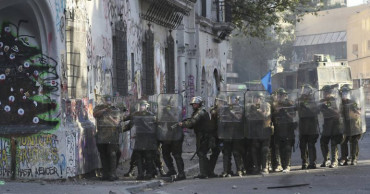
Rights groups protest ramming of protester in Chile
A video showing a protester being smashed between two Chilean police vehicles has inflamed complaints about the government's reaction to two months of continuing street demonstrations.
6 years ago