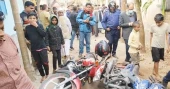
Lalmonirhat
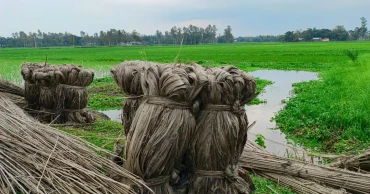
Low yields, uncertain prices worry jute farmers in Lalmonirhat
Jute farmers in Lalmonirhat are facing a difficult season as lower-than-expected yields and uncertainty over market prices raise fears of further losses.
Farmers fear that unless they receive a fair price that covers their production costs, many of them may lose interest in cultivating the “golden fibre” next year after suffering losses in recent seasons.
Jute has been cultivated this year in the char areas and villages of Aditmari, Kaliganj, Hatibandha, Patgram and Sadar upazilas of the district.
Farmers have shown particular interest in cultivating jute on unused and flood-prone land along the Teesta, Dharla and Saniajan rivers, as well as on some higher lands. Many have also planted jute on land where rice and other crops do not grow well.
However, their hopes for a good harvest have been dampened by adverse weather, waterlogging and disease, while uncertainty over market prices remains a major concern.
1 month ago
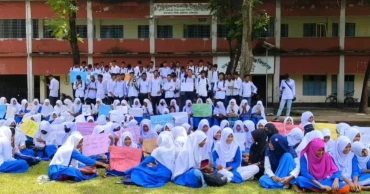
Students boycott classes at Lalmonirhat school over teacher shortage
Students of Dahagram Government High School in Patgram upazila of Lalmonirhat have boycotted classes and launched a protest, demanding the immediate appointment of teachers as the school is operating with only one teacher for nearly 600 students.
Students, guardians and local residents said the severe shortage of teachers has badly disrupted academic activities and is affecting the quality of education at the school.
This School is the only secondary educational institution in the border-enclave union of Dahagram. Students have to cross the historic Tin Bigha Corridor to reach the school.
Established in 1975 to ensure educational opportunities for local students, the school was brought under government management in 2013.
2 months ago

Accused escapes injuring 2 cops in Lalmonirhat
An accused escaped injuring two police officers during a drive at Gendukuri in Hatibandha upazila of Lalmonirhat district on Friday night.
The injured officers are-- Sub-Inspector (SI) Ruhul Amin and Assistant Sub-Inspector (ASI) Abdul Latif of Hatibandha Police Station.
Police said the accused, Rashedul Islam alias Rashed, son of Belal Hossain of Gendukuri village, was wanted in several cases, including theft charges.
A court had issued an arrest warrant against him.
Tipped off, SI Ruhul Amin and ASI Abdul Latif went to his house to arrest him, said Md Asaduzzaman, Superintendent of Lalmonirhat police.
At that time, Rashedul attacked the officers with a sharp weapon and fled the scene, leaving both policemen seriously injured, he said.
SI Ruhul Amin sustained severe injuries, including on his wrist and multiple parts of his body, while ASI Abdul Latif was also wounded.
On information, additional police rushed to the spot and rescued the injured officers.
They were first taken to Hatibandha Upazila Health Complex from where SI Ruhul Amin was shifted to Rangpur Medical College Hospital following deterioration of his condition.
Legal action will be taken against the accused, said SP Asaduzzaman.
3 months ago
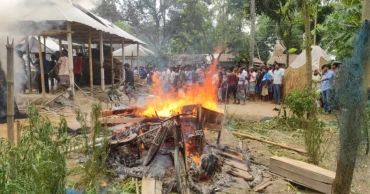
SP, OC among 20 injured as violence erupts over 'killing of child after rape' in Lalmonirhat
A village in Lalmonirhat’s Aditmari upazila turned into a battlefield on Tuesday as enraged residents clashed with police over the “rape and murder” of a seven-year-old girl, leaving at least 20 people, including the district’s superintendent of police (SP) and an officer-in-charge (OC), injured.
Violence erupted after police refused to hand over the prime suspect to the crowd. Seven vehicles were vandalised during the melee.
Nandini Kanto Roy, daughter of Nalini Kanto of Folimari village under Bhelabari union, was found dead in a maize field of the village in the morning, a day after she went missing on Monday afternoon.
Locals spotted muddy soil in the nearby maize field. Later, they dug up the spot, where they found the child's body stuffed inside a sack.
On information, police recovered the body and sent it to Lalmonirhat Sadar Hospital morgue for an autopsy.
Suspicion later fell on Bidhan Chandra Roy, 22, on of Ranjit Kumar Roy of the same village, after a local resident reportedly saw him returning from the maize field carrying a spade on Monday evening.
Later, agitated villagers swooped on his house and vandalised it while he was inside the house.
Policemen, who were present at the spot, took Bidhan into their custody.
However, locals demanded that Bidhan be handed to them for immediate punishment.
As police refused to hand him over to the protesters, they besieged the law enforcers and swooped on them.
As police swung into action, a clash broke out between the two sides, when chases and counter-chase took place for nearly three hours, turning the whole area into a battlefield.
3 months ago

Girl’s body recovered from sack in Lalmonirhat cornfield
Police on Tuesday recovered the body of a seven-year-old girl packed in a sack from a cornfield in Aditmari upazila of Lalmonirhat.
The deceased was Nandini ,daughter of Nolini Kanta of Folimari village under Velabari union.
According to police and locals, the girl went missing on Monday evening.
Despite repeated searches by her family and locals throughout the night and the following morning, she could not be traced.
Later suspicion arose when locals noticed unusually soft soil in a cornfield adjacent to her house.
The body was found wrapped in a sack and buried, they added.
Nazmul Haque, Aditmari Police Station Officer-in-Charge(OC), said police visited the spot after receiving the information and prepared an inquest report.
The body has been sent to Lalmonirhat Sadar Hospital morgue for autopsy.
3 months ago
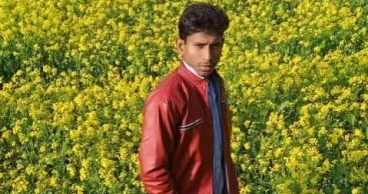
Bangladeshi killed in BSF firing in Lalmonirhat
A Bangladeshi national was killed after being shot by the Indian Border Security Force (BSF) at the Amjhol border in Hatibandha upazila of Lalmonirhat early Thursday.
The deceased was identified as Khademul Haque, 25, son of Amzad Hossain of the Amjhol area.
Locals said Khademul, along with several alleged smugglers, crossed into around 150 yards inside Indian territory when BSF personnel from the 78 Battalion’s Paglamari camp opened fire on them.
He sustained injuries to his face, chest and head in the firing.
Locals and his associates later brought him back to Bangladesh in a critical condition. He was taken to a clinic in Rangpur, where he died while undergoing treatment.
Lt Col Mehedi Imam, commanding officer of Border Guard Bangladesh (BGB) Lalmonirhat 15 Battalion, confirmed the incident.
He said BSF initially denied the firing allegation and a flag meeting at the company commander level has been convened in this regard.
Earlier on May 8, two Bangladeshi nationals were killed and at least 12 others injured in firing by the BSF along the Pathariadwar border in Kasba upazila of Brahmanbaria district.
4 months ago

Homebound for Eid, a family’s journey ends in tragedy on Lalmonirhat road
The joy of returning home for Eid-ul-Fitr turned into heartbreak for a family on Tuesday morning, as a road crash in Patgram claimed three lives including a child, underscoring the persistent dangers that shadow Bangladesh’s festive journeys.
One of the deceased was Shariful Islam, 34, an NGO worker from Monsapur village in Alihat union of Hakimpur upazila, Dinajpur. The other deceased were his wife and son.
The accident occurred near Mirzarkot Model Mosque while the family was returning home during the Eid holidays, Officer-in-Charge of Patgram Police Station said.
Shariful’s daughter was injured and taken to Rangpur Medical College Hospital.
According to police and local sources, Shariful was riding the motorbike with his wife and two children when the truck coming from the opposite direction hit them.
Shariful, his wife, and his son died on the spot.
6 months ago

Vegetable, fruit prices surge in Lalmonirhat during Ramadan
Prices of most vegetables and fruits have increased sharply in Lalmonirhat at the very beginning of the month of Ramadan, despite it being the peak season for many produce items.
A visit to different kitchen markets in Lalmonirhat town on Sunday showed that green chilli was selling at Tk 130 to Tk 170 per kilogram, up from Tk 70 to Tk 90 three days before Ramadan.
Cucumber prices have nearly doubled. Before Ramadan, cucumbers were selling at Tk 35 to Tk 40 per kg, but are now priced at Tk 60 while another local variety (khira) has jumped from Tk 30–40 to Tk 80 per kg.
Quilt makers race against time as bone-chilling cold grips Lalmonirhat
The price of eggplant has increased by Tk 20 to Tk 30 per kg. Previously available at Tk 30 to Tk 40, it is now being sold at Tk 70 per kg.
Tomato prices, which were below Tk 40 before Ramadan and rose to Tk 80 at the beginning of the month, have slightly declined to Tk 60 per kg. Although bottle gourd, cabbage and cauliflower are still selling below Tk 30, overall market instability persists.
Banana prices have risen abnormally with the start of Ramadan. Good quality bananas that previously sold at Tk 30 to Tk 40 per four-piece bunch are now being sold at Tk 60 to Tk 70.
Rezaul Karim, a resident of the Tushbhandar market area, said bananas are a daily necessity in his household and are especially important during Ramadan for iftar. “Even at higher prices, we are compelled to buy. Not only bananas, almost all fruits have become expensive,” he said.
Despite ample supply, winter vegetables costly in Lalmonirhat
7 months ago
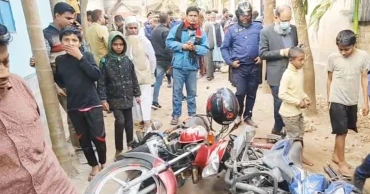
BNP-Jamaat clash in Hatibandha: 25 injured, motorcycles vandalised
At least 25 people were injured and several motorcycles vandalised in a clash between BNP and Jamaat activists in Hatibandha upazila of Lalmonirhat-1 constituency on Sunday, officials and locals said.
The clash took place in the Kasaitari area of Tongbhanga union in the afternoon during campaigning for the upcoming parliamentary elections.
Police and locals said female activists of Jamaat candidate Anwarul Islam Raju were campaigning for the scale symbol in the area when they visited the house of a BNP worker, Barrister Hasan Rajib Pradhan, and were reportedly stopped. A dispute ensued, which escalated into a clash.
Both sides allegedly attacked each other with bricks and sticks, leaving at least 25 people injured and vandalising four to five motorcycles.
Quilt makers race against time as bone-chilling cold grips Lalmonirhat
Hatibandha Police Station, Border Guard Bangladesh (BGB), and Rapid Action Battalion (RAB) personnel rushed to control the situation.
Returning Officer Deputy Commissioner HM Rakib Haider and Lalmonirhat Superintendent of Police Asaduzzaman also visited the site after receiving news of the incident and assured legal action.
Jamaat candidate Anwarul Islam Raju alleged that his female workers were campaigning peacefully when BNP supporters locked them in houses and beat them. “When our leaders and activists went to rescue the trapped workers, they were also beaten,” he added.
He mentioned that ten of his workers were injured, and several motorcycles vandalised.
“We will take legal action,” he said.
BNP candidate Barrister Hasan Rajib Pradhan denied the allegations, saying 15 of his workers were injured and claiming that Jamaat activists initiated the attack. “The opponent is trying to spoil the election atmosphere,” he alleged.
Despite ample supply, winter vegetables costly in Lalmonirhat
Hatibandha Police Station OC Shahin Mohammad Aman Ullah said the clash was due to a campaign-related dispute and the situation was now under control. “So far, no written complaint has been filed by either side,” he said.
Lalmonirhat Police Superintendent Asaduzzaman said several people from both sides were injured in the brickbat attacks and legal action is being taken.
8 months ago
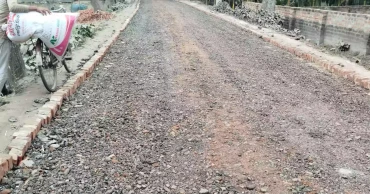
Crumbling roads in Kaliganj: Residents sound alarm over use of substandard materials
Concerns are mounting over the quality of a road reconstruction project in Kaliganj Upazila of Lalmonirhat district after allegations surfaced that substandard materials are being used in the government-funded work.
Local residents allege that low-quality brick chips are being used in the road’s base layer, casting doubt on its long-term durability.
The ongoing work involves reconstructing approximately 900 metres of road from Duhuli Bazar to Namurihat in Chawlbala Union.
Locals allege that the contractor is rushing the work using substandard and unnumbered brick chips (rabbish), ignoring repeated objections from the community.
Read more: Sylhet waterlogging mitigation project delayed again; sees 44pc cost surge
Residents are criticising the muted response of some officials and staff from the Kaliganj Upazila Engineering Office, questioning their accountability in monitoring the project.
Sources reveal that the road reconstruction is part of the Rural Road Maintenance Project, being implemented by the contractor Shan Traders, with a projected cost of Tk 7,524,690 under tender notice number 05/25-26.
The work started on December 31, 2025 and is scheduled for completion by March 31, 2026.
However, allegations suggest that the contractor is attempting to expedite the project through substandard work.
Local resident Mohammad Habib Mia expressed his frustration, saying, “They are laying the road with inferior brick chips. It will be destroyed in a short period, and we will face the same hardships as before. We have protested, but no one pays attention.”
A field visit on Monday afternoon confirmed the claims. Despite the presence of two assistant officers responsible for monitoring the project, substandard materials were being used openly.
Sub-Assistant Engineer Md. Simon, in charge of supervision, declined to comment when approached by the media.
Quilt makers race against time as bone-chilling cold grips Lalmonirhat
Attempts to reach the contractor, Mashiur Rahman, were unsuccessful, as he did not answer calls.
In response, Upazila Engineer Md Habibur Rahman Habib said instructions have been issued to remove the substandard material. If these directives are ignored, necessary action will be taken against the contractor, he added.
8 months ago