Tin Goyenda
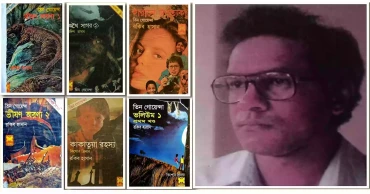
Under the dying yellow bulb: Rakib Hasan, our mentor of courage
When the restless heart that once beat with curiosity, mystery and endless imagination suddenly fell silent, it left more than just grief. It carved an untreatable wound where nostalgia of teenage years used to dwell with sweet melancholia.
This Wednesday, Rakib Hasan, the revered author of the Tin Goyenda series, breathed his last at Gonoshasthaya Nagar Hospital during dialysis. He had returned often, each visit a fragile thread keeping his light alive. But now, before treatment could even begin, death claimed him, causing us a great loss.
Destined to chase mystery
Rakib Hasan was born on December 12, 1950 in Cumilla. His childhood moved with his father’s transferable job, across Feni and beyond, but it was fueled by a world he carried inside, a world of shadows, enigma and bewilderment.
Initially, he completed schooling, tried uneventful regular work for a while. But the 9 to 6 life could never meet the needs of a soul meant to roam the unknown, to explore suspense and to chase anecdotes waiting to be told.
Some books do more than just telling stories. They hide in your backpack, peek from your desk, fold within a fat textbook, become your companions under a warm blanket and your secret friends when the afternoon outside becomes too loud. For those of us who grew up in the '90s and '00s, Tin Goyenda was all of that.
Launched in 1985, it was never just detective fiction. Inspired at first by Robert Arthur Jr.’s ‘The Three Investigators’, Rakib Hasan penned the series into a world for restless juvenile hearts.
Kishore, Musa, and Robin, through their laughter echoing under moonlit skies, courage flickering through dark forests, doubts trembling in shadowed corridors, became our invisible companions. They were our whispered wishes, our daring dreams of justice. Through their adventurous tales, we started believing that mysteries could be solved, truths uncovered and that friendship could conquer any fear.
And then there was Geogina "Jina" Parker. Spirited, mischievous, and fearless, she teased Musa, challenged the boys and yet brought warmth and loyalty that tied the group together. For us juveniles, she wasn’t just a character, she was the laughter in the night, the spark in our imaginations, the daring spirit that made flipping the pages of Tin Goyenda under the dim glow of a bedside lamp feel like sneaking into another world that we didn’t understand properly then.
Even now, when I pick up a yellowed book, spine-cracked and pages pale with time, a pang of nostalgia hits. An adolescence lost, yet alive within the adventures Rakib Hasan left behind. Over 400 books, including more than 150 Tin Goyenda volumes, were his gift. To many of us, those books are the worlds that will never fade.
Beyond 'Tin Goyenda'
It goes without saying that his imagination had no limits. Alongside works under his own name, he wrote as Zafar Chowdhury for the Romohorshok series and as Abu Sayeed for Goyenda Raju. He translated Tarzan, Arabian Nights, and other timeless adventures to bring the distant worlds into the hands of Bangladeshi juveniles.
His writings were never just mere stories of solving mysteries. They were lessons in courage, resilience and quiet bravery which worked like magic to shape the thoughts of young readers. Every tale had the heartbeat of childhood nights, the thrill of discovery, the whisper of courage hidden in shadows, constantly reminding us that even in darkness, something precious waits.
Now that voice has faded like the last soft echo of a bedtime story.
What remains now for the fans? A few faded pages, spines worn thin by love, margins filled with the handwriting of teens who are no longer unreasonable like they used to be. Those books once held beneath old mosquito nets, read by the trembling light of a dying yellow bulb, smelled like rain, mud, dust and multiple true friends. And somewhere between those lines, an entire generation found its courage, its laughter, its desire to live long and dream big.
Tin Goyenda, Goyenda Raju, Romohorshok, names that once echoed through morning schoolyards and late afternoon playgrounds, now rest like ghosts in our shelves, whispering the promises of a world that will never return.
Those tiny pocket books upheld a whole new world to us and helped understand too. They taught us that mystery was never just in the forest or the fog, it was in the ache of growing up, the fear of losing magic and the adamant hope that our heroes never die.
And yet, they did, just like Rakib Hasan, leaving us to wander like nomads through the dim corridors of memories, grappling his writings like torches that still flicker, even after the storyteller is gone.
A final goodbye
I remember sneaking a Tin Goyenda book under my blanket, heart pounding that my mom might find out, reading past midnight, desperate for just one more chapter. I remember the pride when someone asked, “Who solved it?” as if I had been a part of the adventure.
Even as tears fall, I am grateful to him for the laughter, the fear, the puzzles, the nights spent with his words. For understanding the fact that children deserve great stories and that even ordinary life can hold extraordinary wonders.
Goodbye, Rakib Hasan. You have gone, but your mysteries remain in our old dusty bookshelves, in aching hearts, in every juvenile’s pursuit of the unknown who grew up into adults reading your words.
May your divine soul find peace!
And, may your writings never lose their appeal!
11 months ago

Legendary Qazi Anwar Hussain and His Remarkable Creations
Today will be talking about a person, whose journey began in the mid-sixties of the last century and gained popularity in the 1980s to 1990s. Even in the 21st century, his popularity has not diminished. The person is none other than the creator of the Bangla thrill character Masud Rana. From “Rahasya Patrika” to “Kuasha” one person was involved in everything; He is Qazi Anwar Hussain.
Kazi Anwar Hussain single-handedly made the mystery-thriller genre popular in our country. He also made classical foreign literature available to the readers. As the life of his legendary spy Masud Rana, Qazi Anwar’s life was also colorful. On January 19, that colorful life came to an end.
Read 10 Most Useful Foreign Languages to Learn in 2022
Early life and Education of Qazi Anwar Hussain
Qazi Anwar Hussain was born on 19 July 1936 in Bagmara, Rajbari District (British India). His full name is Kazi Shamsuddin Anwar Hussain. The nickname was 'Nawab'. Anwar Hussain passed matriculation from St. Gregory School in 1952 and after that, completed his IA and BA from Jagannath College. He passed MA in Bengali Literature from Dhaka University in 1961. Anwar Hussain spent his childhood in the present residential area of Dhaka Medical College and Dhaka University.
After finishing his studies, he started singing regularly on the radio. His three sisters Sanjeeda Khatun, Fahmida Khatun, and Mahmuda Khatun are still deeply involved in Rabindra Sangeet. He was a music artist of Dhaka Betar from 1958 to 1966.
Read Top Bookstore Cafés in Dhaka: 6 Places Bringing Back the Joy of Reading
Family Life
Qazi Anwar Hossian married singer Farida Yasmin in 1962. The couple has one daughter and two sons. His daughter Shahreen Sonia is a vocalist. Eldest son Kazi Shahnoor Hussain and youngest son Maymur Hussain are involved in writing and publishing services.
Career
While everyone was looking for a job after MA, Anwar Hossian sat idly. In fact, he did not like to work under anyone. He decided to run a tea stall. Later he opened a tea shop called 'Baishakhi' in an empty room in a corner outside the house. After a few days, his father Qazi Motahar Hossian influenced him to start writing the story as Anwar Hossian wrote two stories while he was studying in IA. His life changed with the inspiration of his father. He started a new series with two of his stories, called ‘Kuasha’. Its later history is known to almost everyone. Then the writer no longer had to stay behind, just move forward.
Read Top 10 Historical Mosques in Bangladesh
In May 1963, he opened a press in Shegunbagicha with ten thousand taka given by his father. He bought a treadle machine for eight thousand taka and a typewriter with the rest of the money. Segunbagan Press began its journey with two employees, which was later renamed as Seba Prakashani.
Later, his publishing house played an important role in publishing paperback books in Bangladesh, translating world-renowned novels, and advancing the genre of teenage literature. Kuasha-1 was published in June 1964, marking the debut of Shegunbagan Publishing.
Seba Prokashoni
Segunbagan Press was later renamed Seba Prakashani. Its name was derived from the first two letters of the previous name ‘Segun’ and ‘Bagan.’ It was established in May 1963. Seba Prakashani, founded by Qazi Anwar Hussain, is now a well-known publishing house in Bangladesh. Not only the readers but Seba Prakashani has also made an outstanding contribution in making writers in Bangladesh.
Read Best Online Book Selling Websites in Bangladesh in 2021
Kuasha Series
Kuasha is the first series or book published by Seba Prakashani. Publication began in June 1964 and the chief author was Kazi Anwar Hussain. However, Sheikh Abdul Hakim has also written a few books. The first book published by Seba Prakashani is Kuasha-1 and the last book published in this series is Kuasha-78. A total of 78 books have been published under this series. This series is currently closed.
Masud Rana Series
It is a popular spy story series created by popular fiction writer Qazi Anwar Hussain. The first edition of the series was published in 1966. At present many ghostwriters are writing the Masud Rana series in the name of Kazi Anwar Hussain. From the first book named “Dhongsho Pahar '' in 1966, Seba Prakashani has published more than four hundred detective story books about Masud Rana's character. Although the first two books in the series are original, other books are inspired by the foreign books. That is why this series has so many books.
The character of Masud Rana was originally created by the author as a Bengali version of the James Bond character created by Ian Fleming. But at present, the series is on its way to retaining its place in the history of Bangla books.
Read Rich Dad Poor Dad– Worth Reading in Your Quarantine
Tin Goyenda Series
This is the most popular series published by Seba Prakashani. First published in 1985. Although it was originally published by Rakib Hasan, it has been written by Shamsuddin Nawab since 2003. This is a teenage series based on a foreign story. The first book was "Tin Goyenda.” The book was published as a teenage thriller and the series is a huge milestone in Bangla books history.
Rahasya Patrika
Rahasya Patrika is one of the most popular monthly magazines in Bangladesh. It was first published in 1970. After the independence of Bangladesh, this magazine started to be published regularly from 1984 under the editorship of Qazi Anwar Hussain.
Controversies
The Masud Rana series always had a tag 'For adults'. That must have added to the appeal of the series. So the first criticism against Qazi Anwar Hussain was that he was promoting sexual staff through Masud Rana Series. However, neither Anwar Hussain nor the readers showed any concern about it.
Read Think and Grow Rich by Napoleon Hill: Worth Reading in Your Quarantine
Towards the end of his life, the writer faced an unpleasant copyright case with Sheikh Abdul Hakim. On July 29, 2018, Abdul Hakim filed a complaint against Kazi Anwar Hussain, the proprietor of Seba Prakashan, claiming ownership of 260 books of the Masud Rana series and 50 books of the Kuasha series. Later the copyright office gave their decision favoring Abdul Hakim.
Final Words
Qazi Anwar Hussain was diagnosed with prostate cancer on October 31, 2021. Then faced a brain stroke and a heart attack. Later, he was placed on life support from January 10, 2022. He died on 19 January 2022 while on life support.
Although most of his novels and stories are based on foreign stories Qazi Anwar Hussain is a legendary name in Bangla as he created a reading habit in Bangladeshi Teenagers and youths. Qazi Anwar Hussain will remain in the hearts of those who have read, enjoyed, and will read ‘Tin Goyenda’ and ‘Masud Rana.’
Read 15 to get Bangla Academy Literature award 2021
4 years ago