World-Business

Japanese automaker Nissan says it plans job and production cuts in the U.S
Nissan is slashing production at its U.S. plants and offering buyouts to factory workers there as part of the Japanese automaker’s urgent efforts to return to profitability.
The move is part of Nissan Motor Corp.’s plans, announced two months ago, to slash 9,000 jobs globally, including in China, after it racked up a quarterly loss due to sinking sales and ballooning inventory.
At Nissan's plant in Smyrna, Tennessee, one production line will maintain two shifts, while the other line will consolidate to one shift, the company said.
The Smyrna plant makes Murano, Pathfinder and Rogue sport-utility vehicles and the Infiniti QX60 luxury model.
In the Canton plant in Mississippi, which makes the Altima sedan and Frontier pickup, Nissan is reducing the speed on one line and consolidating another.
In the Decherd plant in Tennessee, which makes engines, shift adjustments will be more gradual. Some will be maintained while others will be reduced by one shift, it said.
When it announced its recovery plan in November, Nissan didn’t give details on where the job cuts might come.
Asian stocks rise as DeepSeek panic fades
The workforce reduction of 9,000 people amounts to about 6% of its more than 133,000 global employees. The company also plans to slash its global production capacity by 20%.
Nissan, based in the port city of Yokohama, said the latest offers count toward its overall job reduction plans, and are designed to make its operations more efficient and flexible.
“Nissan is taking urgent measures globally to turnaround its performance and create a leaner, more resilient business capable of swiftly adapting to changes in the market,” the company said in a statement.
Separately, Nissan and Japanese rival Honda Motor Co. are working to form a joint holding company to integrate their businesses, planned for 2026.
Nissan and Honda announced in March they will work together on electric vehicles. In August, they said that partnership was being broadened. They plan to have a “definitive agreement” by June.
Nissan is set to release its October-December financial results on Feb. 13. Nissan stocks jumped 2% in Tokyo trading after the reports about the U.S. plans surfaced.
1 year ago
Asian stocks rise as DeepSeek panic fades
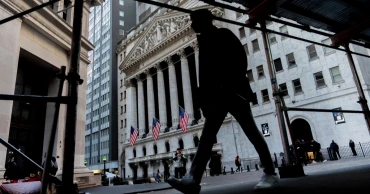
Asian stocks gained on Wednesday in subdued Lunar New Year trading, following a recovery on Wall Street driven by tech stocks, as concerns over Chinese AI company DeepSeek dissipated, reports AP.
Most Asian markets were closed for the holiday. Investors were turning their attention to the Federal Reserve’s upcoming interest rate decision. U.S. futures showed little movement, and oil prices declined.
Tech stocks slide as Chinese rival threatens AI industry; Nvidia falls 17%
In Tokyo, the Nikkei 225 index rebounded from Tuesday’s losses, rising 1% to 39,414.78.
Australia’s S&P/ASX 200 climbed 0.6% to 8,447.00, following data from the Australian Bureau of Statistics that revealed a 0.2% rise in the Consumer Price Index for the December 2024 quarter, the smallest increase since the June 2020 quarter during the COVID-19 downturn.
India's Sensex gained 0.7%, while Thailand’s SET index dropped 0.2%.
On Tuesday, tech stocks bounced back after suffering a drop on Monday due to doubts about the sustainability of the AI investment boom.
The S&P 500 increased by 0.9% to 6,067.70, recovering more than half of its earlier losses. The Dow Jones Industrial Average added 0.3% to 44,850.35, and the Nasdaq composite surged 2% to 19,733.59 after falling 3.1% the previous day.
The focus remained on Nvidia, whose chips are central to the AI boom. The stock rose 8.8% after a nearly 17% drop on Monday, its worst plunge since the 2020 COVID crash.
Other AI-related companies also saw steadier performance, including Broadcom, which rose 2.6%. Constellation Energy gained 1.4% after a sharp 21% drop on Monday. The company had earlier surged due to expectations it would supply electricity to the growing AI data center industry.
Asian shares gain after S&P 500 climbs to a record and Bank of Japan raises rate
These revenue prospects were threatened when DeepSeek, a Chinese firm, claimed to have developed a large language model that can compete with U.S. rivals at a much lower cost. This raised doubts about the future demand for AI chips and electricity.
AI-related stocks had been Wall Street’s biggest performers in recent years, driven by the belief that AI spending would continue to rise. However, concerns have emerged that stock prices may have risen too quickly.
The impact of DeepSeek’s development on the AI industry remains unclear. While it could reduce growth in demand for data centers, electricity, and chips, it may stimulate growth in other sectors.
Later this week, major companies such as Apple, Meta Platforms, Microsoft, and Tesla are expected to report their earnings.
A U.S. report showing weaker-than-expected consumer confidence had minimal impact on the bond market. The key event of the day was the Federal Reserve’s interest rate decision, which is expected to leave the federal funds rate unchanged. If this holds, it would mark the first meeting since September without a rate cut aimed at stimulating the economy.
On Wednesday, U.S. benchmark crude oil fell by 8 cents to $73.69 per barrel. Brent crude, the international standard, lost 12 cents, to $76.37 per barrel.
In currency markets, the U.S. dollar dropped to 155.21 Japanese yen from 155.53 yen. The euro was valued at $1.0437, up from $1.0432.
1 year ago

Tech stocks slide as Chinese rival threatens AI industry; Nvidia falls 17%
Wall Street’s tech giants faced sharp declines on Monday amid concerns over a Chinese competitor potentially disrupting the booming artificial intelligence (AI) sector.
The S&P 500 dropped 1.7% in afternoon trading, on course for its steepest loss in over a month. Tech-heavy Nasdaq Composite took a significant hit, falling 3.2%, as major technology stocks suffered. Nvidia led the slide, plummeting 16%, AP reports.
In contrast, industries outside the AI sector showed resilience. The Dow Jones Industrial Average rose by 137 points, or 0.3%, at 12:42 pm Eastern Time. The Dow's smaller exposure to tech helped cushion its performance compared to the S&P 500 and Nasdaq.
Chinese challenger DeepSeek shakes AI market
The market turbulence stemmed from China, where a company named DeepSeek announced the development of a large language model rivaling US tech leaders at a fraction of the cost.
DeepSeek's app reached the top spot among free apps on Apple’s App Store by Monday morning, a feat considered remarkable given US restrictions on China’s access to advanced AI chips.
Despite the buzz, skepticism remains over DeepSeek's ability to significantly disrupt the AI ecosystem. Questions persist about how it may have bypassed US chip export restrictions and what hardware it used to develop its model.
Asian shares gain after S&P 500 climbs to a record and Bank of Japan raises rate
Dan Ives, an analyst at Wedbush Securities, remarked, “It remains to be seen if DeepSeek found a way to work around these chip restriction rules and what chips they ultimately used. There will be many skeptics around this issue, especially given the information is coming from China.”
The ripple effects of DeepSeek's announcement were felt across global markets. In Amsterdam, Dutch chipmaking equipment producer ASML saw a 7% decline, while in Tokyo, SoftBank Group Corp slid 8.3%. SoftBank's drop follows its recent partnership announcement, backed by the White House, to invest up to $500 billion in AI infrastructure.
On Wall Street, shares of Constellation Energy plunged 19.3%. The company had planned to restart the dormant Three Mile Island nuclear power plant to provide energy for data centres operated by Microsoft.
Investors sought safer alternatives amid the market volatility, leading to a rally in bonds. The yield on the 10-year Treasury note fell from 4.62% late Friday to 4.54% on Monday.
The AI sector, previously a major driver of market growth, experienced a sharp reversal. Companies such as Nvidia, which saw its stock skyrocket from under $20 to over $140 within two years, bore the brunt of the sell-off.
Other leading tech firms, often referred to as the "Magnificent Seven" — Alphabet, Amazon, Apple, Meta Platforms, Microsoft, Nvidia, and Tesla — have collectively dominated the market. They accounted for over half of the S&P 500’s total returns last year, according to S&P Dow Jones Indices.
The heavy reliance on a few tech giants has heightened the market's "concentration risk," experts say. Brian Jacobsen, chief economist at Annex Wealth Management, warned, “This can feel good when those few names are on the ascent, but it is even more dangerous when disruptions take place.”
However, Jacobsen urged against overreacting to Monday’s sell-off. “It’s possible the news out of China is overstated, and we could see a reversal. Even if true, it could present new investment opportunities,” he added.
US stocks hover near records during quiet Thursday
The market's next moves may depend on upcoming earnings reports from major players, including Apple, Meta Platforms, Microsoft, and Tesla. These companies are scheduled to disclose their fourth-quarter results later this week.
Pressure remains on corporations to deliver robust profits, especially as rising Treasury yields have made bonds more attractive. Higher bond yields often weigh on stock prices by increasing the opportunity cost of investing in equities.
So far, corporate earnings have generally exceeded expectations. AT&T’s shares rose 6% on Monday after the company reported better-than-anticipated results.
Outside the US, market responses were less dramatic. European indexes saw modest declines, with France’s CAC 40 dipping 0.3% and Germany’s DAX losing 0.5%.
In Asia, China’s Shanghai Composite edged 0.1% lower after a survey revealed a five-month low in export orders for Chinese manufacturers.
Later this week, the Federal Reserve will convene its latest policy meeting. Recent economic data suggest the Fed is unlikely to cut interest rates, with traders widely expecting it to hold steady.
1 year ago
Asian shares gain after S&P 500 climbs to a record and Bank of Japan raises rate
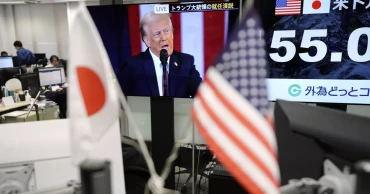
Asian shares advanced Friday after U.S. stocks rose to a record and the Bank of Japan raised its key lending rate.
U.S. futures edged lower and oil prices fell after U.S. President Donald Trump called on oil-producing countries to reduce the price of crude, which would ease worries about inflation.
Markets showed little obvious reaction to Trump's most recent comments about imposing higher tariffs on products from China and other countries.
Tokyo's Nikkei 225 index gained 0.3% to 40,074.87 after the central bank raised its benchmark rate to about 0.5% from 0.25%, as widely expected. It is the highest level for the rate since 2008, as the Bank of Japan shifts out of a long spell of extreme low interest rates meant to spur more borrowing and spending.
Just before the decision, statistics from the government showed the core inflation rate increased to 3% year-on-year in December, reaching the highest level in 16 months and was above the central bank’s 2% target.
The dollar dropped against the Japanese yen, trading at 155.24 yen, down from 156.06 yen.
The Hang Seng in Hong Kong added 1.8% to 20,057.46 and the Shanghai Composite index rose 0.7% to 3,253.79. In South Korea, the Kospi gained 0.6% to 2,530.56. Australia’s S&P/ASX 200 advanced 0.4% to 8,408.30.
Read: Asian shares mixed as Big Tech drops affect Wall Street
On Thursday, the S&P 500 climbed 0.5% to 6,118.71, surpassing its record set early last month. It was the seventh gain in eight days for the main measure of Wall Street’s health. The Dow Jones Industrial Average piled on 0.9% to 44,565.07, while the Nasdaq composite added 0.2% to 20,053.68.
The gains came amid relatively calm moves for Treasury yields in the U.S. bond market. Big swings there in recent months have been shaking the stock market, particularly when rising worries about inflation and the U.S. government’s heavy debt send Treasury yields higher.
Treasury yields took a brief turn upward after President Donald Trump began talking about the prospect of tariffs in a speech by video at the World Economic Forum, saying products made outside of the United States will be subject to a tariff, but they pulled back after he gave few details.
The yield on the 10-year Treasury climbed to 4.64% from 4.61% late Wednesday, though it remains below its high from earlier this month. The two-year Treasury yield eased to 4.29% from 4.30% late Wednesday.
Yields earlier in the day had held relatively steady after a report showed slightly more U.S. workers applied for unemployment benefits last week than economists expected. While the numbers increased, “they were well within the modest range established in recent months,” according to Chris Larkin, managing director, trading and investing, at E-Trade from Morgan Stanley. “Employment continues to highlight US economic outperformance.”
Traders don’t expect the report to push the Federal Reserve to cut its main interest rate at its upcoming meeting next week, according to data from CME Group. If they’re correct, it would be the first meeting since September where the Fed hasn’t lowered the federal funds rate to take pressure off the U.S. economy. Lower rates can goose prices for investments, but they can also give inflation more fuel.
In the cryptocurrency market, where prices have surged on hopes President Donald Trump will make Washington friendlier to the industry, bitcoin fell below $103,000, according to CoinDesk. It had set a record above $109,000 on Monday.
Read more: Asian shares decline amid concerns over rate cuts and tariffs
In other dealings early Friday, U.S. benchmark crude oil shed 13 cents to $74.49 per barrel. Brent crude, the international standard, lost 13 cents to $78.16 per barrel.
The euro rose to $1.0449 from $1.0416.
1 year ago

US stocks hover near records during quiet Thursday
US stocks are hovering near record levels on Thursday amid a relatively uneventful day on Wall Street, reports AP.
The S&P 500 rose 0.2% in midday trading, poised to surpass its all-time high set last month after nearing it the previous day. As of 11:30 a.m. Eastern time, the Dow Jones Industrial Average was up 236 points, or 0.2%, while the Nasdaq composite slipped by 0.2%.
Japan's exports hit record high, but trade deficit continues
Global markets showed similarly subdued activity, despite China’s latest efforts to boost stock prices in the world’s second-largest economy. For instance, Hong Kong stocks briefly gained after China directed pensions and mutual funds to increase investments in domestic equities. However, the Hang Seng index ended down 0.4%.
This relative calm extended to the U.S. bond market, where Treasury yields were mixed. Recent sharp movements in bond yields have impacted stocks, particularly when inflation concerns and high U.S. debt levels drove yields higher. However, bond investors took the latest economic data in stride.
Asian shares show mixed performance following Trump inauguration
The data revealed that slightly more Americans applied for unemployment benefits last week than economists anticipated, but the figures remained within the modest range observed in recent months, according to Chris Larkin, managing director of trading and investing at E-Trade from Morgan Stanley. “Employment continues to underscore U.S. economic outperformance,” he added.
Traders largely believe the report won’t compel the Federal Reserve to adjust its main interest rate during next week’s meeting, based on CME Group data. If this holds true, it will mark the first time the Fed has refrained from lowering rates since September, when it began easing them to support the economy. While lower rates can boost investment prices, they may also fuel inflation.
Treasury yields briefly rose after President Donald Trump discussed potential tariffs at the World Economic Forum, but quickly retreated as details were sparse. A major global concern has been the potential disruption to trade if Trump imposes significant tariffs.
China's economy grows 5% in 2024
The yield on the 10-year Treasury increased to 4.63% from 4.61% late Wednesday, remaining below its earlier monthly peak. Meanwhile, the two-year Treasury yield, which reflects expectations for Fed actions, dipped to 4.28% from 4.30%.
On Wall Street, GE Aerospace surged 6.8% following a stronger-than-expected quarterly profit report. Orders for its airplane engines and services rose by 50% year-over-year to $12.9 billion.
Netflix was another major contributor to the S&P 500’s gains, climbing 2.4% after a 9.7% jump the day before due to an upbeat earnings report.
Conversely, American Airlines fell 7.9% despite surpassing profit and revenue expectations for the latest quarter. The airline warned it might post a larger-than-expected loss in early 2025 and provided a full-year profit forecast with a midpoint below analysts’ predictions.
Video game maker Electronic Arts plunged 18.2% after forecasting slower revenue growth for its soccer game, EA Sports FC25. It also reported lower-than-expected engagement for its Dragon Age game, further impacting revenue.
In international markets, Japan’s Nikkei 225 rose 0.8%, despite a sharp decline for Fuji Media Holdings. This followed the announcement that Masahiro Nakai, a prominent TV host and former pop star, would retire over sexual assault allegations, which have shaken Japan’s entertainment industry. The controversy caused a wave of lost advertising at one of the networks he worked for.
In the cryptocurrency market, bitcoin traded just below $105,000, according to CoinDesk, after setting a record above $109,000 on Monday. Prices have surged on speculation that President Donald Trump will adopt a more favourable stance toward the industry.
1 year ago

Japan's exports hit record high, but trade deficit continues
Japan saw record-high exports last year, as its annual trade deficit declined 44% from the previous year, the Finance Ministry reported Thursday.
The trade deficit, which measures the value of exports minus imports, totaled 5.3 trillion yen ($34 billion), according to government data, as imports ballooned on the back of rising energy costs and growing inflation around the world.
Exports from the world’s third-largest economy totaled 107.9 trillion yen ($691 billion), surpassing the 100 trillion yen mark for the second-straight year, and the biggest value on record for comparable data, which dates back to 1979, the ministry said.
Some companies may have sped up their exports in anticipation of potential tariffs by U.S. President Donald Trump.
Trump has said he expects to put 25% tariffs on Canada and Mexico starting Feb. 1. During his campaign, he threatened to impose tariffs on imports from China, although details on that remain unclear.
Read: Asian shares show mixed performance following Trump inauguration
For the month of December, exports gained a greater-than-expected 2.8% on-year, while imports rose 1.8%. Exports grew to Asian and European nations, while dipping slightly to the U.S.
Imports grew most from India, Hong Kong and Iran.
Demand was especially strong for Japan's vehicles, semiconductors and other machinery.
The weakening yen, another recent trend, has the effect of inflating the value of imports. The U.S. dollar has been hovering at 150-yen levels, sometimes surpassing 160 yen, over the past year, while a year ago it was often at 140-yen levels.
Japan has recorded a trade deficit for four straight years, but last year's deficit was considerably smaller than the 9.5 trillion yen deficit for 2023.
1 year ago
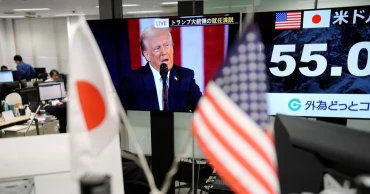
Asian shares show mixed performance following Trump inauguration
Asian shares traded with mixed results in a generally subdued session on Tuesday, despite expectations for market movements following the inauguration of U.S. President Donald Trump, reports AP.
While some analysts suggested the inauguration could boost global market optimism, others cautioned that potential tariffs could dampen Asian economies. U.S. markets remained closed on Monday for the Martin Luther King Jr. Day holiday.
China's economy grows 5% in 2024
Japan's Nikkei 225 index slipped 0.1% to 38,951.77 during morning trading. Australia's S&P/ASX 200 rose 0.5% to 8,392.80, while South Korea's Kospi dipped 0.2% to 2,514.06.
Concerns regarding Trump's policies towards China have somewhat eased, as both nations expressed commitments to improving relations. Trump refrained from announcing immediate tariff measures on Chinese exports to the U.S.
Hong Kong's Hang Seng index climbed 0.4% to 20,012.25, while the Shanghai Composite fell 0.3% to 3,233.85.
“In a surprising turn that eased global market concerns, President Trump indicated he would not impose new tariffs immediately, contrary to earlier expectations,” remarked Stephen Innes, managing partner at SPI Asset Management.
Americans to experience economic pain from Trump tariffs: Canada
Reflecting some market optimism over potential executive actions to stimulate the U.S. economy, U.S. stock market futures edged higher.
In other developments, shares of Fuji Media Holdings—affiliated with prominent Japanese broadcaster Fuji TV—fell during morning trading. The drop followed announcements by several companies, including Toyota Motor Corp., to halt advertising during Fuji TV programmes amidst a sex scandal reported by the weekly magazine Shukan Bunshun.
In energy markets, benchmark U.S. crude slipped $1.14 to $76.74 a barrel, while Brent crude, the international standard, rose 13 cents to $80.28 a barrel.
Germany's economy shrinks again
Currency trading saw modest moves, with the U.S. dollar weakening slightly amid uncertainty surrounding Trump's tariff plans. The dollar declined to 155.14 Japanese yen from 155.61 yen. The euro traded at $1.0389, down marginally from $1.0419.
1 year ago

China's economy grows 5% in 2024
China's economy grew at an annual rate of 5% in 2024, meeting Beijing's "around 5%" growth target, though slower than the previous year.
This performance was driven by robust exports and recent stimulus measures, reports AP.
Americans to experience economic pain from Trump tariffs: Canada
The government reported Friday that the economy accelerated in the fourth quarter, with a 5.4% growth rate from October to December. Export activity surged as businesses and consumers sought to preempt potential tariff increases by U.S. President-elect Donald Trump on Chinese goods.
“The national economy was generally stable, with steady progress and notable achievements in high-quality development,” the National Bureau of Statistics (NBS) stated. The report credited timely implementation of policy measures for boosting public confidence and facilitating a significant economic recovery.
Manufacturing played a key role in the growth, with industrial output rising 5.8% year-on-year. Retail sales of consumer goods increased by 3.5% annually, while exports grew 7.1% and imports rose 2.3%.
Germany's economy shrinks again
Despite these gains, China's economy faces challenges, including weaker consumer spending, deflationary pressures, and a struggling property sector, historically a major growth driver. The economy grew at 5.2% in 2023, and experts anticipate a further slowdown in coming years.
According to Zichun Huang of Capital Economics, recent policy easing helped the economy regain momentum in the last quarter of 2024. Huang noted, “Increased fiscal spending should continue to support activity in the near term, though growth is likely to slow in 2025 due to potential U.S. tariff hikes and structural imbalances.”
China’s aging and declining population adds to its economic pressures. The population dropped for the third consecutive year in 2024, reaching 1.408 billion—a decline of 1.39 million from the previous year. Rising living costs, coupled with stagnant wages, have led many young Chinese to delay or forgo marriage and parenthood, exacerbating demographic challenges.
Some analysts question the accuracy of China’s official growth figures. Cornell University economist Eswar Prasad remarked, “The official growth target’s exact achievement is doubtful, given widespread indicators of weak economic activity and financial stress.” He cited low domestic demand, deflationary pressures, and an unfavourable global environment as major hurdles.
President-elect Trump has pledged to increase U.S. tariffs on Chinese imports, while the outgoing Biden administration recently tightened restrictions on exports of advanced semiconductors and technologies to China, aiming to maintain the U.S. lead in innovation.
In response, China’s government has introduced various stimulus measures, including reducing bank reserve requirements, lowering interest rates, and advancing budget allocations for infrastructure projects. Authorities have also instructed banks to support indebted property developers.
Fu Linghui, NBS spokesperson, emphasised the importance of boosting consumption and domestic demand in 2025. “With coordinated efforts between existing and incremental policies, economic recovery momentum is building, consumer demand recovery has accelerated, and favourable conditions for moderate price rebounds are increasing,” Fu said.
To revive domestic demand, Beijing has expanded a trade-in programme for consumer goods and raised salaries for millions of government employees. However, economists stress the need for broader structural reforms to enhance productivity and reduce reliance on construction and export manufacturing.
Concerns persist about private sector confidence, which has been shaken by years of unpredictable policy changes. Additionally, weak social safety nets, declining housing prices, and subdued stock market performance have dampened household spending.
“China needs a comprehensive and well-coordinated policy package to revitalise growth,” Prasad advised. Such measures should combine substantial monetary and fiscal stimulus with reforms to rebuild private sector confidence and support long-term economic sustainability.
1 year ago

Americans to experience economic pain from Trump tariffs: Canada
Canada's energy minister came to Washington this week to warn U.S. lawmakers about President-elect Donald Trump's tariffs threat on Canada: They'd inflict economic pain on Americans, with higher prices and job losses.
Jonathan Wilkinson, Canada's minister of energy and natural resources, said he feels obligated to sound the alarm about the inflationary risks being created by a president who was elected in large part on the promise of bringing down prices.
"It will mean higher gas prices, it will mean higher food prices, it will mean higher natural gas prices for heating people's homes,” he told The Associated Press on Wednesday. “It will mean higher electricity prices. That's not something Donald Trump campaigned on. He campaigned on actually reducing the price of energy.”
Trump has threatened to impose sweeping 25% tariffs on Canada as well as on Mexico. He's also threatened tariffs on China and Europe, creating a sense of uncertainty about whether this is simply a negotiating ploy or a massive restructuring of U.S. foreign relations.
Trump and his team in recent days have doubled down on his promise to impose tariffs on other nations and downplayed the risk of higher inflation.
“In his first term, President Trump instituted tariffs that created jobs, spurred investment, and resulted in no inflation," said Karoline Leavitt, a transition spokesperson who is also the incoming White House press secretary. "President Trump will work quickly to fix and restore an economy that puts American workers first by re-shoring American jobs, lowering inflation, raising real wages, lowering taxes, cutting regulations, and unshackling American energy.”
Canada is looking at putting retaliatory tariffs on American orange juice, toilets and some steel products if Trump follows through with his threat. When Trump imposed higher tariffs during his first term in office, Canada announced billions of dollars in new duties in 2018 against the U.S. in a tit-for-tat response to new taxes on Canadian steel and aluminum. The dispute never triggered broader inflation across the economy, even if it exacted higher costs for some.
But by targeting America's second largest trading partner after Mexico, Trump risks upending the markets for autos, lumber and oil — all of which could carry over quickly to consumers.
“I do think that people just need to understand that we're going down a path right now that will elevate the cost of living for people in the United States for no benefit," Wilkinson said. "Zero benefit.”
Read: UK inflation unexpectedly eased in December
Wilkinson is considering a run to lead the Liberal Party in Canada after Prime Minister Justin Trudeau announced his resignation this month. He expects to make a decision at the end of the week.
While Trump has said he would announce tariffs immediately after taking the oath of office Monday, it's still not publicly clear what that would actually entail. It's possible he could simply announce intentions to put in tariffs, phase them in on a schedule or simply declare an economic emergency to justify higher taxes on imports.
Trudeau said Wednesday that "nothing is off the table” when it comes to responding to proposed tariffs, but no single region of the country should bear the full brunt from that response. He held a five-hour meeting in Ottawa with the country’s premiers to discuss Trump’s threats.
Even though Trump has signaled a willingness to act on his own, Democrats are looking to place legislative guardrails on his ambitions — a sign that they take the kinds of scenarios being outlined by Canada, Mexico and others seriously.
Reps. Suzan DelBene, D-Wash., and Don Beyer, D-Va., introduced legislation Wednesday that would roll back the International Emergency Economic Powers Act, which gives the president authority to impose sanctions on hostile foreign nations that pose an emergency threat to the U.S.
DelBene said on a call with reporters to preview the legislation that Trump's tariffs constitute a “nationwide sales tax on foreign goods that saddles families with higher prices." “This is the textbook definition of a trade war," she said.
Despite Trump's claim that the U.S doesn't need Canada, a quarter of the oil America consumes per day is from there.
Wilkinson said that, in addition to consumer prices increasing, the U.S. could face job cuts in areas that process Canadian energy products, including the Midwest and Gulf states. "If you don't have access to Canadian gas, you can't do that. The same is true with potash.”
The threat from Canada comes as concerns over the impact of Trump’s tariff proposals on the U.S. economy and inflation mount in business boardrooms, on Wall Street trading floors and among Federal Reserve officials. The Fed has already indicated it is worried tariffs could slightly lift U.S. inflation.
Read more: Germany's economy shrinks again
Neel Kashkari, president of the Fed’s Minneapolis branch, said Wednesday that a one-time tariff imposed by the U.S. likely wouldn’t worsen inflation much in the long run. But once other countries retaliate, Kashkari said, the impact could worsen.
“If there’s tit-for-tat, that becomes much more complicated to try to forecast, what is the imprint of that on actual inflation going forward,” he said.
Wilkinson said, “My focus is actually to try and get us away from the conversation on tariffs, which I would say is lose-lose."
1 year ago

Germany's economy shrinks again
Germany, Europe’s largest economy, saw its economy shrink for the second year in a row in 2024, based on preliminary official data published Wednesday, just weeks ahead of an election where the economy is the central focus, reports AP.
The Federal Statistical Office reported a 0.2% decline in gross domestic product last year, following a contraction in 2023. Ruth Brand, the office's head, stated that the economy is estimated to have shrunk by 0.1% in the fourth quarter compared to the preceding three months. However, this is a provisional estimate as complete economic data for December are still pending.
Asian stocks mixed ahead of US inflation data
Germany's economic struggles have been compounded by external disruptions and domestic challenges, including bureaucratic hurdles and a lack of skilled workers, with politicians divided over solutions.
The government led by Chancellor Olaf Scholz collapsed in November after Scholz dismissed his finance minister over disagreements on revitalising the economy, prompting an early election set for Feb. 23.
Asian shares mixed as Big Tech drops affect Wall Street
Candidates vying to form the next government have presented differing strategies to reinvigorate the economy.
1 year ago