Asia

Malaysian ex-PM Muhyiddin arrested, faces graft charges
Malaysia's former Prime Minister Muhyiddin Yassin has been arrested and will be brought to court to face corruption charges, the anti-graft agency said Thursday.
Muhyiddin, who led Malaysia from March 2020 until August 2021, will be the country's second leader to be indicted after leaving office. Ex-Prime Minister Najib Razak was hit with multiple graft charges after he lost in 2018 general elections, and began a 12-year jail term in August after losing his final appeal in the first of several trials.
The anti-graft agency said Muhyiddin will face several charges Friday related to alleged abuse and money laundering linked to government projects awarded under his rule.
Muhyiddin, 75, went to the anti-graft agency earlier Thursday to answer questions for the second time in three weeks. He was first questioned in February over the award of projects, including COVID-19 economic aid programs.
Prime Minister Anwar Ibrahim, who took power after November's general elections, had ordered a review of government projects approved by past administrations for allegedly not following the rules.
Two senior leaders from Muhyiddin's Bersatu party were also recently charged with graft. The anti-graft agency froze Bersatu's bank accounts for investigations into alleged illegal proceedings.
Muhyiddin, who leads a strong Islamic-dominated opposition, has denied any wrongdoing and accused Anwar's government of trying to crush the opposition ahead of state elections.
3 years ago
Nepal to elect new president amid political uncertainty
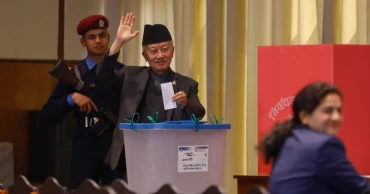
Nepal's parliament members lined up Thursday to elect a new president, the third since the Himalayan nation abolished a centuries-old monarchy and became a republic.
The election of the president has fueled feuds among the main political parties and triggered political uncertainty.
A total of 884 members of the federal parliament and provincial assemblies gathered in the capital, Kathmandu, to vote for the new president. The final results were expected to be announced Thursday night.
Both candidates in the presidential race are prominent career politicians.
Ram Chandra Poudel is a senior leader of the Nepali Congress party and previously served as the Speaker of the House of Representatives.
His opponent, Subash Chandra Nembang of the Communist Party of Nepal (Unified Marxist Leninist), has also previously served as Speaker.
The national election in November last year left a hung parliament, leading to a fragile coalition government taking power.
Prime Minister Pushpa Kamal Dahal's decision to support a candidate outside the coalition partners led to the alliance's biggest party pulling its support. As a result, Dahal was forced to seek a confidence vote in parliament later this month.
Analysts say the presidential election and confidence vote could lead to further instability.
“The phase of political instability in Nepal has not ended despite the fact we had a successful national election and a new coalition government in place,” said Dhruba Adhikary, an independent analyst in Kathmandu.
Besides facing the vote of confidence, Dahal also lost the support of three key political parties that were part of the initial coalition government.
His tenure has had a rocky start even before he could address key issues facing the country of 30 million.
Nepal is still struggling to recover from the economic troubles brought by COVID-19, which led to a drop in the number of foreign tourists coming to climb the country's mountain peaks and hike its trails. Reviving tourism is necessary to bolster Nepal's economy.
Dahal also must balance relations between Nepal's two giant neighbors, India and China. Both New Delhi and Beijing compete for influence in the tiny Himalayan nation.
Nepal's new prime minister typically begins his or her tenure with a visit to one of these countries, but Dahal has not yet announced any such plans.
Political turmoil and frequent changes in government are nothing new in Nepal, where eight different governments have ruled in the past 10 years.
3 years ago

China's Xi calls for 'more quickly elevating' armed forces
China's leader Xi Jinping has called for "more quickly elevating the armed forces to world-class standards," in a speech days after he warned the country was threatened by a U.S.-led campaign of "containment, encirclement and suppression of China."
China must maximize its "national strategic capabilities" in a bid to "systematically upgrade the country's overall strength to cope with strategic risks, safeguard strategic interests and realize strategic objectives," Xi said Wednesday.
His remarks to delegates in the ceremonial parliament representing the People's Liberation Army, the military wing of the ruling Communist Party, and the paramilitary People's Armed Police, were carried by the official Xinhua News Agency.
Read more: Will China's next premier be a moderating influence on Xi?
Xi made a series of calls to accelerate the build-up of self-reliance in science and technology, bolster strategic capabilities in emergency fields, make industrial and supply chains more resilient and make national reserves "more capable of safeguarding national security."
The program laid out by Xi dovetails with a number of national strategies already underway, including the "Made in China 2025" campaign to make China dominant in 10 key fields from integrated circuits to aerospace, and a decades-old campaign for civilian-military integration in the economy.
Xi also mentioned the need for "achieving the goals for the centenary of the PLA in 2027," a date by which, according to some U.S. observers, China intends to have the capability of conquering self-governing Taiwan, an American ally, by military means.
Read more: China accuses Washington of trying to block its development
China has defined the centenary goals in mostly vague terms, such as greater "informatization" and raising the PLA to "world-class standards."
China needs to build "a strong system of strategic deterrent forces, raise the presence of combat forces in new domains and of new qualities, and deeply promote combat-oriented military training," according to a speech Xi gave last year.
China's defense budget has roughly doubled over the past decade, allowing it to maintain the world's largest standing military, with 2 million members, the world's largest navy by number of ships, and the largest missile and aviation forces in the Indo-Pacific.
His most recent comment came after a speech Monday to delegates attending the annual session of the rubber-stamp National People's Congress, that indicated Chinese frustration with U.S. restrictions on access to technology and its support for Taiwan and regional military blocs in unusually blunt terms.
"Western countries led by the United States have implemented all-round containment, encirclement and suppression of China, which has brought unprecedented grave challenges to our nation's development," Xi was quoted as saying by the official Xinhua News Agency.
A State Department spokesperson, Ned Price, responded by saying Washington wants to "coexist responsibly" within the global trade and political system and has no intention of suppressing China.
"This is not about containing China. This is not about suppressing China. This is not about holding China back," Price said in Washington. "We want to have that constructive competition that is fair" and "doesn't veer into that conflict."
3 years ago

Indonesia landslide deaths climb to 21; dozens still missing
Rescuers recovered more bodies buried under tons of mud from a landslide that crashed onto a hilly village on Indonesia’s remote Natuna islands, bringing the death toll to 21, officials said Thursday.
The landslide, triggered by torrential downpours, plunged down surrounding hills on Monday, burying 30 houses in Genting village on a tiny remote island in the Natuna archipelago at the edge of the South China Sea, the National Search and Rescue Agency said in a statement.
Authorities have deployed more than 200 rescuers from the search and rescue agency, police and military to search for 33 people still missing who were apparently trapped in houses that were buried under the landslide, which was 4 meters (13 feet) deep, it said.
Eight people were pulled out alive with injuries, three of whom are in critical condition, National Disaster Management Agency chief Suharyanto said Thursday. They were rushed late Monday to a hospital in Pontianak city on Borneo island, about 300 kilometers (186 miles) from Genting, but one person died at sea on the way.
The search and rescue operation has been hampered by heavy rains around the disaster site. Weather has forced the search effort to be halted several times, while downed communications lines and electricity are also impeding the operation, said Suharyanto who, like many Indonesians, uses a single name.
“We are doing our best to find the missing victims,” Suharyanto said, adding that sniffer dogs are also being mobilized in the search.
Two helicopters and several vessels carrying rescuers, medical teams and relief supplies, including tents, blankets and food arrived on the island from Jakarta and nearby islands on Wednesday.
Monday’s landslide displaced about 1,300 people who were taken to four temporary shelters, Suharyanto said. Authorities feared the death toll could still rise.
Seasonal rains and high tides in recent days have caused dozens of landslides and widespread flooding across much of Indonesia, a chain of 17,000 islands where millions of people live in mountainous areas or near fertile flood plains close to rivers.
In November 2022, a landslide triggered by a 5.6 magnitude earthquake killed at least 335 people in West Java’s Cianjur city, about a third of them children.
3 years ago

Pakistani police use water cannon, tear gas on Khan rally
Pakistani police used water cannons and fired tear gas to disperse supporters of the country's former Prime Minister Imran Khan Wednesday in the eastern city of Lahore. Two dozen Khan supporters were arrested for defying a government ban on holding rallies, police said.
The developments followed Khan's launching of provincial election campaigns Tuesday for eastern Punjab and northwest Khyber Pakhtunkhwa province provinces, where the ex-premier's Pakistan Tehreek-e-Insaf party has held a majority in past rounds of voting.
Khan, now opposition leader, was ousted in a no-confidence vote in Parliament last April. He has claimed his removal was illegal and has also campaigned for early parlimentary elections. The government of his successor, Shahbaz Sharif, has dismissed Khan's demands, saying the nationwide vote will take place as scheduled later in the year.
A senior leader from Khan's party, Hammad Azhar, said police detained scores of their supporters ahead of the planned rally, which was to start in Lahore's upscale Zaman Park area where Khan lives.
Police also swung batons and briefly fired tear gas on the road leading to Khan's house to disperse his supporters. TV footage showed at least one large truck spraying water, scattering protesters.
Khan, who was in his home at the time, condemned the use of "massive police violence against unarmed" people.
Fawad Chaudhry, another senior leader from Khan's party, tweeted that the ban on protests was "the new weapon of the fascist government" of Sharif and its "imperialist forces."
"The people of Pakistan have always fought for their rights," Chaudhry added.
Read more: Pakistan's ex-PM Imran Khan no-show in court, avoids arrest
The 70-year-old former cricket star is embroiled in a string of court cases, including terrorism charges raised by the police in various parts of the country. He has so far avoided arrest and claims the legal imbroglio has been orchestrated by the government in an attempt to silence him.
On Tuesday, he accused the government of being behind the 76 legal cases raised against him. Khan has also claimed, without providing evidence, that his removal was illegal and a conspiracy by Sharif and Washington. Both the United States and Pakistan's government have denied those allegations.
Khan has been living in Lahore since November when he was shot in the leg by a gunman during a protest rally. Since then, he has only once traveled to Islamabad — last week — for court appearances in other cases against him.
3 years ago

UN: Afghanistan is world's most repressive country for women
Since the Taliban takeover of Afghanistan, the country has become the most repressive in the world for women and girls, deprived of many of their basic rights, the United Nations said Wednesday.
In a statement released on the International Women’s Day, the U.N. mission said that Afghanistan's new rulers have shown an almost “singular focus on imposing rules that leave most women and girls effectively trapped in their homes.”
Despite initial promises of a more moderate stance, the Taliban have imposed harsh measures since seizing power in August 2021 as U.S. and NATO forces were in the final weeks of their pullout from Afghanistan after two decades of war.
They have banned girls' education beyond sixth grade and women from public spaces such as parks and gyms. Women are also barred from working at national and international nongovernmental organizations and ordered to cover themselves from head to toe.
“Afghanistan under the Taliban remains the most repressive country in the world regarding women’s rights," said Roza Otunbayeva, special representative of the U.N. secretary-general and head of the mission to Afghanistan.
“It has been distressing to witness their methodical, deliberate, and systematic efforts to push Afghan women and girls out of the public sphere,” she added.
The restrictions, especially the bans on education and NGO work, have drawn fierce international condemnation. But the Taliban have shown no signs of backing down, claiming the bans are temporary suspensions in place allegedly because women were not wearing the Islamic headscarf, or hijab, correctly and because gender segregation rules were not being followed.
As for the ban on university education, the Taliban government has said that some of the subjects being taught were not in line with Afghan and Islamic values.
“Confining half of the country’s population to their homes in one of the world’s largest humanitarian and economic crises is a colossal act of national self-harm," Otunbayeva also said.
“It will condemn not only women and girls, but all Afghans, to poverty and aid-dependency for generations to come," she said. "It will further isolate Afghanistan from its own citizens and from the rest of the world."
At a carpet factory in Kabul, women who were former government employees, high school or university students now spend their days weaving carpets.
“We all live like prisoners, we feel that we are caught in a cage," said Hafiza, 22, who goes only by her first name and who used to be a first-year law student before the Taliban banned women from attending classes at her university. “The worst situation is when your dreams are shattered, and you are punished for being a woman."
The U.N. mission to Afghanistan also said it has recorded an almost constant stream of discriminatory edicts and measures against women since the Taliban takeover — women’s right to travel or work outside the confines of their home and access to spaces is largely restricted, and they have also been excluded from all levels of public decision-making.
“The implications of the harm the Taliban are inflicting on their own citizens goes beyond women and girls,” said Alison Davidian, the special representative for U.N. Women in Afghanistan.
No officials from the Taliban-led government was immediately available for comment.
At the carpet factory, 18-years-old Shahida, who also uses only one name, said she was in 10th grade at one of Kabul high schools when her education was cut short.
“We just demand from the (Taliban) government to reopen schools and educational centers for us and give us our rights,” she said.
Ahead of the International Women’s Day, about 200 Afghan female small business owners put together an exhibition of their products in Kabul. Most complained of losing business since the Taliban takeover.
“I don’t expect Taliban to respect women’s rights," said one of them, Tamkin Rahimi. "Women here cannot practice (their) rights and celebrate Women’s Day, because we cannot go to school, university or go to work, so I think we don’t have any day to celebrate.”
The U.N. Security Council was to meet later Wednesday with Otunbayeva and women representatives from Afghan civil society groups.
According to the statement, 11.6 million Afghan women and girls are in need of humanitarian assistance. However, the Taliban are further undermining the international aid effort through their ban on women working for NGOs.
3 years ago

China accuses Washington of trying to block its development
Is the United States out to sabotage China? Chinese leaders think so.
President Xi Jinping accused Washington this week of trying to isolate his country and hold back its development. That reflects the ruling Communist Party's growing frustration that its pursuit of prosperity and global influence is threatened by U.S. restrictions on access to technology, its support for Taiwan and other moves seen by Beijing as hostile.
Xi, China’s most powerful leader in decades, tries to appear to be above problems and usually makes blandly positive public comments. That made his complaint Monday all the more striking. Xi said a U.S.-led campaign of “containment and suppression” of China has “brought unprecedented, severe challenges.” He called on the public to “dare to fight.”
On Tuesday, Foreign Minister Qin Gang sharpened the warning, saying Washington faces possible “conflict and confrontation” if it fails to change course.
“The foreign minister is speaking on behalf of a widely held view that the United States is coming after China and they have to defend themselves,” said John Delury, an international relations specialist at Yonsei University in Seoul.
China is hardly the only government to fume at Washington’s dominance of global strategic and economic affairs. But Chinese leaders see the United States as making extra effort to thwart Beijing as a challenger for regional and possibly global leadership.
The ruling party wants to restore China's historic role as a political and cultural leader, raise incomes by transforming the country into an inventor of technology, and unite what it considers the Chinese motherland by taking control of Taiwan, the self-ruled island democracy that Beijing claims as part of its territory.
Beijing sees those as positive goals, but American officials see them as threats. They say Chinese development plans are based at least in part on stealing or pressuring foreign companies to hand over technology. Some warn Chinese competition might erode U.S. industrial dominance and incomes.
Washington has set back Beijing's plans by putting Chinese companies including its first global tech brand, Huawei, on a blacklist that limits access to processor chips and other technology. That crippled Huawei’s smartphone brand, once one of the world’s biggest. American officials are lobbying European and other allies to avoid Huawei equipment when they upgrade phone networks.
Washington cites security fears, but Beijing says that is an excuse to hurt its fledgling competitors.
The two governments have the world’s biggest trading relationship and common interests in combating climate change and other problems. But relations are strained over Taiwan, Beijing’s treatment of Hong Kong and mostly Muslim ethnic minorities, and its refusal to criticize or isolate Russia for its invasion of Ukraine.
The official Chinese view has soured following an uptick when Xi met U.S. President Joe Biden in November in Indonesia, said Shi Yinhong, an international relations specialist at Renmin University in Beijing. He noted that in the five months since then, Washington approved more weapons sales to Taiwan, criticized Beijing’s stance on Ukraine and put more Chinese companies on export watchlists, all of which China saw as hostile.
Xi and Qin spoke in a “dramatic way” this week, but “the essence of what they said is China’s long-term stance,” Shi said. The leadership believes “the United States has implemented almost all around, drastic and desperate containment of China in all respects, especially in strategic and military fields.”
“The risk of military conflict between China and the United States is getting bigger,” Shi said.
A State Department spokesperson, Ned Price, said Washington wants to “coexist responsibly” within the global trade and political system and denied the U.S. government wants to suppress China.
“This is not about containing China. This is not about suppressing China. This is not about holding China back,” Price said in Washington. “We want to have that constructive competition that is fair” and “doesn’t veer into that conflict.”
The United States formed a strategic group, the Quad, with Japan, Australia and India in response to concern about China and its claim to vast tracts of sea that are busy shipping lanes. They insist the group doesn’t focus on any one country, but its official statements are about territorial claims and other issues on which they have disputes with Beijing.
The latest change in tone follows acrimonious exchanges over a Chinese balloon that was shot down after passing over North America. Its electronics and other equipment are being examined by the FBI.
Qin, the foreign minister is “trying to position China as a global force for moderation and for peace” in front of foreign audiences and say “it’s the Americans who are blowing things out of proportion,” Delury said.
Xi's government is especially irritated by displays of support by American and other Western legislators for Taiwan, which split with China in 1949 after a civil war.
Taiwan never has been part of the People's Republic of China, but the Communist Party says the island of 22 million people must unite with the mainland, by force if necessary.
Washington is obligated by federal law to see that Taiwan has the weapons to defend itself and has sold it fighter jets and missiles. Chinese leaders complain that encourages Taiwanese politicians who might want to resist unification and possibly declare formal independence, a step Beijing says would lead to war.
Premier Li Keqiang, who is due to step down as China’s No. 2 leader this month, called on Sunday for “peaceful reunification.” But Xi’s government also has stepped up efforts to intimidate the island by flying fighter jets and firing missiles into the sea nearby.
The latest downturn is “testament to the real degradation” of U.S.-Chinese relations, which “never had much trust,” said Drew Thompson, a fellow at the Lee Kuan Yew School of Public Policy at the National University of Singapore.
Chinese leaders “consider any sort of discussion on strategic issues as sensitive and out of bounds,” which leads to “heightened risk of miscalculation,” Thompson said.
“They believe the U.S. is a hegemon that seeks to undermine the Communist Party and its legitimacy, and they have ample evidence of that,” he said. “But should perceptions and the balance of interests change, they could just as easily believe the U.S. is a partner for achieving the party’s objectives.”
3 years ago

Thai man gets 2-year term for calendar said to mock king
A Thai man was sentenced to two years in prison Tuesday for selling calendars featuring satirical cartoons of yellow ducks that a court said mocked the country’s monarch, a legal aid group said.
Bangkok’s Criminal Court ruled that the calendar for 2021 containing pictures of yellow ducks in poses resembled and ridiculed Thailand’s King Maha Vajiralongkorn, diminishing his reputation, the group Thai Lawyers for Human Rights said.
Yellow rubber ducks were at one point a tongue-in-cheek symbol of Thailand’s pro-democracy protest movement.
Also Read: Thailand reinstates foreign arrival vaccination requirement
Narathorn Chotmankongsin was charged under Thailand’s lese majeste law, which calls for three to 15 years’ imprisonment for anyone who defames, insults or threatens the king, the queen, the heir apparent or the regent.
The court declared that six illustrations in the calendar were made to mock the king.
The legal aid group said the 26-year-old defendant, whom it identified by the nickname Ton Mai, had his sentence reduced to two years because he cooperated with the court.
Human Rights Watch issued a statement Wednesday asking Thai authorities to “quash the sentence and promptly release Narathorn Chotmankongsin."
Also Read: 50 years of ties with Thailand: Dhaka calls for regional cohesion
“The prosecution and three-year sentence of a man for selling satirical calendars shows that Thai authorities are now trying to punish any activity they deem to be insulting the monarchy,” said Elaine Pearson, Asia director at Human Rights Watch. “This case sends a message to all Thais, and to the rest of the world, that Thailand is moving further away from — not closer to — becoming a rights-respecting democracy.”
The lese majeste law has long drawn criticism for its harshness and a provision allowing anyone to file a complaint, allowing its use for partisan political purposes. In recent years, it has become a focus of pro-democracy activists, who have called for it to be amended or abolished.
Two young female activists seeking its repeal and other judicial reforms are reportedly in critical condition after hunger striking for more than six weeks.
At least 233 people have been charged with lese majeste since November 2020 according to Thai Lawyers for Human Rights. Before that, prosecutions had been informally suspended, bThaut they were revived as the protest movement gained strength and made increasingly strong criticisms of the monarchy.
The demands to reform the monarchy have been controversial because by tradition, the institution has been considered untouchable and one of the main foundations of Thai nationalism.
3 years ago

Chinese minister warns of conflict unless US changes course
China's foreign minister has warned Washington of “conflict and confrontation” if it fails to change course in relations with Beijing, striking a combative tone amid conflicts over Taiwan, COVID-19 and Russia's invasion of Ukraine.
Qin Gang's language appeared to defy hopes China's might abandon confrontational “wolf warrior” rhetoric. It followed an accusation by Chinese leader Xi Jinping that Western governments led by the United States were trying to encircle and suppress China.
Washington's China policy has “entirely deviated from the rational and sound track,” Qin said at a news conference Tuesday during annual meeting of China’s ceremonial legislature.
China's relations with Washington and Japan, India and other Asian neighbors have soured as Xi's government has pursued assertive policies abroad.
Also Read: US sees China propaganda efforts becoming more like Russia’s
“If the United States does not hit the brake, but continues to speed down the wrong path, no amount of guardrails can prevent derailing and there surely will be conflict and confrontation,” Qin said in his first news conference since taking up his post last year. “Such competition is a reckless gamble, with the stakes being the fundamental interests of the two peoples and even the future of humanity.”
On Monday, Xi accused Washington of hurting China's development.
“Western countries led by the United States have implemented all-round containment, encirclement and suppression of China, which has brought unprecedented grave challenges to our nation’s development,” Xi was quoted as saying by the official Xinhua News Agency.
In the face of that, China must “remain calm, maintain concentration, strive for progress while maintaining stability, take active actions, unite as one and dare to fight,” he said.
A State Department spokesman, Ned Price, said Washington wants to “coexist responsibly” in a global trade and political system and denied the U.S. government wants to suppress China.
“This is not about containing China. This is not about suppressing China. This is not about holding China back," Price said in Washington. “We want to have that constructive competition that is fair” and “doesn’t veer into that conflict.”
U.S. officials are increasingly worried about China's goals and the possibility of war over Taiwan, the self-ruled island democracy claimed by Beijing as part of its territory. Many in Washington have called for the U.S. government to make a bigger effort to counter Chinese influence abroad.
Concerns about Chinese spying on the U.S. and Beijing's influence campaigns there have drawn particular concern.
U.S. Secretary of State Antony Blinken canceled a planned visit to Beijing after Washington shot down a Chinese balloon suspected of being used for spying on U.S. territory. Its electronics and optical equipment are being analyzed by the FBI.
Then last week, Beijing reacted with indignation when U.S. officials raised the issue again of whether the COVID-19 outbreak that first was detected in southern China in late 2019 began with a leak from a Chinese laboratory. The Ministry of Foreign Affairs accused the U.S. of “politicizing the issue" in an attempt to discredit China.
The two countries have traded angry words over Taiwan as Xi's government tried to intimidate the island by firing missiles into the sea and flying fighter planes nearby.
Qin was ambassador to Washington until last year and in a previous stint as Ministry of Foreign Affairs spokesman was known for cutting condemnation of foreign critics.
On Tuesday, he criticized Washington for shooting down the balloon. He repeated claims that its appearance in U.S. skies was an accident.
“In this case the United States' perception and views of China are seriously distorted. It regards China as its primary rival and the most consequential geopolitical challenge," Qin said. “This is like the first button in a shirt being put wrong and the result is that the U.S.-China policy has entirely deviated from the rational and sound track."
Qin called Taiwan the first “red line” that must not be crossed.
China and Taiwan split in 1949 after a civil war. The mainland's Communist Party says the island is obliged to unite with China, by force if necessary.
Washington doesn't public support either unification or formal independence for Taiwan but is obligated by federal law to see that the island has the means to defend itself.
“The U.S. has unshakable responsibility for causing the Taiwan question,” Qin said.
He accused the U.S. government of “disrespecting China's sovereignty and territorial integrity,” by offering the island political backing and furnishing it with weapons in response to Beijing's threat to use force to bring it under Chinese control.
"Why does the U.S. ask China not to provide weapons to Russia, while it keeps selling arms to Taiwan?" Qin asked.
In Taipei, Taiwan's defense minister said the armed forces weren't seeking outright conflict with China's military, but nor would they back away in the event of Chinese aircraft or ships entering Taiwanese coastal seas or airspace.
“It is the nation’s armed forces’ duty to mount an appropriate response,” Chiu Kuo-cheng told legislators.
Beijing has also accused the West of “fanning the flames” by providing Ukraine with weaponry to fend off the Russian invasion. China says it is neutral but said before the invasion that it had a )“no-limits friendship” with Russia. It has refused to criticize Moscow’s attack or to call it an invasion.
A Chinese call for a cease-fire in Ukraine that has drawn praise from Russia but dismissals from the West has done nothing to lessen tensions. U.S. officials accuse China of considering providing weapons to Moscow for use in the war.
“Efforts for peace talks have been repeatedly undermined. There seems to be an invisible hand pushing for the protraction and escalation of the conflict and using the Ukraine crisis to serve a certain geopolitical agenda,” Qin said.
The annual meeting of the National People's Congress is due to endorse the appointment of a new premier and government chosen by the Communist Party in a once-a-decade change.
The meeting also is expected to name Xi to a third term in the ceremonial post of Chinese president after he broke with tradition and awarded himself a third five-year term as ruling party leader in October, possibly preparing to make himself leader for life.
3 years ago

Chinese ships cut internet of Taiwan's outlying islands
In the past month, bed and breakfast owner Chen Yu-lin had to tell his guests he couldn't provide them with the internet.
Others living on Matsu, one of Taiwan’s outlying islands closer to neighboring China, had to struggle with paying electricity bills, making a doctor's appointment or receiving a package.
For connecting to the outside world, Matsu's 14,000 residents rely on two submarine internet cables leading to Taiwan's main island. The first cable was severed by a Chinese fishing vessel some 50 kilometers (31 miles) out at sea. Six days later, on Feb. 8, a Chinese cargo ship cut the second, according to Chunghwa Telecom, Taiwan’s largest service provider and owner of the cables.
The islanders in the meantime were forced to hook up to a limited internet via microwave radio transmission, a more mature technology, as backup. It means one could wait hours to send a text. Calls would drop, and videos were unwatchable.
“A lot of tourists would cancel their booking because there’s no internet. Nowadays, the internet plays a very large role in people’s lives,” said Chen, who lives in Beigan, one of Matsu’s main residential islands.
Also Read: US approves selling Taiwan munitions worth $619 million
Apart from disrupting lives, the loss of the internet cables, seemingly innocuous, has huge implications for national security.
As the full-scale invasion of Ukraine has shown, Russia has made taking out internet infrastructure one of the key parts of its strategy. Some experts suspect China may have cut the cables deliberately as part of its harassment of the self-ruled island it considers part of its territory, to be reunited by force if necessary.
China regularly sends warplanes and navy ships toward Taiwan as part of tactics to intimidate the island’s democratic government. Concerns about China's invasion, and Taiwan's preparedness to withstand it, have increased since the war in Ukraine.
The cables had been cut a total of 27 times in the past five years, according to Chunghwa Telecom.
Taiwan's coast guard gave chase to the fishing vessel that cut the first cable on Feb. 2, but it went back to Chinese waters, according to a person who was briefed on the incident and was not authorized to discuss the matter publicly.
So far, the Taiwanese government has not pointed a direct finger at Beijing.
“We can’t rule out that China destroyed these on purpose,” said Su Tzu-yun, a defense expert at the government think tank, Institute for National Defense and Security Research, citing a research that only China and Russia had the technical capabilities to do this. “Taiwan needs to invest more resources in repairing and protecting the cables.”
Internet cables, which can be anywhere between 20 millimeters to 30 millimeters (0.79 inches to 1.18 inches) wide, are encased in steel armor in shallow waters where they’re more likely to run into ships. Despite the protection, cables can get cut quite easily by ships and their anchors, or fishing boats using steel nets.
Even so, “this level of breakage is highly unusual for a cable, even in the shallow waters of the Taiwan Strait," said Geoff Huston, chief scientist at Asia Pacific Network Information Centre, a non-profit that manages and distributes Internet resources like IP addresses for the region.
Without a stable internet, coffee shop owner Chiu Sih-chi said seeing the doctor for his toddler son's cold became a hassle because first they had to visit the hospital to just get an appointment.
A breakfast shop owner said she lost thousands of dollars in the past few weeks because she usually takes online orders. Customers would come to her stall expecting the food to be ready when she hadn't even seen their messages.
Faced with unusual difficulties, Matsu residents came up with all sorts of ways to organize their lives.
One couple planned to deal with the coming peak season by having one person stay in Taiwan to access their reservation system and passing the information on to the other via text messages. Wife Lin Hsian-wen extended her vacation in Taiwan during the off-season when she heard the internet back home wasn't working and is returning to Matsu later in the week.
Some enterprising residents went across to the other shore to buy SIM cards from Chinese telecoms, though those only work well in the spots closer to the Chinese coast, which is only 10 kilometers (6.21 miles) away at its closest point.
Others, like the bed and breakfast owner Tsao Li-yu, would go to Chunghwa Telecom’s office to use a Wi-Fi hot spot the company had set up for locals to use in the meantime.
“I was going to work at (Chunghwa Telecom),” Tsao joked.
Chunghwa had set up microwave transmission as backup for the residents. Broadcast from Yangmingshan, a mountain just outside of Taipei, Taiwan's capital, the relay beams the signals some 200 kilometers (124 miles) across to Matsu. Since Sunday, speeds were noticeably faster, residents said.
Wang Chung Ming, the head of Lienchiang County, as the Matsu islands are officially called, said he and the legislator from Matsu went to Taipei shortly after the internet broke down to ask for help, and was told they would get priority in any future internet backup plans.
Taiwan's Ministry of Digital Affairs publicly asked for bids from low-Earth orbit satellite operators to provide the internet in a backup plan, after seeing Russia's cyberattacks in the invasion of Ukraine, the head of the ministry, Audrey Tang, told The Washington Post last fall. Yet, the plan remains stalled as a law in Taiwan requires the providers to be at least 51% owned by a domestic shareholder.
A spokesperson for the Digital Ministry directed questions about the progress of backup plans to the National Communications Commission. NCC said it will install a surveillance system for the undersea cables, while relying on microwave transmission as a backup option.
Many Pacific island nations, before they started using internet cables, depended on satellites — and some still do — as backup, said Jonathan Brewer, a telecommunications consultant from New Zealand who works across Asia and the Pacific.
There's also the question of cost. Repairing the cables is expensive, with an early estimate of $30 million New Taiwan Dollars ($1 million) for the work of the ships alone.
“The Chinese boats that damaged the cables should be held accountable and pay compensation for the highly expensive repairs,” said Wen Lii, the head of the Matsu chapter of the ruling Democratic Progressive Party.
Wang, the head of Lienchiang County, said he had mentioned the cables on a recent visit to China, where he had met an executive from China Mobile. They offered to send technicians to help. But compensation, he said, will require providing hard proof on who did it.
China's Taiwan Affairs Office did not respond to a faxed request for comment.
For now, the only thing residents can do is wait. The earliest cable-laying ships can come is April 20, because there are a limited number of vessels that can do the job.
A month without functional internet has its upsides too. Chen Yu-lin, the bed and breakfast owner, has felt more at peace.
It was hard in the first week, but Chen quickly got used to it. “From a life perspective, I think it’s much more comfortable because you get fewer calls,” he said, adding he was spending more time with his son, who usually is playing games online.
At a web cafe where off-duty soldiers were playing offline games, the effect was the same.
“Our relationships have become a bit closer," said one soldier who only gave his first name, Samuel. “Because normally when there’s internet, everyone keeps to themselves, and now we’re more connected."
3 years ago