Asia

Islamic State land mines in central Syria kill 10 workers
Land mines left behind by the Islamic State group in central Syria went off in two different locations on Monday, killing 10 workers as they were collecting truffles in the countryside and wounding 12, state media reported.
According to Syria's state news agency SANA, the two mines exploded east of the central town of Salamiyeh. All the casualties were taken to a hospital in the town, the report added. It wasn't immediately clear what had triggered the explosions.
It is not uncommon for mines left behind years ago, when IS controlled large parts of Syria, to go off inadvertently, usually when stepped on, inflicting casualties.
IS was driven out of all the territory it once held in Syria and neighboring Iraq in 2019, but the extremists left behind countless bombs and booby traps, and large areas have yet to be cleared. The militant group’s sleeper cells still carry deadly attacks both in Syria and Iraq.
SANA said the first explosion on Monday killed nine people and wounded two while the second killed one person and wounded 10.
Read more: Israeli airstrikes kill 5 in Syria
Earlier this month, IS sleeper cells attacked workers collecting truffles near the central town of Sukhna, killing at least 53 people, mostly workers but also some Syrian government security forces.
The truffles are a seasonal delicacy that can be sold for a high price. Since the truffle hunters work in large groups in remote areas, IS militants in previous years have repeatedly preyed on them, emerging from the desert to abduct them, kill some and ransom others for money.
3 years ago

Official: Taliban forces kill 2 IS members in Kabul raid
Taliban security forces killed two militants from the Islamic State group and detained a third in an overnight raid in the Afghan capital of Kabul, the spokesman for the Taliban government said Monday.
The regional affiliate of the Islamic State group — known as the Islamic State in Khorasan Province — is a key rival of the Taliban. The militant group has increased its attacks in Afghanistan since the Taliban takeover of the country in August 2021. Targets have included Taliban patrols and members of Afghanistan’s Shiite minority.
According to Zabihullah Mujahid, the main Taliban government spokesman in Kabul, the operation took place in a residential neighborhood, targeting IS militants who were planning to organize attacks in the Afghan capital. He said the Kher Khana neighborhood is an important IS hideout.
There was no immediate comment from the IS.
Mujahid said two IS members were killed and one was arrested, and ammunition and military equipment were seized in the raid. There were no casualties among the Taliban forces during in the operation, he added.
In a separate operation this month, Taliban intelligence forces killed three IS militants and arrested one in an overnight operation in eastern part of Kabul, in Karti Naw neighborhood. The Taliban had claimed that IS was behind organized recent attacks in the capital.
Overnight, posts on on social media reported several explosions and small-arms fire in the area of Kher Khana.
The Taliban swept across the country in mid-August 2021, seizing power as U.S. and NATO forces were in the last weeks of their final withdrawal from Afghanistan after 20 years of war. The international community has not recognized the Taliban government, wary of the harsh measures they have imposed since their takeover, restricting rights and freedoms, especially for of women and minorities.
Afghanistan’s economy has been sent into a tailspin since the takeover, with millions driven into poverty and hunger. Foreign aid stopped almost overnight. Sanctions on Taliban rulers, a halt on bank transfers and frozen billions in Afghanistan’s currency reserves abroad have already restricted access to global institutions and the outside money that supported the country’s aid-dependent economy before the U.S. and NATO pullout.
But in neighboring Iran, authorities on Sunday handed over control of Afghanistan’s Embassy in Tehran to envoys of the Taliban government.
Previously, the embassy had been staffed with appointees from the former, U.S.-backed Afghan government. The development was a win for the Taliban administration, which is expected to now fly the Taliban flag over the mission in the Iranian capital, not the Afghan flag.
There was no official comment from Tehran on the transfer of authority and it was unclear if that constituted an official recognition of the Islamic Emirate of Afghanistan, as the Taliban call their administration.
In Kabul, the Taliban Foreign Affairs Ministry in a statement said embassy “activities will continue in Tehran following the dispatching" of a new chargé d’affaires and diplomats from Afghanistan. The statement further stresses that changing mission diplomats abroad is the legitimate right of every country.
“The new appointments," it said, would ensure “transparency in the affairs of the embassy as well as expanded relations in various fields between the two Muslim and brotherly.
3 years ago

5 die in SW China mine as hope fades for 47 trapped in north
At least five workers were killed in a roof collapse at a mine in southwestern China, as hope appeared to be fading for 47 miners trapped under tons of rubble after a mining disaster last week in northern China.
Deadly mine disasters occur regularly in China, although authorities have reduced their toll greatly by emphasizing safety and closing smaller operations that lacked necessary equipment.
In the mine in Sichuan province, 25 miners were underground when part of the roof collapsed Sunday morning. Five were killed, three were badly injured and the others escaped, the provincial Department of Emergency Management said. Reports said the mine did not produce coal, but gave no details.
Meanwhile, rescue efforts were continuing at the open-pit mine in the Inner Mongolian region’s Alxa League. The death toll remains six with six others pulled from the rubble alive. The cause for the collapse of a mine wall six days ago is under investigation and an unknown number of people have been detained.
Also Read: 9 workers found dead in China mine explosion; toll now 10
Chinese President Xi Jinping has called for an “all-out” search-and-rescue effort and local authorities have ordered inspections and safety improvements at other mines in Inner Mongolia that produce much of the coal, metals and rare earths the Chinese economy depends on.
Calls to the Ministry of Emergency Management rang unanswered on Monday. The last official report on the rescue effort Saturday said two corridors had been cleared to bring in more equipment and ground-penetrating radar had also been deployed.
Previously, more than 1,000 rescuers were sent to the scene, using heavy machinery, along with life-detection equipment and rescue dogs.
Hours after the initial cave-in, another landslide halted rescue efforts for several hours during the crucial period for rescuing survivors. Since then, crews were carefully excavating by layers to avoid causing more landslides.
3 years ago
‘A time bomb’: India’s sinking holy town faces grim future
Inside a shrine overlooking snow-capped mountains, Hindu priests heaped spoonful of puffed rice and ghee into a crackling fire. They closed their eyes and chanted in Sanskrit, hoping their prayers would somehow turn back time and save their holy — and sinking — town.
For months, the roughly 20,000 residents in Joshimath, burrowed in the Himalayas and revered by Hindu and Sikh pilgrims, have watched the earth slowly swallow their community. They pleaded for help that never arrived, and in January their desperate plight made it into the international spotlight.
But by then, Joshimath was already a disaster zone. Multistoried hotels slumped to one side; cracked roads gaped open. More than 860 homes were uninhabitable, splayed by deep fissures that snaked through ceilings, floors and walls. And instead of saviors they got bulldozers that razed whole lopsided swaths of the town.
The holy town was built on piles of debris left behind by years of landslides and earthquakes. Scientists have warned for decades, including in a 1976 report, that Joshimath could not withstand the level of heavy construction that has recently been taking place.
“Cracks are widening every day and people are in fear. We have been saying for years this is not just a disaster, but a disaster in the making… it’s a time bomb,” said Atul Sati, an activist with the Save Joshimath Committee.
Joshimath’s future is at risk, experts and activists say, due in part to a push backed by the prime minister’s political party to grow religious tourism in Uttarakhand, the holy town’s home state. On top of climate change, extensive new construction to accommodate more tourists and accelerate hydropower projects in the region is exacerbating subsidence — the sinking of land.
Located 1,890 meters (6,200 feet) above sea level, Joshimath is said to have special spiritual powers and believed to be where Hindu guru Adi Shankaracharya found enlightenment in the 8th century before going on to establish four monasteries across India, including one in Joshimath.
Visitors pass through the town on their way to the famous Sikh shrine, Hemkund Sahib, and the Hindu temple, Badrinath.
“It must be protected,” said Brahmachari Mukundanand, a local priest who called Joshimath the “brain of North India” and explained that “Our body can still function if some limbs are cut off. But if anything happens to our brain, we can’t function. … Its survival is extremely important.”
The town’s loose topsoil and soft rocks can only support so much and that limit, according to environmentalist Vimlendu Jha, may have already been breached.
“You can’t just construct anything anywhere just because it is allowed,” he said. “In the short term, you might think it’s development. But in the long term, it is actually devastation.”
At least 240 families have been forced to relocate without knowing if they would be able to return.
Prabha Sati, who fled Joshimath in a panic last month when her home began to crack and tilt, came back to grab the television, idols of Hindu gods and some shoes before state officials demolished her home.
“We built this house with so much difficulty. Now I will have to leave everything behind. Every small piece of it will be destroyed,” she said, blinking back tears.
Authorities, ignoring expert warnings, have continued to move forward with costly projects in the region, including a slew of hydropower stations and a lengthy highway. The latter is aimed at further boosting religious tourism, a key plank of Prime Minister Narendra Modi’s Bharatiya Janata Party.
3 years ago

Slain Hong Kong model’s in-laws, ex-husband appear in court
The ex-husband and former in-laws of a slain Hong Kong model and influencer appeared in court Monday on a joint murder charge after police found her body parts in a refrigerator.
The ex-husband Alex Kwong, his father Kwong Kau and his brother Anthony Kwong were charged with murdering model Abby Choi. His mother Jenny Li faces one count of perverting the course of justice. The four were placed in custody without bail.
Choi, 28, was a model and influencer who shared her glamorous life of photo shoots and fashion shows with more than 100,000 followers on Instagram. Dressed in a tulle floor-length gown, she had just attended a Dior show at Paris Fashion Week.
Her last post was more than a week ago, featuring a photoshoot she had done with L’Officiel Monaco, a fashion publication.
Also Read: Beijing official in Hong Kong warns US envoy after speech
Choi had financial disputes involving tens of millions of Hong Kong dollars with her ex-husband and his family, police said earlier, adding that “some people” were unhappy with how Choi handled her financial assets.
Her friend, Bernard Cheng, said she has four children: two sons ages 10 and 3 and two daughters ages 8 and 6. The elder two were with Kwong, 28, and the younger children were with her current husband, Chris Tam.
Tam said he was very thankful to have had Choi in his life and praised her for being supportive, friend Pao Jo-yee relayed in a Facebook post.
“When Abby was alive, she’s a very kind person and always wanted to help people,” he was quoted in the post. “I feel anyone who could be her family and friends are blessed.”
Pao, who is married to Cheng, told The Associated Press that she has known Choi for over seven years and Choi treated people around her well.
“She is that type of person that wouldn’t have enemies,” she said.
Cheng said Choi had very good relationships with her family members and would travel with the families of her current and former husbands together.
Choi had been missing for several days when police found her dismembered body and documents Friday, including her legs in a refrigerator, in the house in Lung Mei Tsuen, a suburban part of Hong Kong about a 30-minute drive from the border with mainland China.
The gruesome killing of Choi has gripped many in Hong Kong as the southern Chinese city is widely considered safe with a very low level of violent crime. Across the border in mainland China, online discussion over her case went viral on social media.
On Sunday, authorities discovered a young woman’s skull believed to be Choi’s in one of the cooking pots that was seized. Officials believe that a hole on the right rear of the skull is where the fatal attack struck her.
The hearing of the murder case was adjourned to May.
3 years ago

Iraqi president says country now peaceful, life is returning
Nearly 20 years after the overthrow of Saddam Hussein by U.S.-led forces, Iraqi President Abdul Latif Rashid wants the world to know his country now is at peace, democratic and intent on rebuilding economic life while maintaining a government that serves the whole country and the region.
Rashid told The Associated Press on Sunday that after overcoming the hardships of the past two decades, Iraq is ready to focus on improving everyday life for its people. Those hardships included years of resistance to foreign troops, violence between Sunnis and Shiites, and attacks by Islamic State group extremists who once controlled large areas, including Iraq's second-largest city, Mosul.
“Peace and security is all over the country, and I would be very glad if you will report that and emphasize on that, instead of giving a picture of Iraq ... still (as) a war zone, which a lot of media still do,” Rashid said.
While Iraq's major fighting has ended, there have been some recent outbreaks of violence — including on the day of Rashid's election, which came after a yearlong stalemate following the October 2021 election. Ahead of the vote, at least nine rockets targeted Iraq’s Parliament inside Baghdad's fortified Green Zone.
Also Read: Targeting Iran, US tightens Iraq's dollar flow, causing pain
After Rashid's election, he nominated Prime Minister Mohammed Shia al-Sudani, who formed a government with the backing of a coalition of Iran-backed parties and with promises of improving security and public services.
Despite its oil wealth, Iraq's infrastructure remains weak. Private generators fill in for the hours of daily state electricity cuts. Long-promised public transportation projects, including a Baghdad metro, have not come to fruition.
Rashid said this is due to damage as “a result of conflicts and as a result of terror, as a result of a number of years living at war.”
Government critics say the sputtering electricity supply is also a result of endemic corruption, rooted in the country’s sectarian power-sharing system that allows political elites to use patronage networks to consolidate power.
Rashid, who spoke at his presidential quarters in Saddam's former palace, also asserted that most Iraqis believe the 2003 invasion of Saddam-ruled Iraq by the United States and its allies was necessary because of the former dictator's brutality.
He said he believes most Iraqis, “including all sections of the society, the Kurds, the Sunni, the Christian, the Shiites, they were all against" Saddam and appreciate that the U.S. and its allies came to “save” Iraq.
“Obviously certain things did not work out as we hoped. Nobody expected Daesh (the Islamic State group) and nobody expected car bombs," he said. "It should have been controlled right from the beginning. It should have been studied and planned out right from the beginning. I think the myth was that once Saddam is removed, Iraq becomes heaven.”
The reality proved more difficult, he said, but it hasn't weakened Iraq's commitment to democracy.
“Even if you have conflicts and if we have arguments, it’s much better to have a freedom and democracy rather than a dictatorship,” he said.
However, mass anti-government demonstrations that kicked off in late 2019 were often put down by force. Hundreds of protesters were killed by security forces and state-backed armed groups.
Rashid acknowledged there are still conflicts, but urged Iraqis, particularly the younger generation, to be patient and have faith in the future. “We don’t have much choice but to live together ... and let our democratic election take place to represent our values," said Rashid, a veteran Kurdish politician and former water minister after Saddam's ouster.
Rashid assumed the presidency in October. Under Iraq's unofficial power-sharing arrangement, the country's president is always a Kurd, the prime minister a Shiite and the parliament speaker a Sunni.
Rashid's job entails helping to maintain a delicate balance among Iraq's various centers of political power and even-keel relations with both the U.S. and Iran, the government's two key — and often opposing — international backers.
The balancing act is reflected in a monument near Baghdad airport. It extolls Iran’s Revolutionary Guard commander Qassem Soleimani, who was targeted and killed in a 2020 U.S. airstrike.
Improving relations with neighbors including Iran, Syria, Kuwait, Saudi Arabia, Turkey and Jordan is a source of strength for Iraq, Rashid said. Arab countries led by Saudi Arabia had for years kept a distance from Iraq, partly because of its ties to Iran.
He noted with pride that Iraq hosted a Mideast meeting of senior Arab lawmakers on Saturday and expressed the country's willingness to continue serving as a mediator in now-stalled talks between regional rivals Iran and Saudi Arabia.
Rashid also promised to take a hard line on corruption.
In October, reports emerged that over $2.5 billion in Iraqi government revenue was embezzled by a network of businesses and officials from the country’s tax authority. And in recent months, amid allegations of widespread money laundering used to smuggle dollars to U.S.-sanctioned Iran and Syria, the U.S. has taken measures to tighten Iraq's dollar supply, putting pressure on the currency.
“I admit, we did have and we still have some problems with corruption, but the government is very serious (about fighting it),” Rashid said, adding that the government and the central bank are taking measures to regulate transfers out of the country to deter money laundering.
Economically, he said, Iraq is focusing on rebuilding industry and agriculture damaged by years of conflict, and developing its natural gas reserves so as not to be dependent on buying gas from neighboring countries — notably Iran.
Despite the currency's devaluation and inflation in recent months, Iraq's prospects are good, he said, buoyed by strong oil production and high global oil prices.
“Iraq economically is in a sound position and probably is one of the countries in the world which (does not have) a deficit in our budget,” he said.
3 years ago

CIA chief: China has some doubt on ability to invade Taiwan
U.S. intelligence shows that China’s President Xi Jinping has instructed his country’s military to “be ready by 2027” to invade Taiwan though he may be currently harboring doubts about his ability to do so given Russia’s experience in its war with Ukraine, CIA Director William Burns said.
Burns, in a television interview that aired on Sunday, stressed that the United States must take “very seriously” Xi’s desire to ultimately control Taiwan even if military conflict is not inevitable.
“We do know, as has been made public, that President Xi has instructed the PLA, the Chinese military leadership, to be ready by 2027 to invade Taiwan, but that doesn’t mean that he’s decided to invade in 2027 or any other year as well,” Burns told CBS’ “Face the Nation.”
“I think our judgment at least is that President Xi and his military leadership has doubts today about whether they could accomplish that invasion,” he said.
Taiwan and China split in 1949 after a civil war that ended with the Communist Party in control of the mainland. The self-governing island acts like a sovereign nation yet is not recognized by the United Nations or any major country. In 1979, President Jimmy Carter formally recognized the government in Beijing and cut nation-to-nation ties with Taiwan. In response, Congress passed the Taiwan Relations Act, creating a benchmark for a continuing relationship.
Taiwan has received numerous displays of official American support for the island democracy in the face of growing shows of force by Beijing, which claims Taiwan as part of its territory. President Joe Biden has said that American forces would defend Taiwan if China tries to invade. The White House says U.S. policy has not changed in making clear that Washington wants to see Taiwan’s status resolved peacefully. It is silent as to whether U.S. forces might be sent in response to a Chinese attack.
In Sunday’s interview, Burns said the support from the U.S. and European allies for Ukraine following Russian President Vladimir Putin’s invasion of that country may be acting as a potential deterrent to Chinese officials for now but said the risks of a possible attack on Taiwan will only grow stronger.
“I think, as they’ve looked at Putin’s experience in Ukraine, that’s probably reinforced some of those doubts,” Burns said. “So, all I would say is that I think the risks of, you know, a potential use of force probably grow the further into this decade you get and beyond it, into the following decade as well.
“So that’s something obviously, that we watch very, very carefully,” he said.
3 years ago

UN official says Chinese Juncao technology holds key potential to contribute to achievement of UN SDGs
The Chinese Juncao technology holds the key potential to contribute to the achievement of the United Nations' Sustainable Development Goals (SDGs), a UN official told Xinhua in a recent interview.
Amson Sibanda from the United Nations Department of Economic and Social Affairs (UNDESA) said that Juncao technology is an effective tool and a simple technology that can be used by everyone, even somebody with limited knowledge of education.
Sibanda spoke with Xinhua at the just concluded African regional workshop on applications of Juncao technology and its contribution to the achievement of sustainable agriculture and the sustainable development goals in Africa in the Rwandan capital of Kigali.
"The technology has a big potential to contribute to the achievement of sustainable development goals," said Sibanda, who currently serves as the chief of the National Strategies and Capacity Building Branch in the Division for Sustainable Development Goals of UNDESA, adding that the reason why UNDESA is promoting the technology is because of the 2030 agenda of SDGs.
"We believe that the Juncao technology is one of the technological solutions that can be transferred through south-south cooperation to help those countries that want to address the issues of food insecurity, environment challenges and poverty alleviation," he said.
Also Read: China issues peace plan; Zelenskyy says he'll await details
He explained that growing mushrooms using Juncao technology will address food insecurity, generate household income and create employment opportunities for women and youth, calling on African countries and beyond to adopt and implement the technology in the quest for promoting economic development.
"We have seen here in Rwanda how young people have embraced Juncao technology. These young people are very empowered and have big dreams. We wish to see more people across Africa get to know Juncao technology and its benefits," Sibanda said, noting that Juncao technology can protect the environment and address climate change challenges through soil erosion control as well as using Juncao grass to feed livestock.
The knowledge of Juncao technology in producing mushrooms and the use of Juncao grass as a forage for livestock are very important in promoting economic development, said Asimwe L. Rwiguza, director for Grazing Land and Animal Feed Resources in the Tanzanian Ministry of Livestock and Fisheries.
"Juncao technology will help us address the challenge of conflict between crop producers and livestock herders in Tanzania because we are going to increase forage production for livestock using the technology," Rwiguza said, explaining that the conflict is a result of the livestock harming farmers' crop fields due to lack of sufficient fodder.
"We have seen here in Rwanda mushroom products that have been produced using Juncao technology. We have gained that knowledge and we are going to practice it in our country," said Rwiguza.
3 years ago
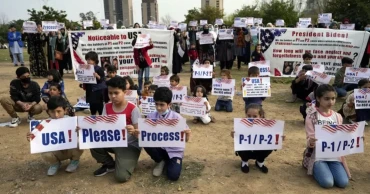
Afghan refugees in Pakistan protest delay in US resettlement
Hundreds of Afghan refugees facing extreme delays in the approval of U.S. visas protested in Pakistan’s capital on Sunday, as an American program to help relocate at-risk Afghans fleeing Taliban rule stalls.
The U.S. government’s Priority 1 and Priority 2, known as P1 and P2 refugee programs were meant to fast track visas for at-risk Afghans including journalists and rights activists after the Taliban takeover in their homeland. Those eligible must have worked for the U.S. government, a U.S.-based media organization or non-governmental organization in Afghanistan, and must be referred by the U.S.-based employer.
Read more: Bombing in crowded bazaar in southwestern Pakistan kills 5
Applicants have been waiting in Pakistan for more than one and a half years for U.S. officials to process their visa applications. The delay in approving visas and resettlement has left Afghan applicants in a highly vulnerable position as they contend with economic hardship and lack of access to health, education and other services in Pakistan.
Mohammad Baqir Ahmadi, who said he’d helped to organize the protest outside of Pakistan’s National Press Club in Islamabad, said many of the Afghans present were facing problems in extending visas to wait out the application process in Pakistan.
Protesters said that applicants had yet to receive the preliminary interview necessary to begin the visa application process.
“We, the holders of P1/P2 cases, your allies, and colleagues, played significant role toward expansion of democracy, human rights, and freedom of expression. We are currently asking for your support and companionship in the bad days of life,” read one banner held by Afghan demonstrators.
Read more: Trade resumes as Pakistan, Afghanistan reopen Torkham border
Hesamuddin, an Afghan who is waiting on the processing of his P2 case, said authorities should evacuate Afghan P1 and P2 applicants to a country where the necessary resettlement support centers (RSC) are open and able to conduct interviews. “They must evacuate us to another country where RSCs are functioning and can process there,” he said.
Under U.S. rules, applicants must first relocate to a third country for their cases to be processed, where it initially can take up to 14 to 18 months and cases are processed through the resettlement support centers.
The Taliban retook power in Afghanistan in August 2021 as U.S. and NATO forces withdrew. Many Afghans sought to leave in the immediate aftermath of the Taliban takeover.
But they have progressively imposed more restrictions, particularly on women. They have banned women and girls from schooling beyond the sixth grade, barred them from most jobs and demanded they cover their faces when outside.
3 years ago

North Korea holds rare meeting on farming amid food shortage
North Korean leader Kim Jong Un opened a major political conference dedicated to agricultural improvement, state media reported Monday, amid outside assessments that the country’s chronic food insecurity is getting worse.
Recent unconfirmed reports have said an unknown number of North Koreans have died of hunger. But observers have seen no indication of mass deaths or famine in North Korea, though its food shortage has likely deepened due to pandemic-related curbs, persistent international sanctions and its own mismanagements.
During a high-level meeting of the ruling Workers’ Party that began Sunday, senior party officials reviewed last year’s work under state goals to accomplish “rural revolution in the new era,” the official Korean Central News Agency reported.
The report said that the meeting of the party’s Central Committee will determine “immediate, important” tasks on agricultural issues and “urgent tasks arising at the present stage of the national economic development.”
KNCA didn’t say whether Kim spoke during the meeting or how long it would last. Senior officials such as Cabinet Premier Kim Tok Hun and Jo Yong Won, one of Kim’s closest aides who handles the Central Committee’s organizational affairs, were also attending.
The meeting is the party’s first plenary session convened only to discuss agriculture. Monday’s report didn’t elaborate on its agenda, but the party’s powerful Politburo said earlier this month that a “a turning point is needed to dynamically promote radical change in agricultural development.”
Most analysts North Korea’s food situation today is nowhere near the extremes of the 1990s, when hundreds of thousands of people died in a famine. However, some experts say its food insecurity is likely at its worst since Kim took power in 2011, after COVID-19 restrictions further shocked an economy battered by decades of mismanagement and crippling U.S.-led sanctions imposed over Kim’s nuclear program.
In early 2020, North Korea tried to shield its population from the coronavirus by imposing stringent border controls that choked off trade with China, its main ally and economic lifeline. Russia’s war on Ukraine possibly worsened the situation by driving up global prices of food, energy and fertilizer, on which North Korea’s agricultural production is heavily dependent.
After spending more than two years in a strict pandemic lockdown, North Korea last year reopened freight train traffic with China and Russia. More than 90% of North Korea’s official external trade goes through its border with China.
Last year, North Korea’s grain production was estimated at 4.5 million tons, a 3.8% drop from 2020, according to South Korean government assessments. The North was estimated to have produced between 4.4 million tons to 4.8 million tons of grain annually from 2012-2021, according to previous South Korean data.
North Korea needs about 5.5 million tons of grain to feed its 25 million people annually, so it’s short about 1 million tons this year. In past years, half of such a gap was usually met by unofficial grain purchases from China, with the rest remaining as unresolved shortfall, according to Kwon Tae-jin, a senior economist at the private GS&J Institute in South Korea.
Kwon says trade curbs due to the pandemic have likely hindered unofficial rice purchases from China. Efforts by North Korean authorities to tighten controls and restrict market activities have also worsened the situation, he said.
It’s unclear whether North Korea will take any action to quickly address its food problems. Some experts say North Korea will use this week’s plenary meeting to boost public support of Kim during his confrontations with the United States and its allies over his nuclear ambitions.
Despite limited resources, Kim has been aggressively pushing to expand his nuclear weapons and missile programs to pressure Washington into accepting the idea of the North as a nuclear power and lift international sanctions on it. After a record year of weapons testing activities in 2022, North Korea launched an intercontinental ballistic missile and other weapons in displays this month.
3 years ago