Asia

Sri Lanka police fire tear gas at election protest; 15 hurt
Police in Sri Lanka on Sunday fired tear gas and water cannons to disperse protesters angry over a decision to postpone local elections after the government said it cannot finance them because of the country's crippling economic crisis.
About 15 people were treated for minor injuries, according to Colombo National Hospital.
Thousands of supporters of the opposition National People's Power party tried to march toward the main business district in capital Colombo, ignoring police warnings after a court order barred them from entering the area, which includes the president's residence, office and several key government buildings.
The order had been obtained in the backdrop of last July's massive protests, when thousands of people stormed the presidential office and residence and occupied them for days. The crisis forced then-President Gotabaya Rajapaksa to flee the country and resign.
The turmoil was caused by severe shortages of some foods, fuel, cooking gas and medicine, after Sri Lanka went bankrupt because it could not repay its foreign debt. The new president, Ranil Wickremesinghe, negotiated a rescue package with the International Monetary Fund for $2.9 billion over four years, but it can be finalized only if Sri Lanka’s creditors give assurances on debt restructuring.
Sri Lanka’s total foreign debt exceeds $ 51 billion, of which it must repay $28 billion by 2027. India and several other creditor countries have so far given assurances that meet the IMF standards, but the deal hinges on whether China would agree to debt restructuring at the same level.
The Finance Ministry under Wickremesinghe said it can't allocate sufficient funds for the March 9 elections for town and village councils, even though political parties had submitted nominations.
The decision forced the Election Commission to indefinitely postpone the elections.
Despite signs of progress in reducing shortages and ending daily power cuts after nearly a year, Wickremesinghe is immensely unpopular. Many people say he lacks the mandate because he was elected by lawmakers backed by Rajapaksa supporters. They accuse Wickremesinghe of protecting members of the Rajapaksa family from corruption allegations in return for backing him in Parliament.
The National People’s Power party, which organized Sunday's rally, has only three lawmakers in Sri Lanka's 225-member Parliament but it enjoys a wave of public support after the economic crisis eroded the popularity of traditional political parties that have ruled Sri Lanka since independence.
3 years ago

Bombing in crowded bazaar in southwestern Pakistan kills 5
A bombing at a crowded bazaar in southwestern Pakistan on Sunday killed at least five people and wounded 16, authorities said amid a surge in violence in this South Asian nation.
No one immediately claimed responsibility for the attack in Barkhan, about 600 kilometers (360 miles) northeast of Quetta, the provincial capital.
Sajjad Afzal, the local police chief, said the bomb was apparently rigged to a motorcycle and was detonated by remote control. Apart from inflicting casualties, the bombing also left several shops at the market badly damaged. Rescuers took the wounded to hospital, Afzal said.
Read more: Trade resumes as Pakistan, Afghanistan reopen Torkham border
Baluchistan has long struggled with a low-level insurgency by the Baluchistan Liberation Army and other small separatist groups demanding independence from the central government in Islamabad.
Authorities claim to have quelled the insurgency but violence has persisted. The restive province has seen attacks by both the Pakistani Taliban and the Islamic State group.
Read more: 13 people killed as bus hits van on Pakistan motorway
Abdul Qudoos Bizenjo, the chief minister of Baluchistan, condemned the bombing, describing it as a terrorist attack.
“Terrorists are trying to create uncertainty through such attacks to achieve their nefarious goals, but we will not allow these anti-state elements to succeed, “ he said without specifically blaming anyone.
3 years ago

German leader seeks Indian support for Russia’s isolation
German Chancellor Olaf Scholz sought assurances Saturday from India that it would support, or at least not block, Western efforts to isolate Russia for waging a devastating war against Ukraine.
Following his talks with Indian Prime Minister Narendra Modi, Scholz stressed that developing countries were being negatively impacted by energy and food shortages resulting from the war and hopes that India will help secure critical supplies to Asia, Africa and the Americas.
Modi maintained his cautious approach and said India wanted the conflict to be ended through dialogue and diplomacy. “India is ready to make its contribution to any peace initiative,” he added.
He has refrained from any overt criticism of Russia as Moscow is a major supplier of arms, oil and India’s other economic needs.
Scholz said that Russia’s war against Ukraine “violated the fundamental principle to what we all agree of not changing borders through the use of violence.”
While the two leaders took no questions from the media after their meeting, Scholz later told German reporters that he and Modi had discussed the war in Ukraine “very extensively and very intensly,” but declined to elaborate, citing the confidential nature of the talks.
Scholz, who arrived in the Indian capital on Saturday, also discussed with Modi ways to boost economic cooperation, including through a free trade agreement between the European Union and India. Scholz made clear he favors a free trade deal and said he “personally will make sure that (the talks) do not drag on.”
The trip is Scholz’s first official visit to India, though it is his fourth meeting with Modi since taking office in 2021, underlining Germany’s interest in reaching out to Delhi.
“There is huge potential for intensified cooperation in sectors such as renewables, hydrogen, mobility, pharma and digital economy” with India, Scholz said in an interview published by The Times of India newspaper on Saturday.
After a videoconference with fellow leaders from the Group of Seven industrial powers on Friday, Scholz said before leaving Berlin that “internationally, we are endeavoring to make clear that Russia stands alone in the world with its aggression against Ukraine.”
Philipp Ackermann, the German ambassador to India, said he understands why India is buying large quantities of oil from Russia.
“That’s something that the Indian government decides and as you get it at a very, very low price, you know I cannot blame the Indian government for buying it,” New Delhi Television cited Ackermann as saying.
Germany has been pushing to diversify its economic relations as it and other European countries try to avoid being dependent on China, a German official said on condition of anonymity because he wasn’t authorized to talk to reporters.
Modi said the business delegation accompanying Scholz was firming up agreements with India in digital technology, the telecommunication sector and diversification of supply chains.
Scholz reiterated that Germany welcomes skilled workers from India, especially in information technology and software industries.
“We want to benefit from the Indian talent employed in Germany in the industrial sector,” he said.
Speaking to reporters later Saturday, Scholz said Germany could help India achieve its ambitious goals when it comes to expanding renewable power generation.
India is set to receive $10.5 billion in aid by 2030 to boost the use of clean energy under agreements the two sides signed in May last year.
Scholz’s delegation included several German business leaders, including the head of ThyssenKrupp, which is trying to sell further submarines to India.
Asked whether such a deal with India, which has been a major buyer of arms from Russia, could be struck, Scholz said he had “the impression that the quality of German technology enjoys great recognition and appreciate here.”
The two-day visit will also take Scholz to India’s information technology hub Bengaluru on Sunday.
3 years ago
Mass protests in Israel as controversial overhauls advanced
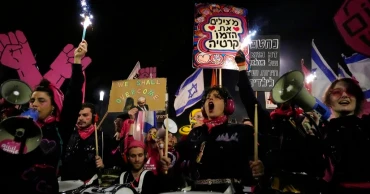
Tens of thousands of Israelis on Saturday protested their far-right government’s plans to overhaul the legal system, three days after parliament advanced a bill that would enable lawmakers to overturn a Supreme Court decision with a simple majority.
The “Supreme Court override” bill’s approval in a preliminary vote in the Knesset was the latest step by Benjamin Netanyahu’s ruling coalition toward realizing the judicial overhaul that is steaming ahead despite calls for dialogue and consensus from American Jews and Israel’s president, and the weekly mass protests.
Also Read: Israel's Netanyahu advances judicial changes despite uproar
In addition to weakening the country's highest court, the protesters say the proposed changes threaten Israel's democratic values and concentrate power with the ruling coalition in parliament. Netanyahu and his ruling coalition believe the court has had unchecked power for years.
For eight weeks, the weekly protests have gained momentum, with large sectors of Israeli society and businesses joining them. On Saturday, the main protest took place in the central city of Tel Aviv along numerous smaller demonstrations across the country.
Also Read: Israel approves over 7,000 settlement homes, groups say
The protesters held Israeli flags, flares, and posters with different messages against the judicial overhauls. “No Constitution, No Democracy," said one placard. Some demonstrators stood behind a banner reading “They Shall Not Pass" and “We Shall Override,” referring to the vote.
3 years ago

Turkey launches investigation into 612 people after quake
Investigations have been launched against more than 600 people in relation to buildings that collapsed in Turkey’s catastrophic earthquake earlier this month, a government official said Saturday.
Justice Minister Bekir Bozdag said 184 of the 612 suspects had been jailed pending trial. Those in custody include construction contractors and building owners or managers, he said in televised comments from a coordination center in Diyarbakir in southeast Turkey.
“The detection of evidence in the buildings continues as a basis for criminal investigation,” Bozdag added.
The aftermath of the 7.8-magnitude quake on Feb. 6, which led to nearly 48,000 deaths in southern Turkey and northern Syria, has seen Turks question the structural integrity of many of the 173,000 buildings that collapsed or were seriously damaged.
Also Read: Death toll from Turkey, Syria earthquake tops 47,000
Experts have said many toppled structures were built with inferior materials and methods and often did not comply with government standards. Opposition parties have accused President Recep Tayyip Erdogan’s administration of failing to enforce building regulations.
The mayor of a town close to the epicenter of the earthquake was detained as part of an investigation into collapsed buildings, the Cumhuriyet newspaper and other outlets reported Saturday.
Okkes Kavak, who heads the district of Nurdagi in Gaziantep province and is a member of Erdogan’s Justice and Development Party (AKP), is said to have failed to ensure construction inspections were carried out.
AFAD, Turkey’s disaster management agency, said that 9,470 aftershocks had hit the region affected by the quake.
“This will continue for a long time… we expect these aftershocks to last for at least two years,” AFAD General Manager Orhan Tatar said in a media briefing in Ankara. He said a 5.3-magnitude quake that hit Bor, a town around 150 miles (about 245 kilometers) west of the Feb. 6 epicenter, was considered “independent” of earlier temblors.
3 years ago
Beijing official in Hong Kong warns US envoy after speech
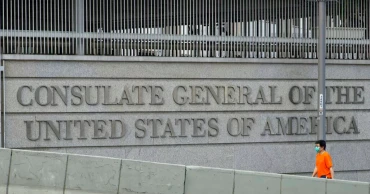
A Chinese diplomat accused the U.S. consul general in Hong Kong of interfering in its affairs after he said the city's freedoms were eroding and warned the American not to cross political “red lines.”
Consul General Gregory May gave a video address last month in which he expressed concern over diminished freedoms in Hong Kong and said its reputation as a business center depended on adherence to international standards and the rule of law.
The Ministry of Foreign Affairs Office in Hong Kong said its commissioner Liu Guangyuan met with May recently to express objections to his “inappropriate” words and deeds.
“Liu also drew three red lines for US consul general and US consulate general in Hong Kong, which is not to endanger China’s national security, not to engage in political infiltration in Hong Kong, and not to slander or damage Hong Kong’s development prospect,” his office said in reply to inquiries from The Associated Press.
Liu also urged May to abide by diplomatic ethics, the office added.
Also Read: China issues peace plan; Zelenskyy says he'll await details
An unidentified U.S. consulate spokesperson said that while they do not generally comment on private diplomatic meetings, they will not hesitate to express publicly or privately the United States' deep concern over the erosion of Hong Kong's autonomy.
May, in his address to the U.S. Center for Strategic & International Studies, also cited a decision by China’s legislature that lets Hong Kong's executive branch decide whether foreign lawyers can be involved in national security cases in the city.
The decision was made after the city's top court allowed pro-democracy publisher Jimmy Lai to hire a British lawyer to represent him as he fights collusion charges that could bring a life prison sentence if he is convicted.
Liu's office accused May of slandering the rule of law and freedom in Hong Kong when he questioned the legal decision made in Beijing and other changes in Hong Kong's governance.
Read More: What is China’s peace proposal for Ukraine War?
The U.S. and other democracies have been critical of China’s crackdown on political freedoms in the former British colony, which was handed back to China in 1997 with a promise by Beijing to keep Western-style liberties under a “one country, two systems” framework.
Hong Kong is among a raft of issues that have sent ties between Beijing and Washington to their lowest level in years, including technology and trade, human rights, threats against Taiwan, and China’s claims in the South China Sea.
3 years ago
German leader seeks Indian support for Russia's isolation
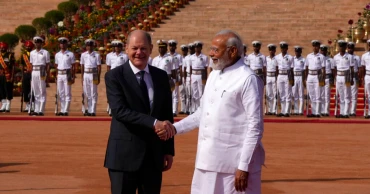
Chancellor Olaf Scholz said Saturday that Germany wants to get India to support, or at least not block, Western efforts to isolate Russia for waging a devastating war against Ukraine.
Following his talks with Indian Prime Minister Narendra Modi, Scholz stressed that developing countries were being negatively impacted by energy and food shortages resulting from the war and hopes that India will help secure critical supplies to Asia, Africa and the Americas.
Modi maintained his cautious approach and said India wanted the conflict to be ended through dialogue and diplomacy. "India is ready to make its contribution to any peace initiative," he added.
He has refrained from any overt criticism of Russia as Moscow is a major supplier of arms, oil and India’s other economic needs.
Scholz said that Russia's war against Ukraine "violated the fundamental principle to what we all agree of not changing borders through the use of violence."
Also Read: German leader Scholz arrives in India to boost economic ties
Scholz, who arrived in the Indian capital on Saturday, also discussed with Modi ways to boost bilateral economic cooperation.
He said he supported a free trade agreement between the European Union and India and he “personally will make sure that this does not drag on.”
The trip is Scholz's first official visit to India, though it is his fourth meeting with Modi since taking office in 2021, underlining Germany’s interest in reaching out to Delhi.
“There is huge potential for intensified cooperation in sectors such as renewables, hydrogen, mobility, pharma and digital economy” with India, Scholz said in an interview published by The Times of India newspaper on Saturday.
After a videoconference with fellow leaders from the Group of Seven industrial powers on Friday, Scholz said before leaving Berlin that “internationally, we are endeavoring to make clear that Russia stands alone in the world with its aggression against Ukraine.”
Philipp Ackermann, the German ambassador to India, said he understands why India is buying large quantities of oil from Russia.
"That’s something that the Indian government decides and as you get it at a very, very low price, you know I cannot blame the Indian government for buying it,” New Delhi Television cited Ackermann as saying.
Germany has been pushing to diversify its economic relations as European countries try to decouple from China, a German official said on condition of anonymity as he was not authorized to talk to reporters.
Modi said the business delegation accompanying Scholz was firming up agreements with India in digital technology, the telecommunication sector and diversification of supply chains.
Scholz reiterated that Germany welcomes skilled workers from India, especially in information technology and software industries.
"We want to benefit from the Indian talent employed in Germany in the industrial sector," he said.
India is set to receive $10.5 billion in aid by 2030 to boost the use of clean energy under agreements the two sides signed in May last year.
The two-day visit will also take Scholz to India’s information technology hub Bengaluru on Sunday.
3 years ago

Russians mark Ukraine war anniversary with flowers, arrests
Russians in Moscow and other cities brought flowers to Ukrainian poets and held one-person pickets with antiwar slogans Friday to mark the first anniversary of Moscow's invasion of Ukraine.
Russian media and civil rights groups reported at least a dozen detentions, part of the Kremlin's sweeping crackdown on dissent that has spiked to unprecedented levels since the start of the war.
At least eight people were detained in Yekaterinburg, Russia’s fourth-largest city, according to OVD-Info, a legal aid group that tracks political arrests. They all had brought flowers to the city’s monument to victims of political repression, the group said.
Online news outlet Sota filmed at least seven people getting detained in St. Petersburg after they brought flowers to a monument for the renowned Ukrainian poet Taras Shevchenko. Footage posted by the outlet showed a police officer explaining to a couple that they had violated coronavirus restrictions.
Sota also reported a person detained in Moscow, where people flocked to the monument of Lesya Ukrainka, another renowned Ukrainian poet, to lay flowers. A contingent of police officers monitored the group but left mostly didn't interrupt.
Also Read: Pregnant Russians flock to Argentina seeking new passports
Five people were detained in the Siberian city of Barnaul, according to the Sibir.Realii news outlet, including a man who picketed a central square with a placard reading “Stop being silent.” In another Siberian city, Komsomolsk-on-Amur, a woman was detained for protesting with a banner that read, “We’re mourning. Forgive us, we screwed up our country,” the outlet reported.
Russians all across the country actively protested against the war in Ukraine during the first week of the invasion. Large rallies quickly fizzled after thousands were detained, but solo pickets -- and detentions -- have persisted throughout the year.
Russian authorities have enforced a law enacted soon after the invasion that effectively criminalizes any public expression against what the Kremlin refers to as a “special military operation” in Ukraine.
The Russian parliament rubber-stamped a bill that outlawed discrediting the Russian military or spreading false information a week after Moscow's troops rolled into Ukraine.
OVD-Info said in a statement Friday that “for 305 out of 365 days of the war, security forces detained people for their anti-war position in various cities of Russia and the annexed Crimea.”
As of mid-December, the group had counted 378 people facing criminal prosecution for their antiwar positions in 69 Russian regions and the Crimean Peninsula that Russia seized from Ukraine in 2014. The group also counted more than 5,500 administrative cases on the charge of discrediting the Russian army.
3 years ago

Pregnant Russians flock to Argentina seeking new passports
Shortly after Vladimir Putin ordered the invasion of Ukraine, Alla Prigolovkina and her husband, Andrei Ushakov, decided they had to flee their Sochi, Russia, home.
Ushakov had been detained for holding up a sign that read “Peace,” and Prigolovkina, a pregnant ski instructor, feared he would soon be drafted and potentially killed, leaving their baby fatherless.
The original plan was to stay in Europe, but anti-Russian sentiment discouraged them.
“We chose Argentina because it has everything we needed: Fantastic nature, a large country, beautiful mountains,” Prigolovkina, 34, told The Associated Press inside the home her family is renting in Argentina’s western Mendoza province. “We felt it would be ideal for us.”
They were hardly alone.
Over the past year, Argentine immigration authorities have noticed flights packed with dozens of pregnant Russians. But whereas Prigolovkina said her family intends to build a life here at the foot of the Andes mountains, local officials believe many of the other recent Russian visitors are singularly focused on receiving one of Argentina’s passports.
Also Read: Europe bans Russian diesel, other oil products over Ukraine
All children born in Argentina automatically receive citizenship and having an Argentine child speeds up the process for the parents to obtain residency permits and, after a couple of years, their own passports.
Crucially, the navy blue booklets allow entry to 171 countries without a visa, a backup plan that Russians believe could come in handy in the ever-uncertain future. Due to sanctions, Russians have also had trouble opening bank accounts in foreign countries, something an Argentine passport could solve.
According to official figures, some 22,200 Russians entered Argentina over the last year, including 10,777 women — many of whom were in the advanced stages of pregnancy. In January, 4,523 Russians entered Argentina, more than four times the 1,037 that arrived in the same month last year.
After an investigation, Argentine officials concluded that Russian women, generally from affluent backgrounds, were entering the country as tourists with the plan to give birth, obtain their documentation and leave. More than half of the Russians who entered the country in the last year, 13,134, already left, including 6,400 women.
“We detected that they don’t come to do tourism, they come to have children,” Florencia Carignano, the national director for migration, said during a meeting with international media.
Although Argentina generally has a relatively permissive immigration process, the recent arrest of two alleged Russian spies who had Argentine passports in Slovenia raised alarms in the South American country, where officials reinforced immigration controls.
“We canceled residencies of Russians who spent more time outside than in,” Carignano said, expressing concern the Argentine “passport will cease to have the trust it enjoys in all countries.”
Immigration authorities have also called on the justice system to investigate agencies that allegedly offer assistance to Russian women who want to give birth in Argentina.
It’s unclear how many women have left Russia to give birth in the last year, but the issue is big enough that lawmakers in Moscow this month raised the question of whether those who choose to give birth abroad should be stripped of the so-called maternity fund that all Russian mothers receive — a financial benefit of almost $8,000 for the first child and about $10,500 for the second.
There is no discussion on whether to cut off access to the maternity fund for Russian mothers who give birth abroad, Kremlin spokesperson Dmitry Peskov said.
The phenomenon also is not entirely new. Prior to the Russia-Ukraine war, Russian women were part of a wave of “birth tourists” in the U.S. and many paid brokers tens of thousands of dollars to arrange their travel documents, accommodations and hospital stays, often in Florida.
Embarking on a long journey during an advanced pregnancy can be particularly perilous, and Russians in Argentina insist that their decision to leave their homes goes beyond a new passport. Despite the government’s claims, some at least seem eager to make Argentina their new home.
In spite of the language barrier and the unfamiliar, stifling summer heat, Prigolovkina and Ushakov have quickly adopted Argentine customs since their July move. Prigolovkina said they especially enjoy spending time in the park with their dogs. And while the family may not have been interested in soccer in Russia, they happily cheered when their newly adopted country won the World Cup late last year.
Still, she also concedes that obtaining a passport for their newborn son, Lev Andrés, was a motivating factor for the move: “We wanted our baby to have the chance to not just be Russian and have a single passport.”
Some experts say a country in which migrants once made up as much as 30% of the population should be particularly sensitive to the plight of Russians trying to start a new life. The South American country was transformed in the late 19th and early 20th century by the influx of millions of European migrants, including many from Italy and Spain.
“Given our history of migration, a country like ours should empathize more with the humanitarian dimension” of these recent immigrants, Natalia Debandi, a social scientist and migrations expert who is a researcher at the publicly funded CONICET institute, said. “They are not terrorists, they are people.”
A study by immigration agents based on interviews with 350 newly arrived Russians concluded that most are married and largely well-off professionals who have remote jobs in finance and digital design or live off savings.
Days before giving birth to a boy named Leo, 30-year-old Russian psychologist Ekaterina Gordienko lauded her experience in Argentina, saying “the health care system is very good, and people are very kind. My only problem is Spanish. If the doctor doesn’t speak English, I use the (Google) translator.”
Gordienko arrived in the nation's capital of Buenos Aires in December with her 38-year-old husband, Maxim Levoshin. “The first thing we want is for Leo to live in a safe country, without a war in his future,” Levoshin said.
In Mendoza, Prigolovkina is excited for her family’s new life in Argentina and optimistic they will be able to give back to the country that has welcomed them.
“We have left everything behind to live in peace. I hope that Argentines understand that Russians can be very useful in different areas of life, in business, the economy, in science,” she said. “They can help make Argentina better.”
3 years ago

German leader Scholz arrives in India to boost economic ties
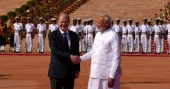
German Chancellor Olaf Scholz arrived in the Indian capital on Saturday where he is expected to discuss with the Indian prime minister Russia's war in Ukraine and ways to boost bilateral economic cooperation, officials said.
"We will discuss intensely all topics relevant for the development of our countries but also the peace in the world, which is important,'' Scholz told reporters after he was received by Indian Prime Minister Narendra Modi at the president's palace.
The trip is Scholz's first official visit to India, though it is his fourth meeting with Modi since taking office in 2021.
The German chancellor is expected to seek India’s support for the tough stance taken by Europe and the United States toward Russia over the war in Ukraine.
After a videoconference with fellow leaders from the Group of Seven industrial powers on Friday, Scholz said before leaving Berlin for India that “internationally, we are endeavoring to make clear that Russia stands alone in the world with its aggression against Ukraine.”
“I will advocate once again there (New Delhi) for our stance, our point of view on this conflict,” he told reporters.
Modi has refrained from any overt criticism of Russia for its invasion of Ukraine as Moscow is a major arms supplier and also provides India with oil and other economic needs.
"There is huge potential for intensified cooperation, in sectors such as renewables, hydrogen, mobility, pharma and digital economy" with India, Scholz said in an interview published by The Times of India newspaper on Saturday.
Philipp Ackermann, the German ambassador to India, said he understands why India is buying large quantities of oil from Russia.
"That’s something that the Indian government decides and as you get it at a very, very low price, you know I cannot blame the Indian government for buying it,” the New Delhi television news channel cited Ackermann as saying.
Scholz also is expected to press for progress toward India-EU free trade and investment protection agreements. Germany has been pushing to diversify its economic relations as European countries try to decouple from China, a German official said on condition of anonymity as he was not authorized to talk to reporters.
In May last year, Germany and India signed a series of bilateral agreements focused on sustainable development under which India will receive $10.5 billion in aid by 2030 to boost the use of clean energy.
Some agreements are expected to be signed on Saturday. Details were not immediately available.
The two-day visit will also take Scholz to India’s information technology hub Bengaluru on Sunday.
3 years ago