Asia
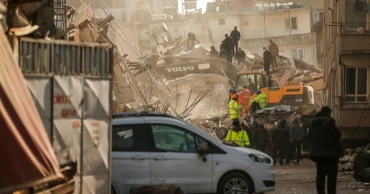
Turkey probes contractors as earthquake deaths pass 33,000
Turkish authorities are targeting contractors allegedly linked with buildings that collapsed in the powerful Feb. 6 earthquakes as rescuers found more survivors in the rubble Sunday, including a pregnant woman and two children, in the disaster that killed over 33,000 people.
The death toll from the magnitude 7.8 and 7.5 quakes that struck nine hours apart in southeastern Turkey and northern Syria rose to 33,185 and was certain to increase as search teams find more bodies.
As despair bred rage at the agonizingly slow rescues, the focus turned to assigning blame.
Turkish Justice Minister Bekir Bozdag said 131 people were under investigation for their alleged responsibility in the construction of buildings that failed to withstand the quakes. While the quakes were powerful, many in Turkey blame faulty construction for multiplying the devastation.
Turkey's construction codes meet current earthquake-engineering standards, at least on paper, but they are rarely enforced, explaining why thousands of buildings toppled over or pancaked down onto the people inside.
Among those facing scrutiny were two people arrested in Gaziantep province on suspicion of cutting down columns to make extra room in a building that collapsed, the state-run Anadolu Agency said. The justice ministry said three people were arrested, seven others were detained and another seven were barred from leaving Turkey.
Also Read: Turkey detains building contractors as quake deaths pass 33,000
Two contractors held responsible for the destruction of buildings in Adiyaman were arrested Sunday at Istanbul Airport while trying to leave the country, the private DHA news agency and other media reported. One detained contractor, Yavuz Karakus, told DHA: “My conscience is clear. I built 44 buildings. Four of them were demolished. I did everything according to the rules.”
Rescuers reported finding more survivors amid increasingly long odds. Thermal cameras were used as crews demanded silence to hear those trapped.
In hard-hit Hatay province, a 50-year-old woman who appeared badly injured was carried out by crews in the town of Iskenderun. Similar rescues in the province saved two other women, one of them pregnant, according to broadcasters TRT and HaberTurk.
HaberTurk showed a 6-year-old boy rescued from his wrecked home in Adiyaman. An exhausted rescuer removed his surgical mask and took deep breaths as several women cried in joy.
Health Minister Fahrettin Koca posted a video of a young girl in a navy blue jumper who was found alive. “There is always hope!” he tweeted.
Rescuers in Antakya, elsewhere in Hatay province, pulled a man in his late 20s or 30s from the rubble, saying he was one of nine trapped in the building. He waved weakly as he was removed on a stretcher as workers applauded and chanted, “God is great!”
German and Turkish workers rescued an 88-year-old in Kirikhan, German news agency dpa reported. Italian and Turkish rescuers found a 35-year-old man in Antakya who appeared unscathed, private NTV television reported.
A child was freed overnight in the town of Nizip, in Gaziantep, state-run Anadolu Agency said, while a 32-year woman was found in a wrecked eight-story building in Antakya and asked for tea when she emerged, according to NTV.
Those were the rare exceptions.
Backhoes and bulldozers prepared a large cemetery in Antakya’s outskirts as trucks and ambulances brought a steady stream of black body bags. Hundreds of graves were marked with simple wooden planks.
Hatay’s airport reopened Sunday after its runway was repaired, and military and commercial planes ferried in supplies and will take away evacuees.
There are 34,717 Turkish personnel involved in rescue efforts. On Sunday, Turkey's Foreign Ministry said they were joined by 9,595 personnel from 74 countries, with more on the way.
In the Syrian capital of Damascus, the head of the World Health Organization warned that the pain will ripple forward, calling the disaster an “unfolding tragedy that’s affecting millions.”
“The compounding crises of conflict, COVID, cholera, economic decline, and now the earthquake have taken an unbearable toll,” Tedros Adhanom Ghebreyesus said.
Tedros said WHO experts were waiting to enter northwestern Syria “where we have been told the impact is even worse.”
U.N. Under-Secretary-General for Humanitarian Affairs Martin Griffiths, visiting the Turkish-Syrian border Sunday, said Syrians are “looking for international help that hasn’t arrived.”
“We have so far failed the people in northwest Syria. They rightly feel abandoned,” he said, adding, “My duty and our obligation is to correct this failure as fast as we can.”
In the town of Atareb, in opposition-run northern Aleppo province, Abdel-Haseeb Abdel-Raheem returned Sunday to his ruined four-story building to try to salvage any valuables but could find only blankets, pillows and some clothes. His aunt and her husband died there, but their three children survived.
With no international rescue efforts in the war-battered region, the 34-year-old had to recover the bodies himself.
“You can’t hear someone inside screaming and sit tight. You can’t sit still. You can’t have the heart to hear someone (crying for help) and you do nothing,” he said, sitting above a mound of debris.
Political disputes have held up aid convoys sent from areas of northeast Syria controlled by U.S.-backed Kurdish groups to those controlled by the Syrian government and by Turkish-backed rebels who have fought with the Kurdish groups over the years.
A U.N. aid convoy sent to northwestern Syria through government-held areas was postponed due to obstruction from Hay’at Tahrir al Sham, an al-Qaida affiliated group ruling Idlib province, a U.N. spokesperson told The Associated Press.
Meanwhile, U.N. aid convoys continue to cross from Turkey into northwestern Syria through the Bab al-Hawa border crossing. The first U.N. convoy only reached northwest Syria from Turkey on Thursday, three days after the disaster struck.
Before that, it was only a steady stream of bodies coming through Bab al-Hawa: Syrian refugees who had fled the civil war and settled in Turkey but died in the disaster, being returned home for burial.
The earthquake death toll in Syria’s northwestern rebel-held region has reached 2,166, according to the rescue group the White Helmets. The overall death toll in Syria stood at 3,553 on Saturday, although the 1,387 deaths reported for government-held parts of the country hadn’t been updated in days. Turkey’s death toll was 29,605 as of Sunday.
Turkey’s Justice Ministry announced the establishment of Earthquake Crimes Investigation bureaus to identify contractors and others responsible for building works. It would gather evidence; instruct experts including architects, geologists and engineers; and check building permits and occupation permits.
A contractor was detained Friday at Istanbul airport before he could leave the country. He built a luxury 12-story building called Ronesans Rezidans in Antakya, and when it fell, it killed an untold number. He was formally arrested Saturday.
In leaked testimony published by Anadolu, the man said the building followed regulations and he did not know why it didn't stay standing. His lawyer suggested his client was a scapegoat.
Under programs that allowed building owners to pay fines instead of bringing them up to code, the government agency responsible for enforcement acknowledged in 2019 that over half of all buildings in Turkey — accounting for some 13 million apartments— were not in compliance.
The detentions could help direct public anger toward builders and contractors, deflecting it from local and state officials who allowed apparently substandard construction to proceed. President Recep Tayyip Erdogan’s government, already burdened by an economic downturn and high inflation, faces parliamentary and presidential elections in May.
The nongovernmental business organization TURKONFED estimated the earthquake damage at $84.1 billion, based on statistics from the devastating 1999 quake in northwestern Turkey, including $70.1 billion in housing and $10.4 billion to gross domestic product.
Rescue crews have been overwhelmed by the widespread damage that has affected roads and airports, making it even harder to move quickly.
Erdogan acknowledged the initial response was hampered by the damage, with the worst-affected area 500 kilometers (310 miles) in diameter and home to 13.5 million. During a tour Saturday, Erdogan said such a tragedy was rare, referring to it as the “disaster of the century” in multiple speeches.
In New York City, mourners gathered Saturday at a mosque to remember a family of four from the borough of Queens who were killed while visiting relatives in Turkey. The Council on American-Islamic Relations said Burak and Kimberly Firik and their sons, aged 1 and 2, died in the disaster.
___
Bilginsoy reported from Istanbul. Suzan Fraser in Ankara, Abby Sewell in Beirut, Kirsten Grieshaber in Berlin and Sarah El Deeb in Atareb, Syria, contributed.
3 years ago

Grief gives way to anger over Turkey’s earthquake response
When Zafer Mahmut Boncuk's apartment building collapsed in Turkey's devastating earthquake, he discovered his 75-year-old mother was still alive — but pinned under the wreckage.
For hours, Boncuk frantically searched for someone in the ancient, devastated city of Antakya to help him free her. He was able to talk to her, hold her hand and give her water. Despite his pleas, however, no one came, and she died on Tuesday, the day after the quake.
Like many others in Turkey, his sorrow and disbelief have turned to rage over the sense there has been an unfair and ineffective response to the historic disaster that has killed tens of thousands of people there and in Syria.
Boncuk directed his anger at President Recep Tayyip Erdogan, especially because she seemed so close to rescue but no one came. Her remains were finally removed Sunday, nearly a week after the building collapsed. His father's body is still in the rubble.
“What would happen if it was your own mother, dear Recep Tayyip Erdogan? What happened to being a world leader? Where are you? Where?” he screamed.
“I gave her water to drink, I cleared her face of rubble. I told her that I would save her. But I failed,” said Boncuk, 60. “The last time we spoke, I asked if I should help her drink some water. She said no, so I rubbed some water on her lips. Ten minutes later, she died.”
Also Read: Turkey detains building contractors as quake deaths pass 33,000
He blamed “ignorance and lack of information and care — that’s why my mother died in front of my eyes.”
Many in Turkey express similar frustration that rescue operations have been painfully slow since the Feb. 6 quakes and that valuable time was lost during the narrow window for finding people alive.
Others, particularly in southern Hatay province near the Syrian border, say Erdogan’s government was late in delivering assistance to the hardest-hit region for what they suspect are both political and religious reasons.
In the southeastern town of Adiyaman, Elif Busra Ozturk waited outside the wreckage of a building on Saturday where her uncle and aunt were trapped and believed dead, and where the bodies of two of her cousins already had been found.
“For three days, I waited outside for help. No one came. There were so few rescue teams that they could only intervene in places they were sure there were people alive,” she said.
At the same complex, Abdullah Tas, 66, said he had been sleeping in a car near the building where his son, daughter-in-law and four grandchildren were buried. He said that rescuers had first arrived four days after the earthquake struck. The Associated Press could not independently verify his claim.
“What good is that for the people under the debris?” he asked.
Onlookers stood behind police tape Saturday in Antakya as bulldozers clawed at a high-rise luxury apartment building that had toppled onto its side.
Over 1,000 residents had been in the 12-story building when the quake struck, according to relatives watching the recovery effort. They said hundreds were still inside but complained the effort to free them had been slow and not serious.
“This is an atrocity, I don’t know what to say,” said Bediha Kanmaz, 60. The bodies of his son and 7-month-old grandson had been pulled from the building — still locked in an embrace — but his daughter-in-law was still inside.
“We open body bags to see if they’re ours, we’re checking if they’re our children. We’re even checking the ones that are torn to pieces,” she said of herself and other grief-stricken relatives.
Kanmaz also blamed Turkey’s government for the slow response, and accused the national rescue service of failing to do enough to recover people alive.
She and others in Antakya expressed the belief that the presence of a large minority of Alevis — an Anatolian Islamic community that differs from Sunni and Shia Islam and Alawites in Syria — had made them a low priority for the government. Traditionally, few Alevis vote for Erdogan’s ruling party. There was no evidence, however, that the region was overlooked for sectarian reasons.
Erdogan said Wednesday that disaster efforts were continuing in all 10 affected provinces and dismissed allegations of no help from state institutions like the military as “lies, fake slander.”
But he has acknowledged shortcomings. Officials said rescue efforts in Hatay were initially complicated by the destruction of the local airport’s runway and bad road conditions.
Anger over the extent of the destruction, however, is not limited to individuals. Turkish authorities have been detaining or issuing detention warrants for dozens of people allegedly involved in the construction of buildings that collapsed, and the justice minister has vowed to punish those responsible.
Kanmaz blamed negligence on the part of the developer of the apartment building where her family had been killed.
“If I could wrap my hands around the contractor’s neck, I would tear him to shreds,” she said.
That contractor, who oversaw the construction of the 250-unit building, was detained at Istanbul Airport on Friday before boarding a flight out of the country, Turkey’s official Anadolu news agency reported. On Saturday, he was formally arrested. His lawyer suggested the public was looking for a scapegoat.
In multiethnic southern Turkey, other tensions are rising. Some expressed frustration that Syrian refugees who fled to the region from their devastating civil war are burdening the sparse welfare system and competing for resources with Turkish people.
“There are many poor people in Hatay, but they don’t offer us any welfare; they give it to the Syrians. They give so much to the Syrians,” Kanmaz said. “There are more Syrians than Turks here.”
There were signs Saturday the tensions could be boiling over.
Two German aid groups and the Austrian Armed Forces temporarily interrupted their rescue work in the Hatay region citing fears for the safety of their staff. They resumed work after the Turkish army secured the area, the Austrian Defense Ministry spokesman tweeted.
“There is increasing tension between different groups in Turkey,” Lt. Col. Pierre Kugelweis of the Austrian Armed Forces told the APA news agency. “Shots have reportedly been fired.”
German news agency dpa reported that Steven Berger, chief of operations of the aid group I.S.A.R. Germany, said that “it can be seen that grief is slowly giving way to anger” in Turkey’s affected regions.
For Kanmaz, it was a mixture of grief and anger.
“I’m angry. Life is over,” she said. “We live for our children; what matters most to us is our children. We exist if they exist. Now we are over. Everything you see here is over.”
____
Emrah Gurel in Adiyaman, Turkey, Zeynep Bilginsoy in Istanbul, Suzan Fraser in Ankara, Turkey, and Kirsten Grieshaber in Berlin contributed.
3 years ago

Indian gov’t withdraws appeal to hug cows on Valentine’s Day
India’s government on Friday withdrew its appeal to citizens to mark Valentine’s Day next week not as a celebration of romance but as “Cow Hug Day” to better promote Hindu values.
The appeal had attracted widespread criticism from political rivals and on social media.
A terse statement issued by the government-run Animal Welfare Board of India said the appeal issued Wednesday “stands withdrawn.”
Nilanjan Mukhopadhyay, a political analyst, said the call to hug cows had been “absolutely crazy, defying logic.”
“The decision to withdraw the government appeal was to prevent the politics of Hindutva (Hindu nationalism) from being ridiculed in the face of severe criticism from all quarters,” he said.
Also read: Indian government asks people to hug cows on Valentine's Day
Young, educated Indians typically spend Valentine’s Day crowding parks and restaurants, exchanging gifts and holding parties.
The Animal Welfare Board had said Wednesday that “hugging cows will bring emotional richness and increase individual and collective happiness.”
Devout Hindus, who worship cows as holy, say the Western holiday goes against traditional Indian values.
In recent years, Hindu hard-liners have raided shops selling Valentine’s Day items, burned cards and gifts, and chased hand-holding couples out of restaurants and parks, insisting that the day promotes promiscuity. Hindu nationalist groups such as Shiv Sena and Bajrang Dal say such raids help reassert a Hindu identity.
Prime Minister Narendra Modi’s government has been pushing a Hindu agenda, seeking the religion’s supremacy in a secular nation known for its diversity. Hindus comprise nearly 80% of the nearly 1.4 billion people. Muslims account for 14%, while Christians, Sikhs, Buddhists and Jains account for most of the remaining 6%.
The cow has long been embedded in the Hindu psyche and is deeply respected by many, much like one’s mother. Most states in India have banned cow slaughter.
3 years ago

Rescuers rejoice as more quake survivors emerge from rubble
Six relatives huddled in a small air pocket, day after day. A desperate teenager grew so thirsty that he drank his own urine. Two frightened sisters were comforted by a pop song as they waited for rescuers to free them.
These earthquake survivors were among more than a dozen people pulled out of the rubble alive Friday after spending over four days trapped in frigid darkness following the disaster that struck Turkey and Syria.
The unlikely rescues, coming so long after Monday’s 7.8-magnitude quake brought down thousands of buildings, offered fleeting moments of joy amid a catastrophe that has killed nearly 24,000 people, injured at least 80,000 others and left millions homeless.
In the Mediterranean coastal city of Iskenderun, a crowd chanted “God is great!” as Haci Murat Kilinc and his wife, Raziye, were carried on stretchers to a waiting ambulance.
“You’ve been working so many hours, God bless you!” a relative of the couple told one of their saviors.
One rescue worker said that Kilinc had been joking with crew members while still trapped beneath the rubble, trying to boost their morale.
Two hours earlier in Kahramanmaras, the city closest to the epicenter, rescuers embraced and chanted their thanks to God after pulling a man from his collapsed home.
Also Read: Rescues in Turkey offer moments of relief in quake aftermath
In Adiyaman, a hard-hit city of more than a quarter-million people, rescuers and onlookers suppressed their joy so as not to frighten 4-year-old Yagiz Komsu as he emerged from the debris, according the HaberTurk television, which broadcast the rescue live.
To distract him, he was given a jelly bean. Teams later rescued his 27-year-old mother, Ayfer Komsu, who had a broken rib.
But the flurry of dramatic rescues could not obscure the devastation spread across a sprawling border region that is home to more than 13.5 million people. Entire neighborhoods of high-rises have been reduced to rubble, and the quake has already killed more people than Japan’s Fukushima earthquake and tsunami, with many more bodies yet to be recovered and counted.
Relatives wept and chanted as rescuers pulled 17-year-old Adnan Muhammed Korkut from a basement in the Turkish city of Gaziantep, near the quake’s epicenter. He had been trapped for 94 hours, forced to drink his own urine to survive.
“Thank God you arrived,” he said, embracing his mother and others who leaned down to kiss and hug him as he was being loaded into an ambulance.
For one of the rescuers, identified only as Yasemin, Adnan’s survival hit home hard.
“I have a son just like you,” she told him after giving him a warm hug. “I swear to you, I have not slept for four days. … I was trying to get you out.”
Elsewhere, HaberTurk television said rescuers had identified nine people trapped inside the remains of a high-rise apartment block in Iskenderun and pulled out six of them, including a woman who waved at onlookers as she was being carried away on a stretcher. The crowd shouted “God is great!” after she was brought out.
The building was only 600 feet (200 meters) from the Mediterranean Sea and narrowly avoided being flooded when the massive earthquake sent water surging into the city center.
Video of another rescue effort in Kahramanmaras showed an emergency worker playing a pop song on his smartphone to distract the two teenage sisters as they waited to be freed.
There were still more stories: A German team said it worked for more than 50 hours to free a woman from a collapsed house in Kirikhan. And a trapped woman could be heard speaking to a team trying to dig her out in video broadcast by HaberTurk television. She told her would-be rescuers that she had given up hope of being found — and prayed to be put to sleep because she was so cold. The station did not say where the operation was taking place.
Even though experts say trapped people can live for a week or more, the odds of finding more survivors were quickly waning.
Death loomed everywhere: Morgues and cemeteries were overwhelmed, and bodies wrapped in blankets, rugs and tarps lay in the streets of some cities.
Temperatures remained below freezing across the large region, and many people have no shelter. The Turkish government has distributed millions of hot meals, as well as tents and blankets, but was still struggling to reach many people in need.
The disaster compounded suffering in a region beset by Syria's 12-year civil war, which has displaced millions of people within the country and left them dependent on aid. The fighting sent millions more to seek refuge in Turkey.
The conflict has isolated many areas of Syria and complicated efforts to get aid in. The United Nations said the first earthquake-related aid convoy crossed from Turkey into northwestern Syria on Friday — a day after an aid shipment planned before the disaster arrived.
The U.N. refugee agency estimated that as many as 5.3 million people have been left homeless in Syria. Sivanka Dhanapala, the country representative in Syria for UNHCR, told reporters Friday that the agency is focusing on providing tents, plastic sheeting, thermal blankets, sleeping mats and winter clothing.
Syrian President Bashar Assad and his wife, Asmaa, visited survivors at the Aleppo University Hospital, according to Syrian state media. It was the leader's first public appearance in an affected area of the country since the disaster. He then visited rescuers in one of the city's hardest-hit areas.
Aleppo has been scarred by years of heavy bombardment and shelling — much of it by the forces of Assad and his ally, Russia — and it was among the cities most devastated by the earthquake.
The Syrian government also announced that it will allow aid to reach all parts of the country, including areas held by insurgent groups in the northwest.
Also Friday, the outlawed Kurdistan Workers’ Party, or PKK, declared a cease-fire in its separatist insurgency in Turkey’s mainly Kurdish southeast, including some areas affected by the quake.
Turkey’s disaster-management agency said more than 20,200 people had been confirmed killed in the disaster so far in Turkey, with more than 80,000 injured.
More than 3,500 have been confirmed killed in Syria, bringing the total number of dead to nearly 24,000.
Some 12,000 buildings in Turkey have either collapsed or sustained serious damage, according to Turkey’s minister of environment and urban planning, Murat Kurum. Turkey's vice president, Fuat Oktay, said more than 1 million people were being housed in temporary shelters.
Engineers suggested that the scale of the devastation was partly explained by lax enforcement of building codes.
___
Alsayed reported from Bab al-Hawa, Syria. Bilginsoy reported from Istanbul. Associated Press journalists Robert Badendieck in Istanbul; Mehmet Guzel in Antakya, Turkey; Emrah Gurel and Yakup Paksoy in Adiyaman, Turkey; Suzan Fraser in Ankara, Turkey; Bassem Mroue and Abby Sewell in Beirut; Salar Salim in Erbil, Iraq; Hogir al-Abdo in Manbij, Syria; and David Rising in Bangkok contributed to this report.
3 years ago

Earthquake compounds Turkish leader’s woes as election nears
Turkish President Recep Tayyip Erdogan came to power 20 years ago riding a wave of public outrage toward the previous government’s handling of a deadly earthquake.
Now, three months away from an election, Erdogan’s political future could hinge on how the public perceives his government’s response to a similarly devastating natural disaster.
“It is going to be a big challenge for Erdogan, who has established a brand for himself as an autocratic figure but an efficient one that gets the job done,” said Soner Cagaptay, a Turkey expert at the Washington Institute and the author of several books on Erdogan.
The aftermath of a massive earthquake isn’t the only parallel to the election of 2002. Back then, Turkey was in the midst of a financial crisis that was punishing its economy.
Today, Turkey’s economy is being hammered by skyrocketing inflation, and Erdogan has faced widespread criticism for his handling of the problem, which has left millions of poor and middle class people struggling to make ends meet.
Also read: Hope dims for families in Turkey as rescue turns to recovery
Erdogan’s political rivals have already begun criticizing his government’s response to the earthquake, saying that over the course of two decades he failed to prepare the country for the inevitable. Experts point to lax enforcement of building codes as a major reason why this week’s quakes were so deadly. But with less than 100 days before the election, Erdogan’s rivals have yet to put forth a candidate to run against him.
The memory of how Bulent Ecevit, the late prime minister, was undone by his poor handling of financial and natural disasters two decades ago must be on Erdogan’s mind as he tries to contain the twin problems he faces today, analysts say.
The 7.8-magnitude earthquake that struck on Feb. 6 was followed nine hours later by another powerful quake, killing more than 24,000 people in both Turkey and Syria.
The devastation spreads across a wide swath of Turkey, affecting 10 provinces in the country’s southeast, and it has strained the ability of domestic and foreign crews to quickly execute rescue efforts. In the first few days after the quake, Turkish television and social media showed people waiting helplessly beside piles of debris in frigid conditions, or using their bare hands to claw through rubble.
“We’ll still have to see the outcome of the relief efforts, whether subzero temperatures continue, casualties increase, whether international assistance which is flowing could make a difference,” said Cagaptay.
Erdogan, who toured the region this week, conceded shortcomings in the initial stages of the response but insisted that everything was now under control.
“If the disaster response is strong, the ruling administration will be rewarded, likely in the polls — if it is poor, the opposite,” Timothy Ash, an analyst at BlueBay Asset Management in London, wrote in an email.
Ecevit blamed the poor response after the 1999 quake that killed some 18,000 people on the vastness of the destruction. Similarly, Erdogan said the response to this week’s quake — which he described as the “strongest in the history of this geography” — has been hampered by winter weather and the destruction of a key airport, making it difficult to quickly reach people trapped in the rubble.
“It is not possible to be prepared for such a disaster,” Erdogan said, promising that “we will not leave any of our citizens uncared for.”
While the bumpy quake response so far hasn’t been great for Erdogan’s reputation, analysts say there is time for him to turn things around before the election set for May 14.
“He has the levers of state at his command and Turkish politics was hardly a level playing field before the earthquake,” Hamish Kinnear, Middle East and North Africa analyst for risk-intelligence company Verisk Maplecroft, said in an email.
Right after the quake, Erdogan declared a three-month state of emergency, giving him the power to “lavish public spending” in those areas, said Kinnear, who believes an Erdogan victory is still likely.
Erdogan has promised to donate 10,000 Turkish lira ($530) to people affected by the quake and to subsidize their rent. On Friday he said an additional 100 billion lira ($5.3 billion) would be allocated for post-quake efforts.
In the last presidential and parliamentary elections in 2018, Erdogan and his alliance for parliament overwhelmingly won in seven of the 10 provinces devastated by this week’s earthquakes. And in recent years he has pushed through changes that eliminated checks and balances between different branches of government, concentrating more power within the presidency.
In Turkey, freedom of expression is limited and the government largely controls the media, which has meant television stations mostly show scenes of “miracle rescues,” while appearing to censor scenes of hardship.
In the face of crushing inflation, Erdogan has increased the minimum wage, pensions and civil-servant salaries. While these steps may have been popular with voters, others have earned him severe criticism.
For example, he has insisted on fighting inflation by repeatedly lowering interest rates to stimulate growth — a strategy that mainstream economists around the world have said only makes the problem worse.
For now, all eyes are on the earthquake response.
In the hard-hit city of Adiyaman, Ahmet Aydin, a resident who lost six relatives as well as his home, his shop and his car in the earthquake, complained about the slow emergency response. But he said he would never stop supporting Erdogan — highlighting the Turkish leader’s potentially lasting appeal.
“We trust our president,” Aydin said. “He would never leave us alone, he would never leave us hungry or thirsty. May Allah protect him.”
Erdogan’s political rivals tell a different story.
This week, Kemal Kilicdaroglu, the leader of Turkey’s main opposition party, blamed the devastation on Erdogan’s two-decade rule.
“Let me be very clear; if there one person responsible for this process, it is Erdogan,” Kilicdaroglu said in a video address. “For 20 years, this government has not prepared the country for an earthquake.”
He also accused the government of misspending taxes imposed in the wake of the 1999 quakes that were intended to prepare the country for future disasters.
As the death toll continues to rise with each passing day, Erdogan says the country’s leaders should strive to be above the political fray.
“This time is one of unity and standing together,” he said on Wednesday. “I cannot tolerate how in a time like this such filthy and negative campaigns are led for the sake of basic, political interests.”
___
Bilginsoy reported from Istanbul.
3 years ago

Earthquake hits Indonesia, killing 4 as restaurant collapses
A shallow earthquake shook Indonesia’s easternmost province of Papua on Thursday, killing four people who were unable to escape when a floating restaurant collapsed into the sea.
The U.S. Geological Survey said the magnitude 5.1 earthquake hit residential areas in Jayapura, near Papua's northern coast and was centered at a depth of 22 kilometers (13 miles). Shallow quakes often cause more damage on the Earth's surface.
“The residents were really panicked. I was in a car, and I felt like the car's wheels were lifted up,” said Tri Asih, a resident of Jayapura, Papua's capital.
Officials said four people who were inside a floating restaurant died when the quake caused it to collapse into the sea.
“The bodies of the four victims have been recovered," National Disaster Mitigation Agency spokesperson Abdul Muhari said at a news conference. "The victims were trapped under the rubble of the cafe and covered by the roof.”
Rescue divers were searching the area around the cafeteria for possible survivors.
Muhari said houses, buildings and medical facilities also were damaged. Some patients at the city's hospital were evacuated to its yard.
A series of strong earthquakes has shaken Papua since January. The Meteorology, Climatology and Geophysics Agency said it has recorded 1,079 earthquakes in Jayapura city and nearby areas since Jan. 2, with 132 of them strong enough to be felt by residents.
Indonesia, a vast archipelago and a home to more than 270 million people, is frequently hit by earthquakes and volcanic eruptions because of its location on the “Ring of Fire,” an arc of seismic faults around the Pacific Basin.
A magnitude 5.6 earthquake on Nov. 21 killed at least 331 people in West Java. It was the deadliest in Indonesia since a 2018 quake and tsunami in Sulawesi killed about 4,340 people.
In 2004, an extremely powerful Indian Ocean quake set off a tsunami that killed more than 230,000 people in a dozen countries, most of them in Indonesia’s Aceh province.
3 years ago

Indian government asks people to hug cows on Valentine's Day
India’s government-run animal welfare department has appealed to citizens to mark Valentine’s Day this year not as a celebration of romance but as "Cow Hug Day”.
The Animal Welfare Board of India said Wednesday that “hugging cows will bring emotional richness and increase individual and collective happiness.”
Devout Hindus, who worship cows as holy, say the Western holiday goes against traditional Indian values.
In recent years, Hindu hardliners have raided shops in Indian cities, burned cards and gifts, and chased hand-holding couples out of restaurants and parks, saying that Valentine’s Day promotes promiscuity. Hardline political groups like Shiv Sena and Bajrang Dal say such actions pave the way to reassert Hindu identity.
Young educated Indians irrespective of their religion typically spend the holiday crowding parks and restaurants, exchanging gifts and holding parties to celebrate like any other Indian festival, especially since India began the process of economic liberalization in the early 1990s.
The Hindu nationalist government led by Prime Minister Narendra Modi has been pushing a Hindu agenda, seeking supremacy of the religion at the expense of a secular nation known for its diversity. Hindus comprise nearly 80% of its nearly 1.4 billion people. Muslims account for 14%, while Christians, Sikhs, Buddhists and Jains account for most of the remaining 6%.
The cow has long been embedded in the Hindu psyche and is deeply respected by many similar to one’s mother. Most states in India have banned cow slaughter. The animal welfare board's appeal asks people to go out and physically hug cows on Feb. 14.
Nilanjan Mukhopadhyay, a political analyst, said the message is "absolutely crazy. It defies logic."
“The unfortunate part is this has now official sanction," he added. "This shows an eraser of one more line between the state and religion, which is very depressing. Now the state is doing what political and religious groups have been campaigning to do.”
3 years ago
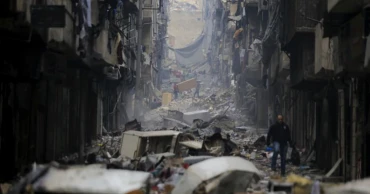
Earthquake stuns Syria's Aleppo even after war's horrors
For years, the people of Aleppo bore the brunt of bombardment and fighting when their city, once Syria’s largest and most cosmopolitan, was among the civil war’s fiercest battle zones. Even that didn’t prepare them for the new devastation and terror wreaked by this week’s earthquake.
The natural disaster piled on many human-made ones, multiplying the suffering in Aleppo and Syria more broadly.
Fighting largely halted in Aleppo in 2016, but only a small number of the numerous damaged and destroyed buildings had been rebuilt. The population has also more recently struggled with Syria's economic downslide, which has sent food prices soaring and residents thrown into poverty.
The shock of the quake is all too much.
Hovig Shehrian said that during the worst of the war in Aleppo, in 2014, he and his parents fled their home in a front-line area because of the shelling and sniper fire. For years, they moved from neighborhood to neighborhood to avoid the fighting.
“It was part of our daily routine. Whenever we heard a sound, we left, we knew who to call and what to do,” the 24-year-old said.
“But … we didn’t know what to do with the earthquake. I was worried we were going to die.”
Monday’s pre-dawn 7.8-magnitude quake, centered about 70 miles (112 kilometers) away in Turkey, jolted Aleppans awake and sent them fleeing into the street under a cold winter rain. Dozens of buildings across the city collapsed. More than 360 people were killed in the city and hundreds of others were injured. Workers were still digging three days later through the rubble, looking for the dead and the survivors. Across southern Turkey and northern Syria, more than 11,000 were killed.
Even those whose buildings still stood remain afraid to return. Many are sheltering in schools. A Maronite Christian monastery took in more than 800 people, particularly women, children and the elderly, crammed into every room.
“Until now we are not sleeping in our homes. Some people are sleeping in their cars,” said Imad al-Khal, the secretary-general of Christian denominations in Aleppo, who was helping organize shelters.
For many, the earthquake was a new sort of terror — a shock even after what they endured during the war.
For Aleppo, the war was a long and brutal siege. Rebels captured the eastern part of the city in 2012, soon after Syria’s civil war began. For the next years, Russian-backed government forces battled to uproot them.
Syrian and Russian airstrikes and shelling flattened entire blocks. Bodies were found in the river dividing the two parts of the city. On the government-held western side, residents faced regular mortar and rocket fire from opposition fighters.
A final offensive led to months of urban fighting, finally ending in December 2016 with government victory. Opposition fighters and supporters were evacuated, and government control imposed over the entire city. Activist groups estimate some 31,000 people were killed in the four years of fighting, and almost the entire population of the eastern sector was displaced.
Aleppo became a symbol of how President Bashar Assad succeeded in clawing back most opposition-held territory around Syria’s heartland with backing from Russia and Iran at the cost of horrific destruction. The opposition holds a last, small enclave in the northwest, centered on Idlib province and parts of Aleppo province, which was also devastated by Monday’s quake.
But Aleppo never recovered. Any reconstruction has been by individuals. The city’s current population remains well below its pre-2011 population of 4.5 million. Much of the eastern sector remains in ruins and empty.
Buildings damaged during the war or built shoddily during the fighting regularly collapse. One collapse, on Jan. 22, left 16 people dead. Another in September killed 11 people, including three children.
Aleppo was once the industrial powerhouse of Syria, said Armenak Tokmajyan, a non-resident fellow at Carnegie Middle East who is originally from the city. Now, he said, it’s economically marginalized, basic infrastructure in gas and electricity is lacking, and its population – which had hoped for improvements after fighting ended – only saw things get worse.
They have also now experienced the physical — and psychological — blow of the earthquake, Tokmajyan said. “It left them wondering, do they really deserve this fate or not? I think the trauma is big and it will take some time until they swallow this really bitter pill after (more than) 10 years of war.”
Rodin Allouch, an Aleppo native, covered the war for a Syrian TV station.
“I used to be on the front line, getting video shots, getting scoops. I was never scared. Rockets and shells were falling and everything, but my morale was high,” he recalled.
The earthquake was different. “I don’t know what the earthquake did to us exactly. We felt we were going to join God. It was the first time in my life I got scared.”
During the war, he had to leave his neighborhood in the eastern sector and rent an apartment on the western side. But the quake has displaced him yet again. As their building shook, he, his wife and four children fled to a nearby garden. Allouch said he won't return until the building is inspected and repaired. It still stands, but has many cracks. The family will instead stay in a ground-floor store front nearby that he rented.
“It is safer to be down (on ground floor) if there is an earthquake,” he said, but complained that there is no fuel for heating. “Life is so miserable."
Many others in Aleppo have been displaced more than once.
Farouk al-Abdullah fled his farm south of Aleppo city during the war. Since then, he has been living with his two wives, 11 children and 70-year-old mother in Jenderis, an opposition-held town in Aleppo province.
Their building there collapsed completely in the earthquake, though the entire family was able to escape.
He said the earthquake, with its destruction everywhere and its aftermath — watching rescue crews pull bodies out of the rubble — “are much more horrible than during the war."
And while war may be senseless, those in it often have a cause they are sacrificing for and wrest some meaning out of the death and destruction.
The war’s devastation in Aleppo at least “is somehow a proof that we weren’t defeated easily,” said Wissam Zarqa, an opposition supporter from the city who was there throughout the siege and now lives in the Turkish capital Ankara.
“But the destruction of natural disasters is all pain and nothing else but pain.”
3 years ago
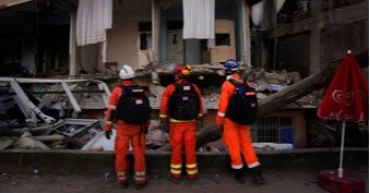
Death toll from catastrophic earthquake hitting Turkey, Syria goes beyond 20,700
Rescuers pulled more survivors from beneath the rubble of collapsed buildings Thursday, but hopes were starting to fade of finding many more people alive more than three days after a catastrophic earthquake and series of aftershocks hit Turkey and Syria, killing more than 20, 700.
Emergency crews working through the night in the city of Antakya were able to pull a young girl, Hazal Guner, from the ruins of a building and also rescued her father, Soner Guner, two hours later, news agency IHA reported.
As they prepared the man to be loaded into an ambulance, rescue crews told him that his daughter was alive and they were taking him to the same field hospital for treatment.
“I love you all,” he faintly whispered to the rescue team.
In Diyarbakir, east of Antakya, rescuers freed an injured woman from a collapsed building in the early morning hours but found the three people next to her in the rubble dead, the DHA news agency reported.
In addition to 12,873 people killed in Turkey, the country's disaster management agency said more than 60,000 have been injured. On the Syrian side of the border, 3,162 have been reported dead and more than 5,000 injured.
Tens of thousands are thought to have lost their homes. In Antakya, former residents of a collapsed building huddled around an outdoor fire overnight into Thursday, wrapping blankets tightly around themselves to try and stay warm.
Serap Arslan said many people remained under the rubble of the nearby building, including her mother and brother. She said machinery only started to move some of the heavy concrete on Wednesday.
“We tried to clear the debris on our own, but unfortunately our efforts have been insufficient,” the 45-year-old said.
Selen Ekimen wiped tears from her face with gloved hands as she explained that both her parents and brother were still buried.
"There's been no sound from them for days,” she said. “Nothing.”
President Recep Tayyip Erdogan was scheduled to travel Thursday to the quake-hit provinces of Gaziantep, Osmaniye and Kilis amid ongoing criticism that the government’s response has been too slow.
Experts said the survival window for those trapped under the rubble or otherwise unable to obtain basic necessities was closing rapidly. At the same time, they said it was too soon to abandon hope.
“The first 72 hours are considered to be critical,” said Steven Godby, a natural hazards expert at Nottingham Trent University in England. “The survival ratio on average within 24 hours is 74%, after 72 hours it is 22% and by the fifth day it is 6%.”
According to the disaster management agency, more than 110,000 rescue personnel were now taking part in the effort and more than 5,500 vehicles, including tractors, cranes, bulldozers and excavators had been shipped.
The task is monumental, however, with thousands of buildings toppled by the earthquake.
Erdogan, who faces a tough battle for reelection in May, acknowledged problems with the emergency response to Monday's 7.8-magnitude quake, but said the winter weather had been a factor. The earthquake also destroyed the runway at Hatay's airport, further disrupting the response.
“It is not possible to be prepared for such a disaster," Erdogan said as he visited the hard-hit province of Hatay on Wednesday. “We will not leave any of our citizens uncared for.” He also hit back at critics, saying "dishonorable people" were spreading “lies and slander” about the government's actions.
The disaster comes at a sensitive time for Erdogan, who faces an economic downturn and high inflation. Perceptions that his government mismanaged the crisis could hurt his standing. He said the government would distribute 10,000 Turkish lira ($532) to affected families.
Teams from more than two dozen countries have joined the local emergency personnel in the effort. But the scale of destruction from the quake and its powerful aftershocks was so immense and spread over such a wide area that many people were still awaiting help.
The region was already beset by more than a decade of civil war in Syria. Millions have been displaced within Syria itself, and millions more have sought refuge in Turkey.
In Syria, aid efforts have been hampered by the ongoing war and the isolation of the rebel-held region along the border, which is surrounded by Russia-backed government forces. Syria itself is an international pariah under Western sanctions linked to the war.
The earthquake’s toll has already outstripped that of a 7.8-magnitude quake in Nepal in 2015, when 8,800 died. A 2011 earthquake in Japan triggered a tsunami, killing nearly 20,000 people.
3 years ago

IEA: Asia set to use half of world’s electricity by 2025
Asia will for the first time use half of the world’s electricity by 2025, even as Africa continues to consume far less than its share of the global population, according to a new forecast released Wednesday by the International Energy Agency.
Much of Asia’s electricity use will be in China, a nation of 1.4 billion people whose share of global consumption will rise from a quarter in 2015 to a third by the middle of this decade, the Paris-based body said.
“China will be consuming more electricity than the European Union, United States and India combined,” said Keisuke Sadamori, the IEA’s director of energy markets and security.
By contrast, Africa — home to almost a fifth of world’s nearly 8 billion inhabitants — will account for just 3% of global electricity consumption in 2025.
“This and the rapidly growing population mean there is still a massive need for increased electrification in Africa,” said Sadamori.
The IEA’s annual report predicts that nuclear power and renewables such as wind and solar will account for much of the growth in global electricity supply over the coming three years. This will prevent a significant rise in greenhouse gas emissions from the power sector, it said.
Scientists say sharp cuts in all sources of emissions are needed as soon as possible to keep average global temperatures from rising 1.5 degrees Celsius (2.7 Fahrenheit) above pre-industrial levels. That target, laid down in the 2015 Paris climate accord, appears increasingly doubtful as temperatures have already increased by more than 1.1 C since the reference period.
One hope for meeting the goal is a wholesale shift away from fossil fuels such as coal, gas and oil toward low-carbon sources of energy. But while some regions are reducing their use of coal and gas for electricity production, in others consumption is increasing, the IEA said.
The 134-page also report warned that electricity demand and supply are becoming increasingly weather dependent, a problem it urged policymakers to address.
“In addition to drought in Europe, there were heat waves in India (last year),” said Sadamori. “Similarly, central and eastern China were hit by heat waves and drought. The United States also saw severe winter storms in December, and all those events put massive strain on the power systems of these regions.”
“As the clean energy transition gathers pace, the impact of weather events on electricity demand will intensify due to the increased electrification of heating, while the share of weather-dependent renewables will continue to grow in the generation mix,” the IEA said. “In such a world, increasing the flexibility of power systems while ensuring security of supply and resilience of networks will be crucial.”
3 years ago