Asia

China announces first population decline in recent years as births plunge
China has announced its first overall population decline in recent years amid an aging society and plunging birthrate.
The National Bureau of Statistics reported the country had 850,000 fewer people at the end of 2022 than over the previous year. It counts only the population of mainland China while excluding Hong Kong and Macao as well as foreign residents.
Read more: China's Communist Party capable of new, greater miracles
That left a total of 1.411.75 billion, with 9.56 million births against 10.41 million deaths, the bureau said at a briefing on Tuesday.
Men also continued to outnumber women by 722.06 million to 689.69 million, the bureau said, a result of the strict one-child policy that only officially ended in 2016 and a traditional preference for male offspring to carry on the family name.
Since abandoning the policy, China has sought to encourage families to have second or even third children, with little success. The expense of raising children in China's cities is often cited as a cause, reflecting attitudes in much of east Asia where birth rates have fallen precipitously.
China has long been the world's most populous nation, but is expected to soon be overtaken by India, if it has not already. Estimates put India's population at more than 1.4 billion and continuing to grow.
The last time China is believed to have recorded a population decline was during the Great Leap Forward at the end of the 1950s, Mao Zedong's disastrous drive for collective farming and industrialization that produced a massive famine killing tens of millions of people.
The bureau said Chinese of working-age between 16 and 59 totaled 875.56 million, accounting for 62.0% of the national population, while those aged 65 and older totaled 209.78 million, accounting for 14.9% of the total.
The statistics also showed increasing urbanization in a country that until recently had been largely rural. Over 2022, the permanent urban population increased by 6.46 million to reach 920.71 million, or 65.22%, while the rural population fell by 7.31 million.
Read more: China's economy grew 3% last year, not even half 2021
No direct comment was made on the possible effect on population figures of the COVID-19 outbreak that was first detected in the central Chinese city of Wuhan before spreading around the world. China has been accused by some specialists of underreporting deaths from the virus by blaming them on underlying conditions, but no estimates of the actual number have been published.
The United Nations estimated last year that the world’s population reached 8 billion on Nov. 15 and that India will replace China as the world’s most populous nation in 2023.
In a report released on World Population Day, the U.N. also said global population growth fell below 1% in 2020 for the first time since 1950.
Also Tuesday, the bureau released data showing China’s economic growth fell to its second-lowest level in at least four decades last year under pressure from anti-virus controls and a real estate slump.
The world’s No. 2 economy grew by 3% in 2022, less than half of the previous year’s 8.1%, the data showed.
That was the second-lowest annual rate since at least the 1970s after 2020, when growth fell to 2.4% at the start of the coronavirus pandemic, although activity is reviving after restrictions that kept millions of people at home and sparked protests were lifted.
3 years ago

Kabul's mannequins, hooded and masked under Taliban rules
Under the Taliban, the mannequins in women’s dress shops across the Afghan capital of Kabul are a haunting sight, their heads cloaked in cloth sacks or wrapped in black plastic bags.
The hooded mannequins are one symbol of the Taliban’s puritanical rule over Afghanistan. But in a way, they are also a small show of resistance and creativity by Kabul’s dress merchants.
Initially, the Taliban wanted the mannequins to be outright beheaded.
Read more: Ex-Afghan female lawmaker, guard shot dead at home
Not long after they seized power in August 2021, the Taliban Ministry of Vice and Virtue decreed that all mannequins must be removed from shop windows or their heads taken off, according to local media. They based the order on a strict interpretation of Islamic law that forbids statues and images of the human form since they could be worshipped as idols — though it also meshes with the Taliban's campaign to force women out of the public eye.
Some clothes sellers complied. But others pushed back.
They complained they’d be unable to display their clothes properly or would have to damage valuable mannequins. The Taliban had to amend their order and allowed the shop owners to cover the mannequins’ heads instead.
Shop owners then had to balance between obeying the Taliban and trying to attract customers. The variety of solutions they came up with are on display on Lycee Maryam Street, a middle-class commercial street lined with dress shops in a northern part of Kabul. The store windows and showrooms are lined with mannequins in evening gowns and dresses bursting with color and decoration — and all in various types of head coverings.
In one shop, the mannequins’ heads were cloaked in tailored sacks made out of the same material as the traditional dresses they modeled. One, in a purple dress beaded with cowrie shells, had a matching purple hood. Another, in a red gown elaborately embroidered in gold, was almost elegant in a mask of red velvet with a gold crown on her head.
“I can’t cover the mannequins’ heads with plastic or ugly things because it would make my window and shop look ugly,” said Bashir, the owner. Like other owners, he spoke to The Associated Press on condition he be identified only by his first name for fear of reprisals.
Shop owners need keep things attractive — the economy has collapsed since the Taliban takeover and the ensuing cutoff of international financing, throwing almost the entire population into poverty.
Elaborate dresses have always been popular in Afghanistan for weddings, which even before the Taliban were usually gender-segregated, giving women a chance to dress in their finest in the country’s conservative society. Under the Taliban, weddings are one of the few remaining opportunities for social gatherings. But with incomes so strained, they have become less elaborate.
Bashir said his sales are half what they used to be.
“Buying wedding, evening and traditional dresses is no longer a priority for people,” he said. “People think more about getting food and surviving.”
Another shop owner, Hakim, shaped aluminum foil over his mannequins’ heads. It adds a certain flash to his merchandise, he decided.
“I made an opportunity out of this threat and ban and did it so the mannequins are even more attractive than before,” he said.
Not all can be so elaborate. In one shop, the mannequins in sleeveless gowns all had black plastic sacks over their heads. The owner said he couldn't afford more.
Another shop owner, Aziz, said agents of the Ministry of Vice and Virtue regularly patrol shops and malls to make sure the mannequins are beheaded or covered. He was dismissive of the Taliban’s justification for the rules. “Everyone knows mannequins aren’t idols, and no one’s going to worship them. In all Muslim countries, mannequins are used to display clothes.”
Read more: Australia pulls out of Afghanistan cricket series
A small number of male mannequins can be seen in display windows, also with their heads covered, suggesting that the authorities are applying the ban uniformly.
The Taliban initially said they would not impose the same harsh rules over society as they did during their first rule in the late 1990s. But they have progressively imposed more restrictions, particularly on women. They have banned women and girls from schooling beyond the sixth grade, barred them from most jobs and demanded they cover their faces when outside.
On a recent day, a woman shopping on Lycee Maryam Street looked at the hooded mannequins.
“When I see them, I feel that these mannequins are also captured and trapped, and I get a sense of fear,” said the woman, who gave only her first name, Rahima.
“I feel like I see myself behind these shop windows, an Afghan woman who has been deprived of all her rights.”
3 years ago

Flight data, voice recorders retrieved from Nepal crash site
Search teams retrieved the flight data and cockpit voice recorders Monday of a passenger plane that plummeted into a gorge on approach to a new airport in the foothills of the Himalayas, officials said, as investigators looked for the cause of Nepal's deadliest plane crash in 30 years.
At least 69 of the 72 people aboard were killed, and officials believe the three missing are also dead. Rescuers combed through the debris, scattered down a 300-meter-deep (984-foot-deep) gorge, for them.
Many of the passengers on Sunday's flight were returning home to Pokhara, though the city is also popular with tourists since it's the gateway to the Annapurna Circuit hiking trail. On Monday evening, relatives and friends were still gathered outside a local hospital, some shouting at officials to speed up the post mortems so they could hold funerals for their loved ones.
It's still not clear what caused the crash, which took place less than a minute's flight from the airport on a mild day with little wind.
In footage taken by a passenger out of a window as the plane came in for a landing, buildings, roads and greenery are visible below. The video, by Sonu Jaiswal and verified by The Associated Press, then shows a violent jolt and a series of jerky images accompanied by yelling before flames fill the screen.
Nepal’s Civil Aviation Authority said the aircraft last made contact with the airport, which began operations only two weeks ago, from near Seti Gorge. A witness who recorded footage of the plane’s descent said it looked like a normal landing until the plane suddenly veered to the left.
"I saw that, and I was shocked," said Diwas Bohora. “I thought that today everything will be finished here after it crashes, I will also be dead.”
After it crashed, red flames erupted and the ground shook violently, Bohora said. “Seeing that scene, I was scared,” he added.
Amit Singh, an experienced pilot and founder of India’s Safety Matters Foundation, said Bohora's video appears to show a stall, a situation in which a plane loses lift, especially likely at low airspeeds.
The twin-engine ATR 72 aircraft, operated by Nepal’s Yeti Airlines, was completing the 27-minute flight from the capital, Kathmandu, to Pokhara, 200 kilometers (125 miles) west. It was carrying 68 passengers, including 15 foreign nationals, as well as four crew members, Nepal’s Civil Aviation Authority said in a statement. The foreigners included five Indians, four Russians, two South Koreans, and one each from Ireland, Australia, Argentina and France.
Read more: Nepal begins national mourning after 68 killed in deadly plane crash
Jagannath Niraula, a spokesman for the authority, said the flight recorders will be handed over to investigators. Pemba Sherpa, spokesperson for Yeti Airlines, confirmed that both the flight data and the cockpit voice recorders were found.
Nepal is home to eight of the world’s 14 highest mountains including Mount Everest. A pilot who routinely flies an ATR 72-500 plane from India to Nepal said the region’s topography, with its mountain peaks and narrow valleys, raises the risk of accidents and sometimes requires pilots to fly by sight rather than relying on instruments.
The pilot, who works for a private Indian airline and insisted on anonymity due to company policy, called the ATR 72-500 an “unforgiving aircraft” if the pilot isn’t highly skilled and familiar with the region’s terrain and wind speeds.
Hundreds of people have gathered outside the Pokhara Academy of Health and Science, Western Hospital, where the bodies are being kept.
Bimala Bhenderi said was planning to meet her friend, Tribhuban Paudel, on Tuesday when she heard that his flight had crashed. “I’m so sad, I can’t believe it still,” she said in tears.
Bikash Jaiswal said he could only identify his wife's brother only by the ring he wore, and that he had yet to tell his wife, who just gave birth to their daughter. Sanjay Jaiswal, who worked as a marketing agent for a private pharmaceutical company in Kathmandu, was flying to Pokhara for the birth. More than 24 hours after the crash, his body lay in the same hospital where his niece was born.
“He was a hardworking person, and now there’s no one left in his family to earn,” Bikash said.
Park Dae-seong, a minister and spokesperson of the Won Buddhist order, confirmed on Monday the deaths of Arun Paudel and his daughter, Prasiddi.
Arun Paudel, 47, had worked as a police officer in Nepal before being introduced into the religion by his brother. He studied the religion for years at a South Korean university before becoming a minister in 2009. He then returned to Nepal and established a school in the Lumbini province in 2013 where children received English, Korean and information technology instruction. Park said Paudel was returning to Nepal for work related to the school, called the Vishow Ekata Academy.
The Civil Aviation Authority said that 41 people have been identified. Gyan Khadka, a police spokesperson in the district, said the bodies would be handed over to family after officials finish post mortem reports.
The type of plane involved, the ATR 72, has been used by airlines around the world for short regional flights since the late 1980s. In Taiwan, two accidents involving ATR 72-500 and ATR 72-600 aircrafts in 2014 and 2015 led to the planes being grounded for a period.
ATR identified the plane involved in Sunday’s crash as an ATR 72-500 in a tweet. According to plane tracking data from flightradar24.com, the aircraft was 15 years old and “equipped with an old transponder with unreliable data.” It was previously flown by India’s Kingfisher Airlines and Thailand’s Nok Air before Yeti took it over in 2019, according to records on Airfleets.net. ATR has not responded to a request for comment.
According to the Safety Matters Foundation’s data, there have been 42 fatal plane crashes in Nepal since 1946.
Sunday’s crash is the country's deadliest since 1992, when all 167 people aboard a Pakistan International Airlines plane were killed when it plowed into a hill as it tried to land in Kathmandu.
The European Union has banned airlines from Nepal from flying into the 27-nation bloc since 2013, citing weak safety standards. In 2017, the International Civil Aviation Organization cited improvements in Nepal’s aviation sector, but the EU continues to demand administrative reforms.
3 years ago

Flight data, voice recorders retrieved from Nepal site after deadly plane crash
A spokesman for Nepal’s Civil Aviation Authority says a flight data recorder and a cockpit voice recorder have been retrieved from the site of the crash of a passenger plane that went down on approach to a newly opened airport in the tourist town of Pokhara.
Jagannath Niraula said the boxes were found on Monday, a day after the ATR-72 aircraft crashed, killing 68 of the 72 people aboard. He said they will be handed over to investigators.
Pemba Sherpa, spokesperson for Yeti Airlines, also confirmed that both the flight data and the cockpit voice recorders have been found.
Nepal began a national day of mourning Monday, as rescue workers rappelled down a 300-meter (984 feet) gorge to continue the search. Two more bodies were found Monday morning.
It remains unclear what caused the crash, the Himalayan country's deadliest airplane accident in three decades. The weather was mild and not windy on the day of the crash.
Read more: Nepal begins national mourning after 68 killed in deadly plane crash
A witness who recorded footage of the plane’s descent from his balcony said he saw the plane flying low before it suddenly veered to its left. “I saw that and I was shocked… I thought that today everything will be finished here after it crashes, I will also be dead,” said Diwas Bohora. After it crashed, red flames erupted and the ground shook violently, like an earthquake, Bohora said. “I was scared. Seeing that scene, I was scared.”
Another witness said he saw the aircraft twist violently in the air after it began descending to land, watching from the terrace of his house. Finally, Gaurav Gurung said, the plane fell nose-first towards its left and crashed into the gorge.
Nepal’s Civil Aviation Authority said the aircraft last made contact with the airport from near Seti Gorge at 10:50 a.m. before crashing.
The twin-engine ATR 72 aircraft, operated by Nepal’s Yeti Airlines, was competing the 27-minute flight from the capital, Kathmandu, to Pokhara, 200 kilometers (125 miles) west. It was carrying 68 passengers, including 15 foreign nationals, as well as four crew members, Nepal’s Civil Aviation Authority said in a statement. The foreigners included five Indians, four Russians, two South Koreans, and one each from Ireland, Australia, Argentina and France.
Hundreds of people gathered outside the Pokhara Academy of Health and Science, Western Hospital, where the bodies are being kept. Relatives and friends of victims, many of whom were from Pokhara, consoled each other as they waited.
Bimala Bhenderi was waiting outside the post-mortem room Monday. She was planning to meet her friend, Tribhuban Paudel, on Tuesday when she heard that his flight had crashed. “I’m so sad, I can’t believe it still,” she said in tears.
Gyan Khadka, a police spokesperson in the district, said 31 bodies have been identified and will be handed over to family after officials finish post mortem reports. The bodies of foreigners and those that are unrecognizable will be sent to Kathmandu for further investigation.
On Sunday, Twitter was awash with images that showed plumes of smoke billowing from the crash site, about 1.6 kilometers (nearly a mile) away from Pokhara International Airport. The aircraft’s fuselage was split into multiple parts that were scattered down the gorge.
Read more: Nepal begins national mourning after 68 killed in deadly plane crash
Hours after dark, scores of onlookers remained crowded around the crash site near the airport in the resort town of Pokhara as rescue workers combed the wreckage on the edge of the cliff and in the ravine below.
Local resident Bishnu Tiwari, who rushed to the crash site near the Seti River to help search for bodies, said the rescue efforts were hampered by thick smoke and a raging fire.
“The flames were so hot that we couldn’t go near the wreckage. I heard a man crying for help, but because of the flames and smoke we couldn’t help him,” Tiwari said.
At Tribhuvan International Airport in Kathmandu, family members appeared distraught as they waited for information.
Prime Minister Pushpa Kamal Dahal rushed to the airport after the crash and set up a panel to investigate the accident.
”The incident was tragic. The full force of the Nepali army, police has been deployed for rescue,” he said.
South Korea’s Foreign Ministry said in a statement that it’s still trying to confirm the fate of two South Korean passengers and has sent staff to the scene. The Russian Ambassador to Nepal, Alexei Novikov, confirmed the death of four Russian citizens who were on board the plane.
Omar Gutiérrez, governor of Argentina’s Neuquen province, wrote on his official Twitter account that an Argentine passenger on the flight was Jannet Palavecino, from his province.
The Facebook page of Palavecino says she was manager of the Hotel Suizo in Neuquen city. She described herself as a lover of travel and adventure tourism.
Australian Treasurer Jim Chalmers told reporters Monday that “our hearts go out to all of the families of the crew and passengers” who died, adding that the government was providing consular support to the family of an Australian who was aboard the plane.
Pokhara is the gateway to the Annapurna Circuit, a popular hiking trail in the Himalayas. The city’s new international airport began operations only two weeks ago.
The type of plane involved, the ATR 72, has been used by airlines around the world for short regional flights. Introduced in the late 1980s by a French and Italian partnership, the aircraft model has been involved in several deadly accidents over the years.
In Taiwan two earlier accidents involving ATR 72-500 and ATR 72-600 aircrafts happened just months apart.
In July 2014, a TransAsia ATR 72-500 flight crashed while trying to land on the scenic Penghu archipelago between Taiwan and China, killing 48 people onboard. An ATR 72-600 operated by the same Taiwanese airline crashed shortly after takeoff in Taipei in February 2015 after one of its engines failed and the second was shut down, apparently by mistake.
The 2015 crash, captured in dramatic footage that showed the plane striking a taxi as it hurtled out of control, killed 43, and prompted authorities to ground all Taiwanese-registered ATR 72s for some time. TransAsia ceased all flights in 2016 and later went out of business.
ATR identified the plane involved in Sunday’s crash as an ATR 72-500 in a tweet. According to plane tracking data from flightradar24.com, the aircraft was 15 years old and “equipped with an old transponder with unreliable data.” It was previously flown by India’s Kingfisher Airlines and Thailand’s Nok Air before Yeti took it over in 2019, according to records on Airfleets.net.
Yeti Airlines has a fleet of six ATR 72-500 planes, company spokesperson Sudarshan Bartaula said.
Nepal, home to eight of the world’s 14 highest mountains, including Mount Everest, has a history of air crashes. Sunday’s crash is Nepal’s deadliest since 1992, when all 167 people aboard a Pakistan International Airlines plane were killed when it plowed into a hill as it tried to land in Kathmandu.
According to the Flight Safety Foundation’s Aviation Safety database, there have been 42 fatal plane crashes in Nepal since 1946.
According to a 2019 safety report from Nepal’s Civil Aviation Authority, the country’s “hostile topography” and “diverse weather patterns” were the biggest dangers to flights in the country. The report said such accidents happened at airports that had short strips of runway for takeoff and landing and most were due to pilot error.
The report added that 37% of all air crashes in Nepal between 2009 and 2018 were due to pilot error, not counting helicopters and recreational flights.
The European Union has banned airlines from Nepal from flying into the 27-nation bloc since 2013, citing weak safety standards. In 2017, the International Civil Aviation Organization cited improvements in Nepal’s aviation sector, but the EU continues to demand administrative reforms.
3 years ago

Myanmar arms industry growing after army takeover: Report
Companies from at least 13 countries have helped Myanmar build up its capacity to produce weapons that are being used to commit atrocities following a 2021 military takeover, independent international experts have found.
The report released Monday by the Special Advisory Council for Myanmar details how the country has stepped up arms production since the army seized power on Feb. 1, 2021, igniting a mass public opposition movement.
The army’s takeover from elected civilian leaders reversed nearly a decade of progress toward democracy after 50 years of military rule. After security forces used lethal force against peaceful demonstrators, opponents of military rule took up arms. Some U.N. experts have characterized the situation as a civil war.
Read more: Myanmar's military govt 'willing to take back Rohingyas' .
The Assistance Association for Political Prisoners has documented more than 2,700 civilian deaths in the violence, including 277 children, while more than 13,000 people have been detained. The true number is believed to be much higher.
Companies in the U.S., Europe, Asia and the Middle East are supporting the military supply chain, the report says, urging those businesses to ensure they are not facilitating human rights abuses.
The growth of the homegrown arms industry comes as some countries have enforced arms embargoes or sanctions against individuals and companies involved in trading or manufacturing arms.
In October, the U.S. Treasury imposed sanctions against Aung Moe Myint, a businessman close to the army who it said facilitates arms deals on its behalf. His brother, Hlaing Moe Myint, and the trading company they founded, Dynasty International Company Ltd., were also targeted. One of its directors, Myo Thitsar, also was designated for sanctions.
In November, the U.S. imposed sanctions on aircraft suppliers to the military, citing deadly air strikes on civilians.
Myanmar has no private arms makers, so any such companies are run by the Ministry of Defense and Directorate of Defense Industries, the report said.
Local factories still can draw upon licensed technology and overseas supply chains, technical support and other backing, sometimes by sending equipment to Singapore and Taiwan for upgrading and maintenance, it said.
In a statement, council expert Chris Sidoti urged that governments investigate and when justified initiate action against companies that enable Myanmar's military to make weapons used in “indiscriminate attacks on civilians."
“Foreign companies that profit from the suffering of the Myanmar people must be held accountable," said Sidoti, a human rights lawyer and a member of the U.N. Fact Finding Mission on Myanmar from 2017 to 2019.
A report last year by the United Nations’ Office of the High Commissioner for Human Rights outlined some of those links, naming companies in Russia, China, Ukraine, Israel, Singapore and the Philippines.
A major factor driving the buildup in the domestic arms making industry is the risk that imports of arms, military aircraft and other weaponry will be cut off by embargoes or sanctions. The army is now self-reliant in making small arms and light weapons, the report says.
Myanmar's arms-making capacity includes a wide variety of items from assault rifles and machine guns to mortars, anti-tank and anti-aircraft weapons, missiles and missile launchers and artillery and air defense systems, it said.
Read more: Myanmar's military regime must end its violence, release those unjustly detained: US
Land mines and naval mines are among other products being made in Myanmar, said the report, citing people who have worked in the industry and also photos of weapons displayed at a defense and security exhibition in Bangkok that showcased such products.
Weapons factories, known as “KaPaSa," an abbreviation of the local name for the Directorate of Defense Industries, draw on components such as fuses, optical sights and detonating caps imported from India and China. They also have computer numerical control, or CNC, machines for milling, grinding and other functions made in Austria, Germany, Japan, Taiwan and the United States, the report said.
The exact number of such factories is unclear but analysis of satellite images and other information has identified dozens of such facilities.
Much of the technology used in the arms-making industry was transferred for civilian use before the military took control, ousting the democratically elected government of Aung San Suu Kyi.
But more research is needed on the complex network of suppliers, licensors of technology and other details of weapons manufacturing, the report said.
Myanmar has endured decades of armed conflict between the central government and ethnic minorities seeking greater autonomy, mostly in border regions.
3 years ago

Ex-Afghan female lawmaker, guard shot dead at home: Police
A former Afghan female lawmaker and her bodyguard have been shot dead by unknown assailants at her home in the capital, Kabul, police said Sunday.
Mursal Nabizada was among the few female parliamentarians who stayed in Kabul after the Taliban seized power in August 2021.
Read more: Afghan women athletes barred from play, fear Taliban threats
It is the first time a lawmaker from the previous administration has been killed in the city since the takeover.
Local police chief Molvi Hamidullah Khalid said Nabizada and her guard were shot dead around 3 a.m. Saturday in the same room.
He said her brother and a second security guard were injured. A third security guard fled the scene with money and jewelry.
She died on the first floor of her home, which she used as her office. Khalid said investigations are underway. He did not answer questions about possible motives.
Abdullah Abdullah, who was a top official in Afghanistan's former Western-backed government, said he was saddened by Nabizada's death and hoped the perpetrators would be punished. He described her as a “representative and servant of the people.”
A former Kandahar parliamentarian, Malalai Ishaqzai, also offered her condolences.
Read more: Afghan Taliban kill 8 in raids of IS hideouts in Afghanistan
Nabizada was elected in 2019 to represent Kabul and stayed in office until the Taliban takeover.
She was a member of the parliamentary defense commission and worked at a private non-governmental group, the Institute for Human Resources Development and Research.
3 years ago

Cars collide on icy road in South Korea; 1 dead, dozens hurt
Nearly 50 vehicles collided on an icy highway near the South Korean capital Sunday night, killing one person and injuring dozens.
At least 47 vehicles were involved in the accident on the Guri-Pocheon highway, where they skidded on the slippery road and collided in succession, said Hwang Tae-geun, an official at the fire department in Pocheon city.
Read more: South Korean president travels to UAE, seeks arms sales
Photos showed police officers and rescuers with stretchers rushing through throngs of cars on a road scattered with debris. Many of the vehicles, which included at least one commuter bus, had damaged fronts or rear-ends and some appeared to have been knocked sideways.
Kim Dong-wan, an official at the fire department of northern Gyeonggi Province, said at least three motorists sustained serious injuries and another person who had been transported to a hospital in cardiac arrest was pronounced dead.
At least 29 others were treated at hospitals for light injuries, he said. Hwang said rescue workers used buses to drive home an unspecified number of people whose injuries weren’t significant enough to require hospital treatment.
The crash occurred near a section of the highway entering Pocheon, which is about 40 kilometers (25 miles) north of Seoul.
The crash was the biggest among multiple traffic accidents that occurred in the country over the weekend because of icy road conditions and snow. Earlier on Sunday evening, seven vehicles collided near a highway tunnel near the eastern coastal city of Gangneung, leaving at least two people injured.
Read more: China halts visas for Japan, South Korea in COVID-19 spat
The Ministry of the Interior and Safety said the snowfalls over the weekend and subzero temperatures forecasted this week likely means that road conditions will continue to be hazardous in the greater capital area and central and eastern regions.
About 3.3 centimeters (1.29 inches) of snow fell in Pocheon over the weekend while some areas in the eastern Gangwon regions saw 40 to 60 centimeters (16 to 23 inches) of snow. At least nine highway sections as well as dozens of dozens of maritime transport routes and hiking trails remained closed as of Monday morning.
3 years ago

Nepal begins national mourning after 68 killed in deadly plane crash
Nepal began a national day of mourning Monday, a day after a plane crashed while attempting to land at a newly opened airport, killing at least 68 of the 72 people aboard. Rescue workers rappelled down a 300-meter (984 feet) gorge to continue the search. Two more bodies have been found Monday morning.
The army, police and rescue workers are also scouring the debris for the flight data recorder. It remains unclear what caused the crash, the Himalayan country's deadliest airplane accident in three decades.
A witness who recorded footage of the plane’s descent from his balcony said he saw the plane flying low before it suddenly veered to its left. “I saw that and I was shocked… I thought that today everything will be finished here after it crashes, I will also be dead,” said Diwas Bohora. After it crashed, red flames erupted and the ground shook violently, like an earthquake, Bohora said. “I was scared. Seeing that scene, I was scared.”
Another witness said he saw the aircraft spinning violently in the air after it began descending to land, watching from the terrace of his house. Finally, Gaurav Gurung said, the plane fell nose-first towards its left and crashed into the gorge.
Nepal’s Civil Aviation Authority said the aircraft last made contact with the airport from near Seti Gorge at 10:50 a.m. before crashing.
Read more: Small plane crashes into Tanzania's Lake Victoria, 19 dead
The twin-engine ATR 72 aircraft, operated by Nepal’s Yeti Airlines, was competing the 27-minute flight from the capital, Kathmandu, to Pokhara, 200 kilometers (125 miles) west. It was carrying 68 passengers, including 15 foreign nationals, as well as four crew members, Nepal’s Civil Aviation Authority said in a statement. The foreigners included five Indians, four Russians, two South Koreans, and one each from Ireland, Australia, Argentina and France.
The bodies are being kept in the Pokhara Academy of Health and Science, Western Hospital. Gyan Khakda, a police spokesperson in the district, said 31 bodies have been identified and will be handed over to family after officials finish post mortem reports. The bodies of foreigners and those that are unrecognizable will be sent to Kathmandu for further investigation.
On Sunday, Twitter was awash with images that showed plumes of smoke billowing from the crash site, about 1.6 kilometers (nearly a mile) away from Pokhara International Airport. The aircraft’s fuselage was split into multiple parts that were scattered down the gorge.
Hours after dark, scores of onlookers remained crowded around the crash site near the airport in the resort town of Pokhara as rescue workers combed the wreckage on the edge of the cliff and in the ravine below.
Local resident Bishnu Tiwari, who rushed to the crash site near the Seti River to help search for bodies, said the rescue efforts were hampered by thick smoke and a raging fire.
“The flames were so hot that we couldn’t go near the wreckage. I heard a man crying for help, but because of the flames and smoke we couldn’t help him,” Tiwari said.
At Tribhuvan International Airport in Kathmandu, family members appeared distraught as they waited for information.
Prime Minister Pushpa Kamal Dahal rushed to the airport after the crash and set up a panel to investigate the accident.
”The incident was tragic. The full force of the Nepali army, police has been deployed for rescue,” he said.
South Korea’s Foreign Ministry said in a statement that it’s still trying to confirm the fate of two South Korean passengers and has sent staff to the scene. The Russian Ambassador to Nepal, Alexei Novikov, confirmed the death of four Russian citizens who were on board the plane.
Omar Gutiérrez, governor of Argentina’s Neuquen province, wrote on his official Twitter account that an Argentine passenger on the flight was Jannet Palavecino, from his province.
The Facebook page of Palavecino says she was manager of the Hotel Suizo in Neuquen city. She described herself as a lover of travel and adventure tourism.
Read more: 68 confirmed dead as passenger plane with 72 on board crashes near Pokhara airport
Pokhara is the gateway to the Annapurna Circuit, a popular hiking trail in the Himalayas. The city’s new international airport began operations only two weeks ago.
The type of plane involved, the ATR 72, has been used by airlines around the world for short regional flights. Introduced in the late 1980s by a French and Italian partnership, the aircraft model has been involved in several deadly accidents over the years.
In Taiwan two earlier accidents involving ATR 72-500 and ATR 72-600 aircrafts happened just months apart.
In July 2014, a TransAsia ATR 72-500 flight crashed while trying to land on the scenic Penghu archipelago between Taiwan and China, killing 48 people onboard. An ATR 72-600 operated by the same Taiwanese airline crashed shortly after takeoff in Taipei in February 2015 after one of its engines failed and the second was shut down, apparently by mistake.
The 2015 crash, captured in dramatic footage that showed the plane striking a taxi as it hurtled out of control, killed 43, and prompted authorities to ground all Taiwanese-registered ATR 72s for some time. TransAsia ceased all flights in 2016 and later went out of business.
ATR identified the plane involved in Sunday’s crash as an ATR 72-500 in a tweet. According to plane tracking data from flightradar24.com, the aircraft was 15 years old and “equipped with an old transponder with unreliable data.” It was previously flown by India’s Kingfisher Airlines and Thailand’s Nok Air before Yeti took it over in 2019, according to records on Airfleets.net.
Yeti Airlines has a fleet of six ATR72-500 planes, company spokesperson Sudarshan Bartaula said.
Nepal, home to eight of the world’s 14 highest mountains, including Mount Everest, has a history of air crashes. According to the Flight Safety Foundation’s Aviation Safety database, there have been 42 fatal plane crashes in Nepal since 1946.
According to a 2019 safety report from Nepal’s Civil Aviation Authority, the country’s “hostile topography” and “diverse weather patterns” were the major challenges surrounding aviation operations in the nation, also resulting in a “number of accidents” to small aircrafts. The report said such accidents happened at airports that had short strips of runway for takeoff and landing and most were due to pilot error.
The report added that 37% of all air crashes in Nepal between 2009 and 2018 were due to pilot error and 50% of all air crashes took place when the airplanes were in “en route phase of flying.” These crashes don’t include helicopters and recreational planes.
Sunday’s crash is Nepal’s deadliest since 1992, when all 167 people aboard a Pakistan International Airlines plane were killed when it plowed into a hill as it tried to land in Kathmandu.
The European Union has banned airlines from Nepal from flying into the 27-nation bloc since 2013, citing weak safety standards. In 2017, the International Civil Aviation Organization cited improvements in Nepal’s aviation sector, but the EU continues to demand administrative reforms.
3 years ago

At least 2 killed, 12 missing in north China chemical plant explosion
A massive explosion at a chemical plant in northeastern China has killed at least two people and left 12 missing.
Another 34 people were injured in the explosion Sunday on the outskirts of the city of Panjin in Liaoning province east of the capital Beijing.
News releases from the local government showed photos of flames and thick black smoke rising from the complex of chemical processing machinery, pipes and storage containers.
Read more: China to work with IORA for global development: Envoy
Fire crews have brought the blaze under control and the local environmental department was monitoring the impact on air quality in the area, the government of Panshan County in the city's suburbs said in a news release.
The cause of the accident remained under investigation, authorities said. People posting on social media said they felt the shock of the explosion, but the damage did not appear to extend beyond the plant.
Read more: China's Communist Party capable of new, greater miracles
China, with the world's second-largest economy, suffers deadly industrial accidents on a regular basis.
The central government has pledged stronger safety measures ever since an explosion in 2015 at a chemical warehouse in the northern port city of Tianjin killed 173 people, most of them firefighters and police officers. In that case, a number of local officials were accused of taking bribes to ignore safety violations.
3 years ago

South Korean president travels to UAE, seeks arms sales
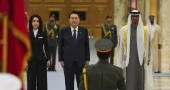
South Korean President Yoon Suk Yeol received an honor guard welcome Sunday on a trip to the United Arab Emirates as he hopes to expand its military sales here.
Yoon’s visit comes as South Korea conducts business deals worth billions of dollars and stations special forces troops to defend the UAE, an arrangement that drew criticism under his liberal predecessor. Now, however, it appears the conservative leader wants to double down on those military links even as tensions with neighboring Iran have already seen Tehran seize a South Korean oil tanker in 2021.
“I think that the situation in the Middle East is changing very rapidly when it comes to geopolitics,” said June Park, a fellow with the International Strategy Forum at Schmidt Futures. “So Korea wants to make sure some of the strategic partnerships and the components ... with the UAE.”
Yoon arrived at Qasr Al Watan palace in Abu Dhabi on Sunday. He was greeted by Emirati leader Sheikh Mohammed bin Zayed Al Nahyan, who took office in May after serving as the country’s de facto ruler for years.
Also Read: S. Korea military sorry for failing to down North’s drones
An honor guard of traditionally dressed Emiratis greeted Yoon and his wife, Kim Keon Hee. They twirled model Lee-Enfield rifles alongside troops on camelback and horseback. Inside, a military band played the South Korean and Emirati national anthems.
While energy-hungry South Korea does rely on the Emirates for just under 10% of its crude oil supply, Seoul has struck a series of deals far beyond oil with this nation of seven sheikhdoms that closely tie the nation to Abu Dhabi. South Korea’s trade with the UAE is into the billions of dollars worth of cars, material and other goods.
Before Yoon’s trip, officials described the visit as seeking to solidify the ties already between the two countries.
“This visit will strengthen strategic cooperation with our brother country UAE in the four core cooperative sectors of nuclear power, energy, investment and defense,” said Kim Sung-han, director of national security in Yoon’s government.
On Saturday, South Korea’s Yonhap news agency quoted an anonymous presidency official as also saying that an arms deal was planned.
“The atmosphere is extremely ripe for security or military cooperation between South Korea and the UAE involving the arms industry,” the official said, according to Yonhap.
Already, South Korea reached a $3.5 billion deal with the UAE in 2022 to sell the M-SAM, an advanced air defense system designed to intercept missiles at altitudes below 40 kilometers (25 miles). Emirati officials have grown increasingly concerned about protecting their airspace after being targeted in long-range drone attacks by Yemen’s Iran-backed Houthi rebels.
While U.S. forces fired Patriot missiles for the first time in combat since the 2003 Iraq invasion to defend Abu Dhabi during those attacks, the Emiratis have been hedging their reliance on American military support since America’s chaotic withdrawal from Afghanistan.
But South Korea’s biggest project remains the Barakah nuclear power plant, Seoul’s first attempt to build atomic reactors abroad. The $20 billion facility, which ultimately will have four reactors, is in the UAE’s western deserts near the Saudi border and one day will account for nearly a quarter of all of the Emirates’ power needs.
It’s also key to the UAE’s plans to go carbon neutral by 2050, a pledge that takes on special importance as it prepares to host the United Nations COP28 climate negotiations beginning in November in Dubai.
Yoon likely wants to assure the Emiratis that South Korea wants to be in the running for lucrative maintenance contracts after his predecessor, President Moon Jae-in, had said Seoul wanted to move away from nuclear energy.
“The energy policy took on a 180 degree shift” after the election, said Park, the analyst. “So Korea is now for nuclear and I guess that the Yoon administration wants to make sure to the Emiratis that there is no concern regarding policy shifts or anything like that.”
Then there’s also the nuclear tensions with North Korea. Yoon, a former top prosecutor, became president in May on a promise to take a harder line on Pyongyang. Up until recent years, hundreds of North Korean laborers were believed to be working in the UAE and elsewhere in the Gulf Arab states, offering a cash stream to Pyongyang as it seeks to evade mounting sanctions over its nuclear program.
However, a crackdown has seen their numbers drastically drop as nations stopped renewing their visas. A recent U.N. expert report did note that high-end camera gear bought in the UAE ended up in North Korea, while another mentioned a North Korean national living in Dubai obtaining foreign currency through an online app by lying about his nationality.
The U.N. also said as recently as 2021 it had information about North Korean diplomats in Iran flying on Dubai-based long-haul carrier Emirates smuggling gold with them.
3 years ago