Asia

Woman in Indonesia killed, swallowed whole by python
A woman in Indonesia's Jambi province was killed and swallowed whole by a python, according to local reports.
Jahrah, a rubber-tapper reportedly in her 50s, had made her way to work at a rubber plantation on Sunday morning, reports BBC.
She was reported missing after failing to return that night, and search parties sent out to find her. A day later villagers found a python with what appeared to be a large stomach.
Locals later killed the snake and found her body inside.
"The victim was found in the snake's stomach," Betara Jambi police chief AKP S Harefa told local media outlets, adding that her body appeared to be largely intact when it was found.
He said the victim's husband had on Sunday night found some of her clothes and tools she had used at the rubber plantation, leading him to call on a search party.
Read:Florida teen wins $10,000 by capturing 28 pythons
After the snake - which was at least 5m (16ft) long - was spotted on Monday, villagers then caught and killed it to verify the victim's identity.
"After they cut the belly apart, they found it was Jahrah inside," Mr Harefa told CNN Indoneisa.
Though such incidents are rare, this is not the first time someone in Indonesia has been killed and eaten by a python. Two similar deaths were reported in the country between 2017 and 2018.
Pythons swallow their food whole. Their jaws are connected by very flexible ligaments so they can stretch around large prey.
One expert had earlier told the BBC that pythons typically eat rats and other animals, "but once they reach a certain size it's almost like they don't bother with rats anymore because the calories are not worth it".
"In essence they can go as large as their prey goes," said Mary-Ruth Low, conservation & research officer for Wildlife Reserves Singapore.
That can include animals as large as pigs or even cows.
3 years ago

China launches Covid-19 vaccine inhaled through mouth
The Chinese city of Shanghai started administering an inhalable COVID-19 vaccine on Wednesday in what appears to be a world first.
The vaccine, a mist that is sucked in through the mouth, is being offered for free as a booster dose for previously vaccinated people, according to an announcement on an official city social media account.
Scientists hope that such “needle-free” vaccines will make vaccination more accessible in countries with fragile health systems because they are easier to administer. They also may persuade people who don’t like getting a shot in the arm to get inoculated.
China wants more people to get booster shots before it relaxes strict pandemic restrictions that are holding back the economy and are increasingly out of sync with the rest of the world. As of mid-October, 90% of Chinese were fully vaccinated and 57% had received a booster shot.
A video posted by an online Chinese state media outlet showed people at a community health center sticking the short nozzle of a translucent white cup into their mouths. The accompanying text said that after slowly inhaling, people hold their breath for five seconds, with the entire procedure completed in 20 seconds.
“It was like drinking a cup of milk tea,” one Shanghai resident said in the video. “When I breathed it in, it tasted a bit sweet.”
The effectiveness of non-needle vaccines has not been fully explored. Chinese regulators approved the inhalable one in September, but only as a booster shot after studies showed it triggered an immune system response in people who had previously received two shots of a different Chinese vaccine.
A vaccine taken orally could fend off the virus before it reaches the rest of the respiratory system, though that would depend in part on the size of the droplets, one expert said.
Larger droplets would train defenses in parts of the mouth and throat, while smaller ones would travel further into the body, said Dr. Vineeta Bal, an immunologist in India.
The inhalable vaccine was developed by Chinese biopharmaceutical company CanSino Biologics Inc. as an aerosol version of the company’s one-shot adenovirus vaccine, which uses a relatively harmless cold virus.
The traditional one-shot vaccine has been approved for use in more than 10 markets including China, Hungary, Pakistan, Malaysia, Argentina and Mexico. The inhaled version has received a go-ahead for clinical trials in Malaysia, a Malaysian media report said last month.
Regulators in India have approved a nasal vaccine, another needle-free approach, but it has yet to be rolled out. The vaccine, developed in the U.S. and licensed to Indian vaccine maker Bharat Biotech, is squirted in the nose.
About a dozen nasal vaccines are being tested globally, according to the World Health Organization.
China has relied on domestically developed vaccines, primarily two inactivated vaccines that have proven effective in preventing death and serious disease but less so than the Pfizer and Moderna vaccines at stopping the spread of the disease.
Chinese authorities also have not mandated vaccination — entering an office building or other public places requires a negative COVID-19 test, not proof of vaccination. And the country’s strict “zero-COVID” approach means that only a small proportion of the population has been infected and built immunity that way, compared to other places.
As a result, it’s unclear how widely COVID-19 would spread if restrictions were lifted. The ruling Communist Party has so far shown no sign of easing the “zero-COVID” policy, moving quickly to restrict travel and impose lockdowns when even just a few cases are discovered.
Authorities on Wednesday ordered the lockdown of 900,000 people in Wuhan, the city where the virus was first detected in late 2019, for at least five days. In remote Qinghai province, the urban districts of Xining city have been locked down since last Friday.
In Beijing, Universal Studios said it would close its hotels and attractions “to comply with pandemic prevention and control.” The city of more than 21 million people reported 19 new cases in the latest 24-hour period.
3 years ago

Veteran Indian politician Kharge takes charge as Congress president
Veteran politician Mallikarjun Kharge on Tuesday became the first non-Gandhi in 24 years to take over the reins of India's main opposition Congress party.
The 80-year-old was officially handed over the baton by interim president Sonia Gandhi at a function at Congress headquarters in the Indian capital this morning.
Sonia was the Congress president for nearly 23 years, while his son Rahul Gandhi held the coveted post for one year.
Addressing party leaders, Sonia said that she was "relieved" with Kharge taking over as Congress president.
"I did my duty to the best of my ability. Today, I will be freed of this responsibility. A weight is off my shoulder. I feel a sense of relief," Sonia said.
"This was a big responsibility. The responsibility is now on Mallikarjun Kharge," she said, adding that "the biggest challenge today was the crisis of democratic values in the country".
Kharge was elected the Congress president on October 19. Considered close to the Gandhi family, he defeated a relatively young Shashi Tharoor, a former UN diplomat, by a huge margin.
While Kharge is a staunch Gandhi family loyalist with 50 years of political experience, 66-year-old Tharoor is an articulate leader who joined the party in 2009 after nearly a 30-year stint in the UN.
Since Prime Minister Narendra Modi's nationalist BJP swept to power in 2014, the Congress has witnessed a vertiginous decline. The Congress is now in power only in a handful of Indian states.
Often blamed for the party's poor performance, Rahul has been reluctant to take over the reins of the party in the run-up to the general elections slated for 2024.
3 years ago
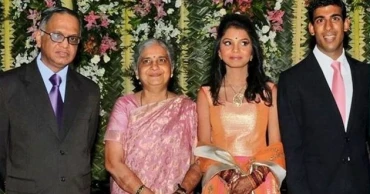
Confident son-in-law Rishi Sunak will do his best for Brits: Indian billionaire businessman
British Prime Minister-designate Rishi Sunak's father-in-law and Indian billionaire businessman NR Narayana Murthy has said he is confident that his son-in-law will do the best for the people of the UK.
Sunak, 42, on Monday was elected as the new leader of the ruling Conservative Party and is all set to become Britain's first prime minister of Indian origin.
"Congratulations to Rishi. We are proud of him and we wish him success. We are confident he will do his best for the people of the United Kingdom," Narayana Murthy, the founder of Indian software behemoth Infosys, told the local media.
Sunak, the former British Chancellor, tied the knot with Narayana Murthy's daughter Akshata a leading fashion designer, in 2009. The couple, who met at Stanford University, has two daughters.
Akshata and Sunak are one of the wealthiest couples in Britain, with a combined fortune of 730 million pounds.
Akshata holds a 0.93% stake in Infosys, and her personal wealth hogged media limelight in the context of her claim of non-domiciled status in the UK.
3 years ago

Cameras capture former leader Hu Jintao being escorted out of event
The twice-a-decade congress of China’s ruling Communist Party is a tightly choreographed event. So when former Chinese President Hu Jintao was guided off stage without explanation Saturday — as the world’s media looked on — questions spilled forth.
The speculation ran from a health crisis to an attempted protest by the 79-year-old former leader, or a political purge by current President Xi Jinping. Xi has previously gone after retired officials on corruption charges, though never one as high-ranking as Hu.
China’s tightly controlled state media didn’t report the incident, but the official Xinhua News Agency tweeted in English several hours later — as speculation raged overseas — that Hu was in poor health and needed to rest.
Major party events can be trying: Former top leader Hu Yaobang died of a heart attack during a meeting at the age of 73, setting off the student-led pro-democracy movement that led to Tiananmen Square protests in 1989.
Hu, who has reportedly been in poor health, appeared confused during the incident, although not in obvious distress. While an attendant held his arm, he shuffled off stage right, speaking briefly with Xi and patting Premier Li Keqiang on the shoulder. Throughout the process, most of the other delegates stared silently ahead.
The Xinhua tweet, while believable, didn’t satisfy skeptics, and the truth may never be definitively known.
The idea that it may have been more than a health issue stemmed from Hu’s somewhat ambiguous relationship with Xi, who succeeded him as party leader in 2012. Xi is the hard-driving son of a Communist elder, while the mild-mannered Hu hails from a family of tea merchants and trained as an engineer.
Hu had favored his protege, Li, as his successor. Li, who belonged to Hu’s Communist Youth League faction, instead got the No. 2 spot in the party hierarchy.
On Saturday, in a sign of a further consolidation of Xi’s power, the party congress removed Li from the leadership, dropping him from the party’s 205-member Central Committee. Li and two others who had also been appointed under Hu and were dropped from the committee are expected to go into retirement.
Hu left the meeting at the hulking Great Hall of the People not long after the election of the new Central Committee, and more than two hours after the session had started.
The spectacle was, in the words of longtime China watcher Bill Bishop, “humiliating.”
The “image of Hu Jintao being led out is a perfect symbol of Xi’s absolute decimation of the ‘Communist Youth League’ faction,” Bishop wrote in his newsletter.
Another member of the same faction, Hu Chunhua, was denied a spot on the all-powerful Politburo Standing Committee in a leadership shuffle at the end of the congress, despite being an early favorite. Hu Chunhua didn’t even make it onto the 24-member Politburo one rung below.
Xi has been steering China into what the party calls a “new era,” away from the legacy of former leader Deng Xiaoping, who launched China on its economic rise with market-oriented reforms — and also selected Hu as a future leader.
It was Deng who put Hu on the all-powerful Politburo Standing Committee — from which China’s leaders come — at the relatively tender age of 49.
Xi has broken with tradition by declining to consult with senior party officials such as Hu, or defer to their factional concerns, analysts say.
Hu attended the congress as a specially invited delegate, as is customary for senior retired officials. He was seated onstage next to Xi, in the front row with party leaders.
Whether he was able to take part in discussions isn’t known — it’s part of the secrecy that surrounds party events. Since stepping down from the presidency in 2013, he has rarely been seen in public, drawing additional attention to his sudden departure at the congress.
3 years ago

India launches 36 internet satellites
India launched a rocket carrying 36 private internet satellites on early Sunday, stepping in to keep the orbital constellation growing after a monthslong interruption related to the war in Ukraine.
The liftoff from southern India was the first launch for London-based OneWeb since breaking with the Russian Space Agency in March because of Moscow’s invasion of Ukraine.
“We have accomplished the orbit very accurately, now the rocket is in its intended orbit,” said S. Somanath, the chairperson of India’s space agency. He said 16 satellites were put into orbit and expressed optimism that “the remaining 20 satellites will get separated as safely as the first of the 16.”
OneWeb now has 462 satellites flying — more than 70% of what the company said it needs to provide broadband services around the world. Despite this year’s disruption, OneWeb said it remains on track to activate global coverage next year with a planned constellation of 648 satellites. It’s already providing service in the northernmost latitudes.
Each OneWeb satellite weighs about 330 pounds (150 kilograms).
It was the 14th launch of OneWeb satellites and relied on India’s heaviest rocket, normally reserved for government spacecraft. All of the previous OneWeb flights were on Russian rockets; the first was in 2019.
The launch is important for India and reflects the gradual opening of its space agency to private customers, said Rajeswari Pillai Rajagopalan, a director specializing in space and security at the Observer Research Foundation in New Delhi.
Rajagopalan said India is an expert at launching smaller satellites and has been trying to corner this market, pitching itself as a satellite launch facility.
With the war in Ukraine still raging, it could open an opportunity for India as many countries shun Russian launch services.
“It could spur that trend in a big way,” she said.
3 years ago

Xi Jinping named to another term as head of ruling Communist Party
President Xi Jinping, China’s most powerful leader in decades, increased his dominance when he was named Sunday to another term as head of the ruling Communist Party in a break with tradition and promoted allies who support his vision of tighter control over society and the struggling economy.
Xi, who took power in 2012, was awarded a third five-year term as general secretary, discarding a party custom under which his predecessor left after 10 years. The 69-year-old leader is expected by some to try to stay in power for life.
On Saturday, Xi’s predecessor, 79-year-old Hu Jintao, abruptly left a meeting of the party Central Committee with an aide holding his arm. That prompted questions about whether Xi was flexing his powers by expelling other leaders. The official Xinhua News Agency later reported Hu was in poor health and needed to rest.
The party also named a seven-member Standing Committee, its inner circle of power, dominated by Xi allies after Premier Li Keqiang, the No. 2 leader and an advocate of market-style reform and private enterprise, was dropped from the leadership Saturday. That was despite Li being a year younger than the party’s informal retirement age of 68.
Xi and other Standing Committee members appeared for the first time as a group before reporters Sunday in the Great Hall of the People, the seat of China’s ceremonial legislature in central Beijing.
The No. 2 leader was Li Qiang, a former Shanghai party secretary who is no relation to Li Keqiang. The holder of that post has since the 1990s served as premier, the top economic official. Zhao Leji, a member of the previous committee, was promoted to No. 3, which puts him in line to head the legislature. Those government posts are to be assigned when the legislature meets next year.
Leadership changes were announced as the party wrapped up a twice-a-decade congress that was closely watched for signs of initiatives to reverse an economic slump or changes in a severe “zero-COVID” strategy that has shut down cities and disrupted business. Officials disappointed investors and the Chinese public by announcing no changes.
The lineup appeared to reflect what some commentators called “Maximum Xi,” valuing loyalty over ability. Some new leaders lack national-level experience as vice premier or Cabinet minister that typically is seen as a requirement for the post.
Li Qiang’s promotion appeared to support that analysis because it puts him in line to be premier with no background in national government. Li Qiang is seen as close to Xi after the two worked together in Zhejiang province in the southeast in the early 2000s.
Li Keqiang was sidelined over the past decade by Xi, who put himself in charge of policymaking bodies. Li Keqiang was excluded Saturday from the list of the party’s new 205-member Central Committee, from which the Standing Committee is picked.
Read: China’s Communist Party capable of new, greater miracles: Xi Jinping
Another leader who left the Standing Committee was Wang Yang, a reform advocate suggested by some as a possible premier. Wang, 67, is below retirement age.
Other new Standing Committee members include Cai Qi, the Beijing party secretary, and Ding Xuexiang, a career party manager who is regarded as Xi’s “alter ego” or chief of staff. Wang Huning, the party’s chief of ideology, stayed on the committee. The No. 7 member is Li Xi, the party secretary since 2017 of Guangdong province in the southeast, the center of China’s export-oriented manufacturing industry.
None of the members is a woman or ethnic minority. The Central Committee includes 11 women, or about 5% of the total.
Party plans call for creating a prosperous society by mid-century and restoring China to its historic role as a political, economic and cultural leader.
Those ambitions face challenges from security-related curbs on access to Western technology, an aging workforce and tension with Washington, Europe and Asian neighbors over trade, security, human rights and territorial disputes.
Xi has called for the “great rejuvenation of the Chinese nation” and a revival of the party’s “original mission” as social, economic and culture leader in a throwback to what he sees as a golden age after it took power in 1949.
During the congress, Xi called for faster military development, more technology self-reliance and defense of China’s interests abroad, which raises the likelihood of further conflict.
The party has tightened control over entrepreneurs who generate jobs and wealth, prompting warnings that rolling back market-oriented reforms will weigh on economic growth that sank to 2.2% in the first half of this year, less than half the official 5.5% target.
Under a revived 1950s propaganda slogan, “common prosperity,” Xi is pressing entrepreneurs to help narrow China’s wealth gap by raising wages and paying for rural job creation and other initiatives.
Xi, in a report to the congress, called last week for “regulating the mechanism of wealth accumulation,” suggesting entrepreneurs might face still more political pressure, but gave no details.
“I would worry if I were a very wealthy individual in China,” said economist Alicia Garcia Herrero of Natixis.
In his report, Xi stressed the importance of national security and control over China’s supplies of food, energy and industrial goods.
Xi said the party would build “self-reliance and strength” in technology. He gave no indication of possible changes in policies that prompted then-President Donald Trump to launch a tariff war with Beijing in 2018 over its technology ambitions.
An “important guideline” from the congress is the “doubling down on the state’s role and the greater focus on national security,” said Garcia Herrero and Gary Ng of Natixis in a report.
The party has poured money into nurturing Chinese creators of renewable energy, electric car, computer chip, aerospace and other technologies. Other governments complain Beijing improperly subsidizes and shields its suppliers from competition.
Trump’s successor, Joe Biden, has kept punitive tariff hikes on Chinese goods and this month increased restrictions on China’s access to U.S. chip technology.
The party has tightened control over private sector leaders including e-commerce giant Alibaba Group by launching anti-monopoly and data security crackdowns. Under political pressure, they are diverting billions of dollars into chip development and other party initiatives. Their share prices on foreign exchanges have plunged due to uncertainty about their future.
Read: China moves to solidify Xi's dominance in leadership shuffle
The party will “step up its industrial policy” to close the “wide gap” between what Chinese tech suppliers can make and what is needed by smartphone, computer and other manufacturers, said Garcia Herrero and Ng.
Xi gave no indication Beijing will change its “zero-COVID” strategy despite public frustration with repeated city closures that has boiled over into protests in Shanghai and other areas.
Xi’s priorities of security and self-sufficiency will “drag on China’s productivity growth,” said Julian Evans-Pritchard, Sheana Yue and Mark Williams of Capital Economics in a report. “His determination to stay in power makes a course correction unlikely.”
The central bank governor, Yi Gang, and bank regulator, Guo Shuqing, also were missing from Saturday’s Central Committee list, indicating they will retire next year, as expected.
Xi suspended retirement rules to keep Gen. Zhang Youxia, 72, on the Central Committee. That allows Zhang, a veteran of China’s 1979 war with Vietnam, to stay as Xi’s deputy chairman on the commission that controls the party’s military wing, the People’s Liberation Army.
The party elite agreed in the 1990s to limit the general secretary to two five-year terms in hopes of avoiding a repeat of power struggles in previous decades. That leader also becomes chairman of the military commission and takes the ceremonial title of president.
Xi has directed an anti-corruption crackdown that snared thousands of officials including a retired Standing Committee member and deputy Cabinet ministers. That broke up party factions and weakened potential challengers.
Xi is on track to become the first leader in a generation to pick his own successor but has yet to indicate possible candidates or when he might step down. Hu Jintao and his predecessor, Jiang Zemin, both were picked in the 1980s by then-supreme leader Deng Xiaoping.
Xi had the ruling party remove the two-term limit for president from China’s constitution in 2018. Chinese officials said the change would allow Xi to stay if needed to complete reforms.
Ahead of the congress, banners criticizing Xi and “zero COVID” were hung from an elevated roadway over a major Beijing thoroughfare in a rare protest. Photos of the event were deleted from social media. The popular WeChat messaging app shut down accounts that forwarded them.
Xi’s government also faces criticism over mass detentions and other abuses against mostly Muslim ethnic groups and the jailing of government critics.
3 years ago

China’s Communist Party capable of new, greater miracles: Xi Jinping
The Communist Party of China (CPC) is fully confident and capable of creating new and even greater miracles on the new journey of the new era, Xi Jinping said as the 20th CPC National Congress came to a conclusion Saturday.
The CPC congress has realized its goals of unifying thinking, fortifying confidence, charting the course and boosting morale, Xi told 2,338 delegates and specially invited delegates present at the closing session of the weeklong congress at the Great Hall of the People in Beijing. "This has been a congress of holding our banner high, pooling our strength, and promoting solidarity and dedication."
At the closing session presided over by Xi, the congress elected a new CPC Central Committee, with 205 members and 171 alternate members, and a new Central Commission for Discipline Inspection (CCDI) consisting of 133 members.
The congress passed a resolution on the report of the 19th CPC Central Committee, a resolution on the work report of the 19th CCDI, and a resolution on an amendment to the CPC Constitution.
Read:China moves to solidify Xi's dominance in leadership shuffle
The congress noted that the establishment of Comrade Xi Jinping's core position on the Party Central Committee and in the Party as a whole and the guiding role of Xi Jinping Thought on Socialism with Chinese Characteristics for a New Era has set the rejuvenation of the Chinese nation on "an irreversible historical course."
The report of the 19th CPC Central Committee charts the course and establishes a guide to action for the new journey for advancing the cause of the Party and the country in the new era and for realizing the Second Centenary Goal, Xi said.
Hailing the report "a guiding Marxist document," Xi said it is a political declaration and a program of action for the CPC to rally and lead the Chinese people of all ethnic groups in securing new victories for socialism with Chinese characteristics.
The CCDI work report underscores the significance of using the Party's own transformation to steer social transformation, and declares the Party's firm resolve to keep improving conduct, promoting integrity and fighting corruption with sober-minded determination to make this an unceasing endeavor, Xi said.
On the revised CPC Constitution, which came into effect as of the date of adoption, Xi said it encapsulates the theoretical, practical and institutional innovations made by the Party.
The revised CPC Constitution sets out clear requirements for upholding and strengthening the Party's overall leadership, promoting the Party's full and rigorous self-governance, continuing and improving Party building, and advancing the Party's self-reform, he said.
The new developments in Xi Jinping Thought on Socialism with Chinese Characteristics for a New Era since the 19th CPC National Congress have been incorporated into the Party Constitution.
Advancing the rejuvenation of the Chinese nation on all fronts through a Chinese path to modernization has been designated as the central task of the Party on the new journey of the new era at the 20th CPC National Congress. This central task has been included in the revised Party Constitution.
Also added to the Party Constitution are statements on gradually realizing the goal of common prosperity for all, pursuing high-quality development, developing a broader, fuller and more robust whole-process people's democracy, elevating the people's armed forces to world-class standards, resolutely implementing the policy of One Country, Two Systems, and resolutely opposing and deterring separatists seeking "Taiwan independence."
Holding dear humanity's shared values of peace, development, fairness, justice, democracy and freedom was also included in the Party Constitution.
On the newly elected CPC Central Committee, Xi said it is a broadly representative and well-structured body with highly qualified members who meet the standards for Central Committee membership, match the expectations of ordinary officials and the general public, and reflect the realities of the Party's leadership teams and contingent of officials.
The new CPC Central Committee will definitely be capable of shouldering the historic mission of rallying and leading the whole Party and the Chinese people of all ethnic groups in building China into a modern socialist country in all respects and in advancing national rejuvenation on all fronts, he said.
"We believe that all the decisions and plans set out at the congress and all its outcomes will play a significant role in guiding and underpinning our efforts to build a modern socialist country in all respects, advance national rejuvenation on all fronts, and secure new victories for socialism with Chinese characteristics," Xi said.
Xi called on the delegates to firmly keep in mind the Party's original aspiration and founding mission and the country's most fundamental interests, and firmly keep in mind that "this country is its people; the people are the country."
During the congress, the central committees of other political parties, the All-China Federation of Industry and Commerce as well as public figures from all ethnic groups and all sectors in China offered their congratulations, as did members of the public through various means. Political parties and organizations in many countries around the world also sent congratulatory messages.
"The presidium of the congress wishes to express its heartfelt thanks to each and every one of them," Xi said.
Read: China’s Communist Party congress pledges continuity, not change
Having come through a century of great endeavor, the Party is once again embarking on a new journey on which it will face new tests, Xi noted. "We are fully confident and capable of creating new and even greater miracles on the new journey of the new era -- miracles that will amaze the world."
Xi urged all Party members to stay closely rallied around the CPC Central Committee and hold high the great banner of socialism with Chinese characteristics.
"We must remain confident in our history, exhibit greater historical initiative, and have the courage to fight and the mettle to win," he said.
Xi called on the Party to stay focused, determinedly forge ahead, and unite and lead all Chinese people in striving to fulfill the goals and tasks set out at the 20th CPC National Congress.
3 years ago

China moves to solidify Xi's dominance in leadership shuffle
China’s ruling Communist Party reaffirmed President Xi Jinping’s continued dominance in running the nation Saturday, one day ahead of giving him a widely expected third five-year term as leader.
A party congress effectively removed Premier Li Keqiang from senior leadership. Li, the nation’s No. 2 official, is a proponent of market-oriented reforms, which are in contrast to Xi’s moves to expand state control over the economy.
The weeklong meeting, as it wrapped up Saturday, also wrote Xi’s major policy initiatives on the economy and the military into the party’s constitution, as well as his push to rebuild and strengthen the party’s position by declaring it absolutely central to China’s development and future.
Analysts were watching for signs of any weakening of or challenge to Xi’s position, but none was apparent. The removal of Li, while not unexpected, signaled Xi’s continuing tight hold on power in the world’s second-largest economy.
“The congress calls on all party members to acquire a deep understanding of the decisive significance of establishing comrade Xi Jinping’s core position on the party Central Committee and in the party as a whole and establishing the guiding role of Xi Jinping Thought,” said a resolution on the constitution approved at Saturday’s closing session.
“Xi Jinping Thought” refers to his ideology, which was enshrined in the party charter at the previous congress in 2017.
In brief closing remarks, Xi said the revision to the constitution “sets out clear requirements for upholding and strengthening the party’s overall leadership.”
Li was among four of the seven members of the party’s all-powerful Politburo Standing Committee who were missing from its new 205-member Central Committee, which was formally elected at the closing session.
That means they won’t be reappointed to the Standing Committee in a leadership shuffle that will be unveiled Sunday. Xi is widely expected to retain the top spot, getting a third term as general secretary.
The three others who were dropped were Shanghai party chief Han Zheng, party advisory body head Wang Yang, and Li Zhanshu, a longtime Xi ally and the head of the largely ceremonial legislature.
Li Keqiang will remain as premier for about six more months until a new slate of government ministers is named.
If he had stayed on the Standing Committee, it would have indicated some possible pushback within the leadership against Xi, particularly on economic policy. Li had already been largely sidelined, though, as Xi has taken control of most aspects of government.
The more than 2,300 delegates to the party congress — wearing blue surgical masks under China’s strict “zero-COVID” policy — met in the Great Hall of the People in central Beijing.
3 years ago

India orders probe into dengue patient's death 'due to lime juice drip'
Authorities in the northern Indian state of Uttar Pradesh have ordered a probe into allegations of medical negligence after the family of a dengue patient claimed that he was given sweet lime (locally known as musambi) juice drip instead of plasma that claimed his life.
The probe was ordered by Uttar Pradesh's deputy chief minister Brajesh Pathak after a video purportedly showing sweet lime juice inside a blood pack at Global Hospital and Trauma Centre in the city of Allahabad went viral on social media.
"Taking cognisance of the viral video at the hospital where a dengue patient was transfused with sweet lemon juice instead of platelets, on my directive the hospital was sealed and the platelet packets have been sent for testing," the deputy chief minister tweeted.
"If found guilty, strict action will be taken against the hospital," he added.
Meanwhile, the district health authorities have ordered the closure of the private hospital. "The probe will determine the fate of the hospital. For now, the hospital has been sealed, pending investigation," an official told the local media.
3 years ago