asia

China blasts Pentagon official’s Taiwan visit, military ties
China on Wednesday sharply criticized a visit to Taiwan by a senior Pentagon official and reaffirmed it has sanctioned Lockheed Martin and a unit of Raytheon for supplying military equipment to the self-governing island democracy.
The comments from the Cabinet’s Taiwan Affairs Office underscore the dramatic deterioration in relations between Beijing and Washington over Taiwan, technology, spying allegations, and, increasingly, Russia’s invasion of Ukraine.
Asked about the reported visit by Michael Chase, deputy assistant secretary of defense for China, office spokesperson Zhu Fenglian said China “resolutely opposes any official interaction and military collaboration” between the U.S. and Taiwan.
Efforts by Taiwan’s ruling Democratic Progressive Party to cement the island’s independence with foreign assistance are “doomed to failure,” Zhu told reporters.
China considers Taiwan part of its territory to be brought under its control by force if necessary, and has been stepping up its military and diplomatic harassment. The sides split amid civil war in 1949, and China’s authoritarian Communist Party has never held sway over the island.
Also Read: Congress delegation visits Taiwan in tense US-China moment
A Pentagon spokesperson did not comment directly on Chase’s visit, repeating that “our commitment to Taiwan is rock-solid and contributes to the maintenance of peace and stability across the Taiwan Strait and within the region.” Taiwan’s Ministry of Foreign Affairs has said it had no information about any such visit.
Chinese Foreign Ministry spokesperson Wang Wenbin said a “new round of tensions” in the Taiwan Strait was a result of the Taiwanese authorities’ attempts to “seek independence with U.S. support, as well as the U.S. intention to contain China with Taiwan.”
“We urge the U.S. to ... stop any form of official U.S.-Taiwan contacts, stop meddling in the Taiwan issue and stop creating new factors of tension in the Taiwan Strait,” Wang said at a daily briefing.
Tensions between the U.S. and China again ratcheted up last month after Washington accused Beijing of sending a spy balloon that was shot down over the American East Coast. Secretary of State Antony Blinken canceled a trip to Beijing in the wake of the incident and said over the weekend that the United States was concerned China would provide weapons to Russia for its war in Ukraine.
China, which has declared a “no limits” friendship with Russia, has pointedly refused to criticize Moscow’s actions, blaming the U.S. and NATO for provoking the Kremlin, and has blasted the punishing sanctions imposed on Russia. Russia, in turn, has strongly backed China over Taiwan.
Also Read: Why China's stand on Russia and Ukraine is raising concerns
On a visit to Moscow Tuesday, the Communist Party’s top diplomat Wang Yi said relations between Moscow and Beijing are “solid as a rock” and will “stand the test of the volatile international situation.”
Russia and China have an “excellent opportunity to continue close strategic cooperation and contacts to protect our shared strategic interests,” Wang said.
Wang Wenbin, the Foreign Ministry spokesperson, said he had no information about a possible visit by Chinese President Xi Jinping to Moscow this spring.
A delegation of U.S. lawmakers visiting Taiwan met on Tuesday with President Tsai Ing-wen, who said she looked for increased cooperation on issues from security to climate change.
On Monday, the delegation met with the head of the legislature as part of their five-day visit. They include Reps. Ro Khanna of California, Tony Gonzales of Texas, Jake Auchincloss of Massachusetts and Jonathan Jackson of Illinois.
The congressional team held talks with Taiwan Semiconductor Manufacturing Company’s founder Morris Chang, considered the father of the island’s world-leading microchip industry that is now investing heavily in U.S. production.
Khanna and Auchincloss are both members of the new House select committee focused on competition with China.
Amid the flurry of exchanges, Taiwan’s Foreign Minister Joseph Wu and head of the National Security Council Wellington Koo were in Washington on Tuesday for what are believed to be security meetings.
They were filmed by Taiwan’s private TVBS television station entering the offices of the body the U.S. uses to oversee relations with Taiwan in lieu of formal diplomatic ties. Washington cut formal relations in 1979 in order to establish ties with Beijing, but remains the island’s chief political and military ally.
China has increasingly lashed back at the increase in exchanges with Taiwan by officials and elected representatives from the U.S. and other democratic nations. China’s campaign of diplomatic isolation has left Taiwan with just 14 formal allies, although it retains robust unofficial relations with dozens of other countries.
Last Thursday, China imposed trade and investment sanctions against Lockheed Martin Corp. and Raytheon Technologies Corp.’s Raytheon Missiles and Defense, barring them from importing goods into China or making new investments in the country.
The Ministry of Commerce declared they had been added to the “unreliable entity” list of companies whose activities are restricted because they might endanger national sovereignty, security or development interests. It wasn’t clear what impact the penalties would have.
3 years ago
Ruins of Turkish city of Antakya tell story of a rich past
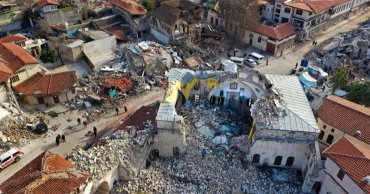
For nearly two weeks, Mehmet Ismet has lived in the ruins of Antakya’s most beloved historic mosque, a landmark in a now-devastated city that was famed for thousands of years as a meeting place of civilizations and revered by Christians, Muslims and Jews.
The 74-year-old took refuge in the Habib Najjar mosque after a 7.8-magnitude earthquake killed tens of thousands in Turkey and Syria on Feb. 6. He has slept and prayed under the few arches still standing, mourning the future of a city renowned for its past.
The destruction in Antakya was nearly total. Much of the city is rubble. What’s still standing is too unsafe to live in. Almost everyone has left. On Monday, a new 6.4 magnitude earthquake, centered in Hatay province where Antakya is located, struck again, killing people, injuring more than 200 and causing more buildings to collapse, in some cases trapping people.
Also Read: Death toll rises to 8 from new Turkey-Syria earthquake
“It can be rebuilt. But it will not be like the old one,” said Ismet, pointing to the destruction of the mosque, where he sat in the courtyard with a friend by a wood-burning heater. “The old is gone. Only the name remains.”
Antakya, known as Antioch in ancient times, has been repeatedly destroyed by earthquakes and rebuilt over history. But residents fear it will be a long time before it recovers from this one, and that its unique historical identity may never be fully restored. The destruction is so great, and they say the government cares little for this area.
Antioch, built in 300 B.C. by a general of Alexander the Great in the Orontes River valley, was one of the biggest cities of the Greco-Roman world, rivaling Alexandria and Constantinople. Saints Peter and Paul are said to have founded one of the oldest Christian communities here, and it’s here that the word “Christian” first came into use. It later drew Muslim and Christian Crusader invaders.
The melding of faiths is part of the city’s character.
A parable from the Quran kept running through Ismet’s mind. Three messengers from God came to a town, urging its sinful people to follow His word. They refused, and God destroyed the city with a mighty blast. The Quran doesn’t name the town, but many traditions say it was ancient Antioch.
Ismet saw a new lesson from the present-day devastation.
“All religions are here. We were living well. Then politics and hypocrisy prevailed, and disagreement followed,” Ismet said. “People... have disagreed and are robbing each other. God is punishing them.”
Also read: Turkey: Couple saved 296 hours after quake, but children die
The mosque can now be reached only by clambering over heaps of concrete and old stones that were once Antakya’s old city. It traces Antakya’s many histories: The site originally held an ancient pagan temple, then a church, before finally settling as a mosque, built in the 13th century. The mosque was destroyed in an earthquake in 1853 and rebuilt four years later by the Ottomans.
Even the legends surrounding Habib Najjar, the mosque’s unknown namesake, are intertwined with multiple faiths.
Ismet recounted one popular story: Najjar was a resident of Antioch who urged locals to believe God’s messengers referred to in the Quran. They beheaded him, and his head rolled down the mountain to the spot where the mosque now stands. Another version of the legend says Najjar was a believer in Jesus, whose disciples cured his son of leprosy, and was killed for promoting the new Christian faith.
Modern Antakya was already a shadow of its ancient self.
In recent years, it witnessed steep economic decline and growing emigration to Europe and the Gulf. Tension had been growing between the shrinking local population, which included Christian and Alevi communities, and a growing Syrian population that fled its country’s civil war.
Some city residents complain of neglect from a central government busy with helping other provinces where it has a stronger voting base. With little evidence, locals accused Syrian refugees of stealing from stores and the government of downplaying the death toll. Many worry more people could leave if Antakya is not rebuilt quickly.
In the face of rising criticism from several quake-hit cities, President Recep Tayyip Erdogan and other officials have recognized delays in the response. No one addressed Antakya’s woes in particular.
“Maybe in one month, we will start the renovation or organization,” Yahya Coskun, deputy director general of Turkey’s museums and cultural heritage, said about the destruction to the city’s landmarks.
“Antakya’s destruction is a loss to humanity,” said Jan Estefan, a silversmith and one of the city’s few remaining Christians. “We still want to live here. We have no intention of leaving.”
Antakya’s Greek Orthodox Church was destroyed. The church, which was the seat of the Greek Orthodox patriarch up until the 14th century, was leveled in an 1872 earthquake and rebuilt.
“History has once again been wiped out,” said Fadi Hurigil, chairman of the board of directors of Antakya Greek Orthodox Church Foundation.
Old mosques were cut off by mountains of rubble. The old bazaar lay in ruins. Crushed buildings line Kurtulus Street, said to have been the world’s first illuminated street when it was lit with torches at night in Roman times. Parts of the archaeological museum have been damaged.
Outside the city center, Mount Starius protected one of Christianity’s earliest churches — St. Pierre — which is built in a cave in the mountain and has sections dating to the 4th century. A set of stairs leading to it was damaged.
There were cracks in the walls of the Synagogue of Antakya, home to the area’s 2,500-year-old Jewish community. The president of the city’s Jewish community and his wife didn’t survive. About a dozen Jewish residents and the synagogue’s Torah scrolls were temporarily relocated to Istanbul, said Rabbi Mendy Chitrik, chairman of the Alliance of Rabbis in Islamic States.
Chitrik said it will hard for the small, elderly community, whittled down by years of emigration, to rebuild. “However, I am certain that it will come back.”
Many residents seem to have accepted it is their city’s fate to return from disaster.
“After seven times, they rebuilt and brought it to life again. Now is the eighth time, and God willing ... we will live in it again,” said Bulent Cifcifli. His mother was killed in the quake, and it took a week to dig her body out.
In one shape or another, Antakya will survive, he said.
“Death is unavoidable. We will die and new people will come,” he said, choking on tears. “Who is Antakya? Today it is us. Tomorrow someone else.”
3 years ago

N Korea calls UN chief's remarks on missile test 'unfair'
North Korea on Wednesday accused U.N. Secretary-General Antonio Guterres of “an extremely unfair and imbalanced attitude,” as it lambasted him for condemning its recent missile test but ignoring alleged U.S. hostility against the North.
After the North’s intercontinental ballistic missile test on Saturday, Guterres strongly condemned the launch and reiterated his call for the North to immediately desist from making any further provocations. In a statement, Guterres also urged North Korea to resume talks on denuclearization of the Korean Peninsula.
“To be most deplorable, the U.N. secretary-general is going on the rampage of illogical and miserable remarks, which are little different from those of U.S. State Department officials over the years,” Kim Son Gyong, the North’s vice foreign minister for international bodies, said in a statement carried by state media.
Kim said North Korea’s ICBM test was a response to the security threat the U.S. posed to the North by temporarily deploying long-range bombers for joint training with South Korea earlier this year. Kim said the test was also a warning to the earlier convocation of the U.N. Security Council on the North.
North Korea views U.S.-South Korea military drills as an invasion rehearsal and is particularly sensitive to the U.S. mobilization of B-1B bombers that can carry a massive conventional payload of both guided and unguided weapons. After the North’s ICBM test, the United States flew B-1B bombers again for separate drills with South Korean and Japanese warplanes.
Read more: US urges UN to condemn North Korea; China, Russia blame US
“The U.N. secretary-general should clearly understand that his unreasonable and prejudiced stand on the Korean Peninsula issue is acting as a factor inciting the hostile acts of the U.S. and its followers against (North Korea),” Kim said.
Last November, North Korean Foreign Minister Choe Son Hui called Guterres “a puppet of the United States” for condemning an earlier ICBM test by the North.
Saturday’s ICBM test, the North’s first missile test since Jan. 1, was made on a steep angle to avoid neighboring countries. The reported launch details again suggested the North has missiles that can reach the U.S. mainland. But many foreign experts say the North still must develop some last remaining technologies to acquire functioning nuclear-tipped missiles, such as one shielding missiles from the harsh conditions during atmospheric reentry.
In response to the latest U.S. deployment of B1-B bombers on Sunday, North Korea said its 600-millimeter multiple rocket launcher fired two rounds off its east coast the next day. North Korea has said its rockets can carry nuclear warheads. South Korea views the weapons as a short-range ballistic missile.
South Korea and the United States are to hold a set of joint military drills in coming weeks, including a table-top exercise set to take place at the Pentagon on Wednesday.
Last year, North Korea test-launched more than 70 missiles, the most ever in a single year, as part of its efforts to enlarge its weapons arsenal. Observers say the North would eventually want to win international recognition as a legitimate nuclear state and use that status as a way to get U.N. and other international sanctions on it lifted.
3 years ago

Fears, questions about N. Korea's growing nuclear arsenal
North Korea's latest missile launches are a demonstration of the country's avowed ability to use nuclear force against South Korea and the mainland U.S. How immediate is that threat?
North Korea claims its nuclear forces are capable of destroying its rivals, and often follows its provocative weapons tests with launch details. But many foreign experts call the North’s claims propaganda and suggest that the country is not yet capable of hitting the United States or its allies with a nuclear weapon.
There’s no question that North Korea has nuclear bombs, and that it has missiles that place the U.S. mainland, South Korea and Japan within striking distance. What’s not yet clear is whether the country has mastered the tricky engineering required to join the bombs and the missiles.
___
ICBMs
North Korea has demonstrated that it has missiles that could fly far enough to reach deep into the continental U.S., but it's not clear whether they can survive reentering the Earth's atmosphere on arrival.
North Korea said it launched a Hwasong-15 intercontinental ballistic missile on Saturday to verify the weapon’s reliability and the combat readiness of the country’s nuclear forces. It’s one of three kinds of ICBMs the country has developed, along with the Hwasong-14 and Hwasong-17. All three are liquid-fueled, and North Korea has portrayed them all as nuclear-capable.
Launched almost straight up to avoid the territories of neighbors, the weapon reached a maximum altitude of about 5,770 kilometers (3,585 miles) and flew 990 kilometers (615 miles), according to North Korean state media. The reported flight details suggest the missile could travel 13,000 kilometers (8,080 miles) or beyond if launched on a normal trajectory.
“These days, North Korea has been disclosing information about its launches in a very detailed manner to try to let others believe what they’ve done is genuine,” analyst Shin Jong-woo at South Korea’s Defense and Security Forum said. “But I think that’s part of their propaganda.”
There are questions on whether North Korea has acquired the technology to shield warheads from the high-temperature, high-stress environment of atmospheric reentry.
A South Korean biennial defense document released last week said it’s not clear whether the missiles can survive reentry, because all of North Korea’s ICBM tests have so far been made on high angles.
Read more: US urges UN to condemn North Korea; China, Russia blame US
Lee Choon Geun, an honorary research fellow at South Korea’s Science and Technology Policy Institute, said a normal trajectory would cause greater stress, as a warhead would spend a longer time passing through altitudes with high air density.
North Korean state media said the launch was made “suddenly” after a surprise order from leader Kim Jong Un.
“The Kim regime’s claims of short-notice launches are thus intended to demonstrate not only the development of strategic and tactical nuclear forces but also the operational capability to use them,” Leif-Eric Easley, a professor at Ewha University in Seoul, said.
In a military parade earlier this month, North Korea showcased around a dozen ICBMs, an unprecedented number that suggested progress in its efforts to mass-produce powerful weapons.
Among them were huge canister-sealed missiles that experts say were likely a version of a solid-fuel ICBM that North Korea has been trying to develop in recent years. Solid-fueled systems allow missiles to be mobile on the ground and make them faster to launch.
___
WARHEADS
North Korea likely has dozens of nuclear warheads. The question is whether they are small enough to fit on a missile.
North Korea has so far performed six underground nuclear test explosions to manufacture warheads that it can place on missiles. Outside estimates of the number of North Korean nuclear warheads vary widely, ranging from 20-60 to up to about 115.
In a 2021 interview with 38 North, a North Korea-focused website, renowned nuclear physicist Siegfried Hecker, who has visited North Korea’s main Yongbyon nuclear complex numerous times, said that “20 to 60 is possible, with the most likely number being 45.”
Some experts argue that North Korea has likely already built miniaturized nuclear warheads to be mounted on missiles, citing the number of years the country has spent on its nuclear and missile programs. But others say North Korea is still years away from producing such warheads.
“After its sixth nuclear test, people accepted that North Korea really will have nuclear weapons. But they are still debating whether it has warhead miniaturization technology,” Shin, the analyst, said.
The North described its sixth nuclear test in 2017 as a detonation of a thermonuclear bomb built for ICBMs. It created a tremor that measured magnitude 6.3, and some studies put its estimated explosive yield at about 50 to 140 kilotons of TNT. In comparison, the pair of atomic bombs dropped on Hiroshima and Nagasaki during World War II — which killed a total of more than 210,000 people — yielded explosions equivalent to about 15 and 20 kilotons of TNT, respectively.
The biennial South Korean defense document said North Korea is estimated to have 70 kilograms (154 pounds) of weapons-grade plutonium. Some observers say that's enough for about 9-18 bombs. The document estimated that North Korea has “a considerable amount of” highly enriched uranium as well.
North Korea’s Yongbyon complex has facilities to produce both plutonium and highly enriched uranium, the two main ingredients to build nuclear weapons.
Plutonium plants are generally large and generate a lot of heat, making them easier to detect. But a uranium enrichment plant is more compact and can be easily hidden from satellite cameras. North Korea is believed to be running at least one additional covert uranium enrichment facility, in addition to one at its Yongbyon complex.
___
SHORT-RANGE WEAPONS
Following the collapse of diplomacy with then-U.S. President Donald Trump in 2019, Kim sped up the development of short-range solid-fuel, nuclear-capable missiles designed to strike key targets in South Korea, including U.S. military bases there.
The so-called “tactical” nuclear weapons include what North Korea calls “super-large” 600-millimeter multiple rocket launchers that it tested Monday. South Korea describes the weapon as a short-range missile system.
North Korean state media said its new artillery system can carry nuclear warheads, and that four rockets would be enough to wipe out an enemy airfield. The statement drew quick outside doubts about whether the weapons are indeed nuclear-capable.
“The North Korean claim doesn’t make sense to some extent. ... Why do they need four tactical nuclear weapons to destroy just one airfield?” Shin, the analyst, said. “Also, which country would disclose such attack scenarios via state media?”
Other new North Korean short-range systems include missiles that were apparently modeled after the Russian Iskander mobile ballistic system or outwardly resemble the U.S. MGM-140 Army Tactical Missile System. Launched from land vehicles, these missiles are designed to be maneuverable and fly at low altitudes, theoretically giving them a better chance of defeating South Korean and U.S. missile defense systems.
Whether North Korea has an ability to arm short-range missiles with nuclear warheads has not been independently confirmed.
While North Korea may be able to place simple nuclear warheads on some of its older missiles, including Scuds or Rodong missiles, it would likely require further technology advancements and nuclear tests to build smaller and more advanced warheads that can be installed on its newer tactical systems, said Lee, the expert.
North Korea also has an intermediate-range, nuclear-capable Hwasong-12 missile capable of reaching Guam, a major U.S. military hub in the Pacific. It has been developing a family of mid-range, solid-fuel Pukguksong missiles which are designed to be fired from submarines or land vehicles.
3 years ago

Death toll rises to 8 from new Turkey-Syria earthquake
The death toll in Turkey and Syria rose to eight in a new and powerful earthquake that struck two weeks after a devastating temblor killed nearly 45,000 people, authorities and media said on Tuesday.
Turkey’s disaster management authority said six people were killed and 294 others were injured with 18 in critical condition after Monday’s 6.4-magnitude quake. In Syria, a woman and a girl died as a result of panic during the earthquake in the provinces of Hama and Tartus, pro-government media outlets said.
The earthquake’s epicenter was in the town of Defne, in Turkey’s Hatay province, which borders Syria. It was also felt in Jordan, Cyprus, Israel, Lebanon and as far away as Egypt, and followed by a second, magnitude 5.8 temblor, and dozens of aftershocks.
Hatay was one of the worst-hit provinces in Turkey in the magnitude 7.8 quake that struck on Feb. 6. Thousands of buildings were destroyed in the province and Monday’s quake further damaged buildings. The governor’s office in Antakya, Hatay’s historic heart, was also damaged.
Officials have warned quake victims to not go into the remains of their homes, but people have done so to retrieve what they can. They were caught up in the new quake.
The majority of deaths in the massive February 6 quake, which was followed by a 7.5 temblor nine hours later, were in Turkey with at least 41,156 people killed. The epicenter was in southern Kahramanmaras province. Authorities said more than 110,000 buildings across 11 quake-hit Turkish provinces were either destroyed or so severely damaged that they need to be torn down.
In government-held Syria, a girl died in the western town of Safita, Al-Watan daily reported while a woman was killed in the central city of Hama that was already affected by the Feb. 6 earthquake, Sham FM radio station said.
The White Helmets, northwest Syria’s civil defense organization, said about 190 people suffered different injuries in rebel-held northwest Syria mostly cases or broken bones and bruises. It said that several flimsy buildings collapsed, adding that there were no cases in which people were stuck under the rubble.
3 years ago

Congress delegation visits Taiwan in tense US-China moment
A delegation of U.S. lawmakers met with the head of Taiwan's legislature on Monday as part of a five-day visit to the self-ruled island that comes as U.S.-China relations remain tense after weeks of trading accusations over a spy balloon.
The delegation that arrived Sunday includes Reps. Ro Khanna of California, Tony Gonzales of Texas, Jake Auchincloss of Massachusetts and Jonathan Jackson of Illinois.
They are expected to meet President Tsai Ing-wen as well as business people. On Monday, they held talks with Taiwan Semiconductor Manufacturing Company's founder Morris Chang, considered the father of the island's chip industry.
Khanna, a Democrat who represents Silicon Valley, said he was in Taiwan to learn about the island's role in the semiconductor industry. Khanna and Auchincloss are both members of the new House select committee focused on competition with China.
Also Read: Senior Chinese diplomat urges U.S. to correct mistakes in airship incident
He addressed the implicit threat facing their visit, as China opposes any form of exchange between Taiwan and foreign governments. China claims the island as part of its territory to be united by force if necessary, and has stepped up military and diplomatic harassment of Taiwan.
“Our efforts to come here are in no way provocative of China, but consistent with the president's foreign policy that recognizes the importance of the relationship like Taiwan, while still seeking ultimately, peace in the region,” Khanna said.
Head of Taiwan's Legislative Yuan, You Si-kun, used the speech to hit back at Wang Yi, the Chinese Communist Party’s most senior foreign policy official, who said over the weekend at the Munich Security Conference that Taiwan “has never been a country and it will not be a country in the future.”
“China ignores historical fact and claims to have sovereignty over Taiwan. Taiwan has already become an independent sovereign nation ... Taiwan has never been ruled by the People's Republic of China for a single day,” You said.
The delegation's visit follows a sensitive trip made by a senior Pentagon official on Friday, reported by the Financial Times.
A Pentagon spokesperson did not comment on the visit by Michael Chase, deputy assistant secretary of defense for China, repeating that "our commitment to Taiwan is rock-solid and contributes to the maintenance of peace and stability across the Taiwan Strait and within the region.” Taiwan's Ministry of Foreign Affairs said it had no information about any such visit.
Tensions between the U.S. and China again ratcheted up last month after Washington accused Beijing of sending a spy balloon that was shot down over the American East Coast, and Secretary of State Antony Blinken canceled a trip to Beijing. Blinken also said over the weekend that the United States was concerned that China would provide weapons to Russia for its war in Ukraine.
3 years ago

Why China's stand on Russia and Ukraine is raising concerns
Nearly one year after Russia invaded Ukraine, new questions are rising over China’s potential willingness to offer military aid to Moscow in the increasingly drawn-out conflict.
In an interview that aired Sunday, U.S. Secretary of State Antony Blinken said American intelligence suggests China is considering providing arms and ammunition to Russia, an involvement in the Kremlin’s war effort that he said would be a “serious problem.”
China has refused to criticize Russia for its actions or even to call it an invasion in deference to Moscow. At the same time, it insists that the sovereignty and territorial integrity of all nations must be upheld. The question now is whether China is willing to convert that rhetorical backing into material support.
Here's a look at where China stands on the conflict.
___
DOES CHINA BACK RUSSIA IN ITS WAR ON UKRAINE?
China has tried to walk a fine — and often contradictory — line on the Russian invasion.
China says Russia was provoked into taking action by NATO's westward expansion. Just weeks before the Feb. 24, 2022, invasion, Chinese President Xi Jinping hosted Russian President Vladimir Putin in Beijing for the opening of the Winter Olympics, at which time the sides issued a joint statement pledging their commitment to a “no limits" friendship. China has since ignored Western criticism and reaffirmed that pledge.
Also Read: Russia to test new hypersonic missile in drills with China and South Africa
But China has yet to confirm the visit Putin has said he expects from Xi this spring.
China is “trying to have it both ways," Blinken said Sunday on NBC. "Publicly, they present themselves as a country striving for peace in Ukraine, but privately, as I said, we’ve seen already over these past months the provision of non-lethal assistance that does go directly to aiding and abetting Russia’s war effort.”
___
HAS CHINA PROVIDED MATERIAL SUPPORT TO RUSSIA?
So far, China's support for Russia has been rhetorical and political, with Beijing helping prevent efforts to condemn Moscow at the United Nations.
Blinken, at a security conference in Munich, Germany, said the United States has long been concerned that China would provide weapons to Russia and that “we have information that gives us concern that they are considering providing lethal support to Russia in the war against Ukraine.” That came a day after Blinken held talks with Wang Yi, the Chinese Communist Party’s most senior foreign policy official, in a meeting that offered little sign of a reduction in tensions or progress on the Ukraine issue.
“It was important for me to share very clearly with Wang Yi that this would be a serious problem,” Blinken said, referring to potential military support for Russia.
The U.S. ambassador to the United Nations, Linda Thomas-Greenfield, also expressed her concern about any effort by the Chinese to arm Russia, saying “that would be a red line.”
Also Read: Putin, Xi vow closer ties as Russia bombards Ukraine again
Russian and Chinese forces have held joint military drills since Russia invaded Ukraine a year ago, most recently sending ships to take part in exercises with the South African navy in a key shipping lane off the South African coast.
___
WHAT HAS CHINA SAID ON THE MATTER?
Following the meeting between Wang and Blinken, China's Foreign Ministry issued a statement that it has always played a constructive role in the Ukraine conflict by adhering to principles, encouraging peace and promoting talks.
The ministry said the China-Russia partnership “is established on the basis of non-alignment, non-confrontation, and non-targeting of third parties,” and that the U.S. was adding “fuel to the fire to take advantage of the opportunity to make profits.”
Beijing says it has continued a normal trade relationship with Russia, including purchases of oil and gas, as have other countries such as India. However, that trade is seen as throwing an economic lifeline to Moscow, but there have been no documented cases of China providing direct aid to the Russian military along the lines of the inexpensive military drones that Iran sells to Moscow.
___
WHAT COULD HAPPEN IF CHINA AIDS RUSSIA?
“To the best of our knowledge, they haven’t crossed that line yet,” Blinken told NBC on Sunday.
Blinken did not specify what measures the U.S. could take in response to Chinese military support for Russia, but efforts to put a floor under ties that have deteriorated to their lowest level in decades have so far been unsuccessful. The U.S. has sought to limit Chinese access to the latest microprocessors and manufacturing equipment, and has continued to challenge Chinese territorial claims in the South China Sea.
For China, the most sensitive issue is U.S. support for Taiwan, the self-governing island democracy that Beijing considers its own territory to be conquered by military force if deemed necessary. Taiwan is a major customer for U.S. defensive arms and has hosted a growing number of prominent American elected officials, enraging Beijing.
Meanwhile, U.S. Congress members have called for the banning of TikTok and other Chinese-owned social media platforms, as well as increased sanctions on Chinese firms backed by the Communist Party, which wields ultimate control over the Chinese economy and suppresses independent media and political opposition voices.
3 years ago

Blinken tours Turkey’s earthquake zone, pledges $100M in aid
U.S. Secretary of State Antony Blinken took a helicopter tour Sunday of one of the provinces worst-affected by the Feb. 6 earthquake in southern Turkey and northern Syria and pledged a further $100 million in aid to help the region.
“This is going to be a long-term effort,” Blinken said at Incirlik Air Base, a joint U.S.-Turkish facility that has coordinated the distribution of disaster aid. “The search and rescue, unfortunately, is coming to an end. The recovery is on, and then there will be a massive rebuilding operation.”
President Joe Biden announced $85 million for Turkey and Syria days after the earthquake that has killed more than 44,000 people in the two countries. The U.S. has also sent a search and rescue team, medical supplies and equipment.
The additional aid includes $50 million in emergency refugee and migration funds and $50 million in humanitarian assistance, Blinken said.
The secretary of state is making his first trip to NATO ally Turkey since he took office two years ago. Blinken arrived at Incirlik Air Base, near Adana, on Sunday after attending the Munich Security Conference in Germany.
He toured Turkey’s toured Hatay province from the air with Turkish Foreign Minister Mevlut Cavusoglu. He was expected to meet with U.S. and Turkish service personnel, as well as Turkish military families affected by the earthquake.
“When you see the extent of the damage, the number of buildings, the number of apartments, the number of homes that have been destroyed, it's going to take a massive effort to rebuild,” the top U.S. diplomat said after the helicopter tour.
“The most important thing right now is to get assistance to people who need it, to get them through the winter and to get them back on their feet," Blinken said as troops nearby unloaded boxes of aid... We’ll stick with it until we get the job done.”
Incirlik, home to the U.S. Air Force’s 39th Air Base Wing, has been a crucial logistics center for aid distribution. Supplies from around the world have been flown into the base and sent by truck and helicopter to those in need, including in difficult to reach villages.
Blinken is set to fly to Ankara, Turkey's capital, later Sunday for discussions with Turkish officials on Monday, including an anticipated meeting with President Recep Tayyip Erdogan. As well as the effects of the earthquake, Blinken is expected to discuss Sweden and Finland's efforts to join NATO, which Turkey has delayed.
3 years ago

North Korea fires short-range missiles after making threat
North Korea fired two short-range ballistic missiles off its eastern coast on Monday in its second weapons test in three days that drew quick condemnation from its rivals.
The weapons firings follow an intercontinental ballistic missile launch Saturday and North Korea’s threats to take an unprecedented strong response to U.S.-South Korean military drills that the North views as an invasion rehearsal. Some experts say North Korea could use a new testing spree to expand its arsenal and intends eventually to use its boosted capability as leverage in negotiations the United States.
South Korea's military said it detected the two missile launches from a western coastal town, just north of Pyongyang, the North Korean capital, on Monday morning. Japan said both missiles landed in the waters between the Korean Peninsula and Japan and that no damage involving aircraft and vessels in the area was reported.
According to Japanese and South Korean assessments, the North Korean missiles flew at a maximum altitude of 50-100 kilometers (30-60 miles) and a distance of 340-400 kilometers (210-250 miles).
South Korea’s military said North Korea’s repeated missile launches are “a grave provocation” that undermine international peace. Japan condemned the launches as a threat to the peace and safety of Japan and the international society.
Read: North Korea confirms ICBM test, warns of more powerful steps
The U.S. Indo-Pacific Command said the missile launches highlight “the destabilizing impact” of North Korea’s unlawful weapons programs. It said the U.S. commitments to the defense of South Korea and Japan “remain ironclad.”
North Korea’s state media said long-range artillery units on its western coast fired two rounds cross-country toward the eastern waters on Monday morning, possibly referring to the same activity its neighbors said were missile launches. The official Korean Central News Agency said the North Korean artillery rounds simulated strikes on targets up to 395 kilometers (245 miles) away.
The North said the launches involved its new 600 millimeter multiple rocket launcher system that could be armed with “tactical” nuclear weapons for battlefield use. Some experts viewed the weapons system as a short-range ballistic missile.
“The frequency of using the Pacific as our firing range depends upon the U.S. forces’ action character,” Kim Yo Jong, the powerful sister of North Korean leader Kim Jong Un, said in a statement carried by state media. “We are well aware of the movement of U.S. forces’ strategic strike means, (which are) recently getting brisk around the Korean Peninsula.”
Calling the United States “the worst maniacs,” she threatened to take unspecified “corresponding counteraction” in response to the future moves by the U.S. military.
She could be referring to the U.S. flyover of B-1B long-range, supersonic bombers on Sunday for separate training with South Korea and Japan. The B-1B deployment came as response to North Korea’s launch of the Hwasong-15 ICBM off its east coast on Saturday in the country’s first missile test since Jan. 1.
North Korea is extremely sensitive to the deployment of B-1B bombers, which can carry a huge payload of conventional weapons.
North Korea’s state media said Sunday the ICBM test was meant to further bolster its “fatal” nuclear attack capacity and verify the weapon’s reliability and the combat readiness of the country’s nuclear force. In her earlier statement Sunday, Kim Yo Jong threatened to take additional powerful steps over upcoming military drills between the United States and South Korea.
North Korea has steadfastly slammed regular South Korea-U.S. military drills as a practice for a northward invasion though the allies say their exercises are defensive in nature. Some observers say North Korea often uses its rivals’ drills as a pretext to hone and perfect its weapons systems.
The South Korean and U.S. militaries plan to hold a table-top exercise this week to hone a joint response to a potential use of nuclear weapons by North Korea. The allies are also to conduct another joint computer simulated exercise and field training in March.
Hours after Monday's launches, South Korea’s Foreign Ministry said Seoul placed unilateral sanctions on four individuals and five institutions it said were involved in illicit activities supporting the North’s nuclear arms development and evasion of sanctions. While South Korean President Yoon Suk Yeol’s government has so far placed sanctions on 31 individuals and 35 organizations for supporting the North’s nuclear ambitions, such steps are seen as mostly symbolic considering the lack of business activities between the rivals.
North Korea has claimed to have missiles capable of striking both the U.S. mainland and South Korea with nuclear weapons, but many foreign experts have said North Korea still has some key remaining technologies to master, such as shrinking the warheads small enough to be mounted on missiles and ensuring those warheads survive atmospheric reentry.
In her statement Monday, Kim Yo Jong reiterated that North Korea has reentry vehicle technology. She also hit back at South Korean experts who questioned whether North Korea’s ICBMs would be functional in real-war situations.
Kim Yo Jong insisted that the nine hours of launch preparation time after her brother Kim Jong Un ordered it included the efforts sealing the launch site and evacuating people, and was not long because of shortcomings of the missile system itself.
Last year, North Korea set an annual record with the launch of more than 70 missiles. North Korea has said many of those weapons tests were a warning over previous U.S.-South Korean military drills. It also passed a law that allows it to use nuclear weapons preemptively in a broad range of scenarios.
Kim Jong Un entered 2023 with a call for an “exponential increase” of the country’s nuclear warheads, mass production of battlefield tactical nuclear weapons targeting South Korea and the development of more advanced ICBMs targeting the U.S.
3 years ago
North Korea confirms ICBM test, warns of more powerful steps
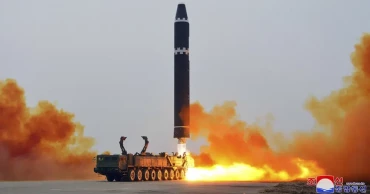
North Korea said Sunday its latest intercontinental ballistic missile test was meant to further bolster its “fatal” nuclear attack capacity against its rivals, as it threatened additional powerful steps in response to the upcoming military training between the United States and South Korea.
The United States responded by flying long-range supersonic bombers later Sunday for a joint exercise with South Korean warplanes in a demonstration of strength against North Korea.
Saturday’s ICBM test, the North’s first missile test since Jan. 1, signals its leader Kim Jong Un is using his rivals’ drills as a chance to expand his country’s nuclear arsenal to get the upper hand in future dealings with the United States. An expert says North Korea may seek to hold regular operational exercises involving its ICBMs.
North Korea’s official Korean Central News Agency said its launch of the Hwasong-15 ICBM was organized “suddenly” without prior notice at Kim’s direct order.
KCNA said the launch was designed to verify the weapon’s reliability and the combat readiness of the country’s nuclear force. It said the missile was fired at a high angle and reached a maximum altitude of about 5,770 kilometers (3,585 miles), flying a distance of about 990 kilometers (615 miles) for 67 minutes before accurately hitting a pre-set area in the waters between the Korean Peninsula and Japan.
The steep-angle launch was apparently to avoid neighboring countries. The flight details reported by North Korea, which roughly matched the launch information previously assessed by its neighbors, show the weapon is theoretically capable of reaching the mainland U.S. if fired at a standard trajectory.
The Hwasong-15 launch demonstrated the North’s “powerful physical nuclear deterrent” and its efforts to “turn its capacity of fatal nuclear counterattack on the hostile forces” into an extremely strong one that cannot be countered, KCNA said.
Whether North Korea has a functioning nuclear-tipped ICBM is still a source of outside debate, as some experts say the North hasn’t mastered a way to protect warheads from the severe conditions of atmospheric reentry. The North says it has acquired such a technology.
The Hwasong-15 is one of North Korea’s three existing ICBMs, all of which use liquid propellants that require pre-launch injections and cannot remain fueled for extended periods. The North is pushing to build a solid-fueled ICBM, which would be more mobile and harder to detect before its launch.
“Kim Jong Un has likely determined that the technical reliability of the country’s liquid propellant ICBM force has been sufficiently tested and evaluated to now allow for regular operational exercises of this kind,” said Ankit Panda, an expert with the Carnegie Endowment for International Peace.
Chang Young-keun, a missile expert at Korea Aerospace University in South Korea, said that North Korea appeared to have launched an upgraded version of the Hwasong-15 ICBM. Chang said the information provided by North Korea showed the missile will likely have a longer potential range than the standard Hwasong-15.
Later Sunday, the U.S. sent B-1B bombers streaking over the Korean Peninsula to train with South Korean and U.S. fighter jets, according to South Korea’s Joint Chiefs of Staff. It said Sunday’s training reaffirmed Washington’s “iron-clad” security commitment to South Korea.
North Korea is sensitive to the deployment of U.S. B-1B bombers, which are capable of carrying a huge payload of conventional weapons.
The North’s launch came a day after it vowed an “unprecedentedly” strong response over a series of military drills that Seoul and Washington plan in coming weeks.
In a statement Sunday, Kim Yo Jong, the influential sister of Kim Jong Un, accused South Korea and the U.S. of “openly showing their dangerous greed and attempt to gain the military upper hand and predominant position in the Korean Peninsula.”
“I warn that we will watch every movement of the enemy and take corresponding and very powerful and overwhelming counteraction against its every move hostile to us,” she said.
North Korea has steadfastly slammed regular South Korea-U.S. military drills as an invasion rehearsal though the allies say their exercises are defensive in nature.
“By now, we know that any action taken by the U.S. and South Korea — however justified from the vantage point of defense and deterrence against (North Korea’s) reckless behavior — will be construed and protested as an act of hostility by North Korea,” said Soo Kim, a security analyst at the California-based RAND Corporation. “There will always be fodder for (Kim Jong Un’s) weapons provocations.”
“With nuclear weapons in tow and having mastered the art of coercion and bullying, Kim does not need ‘self-defense.’ But pitting the U.S. and South Korea as the aggressors allows Kim to justify his weapons development,” Soo Kim said.
U.S. National Security Council spokesperson Adrienne Watson said the U.S. will take all necessary measures to ensure the security of the American homeland and South Korea and Japan. South Korea’s presidential National Security Council said it will seek to strengthen its “overwhelming response capacity” against potential North Korean aggression based on the military alliance with the United States.
The South Korean and U.S. militaries plan to hold a table-top exercise this week to hone a joint response to a potential use of nuclear weapons by North Korea. The allies are also to conduct another joint computer simulated exercise and field training in March.
The foreign ministers of South Korea and Japan, meeting on the sidelines of a security conference in Germany on Saturday, agreed to boost a trilateral cooperation involving the United States and exchanged in-depth views on the issue of Japan’s colonial-era mobilization of forced Korean laborers — a key sticking point in efforts to improve their ties, according to Seoul’s Foreign Ministry.
South Korea and Japan are both key U.S. allies but often spat over issues stemming from Tokyo’s 1910-45 colonial occupation of the Korean Peninsula. But North Korea’s recent missile testing spree is pushing the two countries to explore how to reinforce their security cooperation.
3 years ago