asia

68 confirmed dead as passenger plane with 72 on board crashes near Pokhara airport
Scores of rescue workers and onlookers crowded near a steep gorge outside a resort town in central Nepal where a regional passenger plane crashed Sunday, as rescuers combed the wreckage on the edge of the cliff and in the ravine below.
So far, 68 people have been confirmed dead after a regional passenger plane with 72 aboard crashed into a gorge while landing at a newly opened airport in the resort town of Pokhara, according to an announcement posted by the country’s Civil Aviation Authority to Twitter. It’s the country’s deadliest airplane accident in three decades.
It was not immediately clear what caused the accident.
A witness said he saw the aircraft spinning violently in the air after it began to attempt a landing, watching from the terrace of his house. Gaurav Gurung said the plane fell nose-first towards its left and then crashed into the gorge.
At the crash site near the Seti River, about 1.6 kilometers (nearly a mile) away from Pokhara International Airport, rescuers sprayed fire hoses and heaved ropes down to another smoldering part of the wreck below. Some bodies, burned beyond recognition, were carried by firefighters to hospitals, where grief-stricken relatives had assembled. At Kathmandu airport, family members appeared distraught as they were escorted in and at times exchange heated words with officials as they waited for information.
“The plane caught fire after the crash. There was smoke everywhere,” Gurung said.
The aviation authority said the aircraft last made contact with the airport from near Seti Gorge at 10:50 a.m. before crashing.
The twin-engine ATR 72 aircraft, operated by Nepal’s Yeti Airlines, was flying from the capital, Kathmandu, to Pokhara, a 27-minute flight. It was carrying 68 passengers including 15 foreign nationals, as well as four crew members, Nepal’s Civil Aviation Authority said in a statement. The foreigners included five Indians, four Russians, two South Koreans, and one each from Ireland, Australia, Argentina and France. No survivors have been found yet.
Tek Bahadur K. C., a senior administrative officer in the Kaski district, said he expected rescue workers to find more bodies at the bottom of the gorge.
Also read: At least 32 killed as passenger plane with 72 on board crashes near Pokhara airport
Images and videos shared on Twitter showed plumes of smoke billowing from the crash site as rescue workers, Nepali soldiers, and crowds of people gathered around the wreckage of the aircraft to find survivors. The aircraft’s fuselage was split into multiple parts that were scattered down the gorge.
Prime Minister Pushpa Kamal Dahal, who rushed to the airport after the crash, set up a panel to investigate the accident.
”The incident was tragic. The full force of the Nepali army, police has been deployed for rescue,” he said.
South Korea’s Foreign Ministry said in a statement that it’s still trying to confirm the fate of two South Korean passengers and has sent staff to the scene. The Russian Ambassador to Nepal, Alexei Novikov, confirmed the death of four Russian citizens who were on board the plane.
The type of plane involved, the ATR 72, has been used by several airlines around the world for short regional flights. Introduced in the late 1980s by a French and Italian partnership, the aircraft model has been involved in several deadly accidents over the years. In 2018, an ATR 72 operated by Iran’s Aseman Airlines crashed in a foggy, mountainous region, killing all 65 aboard.
In Taiwan two earlier accidents involving ATR 72-500 and ATR 72-600 aircrafts happened just months apart.
In July 2014, a TransAsia ATR 72-500 flight crashed while trying to land on the scenic Penghu archipelago between Taiwan and China, killing 48 people onboard. An ATR 72-600 operated by the same Taiwanese airline crashed shortly after takeoff in Taipei in February 2015 after one of its engines failed and the second was shut down, apparently by mistake.
The 2015 crash, captured in dramatic footage that showed the plane striking a taxi as it hurtled out of control, killed 43, and prompted authorities to ground all Taiwanese-registered ATR 72s for some time. TransAsia ceased all flights in 2016 and later went out of business.
ATR identified the plane involved in Sunday’s crash as an ATR 72-500 in a tweet. According to plane tracking data from flightradar24.com, the aircraft was 15 years old and “equipped with an old transponder with unreliable data.” It was previously flown by India’s Kingfisher Airlines and Thailand’s Nok Air before Yeti took it over in 2019, according to records on Airfleets.net.
Yeti Airlines has a fleet of six ATR72-500 planes, company spokesperson Sudarshan Bartaula said.
Pokhara, located 200 kilometers (125 miles) west of Kathmandu, is the gateway to the Annapurna Circuit, a popular hiking trail in the Himalayas. The city’s new international airport began operations only two weeks ago. It was built with Chinese construction and financial support. The Chinese ambassador to Nepal, Chen Song, said in a tweet he was “very shocked” to learn of the accident.
“At this difficult time, our thoughts are with Nepali people. I would like to express my deep condolences to the victims, and sincere sympathies to the bereaved families,” he wrote.
Sunday’s crash is Nepal’s deadliest since 1992, when all 167 people aboard a Pakistan International Airlines plane were killed when it plowed into a hill as it tried to land in Kathmandu.
Nepal, home to eight of the world’s 14 highest mountains, including Mount Everest, has a history of air crashes. According to the Flight Safety Foundation’s Aviation Safety database, there have been 42 fatal plane crashes in Nepal since 1946.
Last year, 22 people died when a plane crashed on a mountainside in Nepal. In 2016, a Tara Air Twin Otter flying from Pokhara to Kathmandu crashed after takeoff, killing all 23 people aboard.
In 2012, an Agni Air plane flying from Pokhara to Jomsom crashed, killing 15 people. Six people survived. In 2014, a Nepal Airlines plane flying from Pokhara to Jumla crashed, killing all 18 on board.
In 1992, all 167 people aboard a Pakistan International Airlines plane were killed when it plowed into a hill as it tried to land in Kathmandu.
The European Union has banned airlines from Nepal from flying into the 27-nation bloc since 2013, citing weak safety standards. In 2017, the International Civil Aviation Organization cited improvements in Nepal’s aviation sector, but the EU continues to demand administrative reforms.
3 years ago

China reports 60,000 COVID-related deaths since early December
China on Saturday reported nearly 60,000 deaths in people who had COVID-19 since early December, offering hard numbers for an unprecedented surge that was apparent in overcrowded hospitals and packed crematoriums, even as the government released little data about the status of the pandemic for weeks.
Those numbers may still underestimate the toll, though the government said the “emergency peak" of its latest surge appears to have passed.
The toll included 5,503 deaths due to respiratory failure caused by COVID-19 and 54,435 fatalities from other ailments combined with COVID-19 since Dec. 8, the National Health Commission announced. It said those “deaths related to COVID” occurred in hospitals, which means anyone who died at home would not be included in the numbers.
The report would more than double China’s official COVID-19 death toll to 10,775 since the disease was first detected in the central city of Wuhan in late 2019. China has counted only deaths from pneumonia or respiratory failure in its official COVID-19 death toll, a narrow definition that excludes many deaths that would be attributed to COVID-19 in much of the world.
China stopped reporting data on COVID-19 deaths and infections after abruptly lifting anti-virus controls in early December despite a surge in infections that began in October and has filled hospitals with feverish, wheezing patients. Hospitals in Beijing across the country have been overwhelmed with patients, and funeral homes and crematoriums have struggled to handle the dead.
Read more: Bangladesh sees 10 more Covid cases, zero death
The World Health Organization and other governments appealed for information after reports by city and provincial governments suggested as many as hundreds of millions of people in China might have contracted the virus.
Infection numbers now appear to be falling based on a decline in the number of patients visiting fever clinics, said a National Health Commission official, Jiao Yahui.
The daily number of people going to those clinics peaked at 2.9 million on Dec. 23 and had fallen by 83% to to 477,000 on Thursday, according to Jiao.
“These data show the national emergency peak has passed,” Jiao said at a news conference.
Whether China truly has passed a COVID-19 peak is hard to assess, said Dr. Dale Bratzler, chief COVID officer at the University of Oklahoma and head of quality control at the university’s hospital.
“That’s difficult to know,” Bratzler said. “China quarantined people indoors, there are many people unvaccinated, the people are vulnerable.”
Dr. Albert Ko, an infectious disease physician and professor of public health at the Yale School of Public Health, said the number of COVID-19 deaths China is reporting may be a “significant underestimation” because of how they define them.
“They’re using a very narrow case definition for (COVID) deaths,” Ko said. “They have to have respiratory failure ... in order to be counted as a case you have to be at a place where they can say you fulfilled all the requirements, and that’s at a hospital.”
Hospitals in China, Ko said, are located mostly in large cities where COVID outbreaks have been reported, not in isolated rural areas.
“This is the Lunar New Year, people are traveling, going to the countryside where the population is vulnerable,” Ko said. “We’re really worried about what’s going to happen in China as this outbreak moves to the countryside.”
Read more: China halts visas for Japan, South Korea in COVID-19 spat
For nearly three years, China had kept its infection rate and deaths far lower than those of the United States and some other countries at the height of the pandemic with a “zero-COVID” strategy that aimed to isolate every case. That shut down access to some cities, kept millions of people at home and sparked angry protests.
Those rules were suddenly eased in early December after some of the largest shows of public dissent against the ruling Communist Party in more than 30 years. That set off new problems in a country that relies on domestically developed vaccines that are less reliable than others used globally, and where older people — those more susceptible to dying from the virus — are less likely to be vaccinated than the general population.
The Health Commission said the average age of people who died since Dec. 8 is 80.3 years, and 90.1% are aged 65 and above. It said more than 90% of people who died had cancer, heart or lung diseases or kidney problems.
“The number of elderly patients dying from illness is relatively large, which suggests that we should pay more attention to elderly patients and try our best to save their lives,” said Jiao.
The United States, South Korea, Japan and several other countries have imposed virus testing and other controls on people arriving from China. Beijing retaliated on Wednesday by suspending issuance of new visas to travelers from South Korea and Japan.
This month, WHO Director-General Tedros Adhanom Ghebreyesus said agency officials met with Chinese officials to underline the importance of sharing more details about COVID-19 issues, including hospitalization rates and genetic sequences.
3 years ago

Iran hangs former defense ministry official over spy claim
Iran said Saturday it had executed a dual Iranian-British national who once worked for its defense ministry, despite an international outcry over his death sentence and those of others held amid nationwide protests.
Iran’s Mizan news agency, associated with the country’s judiciary, announced Ali Reza Akbari’s hanging.
It did not say when it happened. However, there were rumors he had been executed days ago.
Iran had accused Akbari, without offering evidence, of being a spy for Britain’s MI-6 intelligence agency. It aired a highly edited video of Akbari discussing the allegations resembling others that activists have described as coerced confessions.
On Friday, State Department deputy spokesman Vedant Patel criticized Akbari’s pending execution.
“The charges against Ali Reza Akbari and his sentencing to execution were politically motivated. His execution would be unconscionable," he said. “We are greatly disturbed by the reports that Mr. Akbari was drugged, tortured while in custody, interrogated for thousands of hours, and forced to make false confessions.”
Read more: Iran executes 2 more men detained amid nationwide protests
He added: “More broadly, Iran’s practices of arbitrary and unjust detentions, forced confessions, and politically motivated executions are completely unacceptable and must end.”
Britain’s Foreign Office did not immediately respond to a request for comment.
Foreign Secretary James Cleverly had earlier called on Iran to stop the execution.
“The Iranian regime should be in no doubt,” he wrote Friday online. “We are watching the case of Ali Reza Akbari closely.”
Iran’s government for months has been trying to allege — without offering evidence — that foreign countries have fomented the unrest gripping the Islamic Republic since the death of a woman in September detained by the morality police. Protesters say they are angry over the collapse of the economy, heavy-handed policing and the entrenched power of the country’s Islamic clergy.
Iran is one of the world’s top executioners.
For several years, Iran has been locked in a shadow war with the United States and Israel, marked by covert attacks on its disputed nuclear program. The killing of Iran’s top nuclear scientist in 2020, which Iran blamed on Israel, indicated foreign intelligence services had made major inroads.
Akbari, who ran a private think tank, has not been seen in public since 2019, when he was apparently arrested. He also was close to Ali Shamkhani, a top security official in Iran, leading analysts to suggest his death sentence was tied to a possible power struggle within the country’s security apparatus amid the protests.
Akbari had previously led the implementation of a 1988 cease-fire between Iran and Iraq following their devastating eight-year war, working closely with U.N. observers.
Authorities have not released any details about his trial. Those accused of espionage and other crimes related to national security are usually tried behind closed doors, where rights groups say they do not choose their own lawyers and are not allowed to see evidence against them.
Read more: Iran execution: Man publicly hanged from crane amid protests
The anti-government protests, which have continued for nearly four months with no sign of ending, are one of the biggest challenges to the Islamic Republic since the 1979 revolution that brought it to power.
At least 520 protesters have been killed and more than 19,300 people have been arrested, according to Human Rights Activists in Iran, a group that has been monitoring the unrest. Iranian authorities have not provided official figures on deaths or arrests.
Iran has executed four people after convicting them of charges linked to the protests in similarly criticized trials, including attacks on security forces.
3 years ago

Suspect charged with murder in assassination of Japan's Abe
Japanese prosecutors formally charged the suspect in the assassination of former Prime Minister Shinzo Abe with murder, sending him to stand trial, a Japanese court said Friday.
Tetsuya Yamagami was arrested immediately after allegedly shooting Abe with a homemade gun as the former leader was making a campaign speech in July outside a train station in Nara in western Japan.
Later that month, Yamagami was sent to an Osaka detention center for a nearly six-month mental evaluation, which ended Tuesday. Yamagami is back in police custody in Nara.
Prosecutors said results of his mental evaluation showed he is fit to stand trial. Yamagami was also charged with violating a gun control law, according to the Nara District Court.
Read more: Japan PM blames police for death of former leader Shinzo Abe
Police have said Yamagami told them that he killed Abe, one of Japan’s most influential and divisive politicians, because of Abe’s apparent links to a religious group that he hated. In his statements and in social media postings attributed to him, Yamagami said he developed a grudge because his mother had made massive donations to the Unification Church that bankrupted his family and ruined his life.
One of his lawyers, Masaaki Furukawa, told the Associated Press on Thursday that Yamagami was in good health during his mental evaluation in Osaka when he was only allowed to see his sister and three lawyers.
Furuawa said his trial is a serious case and involve a jury panel of citizens. Due to the complexity of the case, it would take at least several months before his trial begins, he said.
Police are also reportedly considering adding several allegations, including weapons production, vilation to explosives control law and causing damage to buildings.
Some Japanese have expressed sympathy for Yamagami, especially those who also suffered as children of followers of the South Korea-based Unification Church, which is known for pressuring adherents into making big donations and is considered a cult in Japan.
Thousands of people have signed a petition requesting leniency for Yamagami, and others have sent care packages to his relatives or the detention center.
Read more: Japan's ex-leader Shinzo Abe assassinated during a speech
The investigation into the case has led to revelations of years of cozy ties between Abe’s governing Liberal Democratic Party and the church since Abe’s grandfather, former Prime Minister Nobusuke Kishi, helped the church take root in Japan in the 1960s over shared interests in conservative and anti-communist causes.
Current Prime Minister Fumio Kishida’s popularity has plunged over his handling of the church controversy and for insisting on holding a rare, controversial state funeral for Abe.
3 years ago
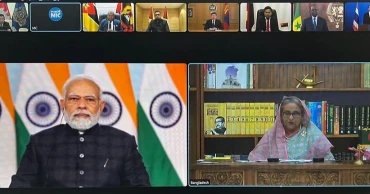
Modi calls on leaders of Global South to unitedly forge a common agenda for its own development
At the Voice of the Glocal South Summit hosted virtually by India on Thursday, Prime Minister of India, Narendra Modi called on leaders of the Global South to unitedly forge a common agenda for its own development and for the three-fourth of humanity that lives in it.
Bangladesh, represented by Prime Minister Sheikh Hasina, was invited to the inaugural session where world leaders shared their country’s views.
She thanked the Indian government for inviting Bangladesh to this important summit that would provide it a unique opportunity to engage with counterparts world over.
Read more: Modi rolls out 5G mobile internet services in India
PM Hasina warmly congratulated Indian Prime Minister Narendra Modi and the government of India on assumption of G20 Presidency and added that Bangladesh welcomes India's vision as the President of G20 to ensure inclusive development under the theme, "One Earth, One Family, One Future".
PM Modi spoke of the Global South as a united entity with the greatest stakes in the future and added that India has always stood for the greater role of developing countries in determining our common future.
To reshape the global emerging order, he called for an equivalent voice of the Global South.
To redesign global political and financial governance, remove inequities, enlarge opportunities, support growth and spread progress and prosperity, he called for simple, scalable and sustainable solutions to transform the Global South and proposed a 4R strategy - ‘Respond, Recognize, Respect and Reform’: Respond to the priorities of the Global South by framing an inclusive and balanced international agenda; Recognize that the principle of ‘Common but Differentiated Responsibilities’ applies to all global challenges; Respect sovereignty of all nations, rule of law and peaceful resolution of differences and disputes; and Reform international institutions, including the United Nations, to make them more relevant.
Human-centric development came out as an-important important priority from all the world leaders.
Read more: India’s G20 agenda to be inclusive, ambitious, action-oriented, decisive: Modi
3 years ago

China border situation is 'unpredictable': Indian army chief
India’s army chief said on Thursday the border situation with China is stable but unpredictable after a nearly two-and-a-half-year standoff between tens of thousands of soldiers from both countries in the eastern Ladakh area.
Gen. Manoj Pande told reporters the countries were continuing to talk both at the diplomatic and military levels, and that India's military maintains a high level of preparedness.
Read more: Indian and Chinese soldiers engage in new border combat
"We have adequate forces. We have adequate reserves in each of our sectors to be able to effectively deal with any situation or contingency,” Pande said.
"I would say the situation is stable and under control, yet unpredictable,” he said.
Pande added that the Russia-Ukraine conflict has impacted the supply of spare parts for India’s military but did not provide more details. He also spoke about India’s reliance on equipment from these countries.
"The sustenance of these weapons systems — equipment in terms of spares, in term of ammunition — is one issue that we have addressed,” he said.
Experts say up to 60% of Indian defense equipment comes from Russia, and New Delhi finds itself in a bind amid the standoff with China over a territorial dispute. Twenty Indian troops and four Chinese soldiers died in a clash in 2020.
The Times of India newspaper reported on Thursday that India is having problems transporting back one of its diesel-run submarines after a major refit in Russia, which has been hit with sanctions over the Ukraine war.
Read more: Indian, Chinese troops clash at border in fresh faceoff
India says China occupies 38,000 square kilometers (15,000 square miles) of its territory in the Aksai Chin Plateau, which India considers part of Ladakh, where the current face-off is happening.
India says any unilateral change in the border status quo by Beijing is unacceptable.
The Line of Actual Control separates Chinese and Indian-held territories from Ladakh in the west to India’s eastern state of Arunachal Pradesh, which China claims in its entirety. India and China fought a deadly war over the border in 1962.
3 years ago

Official: Explosion near Foreign Ministry in Kabul kills 5
An explosion near the Foreign Ministry in the Afghan capital on Wednesday killed five people and wounded several others, a Taliban police spokesman said, the second prominent attack in Kabul so far in 2023.
There was no immediate claim of responsibility for the attack, but the regional affiliate of the Islamic State group — known as the Islamic State in Khorasan Province — has increased its assaults since the Taliban takeover of Afghanistan in 2021. Targets have included Taliban patrols and members of the country’s Shiite minority.
The mid-afternoon explosion was followed by peals of sirens. Taliban security forces prevented journalists from getting close to the site, threatening them with guns and telling them to leave.
Kabul police chief spokesman Khalid Zadran said security teams have been deployed to the site. Later he said that as the result of the explosion, “five of our civilians were killed and a number of others were wounded.”
Read more: Roadside bomb kills 6 people in north Afghanistan: Taliban
Zadran offered no other details on the source of the blast or say how many people were wounded. Taliban government officials did not respond to requests seeking additional comment.
Checkpoints line the fortified route to the ministry, which is on one of the roads leading to the presidential palace. Guards stop and search vehicles and people along the way.
A photograph posted on social media, purportedly of the blast site, shows at least six bodies on the ground.
Former Afghan President Hamid Karzai condemned the explosion, calling it an “act of terrorism, a crime against humanity and an act against all human and Islamic values.” He expressed his condolences to the families of the victims and wished the wounded a swift recovery.
In the earlier attack this year in Kabul, the Islamic State group claimed responsibility for a bombing near a checkpoint at the city’s military airport that killed and wounded several people. There have been no official casualty figures for that attack so far.
Read more: Afghan Taliban kill 8 in raids of IS hideouts in Afghanistan
IS also claimed an assault on a Kabul hotel in mid-December.
3 years ago

Afghan women athletes barred from play, fear Taliban threats
Noura’s determination to play sports was so great that she defied her family’s opposition for years. Beatings from her mother and jeers from her neighbors never stopped her from the sports she loved.
But the 20-year-old Afghan woman could not defy her country’s Taliban rulers. They have not just banned all sports for women and girls, they have actively intimidated and harassed those who once played, often scaring them from even practicing in private, Noura and other women say.
Noura has been left shattered. “I’m not the same person anymore,” she said. “Since the Taliban came, I feel like I’m dead.”
A number of girls and women who once played a variety of sports told The Associated Press they have been intimidated by the Taliban with visits and phone calls warning them not to engage in their sports. The women and girls spoke on condition of anonymity for fear they will face further threats.
Read more: 4 NGOs suspend work in Afghanistan after Taliban bar women
They posed for an AP photographer for portraits with the equipment of the sports they loved. They hid their identities with burqas, the all-encompassing robes and hood that completely cover the face, leaving only a mesh to see through. They didn't normally wear the burqa, but they said they sometimes do now when they go outside and want to remain anonymous and avoid harassment.
The ban on sports is part of the Taliban's escalating campaign of restrictions that have shut down life for girls and women.
Since their takeover of Afghanistan in August 2021, the Taliban have barred girls from attending middle and high school. Last month, they ordered all women thrown out of universities as well.
The Taliban require women to cover their hair and faces in public and prohibit them from going to parks or gyms. They have severely limited women’s ability to work outside the home and most recently forbade non-governmental organizations from employing women, a step that could cripple the vital flow of aid.
Even before the Taliban, women’s sports were opposed by many in Afghanistan’s deeply conservative society, seen as a violation of women’s modesty and of their role in society. Still, the previous, internationally-backed government had programs encouraging women's sports and school clubs, leagues and national teams for women in many sports.
A 20-year-old mixed martial artist recalled how in August 2021, she was competing in a local women’s tournament at a Kabul sports hall. Word spread through the audience and participants that the advancing Taliban were on the city’s outskirts. All the women and girls fled the hall. It was the last competition the young athlete ever played in.
Months later, she said she tried to give private lessons for girls. But Taliban fighters raided the gym where they were practicing and arrested them all. In detention, the girls were humiliated and mocked, she said. After mediation by elders, they were released after promising not to practice sports anymore.
She still practices at home and sometimes teaches her close friends.
“Life has become very difficult for me, but I am a fighter, so I will continue to live and fight,” she said.
Read more: Taliban bar women from university education in Afghanistan
Mushwanay, spokesman of the Taliban’s Sports Organization and National Olympic Committee, said authorities were looking for a way to restart sports for women by building separate sports venues. But he gave no time frame and said funds were needed to do so. Taliban authorities have repeatedly made similar promises to allow girls 7th grade and up to return to school, but still have not done so.
Noura faced resistance her whole life as she tried to play sports.
Raised in a poor Kabul district by parents who migrated from the provinces, Noura started out playing soccer alongside local boys in the street. When she was nine, a coach spotted her and, at his encouragement, she joined a girls’ youth team.
She kept it a secret from everyone but her father, but her cover was blown by her own talent. At 13, she was named the best girl soccer player in her age group, and her photo and name were broadcast on television.
“All over the world, when a girl becomes famous and her picture is shown on TV, it’s a good day for her and she’s at the peak of happiness,” she said. “For me, that day was very bitter and the beginning of worse days.”
Furious, her mother beat her, shouting that she was not allowed to play soccer. She kept playing in secret but was exposed again when her team won a national championship, and her photo was in the news. Again, her mother beat her.
Still, she sneaked off to the award ceremony. She broke down in tears on stage as the audience cheered. “Only I knew I was crying because of loneliness and the hard life I had,” she said.
When she found out, her mother set fire to her soccer uniform and shoes.
Noura gave up soccer, but then turned to boxing. Her mother eventually relented, realizing she couldn’t stop her from sports, she said.
The day the Taliban entered Kabul, she said, her coach called her mother and said Noura should go to the airport to be taken out of the country. Noura said her mother didn’t deliver the message because she didn't want her to leave. When she learned of the message—too late to escape—Noura said she cut her wrists and had to be taken to the hospital.
“The world had become dark for me,” she said.
Three months later, someone who identified himself as a member of the Taliban called the family and threatened her. “They were saying, why did you play sports? Sports are forbidden,” she recalled.
Terrified, she left Kabul, disguising herself in her burqa to travel to her family’s hometown. Eventually, she returned but remains in fear.
“Even if my life was difficult, I used to have confidence in myself and knew that, with effort, I could do what I wanted,” she said. “Now I don’t have much hope anymore.”
3 years ago

China renews threat against Taiwan as island holds drills
China renewed its threats Wednesday to attack Taiwan and warned that foreign politicians who interact with the self-governing island are “playing with fire.”
A spokesperson for China's Taiwan Affairs Office said the country was recommitted in the new year to “safeguarding sovereignty and territorial integrity” and “smashing plots for Taiwan independence” on the self-governing democracy that separated from mainland China in 1949.
“The malicious support for Taiwan independence among anti-China elements in a few foreign countries are a deliberate provocation,” Ma Xiaoguang said at a biweekly news conference.
China views Taiwan as a Chinese territory that must be brought under Beijing's control, by force if necessary. A string of visits in recent months by foreign politicians to Taiwan, including by then-U.S. House Speaker Nancy Pelosi and numerous politicians from the European Union, spurred displays of military might from both sides.
This week, Taiwan’s military is staging drills intended to reassure the public of its ability to counter China’s threats ahead of this month’s Lunar New Year holiday.
“The most important thing is to maintain the safety of our airspace and national security,” air force Lt. Col. Wu Bong-yeng told reporters at Hsinchu Air Base just south of the capital, Taipei.
The drills coincide with a visit from German and Lithuanian lawmakers — the latter Baltic state being a particular target of Chinese ire for upgrading its ties with Taiwan.
“We call on the relevant countries to … cease sending the wrong signals to Taiwan independence separatist forces and cease playing with fire on the question of Taiwan," Ma said.
China has responded to foreign visits by holding large-scale military exercises seen by some as a rehearsal for a blockade or invasion. Beijing sends airplanes and warships toward Taiwan on a near-daily basis, often crossing the midline of the 160 kilometer (100 miles) Taiwan Strait dividing the sides. At the end of December, China sent a record 71 planes and seven ships toward Taiwan — the largest such scale exercise in 2022.
China’s efforts to isolate the island diplomatically have left Taiwan with just 14 official diplomatic partners, although it retains robust unofficial relations with key ally the U.S. and more than 100 nations around the world.
3 years ago

China halts visas for Japan, South Korea in COVID-19 spat
Chinese embassies stopped issuing new visas for South Koreans and Japanese on Tuesday in apparent retaliation for COVID-19 measures recently imposed by those countries on travelers from China.
It wasn’t clear whether China would expand the visa suspensions to other countries that have imposed virus testing on passengers from China following its COVID-19 surge.
The embassies in Tokyo and Seoul announced the suspensions in brief online notices.
The Seoul notice, posted on the embassy’s WeChat social media account, said the ban would continue until South Korea lifts its “discriminatory entry measures” against China. The announcement covered tourist, business and some other visas.
China’s Foreign Ministry threatened countermeasures last week against countries that had announced new virus testing requirements for travelers from China. At least 10 in Europe, North America and Asia have done so recently, with officials expressing concern about a lack of information about the Chinese outbreak and the potential for new virus variants to emerge.
South Korea had also stopped issuing most short-term visas at its consulates in China for the month of January, except for government activities, essential business and humanitarian reasons. Japan has not announced a similar step.
Read: China holds large-scale joint strike drills aimed at Taiwan
China’s embassy in Tokyo said only that visa issuance had been suspended. The announcements appeared to apply only to new applicants, with nothing about people currently holding visas.
Japan has protested the move through diplomatic channels, Foreign Minister Yoshimasa Hayashi told reporters in Argentina.
“It is extremely regrettable that China has restricted visa issuances,” he said, adding that Japan would respond appropriately while watching China’s outbreak and how much information the government shares about it.
A South Korean Foreign Ministry statement said that “our government’s step to strengthen anti-virus measures on passengers arriving from China is based on scientific and objective evidence ... and we have communicated with the Chinese side in advance.”
A Japanese Foreign Ministry official said earlier that it would be “regrettable” if restrictions were imposed. The official spoke on customary condition of anonymity.
A withholding of visas from South Korean or Japanese businesspeople could delay a hoped-for revival of commercial activity and potential new investment following China’s abrupt lifting of anti-virus controls last month.
Business groups had warned earlier that global companies were shifting investment plans away from China because it was too hard for foreign executives to visit under the pandemic controls. A handful of foreign auto and other executives have visited China over the past three years, but many companies have relied on Chinese employees or managers already in the country to run their operations.
A South Korean restaurant owner in Beijing said the announcement forced friends to postpone plans to visit China. He spoke on condition of anonymity out of concern his business might be affected. He added that he is preparing to renew his Chinese work visa and doesn’t know whether that will be affected.
In a phone call on Monday before the visa suspension was announced, Chinese Foreign Minister Qin Gang “expressed concern” about the measures taken by South Korea to his counterpart, Foreign Minister Park Jin. Qin said he “hopes that the South Korean side will uphold an objective and scientific attitude.”
Read: Travelers rush to take advantage of China reopening
China’s move appeared to be grounded in its demands that its citizens be treated the same as those of other countries. About a dozen countries have followed the U.S. in requiring either a negative test before departing China, a virus test on arrival at the airport, or both.
“Regrettably, a handful of countries, in disregard of science and facts and the reality at home, have insisted on taking discriminatory entry restriction measures targeting China,” Chinese Foreign Ministry spokesperson Wang Wenbin said Tuesday. “China firmly rejected this and took reciprocal measures.”
He did not respond directly when asked if new visas had been suspended for South Koreans and Japanese, saying only that he had “made it very clear.”
The World Health Organization and several nations have accused China of withholding data on its outbreak. A WHO official said Tuesday that t he agency sees no immediate threat for the European region from China’s outbreak, but that more information is needed.
China’s ambassador to Australia said the response of those nations to China’s COVID-19 outbreak hadn’t been proportionate or constructive.
Xiao Qian told reporters in Canberra that China had shifted its strategy late last year from preventing infections to preventing severe cases. He said countries should use a science-based response.
“Entry restrictions, if they’re targeted at China, they’re unnecessary,” the ambassador told reporters.
Once-cordial ties between South Korea and China, its biggest trading partner, soured in recent years after Beijing targeted businesses, sports teams and even K-pop groups to protest deployment of an advanced U.S. anti-missile system in South Korea.
China abruptly reversed its “zero-COVID” strategy of trying to contain the virus last month in response to what it says was the changing nature of the outbreak. That came after three years of lockdowns, quarantines and mass testing that prompted rare politically tinged protests in the streets in Beijing and other major cities.
The most optimistic forecasts say China’s business and consumer activity might revive as early as the first quarter of this year. But before that happens, entrepreneurs and families face a painful squeeze from a surge in virus cases that has left employers without enough healthy workers and kept wary customers away from shopping malls, restaurants, hair salons and gyms.
China is now facing a surge in cases and hospitalizations in major cities and is bracing for a further spread into less developed areas with the start of the Lunar New Year travel rush, set to accelerate in the coming days. While international flights are still reduced, authorities say they expect domestic rail and air journeys will double over the same period last year.
3 years ago