asia

Thailand hosts informal meeting on Myanmar political crisis
Three Cabinet ministers from Myanmar attended an informal regional meeting in Thailand's capital on Thursday to discuss efforts to restore peace in the military-run country, Thai officials said.
“The open-ended informal consultation was meaningful, with ministers engaging in free-flow and proactive discussions,” Thai Foreign Ministry spokesperson Kanchana Patarachoke said.
Representatives from Cambodia, Laos and Vietnam also attended the meeting.
There was no indication that the talks made any progress toward resolving Myanmar’s crisis or in facilitating more engagement with its generals.
Myanmar’s military government is shunned by many nations for seizing power and violently suppressing opposition to its rule, but neighboring Thailand has remained on good terms with the generals and refrained from serious criticism.
The meeting came a day after the U.N. Security Council approved a resolution demanding an immediate end to violence in Myanmar and urging its military rulers to restore democratic institutions and release all “arbitrarily detained” prisoners, including ousted leader Aung San Suu Kyi. The council voted 12-0 on Wednesday's resolution, with China, India and Russia abstaining.
Read more: UN Security Council adopts first-ever resolution on Myanmar; China, Russia and India abstain from voting
Myanmar’s army seized power in February last year and cracked down on widespread protests. After security forces used lethal force against peaceful demonstrators, opponents of military rule took up arms. Some U.N. experts have characterized the country’s current situation as a civil war.
The military's actions caused many nations to ostracize the ruling generals and impose political and economic sanctions on them.
The Association of Southeast Asian Nations, of which Myanmar is a member, has sought to promote a five-point peace plan. Myanmar’s military rulers initially agreed to the plan but then made little effort to implement it.
ASEAN subsequently declared that Myanmar was not welcome to send members of its military government to the regional grouping’s meetings because of its failure to cooperate with the plan.
Kanchana said Thursday's informal meeting was held in Bangkok on the sidelines of Thai-Myanmar bilateral talks. She said it did not include any representatives from Malaysia, Indonesia and Singapore, the three ASEAN members most critical of Myanmar’s military.
“The consultation was a non-ASEAN meeting but intended to complement ASEAN’s ongoing collective efforts to find a peaceful political resolution for the situation in Myanmar,” Kanchana said in a statement.
Read more: Momen urges PUIC delegation to work for repatriation of Rohingyas to Myanmar
Those attending from Myanmar included Foreign Minister Wunna Maung Lwin, Minister for Investment and Foreign Economic Relations Kan Zaw, and Minister for International Cooperation Ko Ko Hlaing.
Myanmar's foreign ministry said in a statement that its delegation “cordially exchanged views on the matters of Myanmar’s cooperation with ASEAN for the implementation of the ASEAN five-point consensus” and other matters. It also reiterated its defense of the military government’s actions.
3 years ago

China sends 39 warplanes, 3 ships toward Taiwan in 24 hours
China’s military sent 39 planes and three ships toward Taiwan in a 24-hour display of force directed at the island, Taiwan’s defense ministry said Thursday.
China’s military harassment of self-ruled Taiwan, which it claims is its own territory, has intensified in recent years, and the Communist Party’s People’s Liberation Army has sent planes or ships toward the island on a near-daily basis.
Between 6 a.m. Wednesday and 6 a.m. Thursday, 30 of the Chinese planes crossed the median of the Taiwan Strait, an unofficial boundary once tacitly accepted by both sides, according to Taiwan’s Ministry of National Defense.
Read more: China sanctions Pelosi, sends 100 warplanes to Taiwan drills
Those planes flew to the island’s southwest and then horizontally all the way to the southeastern side before doubling back, according to a diagram of the flight patterns provided by Taiwan. Among the planes were 21 J-16 fighter jets, 4 H-6 bombers and two early-warning aircraft.
Taiwan said it monitored the Chinese moves through its land-based missile systems, as well as on its own navy vessels.
China’s military held large military exercises in August in response to U.S. House speaker Nancy Pelosi’s visit to Taiwan. Beijing views visits from foreign governments to the island as de facto recognition of the island as independent and a challenge to China’s claim of sovereignty.
Read more: US reaffirms Taiwan support after China sends warplanes
In its largest military exercises aimed at Taiwan in decades, China sailed ships and flew aircraft regularly across the median of the strait and even fired missiles over Taiwan itself that ended up landing in Japan’s exclusive economic zone.
3 years ago

Japan reverts to max nuclear power to tackle energy, climate
Japan on Thursday adopted a new policy promoting greater use of nuclear energy to ensure a stable power supply amid global fuel shortages and to reduce carbon emissions — a major reversal of its phase-out plan since the Fukushima crisis.
The new policy says Japan must maximize the use of existing nuclear reactors by restarting as many of them as possible and prolonging the operating life of old reactors beyond their 60-year limit, and by developing next-generation reactors to replace them.
Anti-nuclear sentiment and safety concerns rose sharply in Japan after the 2011 Fukushima disaster, and restart approvals have since come slowly under stricter safety standards. Utility companies have applied for restarts at 27 reactors in the past decade. Seventeen have passed safety checks and only 10 have resumed operations. That was in line with Japan's earlier plan to phase out nuclear energy by 2030.
In a reversal, the new policy says nuclear power provides stable output and serves “an important role as a carbon-free baseload energy source in achieving supply stability and carbon neutrality” and pledges to “sustain use of nuclear power into the future."
The Economy and Industry Ministry has drafted a plan to allow extensions every 10 years for reactors after 30 years of operation, while also permitting utilities to subtract offline periods in calculating reactors’ operational life beyond the current 60-year limit.
The plan was approved on Wednesday by the Nuclear Regulation Authority, Japan's nuclear watchdog, paving the way for the policy to be adopted. New safety inspection rules still need to be compiled into law and approved by Parliament.
Read more: Policy, climate, war make 2022 'pivot year' for clean energy
Most nuclear reactors in Japan are more than 30 years old. Four reactors that have operated for more than 40 years have received permission to operate, and one is currently online.
The policy paper says Japan will also push for the development and construction of “next-generation innovative reactors” with safer features to replace about 20 reactors now set for decommissioning.
Thursday’s adoption of the new policy comes less than four months after Prime Minister Fumio Kishida launched the “GX (Green Transformation) Implementation Council” of outside experts and ministers to “consider all options” to compile a new policy that addresses global fuel shortages amid Russia’s war on Ukraine and seeks to achieve carbon neutrality by 2050.
The council also adopted plans to make renewables Japan's main energy source and further promote hydrogen and ammonia as well as off-shore wind power and other forms of energy to promote decarbonization, supply resilience and economic security.
The regulation authority’s commissioner, Shinichi Yamanaka, told a news conference the new safety rules requiring operational permits every decade after 30 years will be safer than a current one-time 20-year extension option for 40-year-old reactors.
Takeo Kikkawa, an economics professor at the International University of Japan and an expert on energy, said utility operators under the new policy could keep using old equipment instead of investing in new technology or renewables. He also said prolonging the operational life of old reactors is unsafe.
“Naturally, we should aim for newer technology and use it safely. Therefore, extending reactors' lifespans is an undesirable move,” Kikkawa recently told a talk show.
Read more: UN climate deal: Calamity cash, but no new emissions cuts
The new policy does not help address imminent supply shortages because reactors cannot be restarted as quickly as the government hopes due to operators' delayed safety upgrades and other obstacles including local consent, experts say.
Nuclear energy accounts for less than 7% of Japan’s energy supply, and achieving the government's goal of raising its share to 20-22% by fiscal 2030 will require about 27 reactors, from the current 10 — a target some say is not achievable.
Experts say developing next-generation reactors involves huge costs and uncertain prospects.
Kenichi Oshima, a Ryukoku University professor of environmental economy and energy policy, said some of what the government calls “innovative” reactors are not so different from existing technology and that prospects for nuclear fusion and other next-generation reactors are largely uncertain and not achievable anytime soon.
The regulation authority came under fire Wednesday after revelations by a civil group that a few of its experts had discussed details with industry ministry officials before the watchdog was officially asked to consider a rule change, despite their compulsory independence.
Despite the failure and closure of the Monju plutonium-burning reactor, Japan insists on continuing with spent-fuel reprocessing at the trouble-prone Rokkasho plant and nuclear fuel recycling, which has created a stockpile of excess plutonium and drawn international concerns over its nuclear safeguards. The Rokkasho plant recently announced its 26th postponement of its launch target to 2024 from 2022.
Opponents say nuclear power is not flexible and not even cheaper than renewables when final waste management and necessary safety measures are added, and that it can cause immeasurable damage in an accident or in conflict, as in Russia’s attacks on a Ukrainian nuclear plant.
Ruiko Muto, a survivor of the Fukushima disaster, called the new policy “extremely disappointing.” She added: “The Fukushima disaster is not over yet and the government seems to have already forgotten what happened.”
3 years ago

Reports of severe COVID in China are "extremely concerning", WHO
The head of the World Health Organization said the agency is “very concerned” about rising reports of severe coronavirus disease across China after the country largely abandoned its “zero COVID” policy, warning that its lagging vaccination rate could result in large numbers of vulnerable people getting infected.
At a press briefing on Wednesday, WHO Director-General Tedros Adhanom Ghebreyesus said the U.N. agency needs more information on COVID-19 severity in China, particularly regarding hospital and intensive care unit admissions, “in order to make a comprehensive risk assessment of the situation on the ground.”
“WHO is very concerned over the evolving situation in China with increasing reports of severe disease,” Tedros said. He added that while COVID deaths have dropped more than 90% since their global peak, there were still too many uncertainties about the virus to conclude that the pandemic is over.
Some scientists have warned that the unchecked spread of COVID-19 in China could spur the emergence of new variants, which might unravel progress made globally to contain the pandemic.
“Vaccination is the exit strategy from omicron,” WHO emergencies chief Dr. Michael Ryan said.
Ryan said the explosive surge of cases in China was not exclusively due to the lifting of many of the country’s restrictive policies and that it was impossible to stop transmission of omicron, the most highly infectious variant yet seen of COVID-19.
Also read: China limits how it defines COVID deaths in official count
He said vaccination rates among people over age 60 in China lagged behind many other countries and that the efficacy of the Chinese-made vaccines was about 50%.
“That’s just not adequate protection in a population as large as China, with so many vulnerable people,” Ryan said. He added that while China has dramatically increased its capacity to vaccinate people in recent weeks, it’s unclear whether that will be enough.
To date, China has declined to authorize Western-made messenger RNA vaccines, which have proven to be more effective than its locally made shots. Beijing did agree to allow a shipment of the BioNTech-Pfizer vaccine to be imported, for Germans living in China.
“The question remains whether or not enough vaccination can be done in the coming week or two weeks that will actually blunt the impact of the second wave and the burden on the health system,” Ryan said.
Like Tedros, he said WHO had insufficient information about the extent of severe disease and hospitalization, but he noted that nearly all countries overwhelmed by COVID-19 had struggled to share such real-time data.
Ryan also suggested China’s definition of COVID deaths was too narrow, saying the country was limiting it to people who have suffered respiratory failure.
“People who die of COVID die from many different (organ) systems’ failures, given the severity of infection,” Ryan said. “So limiting a diagnosis of death from COVID to someone with a COVID positive test and respiratory failure will very much underestimate the true death toll associated with COVID.”
Countries such as Britain, for example, define any COVID death as someone who has died within 28 days of testing positive for the virus.
Globally, nearly every country has grappled with how to count COVID deaths, and official numbers are believed to be a major underestimate. In May, WHO estimated there were nearly 15 million coronavirus deaths worldwide, more than double the official toll of 6 million.
3 years ago

China limits how it defines COVID deaths in official count
China only counts deaths from pneumonia or respiratory failure in its official COVID-19 death toll, a Chinese health official said, in a narrow definition that limits the number of deaths reported, as an outbreak of the virus surges following the easing of pandemic-related restrictions.
Deaths that occur in patients with pre-existing illnesses are not counted as COVID-19 deaths, said Wang Guiqiang, the head of infectious disease at Peking University's No. 1 Hospital.
China has always been conservative in how it counts illnesses, whether from the flu or COVID-19. In most countries, including the United States, guidelines stipulate that any death where COVID-19 is a factor or contributor is counted as a COVID-19-related death.
In effect, Wang’s comments on Tuesday simply clarified publicly what the country has been doing throughout the pandemic.
Read more: China reduces COVID-19 case number reporting as virus surges
On Wednesday, China reported no new COVID-19 deaths and in fact subtracted one death from the overall toll, lowering it to 5,241, according to a daily tally issued by the National Health Commission, which did not offer an explanation for the decrease.
The clarification of how China officially records COVID-19 deaths comes as cases have soared across the country amid the loosening of restrictions. Yet the overall count remains blurry, as China has stopped requiring daily PCR tests and many people are testing at home. Anecdotally, many people have fallen ill in cities like Beijing and Shanghai.
Earlier this year, Shanghai was hit by an omicron-driven outbreak. Multiple people told the AP then that their elderly family members who tested positive for COVID-19 and died were not counted in the city's official death toll. When patients had underlying diseases, the deaths were attributed to those.
An AP investigation then showed that numbers have been clouded by the way health authorities tally COVID-19 statistics, applying a much narrower, less transparent and at times shifting standard, as Shanghai changed how it defined positive cases.
Read more: China to drop travel tracing as it relaxes ‘zero COVID’
That narrower criteria has meant China’s COVID-19 death toll will always be significantly lower than those of many other nations.
An Associated Press reporter saw multiple people being wheeled out of funeral homes in Beijing last week, and two relatives told the AP their loved ones had died after testing positive for COVID-19. Last week, however, the country did not report any deaths due to COVID-19.
Different countries count cases and deaths differently, and patchy testing means that direct comparisons are often misleading.
But experts have repeatedly advised that authorities should err on the side of caution while counting deaths. Problems in death counts have raised questions in countries ranging from South Africa to Russia.
The World Health Organization estimated in May that nearly 15 million people died from COVID-19 or due to overwhelmed health systems in the first two years of the pandemic. That is more than the official death toll of over 6 million for that period.
3 years ago
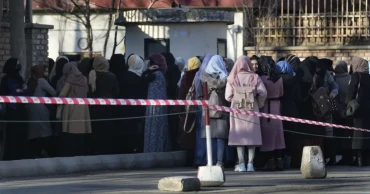
Taliban bar women from university education in Afghanistan
Afghanistan’s Taliban rulers on Tuesday banned female students from attending universities effective immediately in the latest edict cracking down on women’s rights and freedoms.
Despite initially promising a more moderate rule respecting rights for women’s and minorities, the Taliban have widely implemented their strict interpretation of Islamic law, or Sharia.
They have banned girls from middle school and high school, restricted women from most employment and ordered them to wear head-to-toe clothing in public. Women are also banned from parks and gyms.
The Taliban were ousted in 2001 by a U.S.-led coalition for harboring al-Qaida leader Osama bin Laden and returned to power after America’s chaotic departure last year.
Read: Taliban official: 27 people lashed in public in Afghanistan
The decision was announced after a government meeting. A letter shared by the spokesman for the Ministry of Higher Education, Ziaullah Hashmi, told private and public universities to implement the ban as soon as possible and to inform the ministry once the ban is in place.
Hashmi tweeted the letter and confirmed its contents in a message to The Associated Press without giving further details.
The decision is certain to hurt efforts by the Taliban to win recognition from potential international donors at a time when the country is mired in a worsening humanitarian crisis. The international community has urged Taliban leaders to reopen schools and give women their right to public space.
The university ban comes weeks after Afghan girls took their high school graduation exams, even though they have been banned from classrooms since the Taliban took over the country last year.
“I can’t fulfill my dreams, my hopes. Everything is disappearing before my eyes and I can’t do anything about it,” said a third-year journalism and communication student at Nangarhar University. She did not want to be identified for fear of reprisals.
“Is being a girl a crime? If that’s the case, I wish I wasn’t a girl,” she added. “My father had dreams for me, that his daughter would become a talented journalist in the future. That is now destroyed. So, you tell me, how will a person feel in this situation?”
Read: Taliban: 2 civilians killed in a bomb blast in Afghanistan
She added that she had not lost all hope yet.
“God willing, I will continue my studies in any way. I’m starting online studies. And, if it doesn’t work, I will have to leave the country and go to another country,” she said.
U.N. Secretary-General Antonio Guterres condemned the decision, calling it another “broken promise” from the Taliban and a “very troubling” move.
“It’s difficult to imagine how a country can develop, can deal with all of the challenges that it has, without the active participation of women and the education,” Guterres said.
Robert Wood, the deputy U.S. ambassador to the United Nations, said the Taliban cannot expect to be a legitimate member of the international community until they respect the rights of all Afghans.
U.S. National Security Council spokesperson Adrienne Watson said the United States also condemned the move by the Taliban.
“This deplorable decision is the latest effort by Taliban leadership to impose additional restrictions on women and girls in Afghanistan and prevent them from exercising their human rights and fundamental freedoms,” Watson said.
“As a result of this unacceptable stance to hold back half of the population of Afghanistan, the Taliban will be further alienated from the international community and denied the legitimacy they desire,” she added.
Afghanistan’s U.N. seat is still held by the previous government led by former President Ashraf Ghani, despite the Taliban’s request to represent the country at the United Nations, which was recently deferred again.
Afghanistan’s charge d’affairs Naseer Ahmed Faiq said at the U.N. that the announcement “marks a new low in violation of most fundamental and universal human rights for all of humanity.”
3 years ago

Pakistan launches operation to free officers held by Taliban
Pakistan's special forces on Tuesday stormed a counter-terrorism center in a remote northwestern district to free several security officials who were taken hostage earlier this week by a group of detained Pakistani Taliban militants, security officials said.
The operation came after the detainees, who were held for years at the center in Bannu, in Khyber Pakhtunkhwa province, overpowered their guards on Sunday, seized their weapons and took them hostage. On Monday, one officer at the center was reported killed by the hostage-takers.
Read more: Pakistani Taliban overpower guards, seize police center
Pakistani officials tried to negotiate with the hostage-takers but after more than 40 hours of failed efforts, special forces deployed to the area stormed the compound, security and intelligence officials said. They did not elaborate.
By Tuesday afternoon, thick black smoke billowed into the sky from inside the compound, after two explosions were heard. Intermittent gunshots were reverberating across the area, the officials said. They spoke to The Associated Press on condition of anonymity to discuss the ongoing situation.
It was not immediately clear what had happened to the hostages or the Taliban fighters. No military or government spokesmen were immediately available for comment.
Earlier, officials said there were about 30 Taliban fighters involved in the takeover of the center. The hostage-takers had demanded a safe passage to the former strongholds of the militant group.
Read more: Afghan forces shell border town, killing 6: Pakistani army
The brazen taking over the center on Sunday was a reflection of the government’s inability to exercise control over the remote region along the border with Afghanistan.
The Pakistani Taliban are also known as Tehreek-e-Taliban Pakistan or TTP. They are separate but allied with the Afghan Taliban who seized power in neighboring Afghanistan last year as U.S. and NATO troops were in the final weeks of their pullout from the country after 20 years of war.
3 years ago

Urgently rescue boat carrying upto 200 Rohingyas: ASEAN parliamentarians urge member states, others
Parliamentarians from Southeast Asia have urged ASEAN member states and other countries in the region to urgently rescue a boat carrying up to 200 Rohingya refugees, including women and children, which has reportedly been adrift off the coasts of Thailand, Malaysia, Indonesia and India for weeks.
According to the United Nations High Commissioner for Refugees (UNHCR), the boat has been adrift in high seas since late November, and dozens on board have already died during the journey, while survivors have no access to food, drinking water or medication.
“We urgently call on ASEAN member states and other countries in the region to fulfill their humanitarian obligations and launch search and rescue operations for the boat if it enters their waters, and to allow for the proper disembarkation of the refugees. It is disgraceful that a boat filled with men, women, and children in grave danger has been allowed to remain adrift. Neglecting the people on the boat is nothing short of an affront to humanity,” said Eva Sundari, Board Member of ASEAN Parliamentarians for Human Rights (APHR), and former member of the Indonesian House of Representatives.
According to media reports and information from human rights organizations, two other boats carrying Rohingya refugees have been adrift in the past weeks.
One, carrying 154 refugees, was rescued by a Vietnamese oil service vessel on December 8. They were handed over to the Myanmar navy.
Read More: https://unb.com.bd/category/Bangladesh/very-limited-spaces-offered-for-rohingya-resettlement-unhcr/106307
Another, carrying 104 refugees, was rescued by the Sri Lanka navy on December 18 and disembarked at Kankesanturai Harbor.
The Rohingyas have been suffering persecution in their country of origin, Myanmar, for decades.
The overwhelming majority of them were rendered stateless in the early 1990s by the authorities, and have suffered the most serious human rights violations since at least the late seventies.
In 2016 and 2017 they were the target of brutal military operations, displacing over 730,000 to neighbouring Bangladesh and for which the Myanmar army has been accused of genocide.
In these desperate conditions, many of them put themselves at the hands of unscrupulous human smugglers to seek a better life in countries like Malaysia, in extremely dangerous journeys through the Andaman Sea.
“In all likelihood, the delay in rescuing these boats has already caused untold suffering and loss of life. Any further delay is unconscionable. This neglect of Rohingya refugees stranded in the sea is nothing new, as it has been going on for years, and has resulted in hundreds, if not thousands, of deaths that could have been easily been prevented if the countries in the region fulfilled the most elementary humanitarian principles,” said Charles Santiago, Chairperson of APHR, and former member of Parliament from Malaysia.
Read More: 16 Rohingya including children and women detained in Sreemangal
APHR urged ASEAN to devise a comprehensive and coordinated regional response to the issue of refugees stranded at sea, in order to act effectively, and according to humanitarian principles, in such situations, as saving lives at sea must be a collective effort.
But ASEAN should also address the root causes of the tragedy that befell the Rohingya for so many years, including putting pressure on the Myanmar authorities to restore their citizenship, and receiving the refugees currently living in camps in Bangladesh, APHR said on Tuesday.
ASEAN should also help to hold the perpetrators of atrocities against the Rohingya people accountable, especially now that the army that launched the genocidal military operations against them in 2016 and 2017 has thrown Myanmar into chaos since staging an illegal coup d’état on February 1, 2021.
“ASEAN and the international community at large have stood idly for too long as the Rohingya tragedy unfolded over the years. Those countries who claim to defend human rights have a moral obligation to address the root causes of the human rights crisis afflicting the Rohingya, or these humanitarian tragedies will only repeat again and again. ASEAN member states, as well as their partners in the region and beyond, must ensure that Myanmar restore the rights of the Rohingya people, end all discriminatory practices and holds those responsible for crimes against humanity to account,” said Kasit Piromya, APHR Board Member and former Thai Minister of Foreign Affairs.
3 years ago

Russia, China to hold joint naval drills
Russian warships set off Monday to take part in a joint naval drill with China, an exercise that showcases increasingly close defense ties between the two countries as they face tensions with the United States.
The Russian Defense Ministry said the Varyag missile cruiser, the Marshal Shaposhnikov destroyer and two corvettes of Russia's Pacific Fleet would take part in maneuvers in the East China Sea starting Wednesday.
The ministry said the Chinese navy planned to deploy several surface warships and a submarine for the exercise. Russian and Chinese aircraft will also take part in the drills, according to the ministry.
Moscow and Beijing have displayed their growing military cooperation in recent months.
In November, Tu-95 bombers of the Russian air force and Chinese H-6K bombers flew joint patrols over the Sea of Japan and the East China Sea. As part of the drills, the Russian bombers landed in China for the first time, and the Chinese bombers flew to an air base in Russia.
In September, China sent more than 2,000 troops along with more than 300 military vehicles, 21 combat aircraft, and three warships to take part in a sweeping joint exercise with Russia. The maneuvers marked the first time that China sent forces from three branches of its military to take part in a single Russian drill, in what was described as a show of the breadth and depth of China-Russia mutual trust.
Defense cooperation between Moscow and Beijing has grown stronger since Russian President Vladimir Putin sent his troops into Ukraine on Feb. 24.
China, which has declared a “no limits” friendship with Russia, has pointedly refused to criticize Moscow’s actions, blaming the U.S. and NATO for provoking the Kremlin, and has blasted the punishing sanctions imposed on Russia.
Russia, in turn, has strongly backed China amid the tensions with the U.S. over Taiwan.
3 years ago

Pakistani Taliban overpower guards, seize police center
Several Pakistani Taliban detainees have managed to overpower their guards at a counter-terrorism center in northwestern Pakistan, snatching police weapons and taking control of the facility, officials said Monday.
The militants at the detention center in Bannu, a district in the Khyber Pakhtunkhwa province and part of a former tribal region, also took police and others inside the compound hostage, according to Mohammad Ali Saif, a spokesman for the provincial government.
Officials say at least 30 Taliban fighters are involved in the takeover and that there could be as many as 10 hostages being held.
The brazen action reflected the Pakistani government’s inability to exercise control at all times over the remote region along the border with Afghanistan. The Pakistani Taliban are a separate group but also allied with the Afghan Taliban, who seized power in the neighboring country last year, as U.S. and NATO troops were in the final stages of their pullout from Afghanistan.
Few other details have emerged about the incident, which started late on Sunday — apparently while police were interrogating the Taliban detainees, according to Saif.
By Monday morning, Pakistan had dispatched military troops and special police forces to the area as security official were trying to negotiate with the hostage-takers. Saif said the place was surrounded and that an operation was underway. He did not elaborate.
Read: Taliban official: 27 people lashed in public in Afghanistan
Authorities were still in talks with the hostage-takers, enlisting the help of several relatives of the Taliban insurgents, security officials told The Associated Press. They spoke on condition of anonymity because they were not authorized to talk to reporters.
The officials said some soldiers were also among the hostages. There were concerns that the military could storm the facility if negotiations fail. In a video message circulating on social media, the hostage-takers threatened to kill the officers if their safe passage was not quickly arranged by the government.
Mohammad Khurasani, a spokesman for the Pakistani Taliban — also known as Tehreek-e-Taliban Pakistan or TTP — confirmed the incident. He said some of the hostage-takers were members of the Pakistani Taliban who had been detained for years. Khurasani said the TTP fighters were demanding safe passage to North or South Waziristan.
Those areas were a Taliban stronghold until a wave of military offensives over the past years declared the region cleared of insurgents. Since then, TTP’s top leaders and fighters have been hiding in neighboring Afghanistan though the militants still have relatively free reign in patches of the province.
Earlier, in a video message, the hostage-takers had demanded they be airlifted to Afghanistan but Khurasani said that demand had been made by mistake, since their fighters were not aware — due to their prolonged detention — that TTP now “enjoys control in some” parts of Khyber Pakhtunkhwa, near the Afghan border.
Read: Taliban captured, bound and shot to death 27 men in Afghan province: Report
The Pakistani Taliban have stepped up attacks on security forces since last month, when they unilaterally ended a monthslong cease-fire with the Pakistani government. The violence has strained relations between Pakistan and Afghanistan’s Taliban rulers, who had brokered the cease-fire in May.
The TTP has waged an insurgency in Pakistan over the past 15 years, fighting for stricter enforcement of Islamic laws in the country, the release of their members who are in government custody and a reduction of Pakistani military presence in the country’s former tribal regions.
3 years ago