asia
Thailand, Cambodia agree to immediate, unconditional ceasefire: Malaysian PM
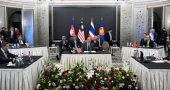
Thailand and Cambodia have agreed to an “immediate and unconditional” ceasefire from midnight to end deadly border clashes, Malaysian Prime Minister Anwar Ibrahim announced on Monday.
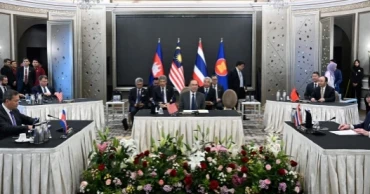
Anwar, who chaired the emergency talks as head of the Association of Southeast Asian Nations (ASEAN), said both countries reached a common understanding to take steps toward restoring peace and normalcy along their shared border.
Cambodian Prime Minister Hun Manet and Thai Acting Prime Minister Phumtham Wechayachai “have agreed to an immediate and unconditional ceasefire with effect from... midnight of 28 July,” Anwar said as he read out a joint statement following the meeting.
Both leaders hailed the outcome of the talks and shook hands at the conclusion of the brief press conference held at the Malaysian Prime Minister’s official residence in Putrajaya.
Earlier in the day, Hun Manet and Phumtham met in Malaysia in a bid to halt escalating violence that has continued for five days, despite mounting international pressure to end the conflict.
The clashes began last Thursday after a land mine explosion along the border wounded five Thai soldiers. Both sides blamed each other for initiating the violence, which has so far killed at least 35 people and displaced more than 260,000 residents in both countries. In response, Thailand shut all border crossings with Cambodia, except for routes used by Cambodian migrant workers returning home, and both nations recalled their ambassadors.
Despite the high-level talks, troops from both countries continued to exchange fire on Monday. Associated Press reporters in Cambodia’s Oddar Meanchey province said gunfire could still be heard at dawn in the border town of Samrong.
Maly Socheata, a spokesperson for Cambodia’s defense ministry, said the Thai assault was “ongoing and strong” on Monday.
Anwar, speaking late Sunday, said both sides were expected to present their conditions for peace but stressed, “what is important is immediate ceasefire.”
“I hope this can work,” Anwar told Malaysian national news agency Bernama. “Although it’s not as bad as many other countries, we have to put a stop (to the violence).”
The meeting came amid direct pressure from U.S. President Donald Trump, who warned that Washington may halt trade deals with both countries if hostilities continue.
Before departing for Kuala Lumpur, Thai Acting Prime Minister Phumtham said that representatives from China and the United States would attend the talks as observers. He underscored that while the main objective was securing a ceasefire, trust remained a major concern.
“We have informed that we don’t have trust in Cambodia. All they have done reflect that they are not sincere in solving this problem. So they have to show the detail how they will do to prove their sincerity,” Phumtham told reporters in Bangkok.
10 months ago
Firefighter dies as wildfires ravage Turkish forests, 14 killed in weeks
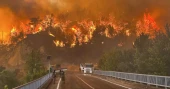
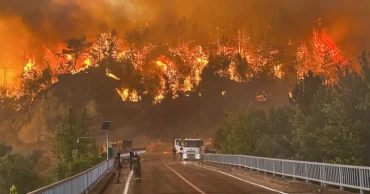
Wildfires that have raged across Turkey for weeks reached the outskirts of the country’s fourth-largest city, Bursa, early Sunday, prompting the evacuation of more than 1,700 residents and claiming the life of a firefighter.
Fires erupted overnight in the forested mountains surrounding the northwestern city, casting a red glow across the eastern suburbs and burning through about 3,000 hectares of land, according to Bursa Mayor Mustafa Bozbey.
The Bursa governor’s office said 1,765 people were evacuated from northeastern villages, while over 1,900 firefighters battled the flames. The highway connecting Bursa to the capital Ankara was closed due to nearby forest fires.
One firefighter died of a heart attack during operations, the mayor said.
Opposition lawmaker Orhan Saribal described the scene as “an apocalypse.”
Although calming winds brought slight relief to firefighters by morning, television footage showed charred farmland and pine forests.
Cambodia urges ceasefire as border clashes with Thailand escalate
Turkey’s Forestry Minister Ibrahim Yumakli said 84 separate wildfires were reported nationwide on Saturday. The country’s northwest, including Karabuk province, faced the greatest threat.
The fires have been fueled by unusually high temperatures, dry weather, and strong winds. The General Directorate of Meteorology reported a record 50.5°C in southeastern Sirnak province on Friday, the highest ever recorded in Turkey.
Fourteen people have died in recent weeks, including 10 rescue volunteers and forestry workers in a fire in Eskisehir on Wednesday.
Justice Minister Yilmaz Tunc said legal action has been taken against 97 suspects in connection with fire incidents investigated in 33 provinces since June 26.
Meanwhile, Bulgaria and Serbia are also battling severe wildfires, with several areas declared disaster zones.
10 months ago
Thailand, Cambodia agree to ceasefire talks after Trump steps in, but border fighting continues
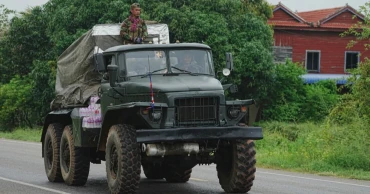
Thailand and Cambodia have agreed to begin ceasefire talks amid ongoing border clashes, following mediation by U.S. President Donald Trump. The conflict, now in its fourth day, has left at least 33 people dead and forced more than 168,000 to flee.
Trump said via Truth Social on Saturday that he had spoken with both countries' leaders and warned of halting trade deals if hostilities did not stop. Later, he announced that both sides had agreed to meet and negotiate a truce.
Cambodian Prime Minister Hun Manet confirmed that his government had accepted an “immediate and unconditional ceasefire” and said Trump had informed him that Thailand had also agreed. Cambodia’s foreign minister has been tasked with coordinating with U.S. Secretary of State Marco Rubio and engaging with Thai officials on the ceasefire.
Thailand responded cautiously. Acting Prime Minister Phumtham Wechayachai welcomed Trump's involvement and agreed in principle but emphasized that Cambodia must show genuine intent. He called for urgent bilateral dialogue to resolve the issue.
Cambodia urges ceasefire as border clashes with Thailand escalate
Despite the diplomatic push, fighting persisted Sunday, with both sides trading blame over renewed shelling and troop movements along the contested border. Thailand accused Cambodia of attacking civilian areas, while Cambodia alleged Thai troops launched ground incursions.
Thailand reported 20 deaths, mostly civilians, while Cambodia confirmed 13 fatalities. Thousands of families remain displaced, with border villages largely emptied and public services disrupted.
The UN Security Council has urged ASEAN to mediate, while Human Rights Watch condemned the reported use of cluster bombs, calling for both governments to protect civilians.
Source: Agency
10 months ago
Cambodia urges ceasefire as border clashes with Thailand escalate
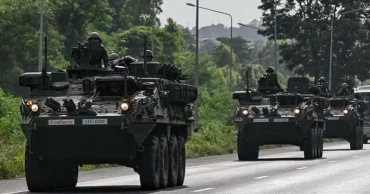
Cambodia has called for an unconditional and immediate ceasefire with Thailand amid ongoing deadly border clashes that have killed at least 32 people, including civilians, and displaced nearly 200,000.
Speaking at the United Nations, Cambodia's ambassador Chhea Keo urged a peaceful resolution to the conflict. However, Thailand's Foreign Minister Maris Sangiampongsa said any talks would require Cambodia to show genuine commitment to ending the violence.
The fighting, which erupted on Thursday, has continued for three consecutive days and spread to 12 areas along the border. Thailand claims Cambodian forces initiated a new attack near the southern coast, which its navy repelled. Earlier clashes were reported in Thailand’s Surin, Ubon Ratchathani, and Srisaket provinces. Martial law has been imposed in eight Thai districts bordering Cambodia.
Thousands displaced as border fighting between Thailand and Cambodia escalates
Thai officials say 19 people, including 13 civilians, have died on their side, with nearly 140,000 evacuated. Cambodia reports 13 deaths and over 35,000 displaced.
Thailand’s acting Prime Minister warned the conflict could escalate into full-scale war, noting the use of heavy weaponry. Thailand accused Cambodia of targeting civilian zones, while Cambodia claimed Thailand used cluster munitions an internationally banned weapon though Bangkok has yet to respond to the allegation.
Despite calls from the US and ASEAN for a ceasefire and Malaysia’s offer to mediate, Thailand insists external mediation is unnecessary. The two countries blame each other for starting the clashes, rooted in a century-old border dispute that resurfaced in May after a Cambodian soldier was killed.
#With inputs from BBC
10 months ago
Glacial flood alert issued for northwest Pakistan
Pakistan has issued a glacial flood alert for its northwest region as heavy rains are expected to continue in the coming week, officials said Saturday.
Khyber Pakhtunkhwa province is experiencing heavier downpours than the same period last year, prompting warnings of flooding from glacial lake outbursts, according to Anwar Shahzad, spokesperson for the local disaster management authority.
A letter issued mid-July warned that persistent high temperatures could accelerate snow and glacier melting, increasing the risk of severe weather events in vulnerable areas.
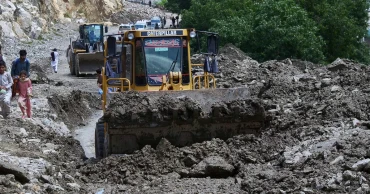
Dr. Abdul Samad of the Khyber Pakhtunkhwa Tourism Department said rescue teams evacuated more than 500 tourists from Naran following a cloudburst Friday night that blocked the main road. Authorities deployed heavy machinery to clear debris and reopen access.
In Gilgit-Baltistan, the government distributed hundreds of tents, thousands of food packets, and medicine to flood-affected communities.
Death toll rises to 16 in Pakistan building collapse
Spokesperson Faizullah Firaq described the situation as “severe destruction” in several areas, with damage to homes, infrastructure, crops, and businesses.
Search operations are ongoing for missing persons along the Babusar Highway, where floods affected nine villages. Helicopters rescued tourists stranded at the popular Fairy Meadows site.
Pakistan has received above-average rainfall during this monsoon season, raising fears of a repeat of the devastating 2022 floods that submerged one-third of the country and killed 1,737 people.
So far, around 260 deaths have been reported this season, which is expected to last until mid-September.
Despite being among the countries most vulnerable to climate change, Pakistan is one of the lowest greenhouse gas emitters globally.
10 months ago
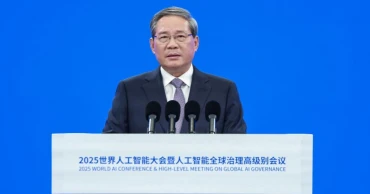
Chinese Premier calls for global AI governance framework with broad consensus
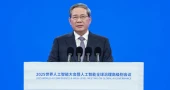
Chinese Premier Li Qiang on Saturday said the international community should place greater emphasis on the joint governance of artificial intelligence (AI), calling for the early formation of a global framework and rules that have broad consensus to guide the development and use of AI.
"China attaches great importance to global AI governance, and has been actively promoting multilateral and bilateral cooperation with a willingness to offer more Chinese solutions," Li said while addressing the opening ceremony of the 2025 World AI Conference and High-Level Meeting on Global AI Governance in Shanghai.
Li said that the Chinese government proposes the creation of a global AI cooperation organization.
Chinese medical team offers full support for Bangladesh in treating injured
He said that rapid progress is being made in fields such as large language models, multimodal large models and embodied AI, propelling AI development toward greater efficiency and higher intelligence.
Acknowledging that AI has begun to empower various industries and enter households, emerging as a new engine for economic growth, Li said the risks and challenges posed by AI have sparked widespread concern.
There is an urgent need to foster further consensus on how to strike a balance between development and security, he noted.
No matter how technology transforms, it must remain a tool to be harnessed and controlled by humans, Li said, adding that AI should become an international public good that benefits humanity.
China’s exports rise 5.8% in June as tariff truce triggers rush of orders
Li urged more efforts to ensure universal access to AI so that more countries and groups will benefit from it. "China is willing to share its AI development experience and technological products to help countries around the world -- especially those in the Global South -- to strengthen their capacity building."
He suggested greater cooperation on innovation to achieve more groundbreaking results. He said that China stands ready to undertake joint technical research with other countries, and will be more open in sharing open-source technology and products.
More than 1,000 officials and representatives of industries, universities and research institutes from China and abroad attended the opening ceremony.
An action plan for global AI governance was issued at the conference.
10 months ago
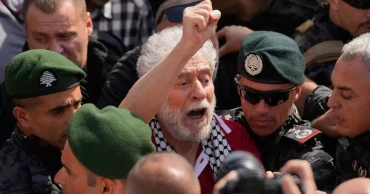
Militant Georges Abdallah returns to Lebanon after over four decades in French prison
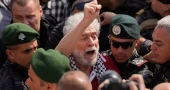
Georges Ibrahim Abdallah, a Lebanese communist militant known for his pro-Palestinian stance, returned to Lebanon on Friday after spending more than 40 years in prison in France.
Now 74, Abdallah had been serving a life sentence for his involvement in the 1982 assassinations of two diplomats—U.S. Army Lt. Col. Charles Ray and Israeli diplomat Yacov Barsimantov—in Paris. He was arrested in 1984 and sentenced in 1987. Despite being eligible for parole since 1999, his numerous release petitions had previously been rejected.
Last week, a Paris Court of Appeal approved his conditional release, requiring him to leave France permanently.
The decision was met with strong criticism from the United States. The U.S. Embassy in Paris posted a photo on social media showing staff standing solemnly around a memorial plaque honoring Ray. “The United States opposes the release of convicted terrorist Georges Ibrahim Abdallah,” the post stated, adding that his freedom threatens U.S. diplomats and dishonors the victims' memories.
One killed another injured in University of New Mexico dorm shooting
In Lebanon, Abdallah is viewed by many as a political prisoner. Although there was no formal state reception, a large crowd of supporters—including several lawmakers—gathered outside Beirut airport to welcome him. Waving Palestinian and Lebanese Communist Party flags and holding banners that read, “George Abdallah is free — a Lebanese, Palestinian and international freedom fighter,” the crowd erupted in cheers upon his arrival.
Wearing a red shirt and a Palestinian keffiyeh, Abdallah briefly greeted his supporters before heading to his hometown, Qobayat, a Christian village in northern Lebanon. Speaking to the press, he urged Arabs to protest in support of Gaza, condemning inaction amid the suffering there. “Gaza’s children are all walking skeletons,” he said. “Millions of Arabs are just watching.”
Abdallah also called for resistance against Israel, declaring it is “living the final chapters of its existence.”
Israel has not issued any official response to his release.
10 months ago
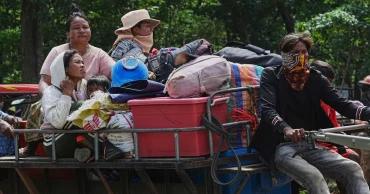
Tens of thousands displaced as Thailand-Cambodia border clashes escalate
Fighting between Thailand and Cambodia entered its second day on Friday, forcing tens of thousands to flee and raising concerns of a wider conflict.
The U.N. Security Council is set to hold an emergency meeting on the crisis later Friday in New York. Malaysia, which chairs the ASEAN bloc that includes both nations, has called for a ceasefire and offered to mediate.
According to Thailand’s Health Ministry, over 58,000 people have been relocated to temporary shelters in four Thai provinces along the border. Cambodia reported that more than 4,000 residents near the frontier have also evacuated.
At least 14 people have been killed in Thailand, while Cambodia recorded its first fatality on Friday.
Clashes erupt after land mine blastTensions flared following a land mine explosion on Wednesday that injured five Thai soldiers in a disputed border zone.
Thailand’s military said fighting resumed early Friday in multiple areas, including Chong Bok and Phu Makhuea in Ubon Ratchathani province, and Phanom Dong Rak in Surin province. Exchanges of fire were also reported near the Ta Muen Thom temple. AP reporters near the border heard artillery fire from early morning.
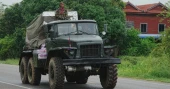
Thai officials accused Cambodian troops of using heavy artillery and Russian BM-21 rocket launchers, prompting what they called “appropriate supporting fire” in response.
Thailand reported 14 deaths — one soldier and 13 civilians, including children — with 15 soldiers and 30 civilians wounded.
In Cambodia, Gen. Khov Ly said a man died after a Thai rocket struck a Buddhist pagoda in Oddar Meanchey province. Four civilians were also injured on Thursday.
The Thai army denied targeting civilian areas and accused Cambodia of placing weapons near residential zones, using people as “human shields.”
Border villages empty as residents fleeAs the conflict worsened, many residents on both sides abandoned their homes.
Thailand-Cambodia border clashes escalate, at least 12 dead as airstrikes begin
In Surin, about 600 people took shelter in a university gymnasium, 80 kilometers from the border. Some sat in groups on blankets and mats, while others lined up for meals.
Seamstress Pornpan Sooksai, who brought along four cats in two cages, said she was doing laundry when she heard explosions near the Ta Muen Thom temple. “I was terrified,” she said.
Another evacuee, Rattana Meeying, recalled living through the 2011 conflict, but said this time felt more violent. “Children and the elderly were struck without warning,” she said.
At Phanom Dong Rak hospital, windows were shattered and the roof damaged by shelling on Thursday. Explosions could still be heard on Friday as injured soldiers arrived, including one who lost both legs.
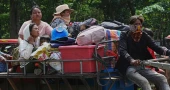
In Sisaket province, long lines of vehicles were seen as villagers obeyed evacuation orders.
Across the border in Cambodia, villages in Oddar Meanchey were nearly deserted. Residents had locked homes and fled, while livestock roamed freely. Some had dug makeshift bunkers using wood and metal sheets.
Several hundred Cambodians gathered at a remote Buddhist temple surrounded by rice fields, sheltering under plastic tents. Women rocked babies in hammocks as children played nearby.
Veng Chin, 74, urged both governments to find a peaceful solution. “I want to go home and work on my farm,” he said.
ASEAN and UN urge calmThe ongoing hostilities mark a rare military clash between ASEAN member states. While Thailand has had previous border tensions with Cambodia and Myanmar, this conflict has drawn broader attention.
Malaysian Prime Minister Anwar Ibrahim, speaking as ASEAN chair, said he spoke to Cambodian leader Hun Manet and Thai Acting Prime Minister Phumtham Wechayachai, encouraging peaceful dialogue. Malaysia is ready to mediate, he added.
Over 100 aid organizations warn of worsening starvation in Gaza amid ongoing Israeli strikes
U.N. Secretary-General Antonio Guterres has also called for restraint and dialogue, according to deputy spokesperson Farhan Haq.
History of border tensionsThe 800-kilometer border between Thailand and Cambodia has long been disputed. The last major escalation in 2011 left 20 people dead.
This latest conflict was triggered in May when a Cambodian soldier was killed. Though both sides initially agreed to ease tensions, measures like travel and trade restrictions kept the situation tense.
The land mine blast that injured Thai soldiers on Wednesday caused Thailand to withdraw its ambassador and expel Cambodia’s envoy. Land border crossings were shut, and Thai nationals were advised to return home, with airlines offering evacuation support.
Cambodia responded by recalling embassy staff from Bangkok and downgrading diplomatic ties.
Fighting resumed on Thursday, with both sides accusing each other of drone use and launching artillery. Thailand said it responded with airstrikes, including two bombing runs by F-16s.
Cambodia alleged that bombs landed near the Preah Vihear temple, a UNESCO World Heritage site. Phnom Penh shared photos of the reported damage and vowed to pursue justice internationally.
The conflict has also affected Thai politics. Prime Minister Paetongtarn Shinawatra was suspended from office on July 1 amid an ethics probe linked to a phone call with Cambodia’s former Prime Minister Hun Sen.
Source: Agency
10 months ago
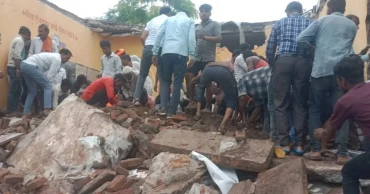
School roof collapse in Rajasthan kills four children, Indian media say
A roof collapse at a school in India’s western state of Rajasthan on Friday claimed the lives of at least four children and left 17 others injured, according to local media reports. Many students are still believed to be trapped beneath the debris.
A local police official, speaking to Reuters on condition of anonymity, said the building was old and the collapse may have been triggered by heavy rainfall in the area.
Rajasthan Education Minister Madan Dilawar told AajTak news channel that the roof collapsed following morning prayers while 25 to 30 students were present in the room.
News channel footage showed local residents at the scene, while anguished family members wept as authorities used cranes to clear the rubble.
Bridge collapse kills 9 in India's Gujarat state
According to media reports, 32 students had been rescued, and the search efforts were ongoing.
Rajasthan Chief Minister Bhajanlal Sharma posted on X that directions had been given to ensure proper medical treatment for the injured.
Some of the injured are in critical condition, local police officer Amit Kumar told PTI, as cited by the Economic Times.
Source: Agency
10 months ago
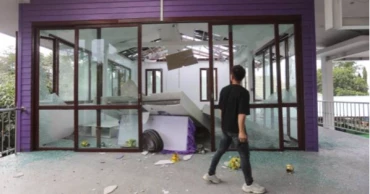
Thailand-Cambodia border clashes escalate, at least 12 dead as airstrikes begin
Tensions between Thailand and Cambodia surged Thursday as deadly border clashes erupted, killing at least 12 people — mostly Thai civilians — and prompting Thailand to launch airstrikes in response.
Thai and Cambodian forces exchanged fire across at least six border areas, using small arms, artillery, and rockets. Thailand’s Defense Ministry confirmed the use of F-16 fighter jets in airstrikes, claiming self-defense after Cambodian rocket attacks. The clashes followed a landmine blast Wednesday that injured five Thai soldiers, prompting Thailand to expel Cambodia’s ambassador and withdraw its own from Phnom Penh.
Public Health Minister Somsak Thepsuthin reported that among the dead were 11 civilians and one soldier, with children as young as eight among the victims. He condemned the targeting of civilians and a hospital as violations of international law.
Both sides accused each other of instigating the violence. Thailand claimed its sovereignty was under attack, while Cambodia insisted its military was only responding to Thai aggression. Cambodian Prime Minister Hun Manet appealed to the UN Security Council for intervention, while Thailand shut all land crossings and prepared to evacuate citizens.
The conflict, rooted in long-standing border disputes, escalated beyond typical skirmishes. Relations had worsened since a deadly clash in May. The latest fighting began near the Ta Muen Thom temple and later spread near the historic Preah Vihear site, a UNESCO World Heritage location Cambodia says was damaged in Thai airstrikes.
Iran open to resuming nuclear talks with US—but only with security guarantees
Diplomatic ties further deteriorated as Cambodia recalled its embassy staff from Bangkok. The Thai government also faces domestic criticism over its handling of the crisis. Meanwhile, Japan and others have urged both nations to de-escalate and resume peaceful dialogue to preserve regional stability. Source: Agency
10 months ago