asia

Australian PM Albanese begins China visit with focus on trade
Australian Prime Minister Anthony Albanese has begun a visit to China aimed at strengthening bilateral trade ties, marking a renewed phase of engagement between the two countries.
On Sunday, Albanese met with Shanghai Party Secretary Chen Jining, the first in a series of high-level meetings scheduled during the visit. He is expected to meet Chinese President Xi Jinping, Premier Li Qiang, and Zhao Leji, Chairman of the National People’s Congress.
Speaking to Chinese state broadcaster CGTN upon arrival in Shanghai on Saturday, Albanese said he was leading “a very large business delegation” to China, reflecting the significance of economic relations between the two nations.
During his weeklong trip, Albanese is expected to engage with business, tourism, and sports representatives in Shanghai and Chengdu. His itinerary also includes a CEO roundtable in Beijing on Tuesday, according to his office.
This marks Albanese’s second visit to China since his center-left Labor Party came to power in 2022. The party was reelected in May with an increased majority.
Ex-South Korean leader Yoon held again over martial law declaration
Since taking office, Albanese has successfully lobbied Beijing to lift a range of official and unofficial trade barriers imposed during the previous conservative administration. Those restrictions had cost Australian exporters more than 20 billion Australian dollars (approximately US$13 billion) annually.
Diplomatic tensions under the former government arose from Australia’s calls for an independent investigation into the origins and response to COVID-19. Although Albanese has prioritized repairing ties, he also emphasized the need to reduce Australia’s economic reliance on China, a key free trade partner.
“My government has worked very hard to diversify trade … and to increase our relationships with other countries in the region, including India and Indonesia and the ASEAN countries,” Albanese said ahead of the visit, referring to the 10-member Association of Southeast Asian Nations.
“But the relationship with China is an important one, as is our relationships when it comes to exports with the north Asian economies of South Korea and Japan,” he added.
In an editorial published Sunday, China’s official Xinhua News Agency described the bilateral relationship as “steadily improving” and gaining “fresh momentum.” The editorial stated, “There are no fundamental conflicts of interest between China and Australia. By managing differences through mutual respect and focusing on shared interests, the two sides can achieve common prosperity and benefit.”
10 months ago
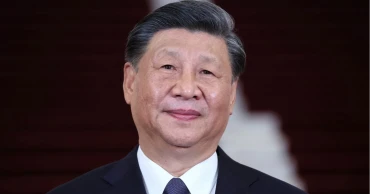
Xi urges film industry to craft works reflecting the spirit of times and people's aspirations
Chinese President Xi Jinping has called on people working in the country's film industry to create more fine cinematic works that reflect the spirit of the times and express the people's aspirations.
Xi, also general secretary of the Communist Party of China Central Committee and chairman of the Central Military Commission, made the remarks in a recent reply letter to eight veteran Chinese film artists, including 97-year-old famed actress Tian Hua.
In his reply, Xi said that reading the letter from the artists reminded him of the classic films they had participated, which are widely known and cherished by the public.
Xi expressed the hope that the artists would continue to set an example in upholding virtue and pursuing artistic excellence.
He encouraged them to inspire the broader film community to strengthen cultural confidence, stay rooted in real life, and make new contributions to the prosperity of arts and the building of a culturally strong nation.
10 months ago
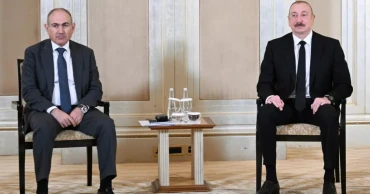
No Breakthrough in Armenia-Azerbaijan Peace Talks Despite Continued Commitments
The latest round of peace talks between the leaders of Armenia and Azerbaijan ended Thursday in Abu Dhabi without any breakthrough in their decades-long conflict over the South Caucasus region.
Armenian Prime Minister Nikol Pashinyan and Azerbaijani President Ilham Aliyev met to push forward negotiations on a peace treaty, following Azerbaijan’s full recapture of the disputed Karabakh province last year. While both sides had agreed in principle to the wording of a peace deal in March, Thursday’s meeting yielded no timeline for its finalization.
Bangladesh invites Azerbaijani investment, esp in renewable energy
Instead, both leaders reiterated their commitment to continue dialogue on key issues, including border demarcation and confidence-building measures. In a joint statement, the two nations said they would stay engaged in bilateral talks despite the lack of immediate progress.
Armenia and Azerbaijan have remained in conflict since the early 1990s, when ethnic Armenian forces took control of Karabakh. A six-week war in 2020 saw Azerbaijan reclaim significant territory, and a swift military operation in September 2023 led to Karabakh’s capitulation and further handovers of border villages by Armenia.
Over 600 foreigners flee Iran into Azerbaijan
Tensions have also escalated within Armenia. Many citizens oppose recent territorial concessions, particularly in the Syunik region, where Azerbaijan seeks a land corridor to its Nakhichevan exclave. Protests erupted last year, prompting the Armenian government to arrest opposition figures, including two senior archbishops accused of plotting to overthrow the government.
Despite the challenges, both sides say they remain committed to resolving the conflict through peaceful negotiations.
Source: Agency
10 months ago
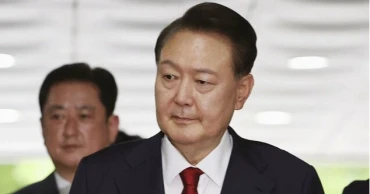
Ex-South Korean leader Yoon held again over martial law declaration
Former South Korean President Yoon Suk Yeol was once again taken into custody Thursday over charges linked to his short-lived declaration of martial law late last year.
The Seoul Central District Court approved the latest arrest warrant against Yoon over fears he could destroy evidence. He was previously held in custody following his initial arrest in January, but was released in March after the same court overturned his detention.
Yoon was removed from office in April after the Constitutional Court upheld an impeachment motion submitted by the parliament over his imposition of martial law in December, which threw the nation into a months-long political crisis.
The criminal investigation is being handled by a special counsel team led by special prosecutor Cho Eun Suk. The probe was launched after Lee Jae Myung was elected president in June to replace Yoon.
Malaysian PM warns Southeast Asia that trade war is not ‘passing storm’
Yoon is already standing trial over allegations that his declaration of martial law amounted to an insurrection, which carries a maximum sentence of life in prison or death if convicted. He has denied the charges.
The conservative former president defended himself during a court hearing on Wednesday over whether to issue the latest arrest warrant, which includes charges such as obstruction of official duties and abuse of power.
Source: Kyodo News
10 months ago
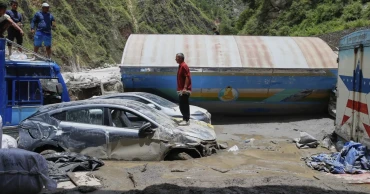
19 missing and recover 9 bodies after flooding in Nepal
Dozens of rescuers continued search operations along a mountain river in Nepal on Wednesday after monsoon floods swept away the country’s main border bridge to China, killing at least nine people and leaving 19 others missing.
The floods, triggered by heavy rainfall on Tuesday, destroyed the Friendship Bridge at Rasuwagadhi—Nepal’s primary trade link with China—located about 120 kilometers (75 miles) north of Kathmandu. Several homes and trucks parked at the border for customs checks were also washed away. Hundreds of electric vehicles imported from China had been awaiting clearance at the site.
Monsoon floods wash away Nepal-China bridge, 18 missing
According to the Rasuwa District Administration Office, nine bodies have been recovered so far. Rescue teams have saved 55 people, including four Indian nationals and one Chinese citizen. Among the missing are 13 Nepali citizens and six Chinese nationals, as confirmed by the National Disaster Risk Reduction and Management Authority.
The Chinese Embassy in Nepal stated that the missing Chinese nationals and eight of the Nepalis were working on a China-assisted construction project near the border.
In response, Prime Minister Khadga Prasad Oli, accompanied by senior ministers and officials, visited the affected area. Oli had earlier convened an emergency meeting, directing all relevant authorities and security forces to intensify rescue and relief efforts.
With the Rasuwagadhi route now severed, all cross-border trade through this key point has come to a halt. Goods must now be rerouted through India, creating significant logistical delays.
Nepal’s monsoon season, spanning June to September, regularly brings heavy flooding that damages infrastructure and threatens lives across the country.
10 months ago
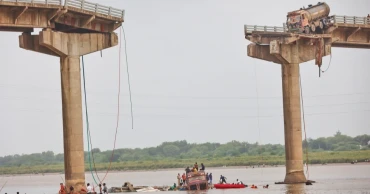
Bridge collapse kills 9 in India's Gujarat state
At least nine people were killed on Wednesday when a section of a bridge collapsed into a river in India’s western state of Gujarat, according to local police cited by the Press Trust of India.
Gujarat Health Minister Rushikesh Patel said that multiple vehicles were crossing the bridge at the time of the collapse, which caused several to plunge into the river. At least five individuals have been rescued so far, he confirmed.
Death toll rises to 36 in India pharma factory blast
The collapse occurred in Vadodara district, an area that has been experiencing heavy rainfall in recent days. Patel noted that the bridge was built in 1985.
Indian Prime Minister Narendra Modi expressed his condolences, calling the incident “deeply saddening.”
India has long faced challenges with infrastructure safety, with incidents involving roads, bridges, and other structures not uncommon. In one of the country’s worst recent infrastructure disasters, a century-old cable suspension bridge in Gujarat collapsed in 2022, sending hundreds into the river and resulting in the deaths of at least 132 people.
10 months ago
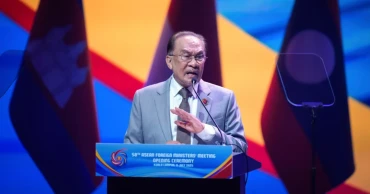
Malaysian PM warns Southeast Asia that trade war is not ‘passing storm’
Malaysian Prime Minister Anwar Ibrahim on Wednesday warned that global trade is being weaponized, as foreign ministers from the Association of Southeast Asian Nations (ASEAN) convened their annual meeting amid rising fears over impending U.S. trade tariffs.
Anwar’s warning came as concerns mount across the 10-nation ASEAN bloc, many of whose economies are heavily reliant on exports. Six member states are among 14 countries facing steep new U.S. tariffs—ranging from 25% to 40%—scheduled to take effect on August 1 unless agreements are reached.
Opening the meeting, Anwar said the world is witnessing a time when “power unsettles principle” and economic tools once meant to foster growth are now being used “to pressure, isolate and contain.” Without naming the United States, he urged ASEAN to forge a united response to emerging trade threats.
China ready to work with UN to strengthen more just and equitable int'l order: Premier Li
“Our cohesion must not end at declarations,” he said, calling on the group to strengthen intra-ASEAN trade, advance regional integration, and reduce strategic dependencies on major external powers. “This is no passing storm. It is the new weather of our time.”
U.S. President Donald Trump initially announced the tariff measures in April but delayed them by 90 days for negotiations. On Tuesday, he reintroduced the tariffs, which will apply to 14 countries unless deals are finalized by August. He also warned of even higher tariffs should any country retaliate.
So far, Vietnam is the only ASEAN member to have secured a deal, which reduced its tariffs from 46% to 20%. The new tariff rates include 36% for Thailand and Cambodia, 32% for Indonesia, 25% for Malaysia, and 40% for both Laos and Myanmar.
Several ASEAN countries have initiated bilateral discussions with Washington and plan to hold a regional summit with the U.S. later this year to adopt a unified approach.Responding to the economic uncertainty, Malaysia’s central bank on Wednesday cut its benchmark interest rate for the first time in five years.
Meanwhile, Malaysian Trade Minister Zafrul Aziz stated that while Kuala Lumpur will continue talks with the U.S., it will not agree to any terms that compromise national interest or sovereignty.
He referenced American demands concerning government procurement policies, halal certification, medical regulations, and digital tax policies but did not elaborate. “It has to be fair ... if the deal does not benefit Malaysia, we should not have a deal,” he emphasized.
Beyond trade tensions, the ASEAN bloc is grappling with internal crises, including the ongoing civil war in Myanmar and a simmering border dispute between Thailand and Cambodia.
The foreign ministers' meeting in Malaysia will be followed by high-level talks on Thursday and Friday with key external partners including the United States, China, Japan, India, Russia, and the European Union.U.S. Secretary of State Marco Rubio is set to arrive Thursday for his first visit to Asia. His trip follows the cancellation of planned stops in Japan and South Korea last week. Other prominent attendees include Chinese Foreign Minister Wang Yi and Russian Foreign Minister Sergei Lavrov.Analysts say these upcoming talks will be a critical test of ASEAN’s ability to maintain its independence and uphold a rules-based trade framework amid intensifying global geopolitical rivalry.
“ASEAN must be among those who choose to stand for rules, even when others choose retreat,” Anwar said, with officials confirming he will meet Rubio to address the tariff concerns directly.
Russia becomes first state to recognise Afghanistan's Taliban government
Commentators see Rubio’s presence as a sign of Washington’s renewed engagement with Southeast Asia. Collins Chong Yew Keat, a foreign affairs and security analyst at Universiti Malaya, noted that the U.S. still offers ASEAN significant military and economic advantages but now expects more alignment.
“Trump’s administration, while still offering the strongest military deterrence and market access, expects ASEAN to stop exploiting this security umbrella while cozying up economically to China,” he said.
10 months ago
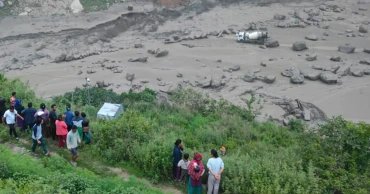
Floods destroy Nepal-China bridge; 9 dead, 19 missing
At least nine people have died and 19 others remain missing after monsoon-triggered floods swept away Nepal’s main bridge connecting the country to China, authorities said Wednesday, as rescue efforts continue along the swollen mountain river.
Dozens of rescuers have been deployed to the affected area and more are expected to join the operation, police confirmed. The bodies of nine victims have so far been recovered from the river, while 55 people — including four Indian nationals and one Chinese citizen — have been rescued, according to the Rasuwa District Administration Office.
Prime Minister Khadga Prasad Oli flew to the flood-hit region along with top ministers and officials. He had earlier convened an emergency meeting on Tuesday night, instructing all security forces and government agencies to assist in rescue and recovery operations.
The flooding on the Bhotekoshi River occurred early Tuesday and destroyed the Friendship Bridge at Rasuwagadi, a vital trade link located 120 kilometers (75 miles) north of the capital, Kathmandu.
Monsoon floods wash away Nepal-China bridge, 18 missing
Several houses and trucks waiting for customs inspections at the border were swept away by the floodwaters. Among the losses were hundreds of electric vehicles imported from China that had been parked at the border point.
The National Disaster Risk Reduction and Management Authority said the 19 missing individuals include 13 Nepali citizens and six Chinese nationals. According to a statement from the Chinese Embassy in Nepal, cited by state media, the Chinese and eight of the Nepali victims were working on a Chinese-assisted construction project on the Nepali side of the border.
The destruction of the Friendship Bridge has brought trade between China and Nepal through this route to a complete halt. Authorities noted that the only alternative now is a significantly longer route — shipping goods from China to India, and then transporting them overland to Nepal.
Flooding during Nepal’s annual monsoon season, which typically runs from June to September, frequently causes widespread damage, disrupting transportation and threatening lives and livelihoods across the country.
10 months ago
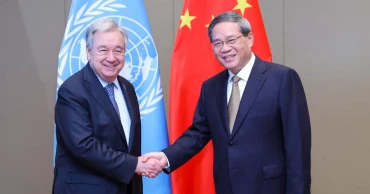
China ready to work with UN to strengthen more just and equitable int'l order: Premier Li
Chinese Premier Li Qiang on Tuesday said that China is ready to further enhance collaboration with the United Nations to jointly promote a more just and equitable international order.
The Premier made the remarks during his meeting with UN Secretary-General Antonio Guterres on the sidelines of the 17th BRICS Summit in Rio de Janeiro, Brazil.
Over the 80 years since its founding, the United Nations has made vital contributions to safeguarding world peace and tranquility while promoting common development, Li said.
Cautioning that the world is facing mounting unstable and uncertain factors, Li said that the UN needs to play a better role.
China stays committed to multilateralism and win-win cooperation: Assistant Foreign Minister Hong Lei
The vision of building a community with a shared future for mankind and the three major global initiatives, proposed by Chinese President Xi Jinping, are highly consistent with the purposes and principles of the UN Charter, as they embody China's steadfast commitment and pragmatic approach to support multilateralism and the work of the UN, stressed Li.
The more complex the international situation becomes, the more necessary it is to uphold the authority of the UN, said Li, stating that China firmly supports the UN's central role in global governance and stands ready to work with all parties to practice true multilateralism and to better advance the UN's work.
As the global security faces grave challenges, China has made extensive efforts to promote dialogue for the political settlement of hotspot issues, and will continue to support the UN in playing its unique role in de-escalating tensions, the premier said.
China opposes trade deals that undermine its interests, says Commerce Ministry
He mentioned that all parties should prioritize development on the international agenda, work together to enhance global development cooperation, allocate resources first and foremost to key areas such as poverty alleviation, education, employment and capacity building, and revitalize the global development partnership.
As a responsible major developing country, China will continue to uphold opening-up, share its opportunities globally, and promote shared development, said Li.
He also emphasized China's support for the United Nations as the primary platform to address gaps in global governance in emerging areas such as artificial intelligence, cyberspace, polar regions, and outer space.
China, EU aim to deepen cooperation on global issues
10 months ago
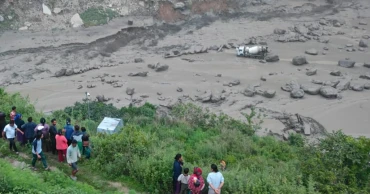
Monsoon floods wash away Nepal-China bridge, 18 missing
Monsoon-swollen floodwaters swept away the main bridge linking Nepal with China on Tuesday, leaving 18 people missing and halting a key trade route, according to Nepali authorities.
The Bhotekoshi River, swollen by heavy rainfall, destroyed the Friendship Bridge at Rasuwagadi, located about 120 kilometers (75 miles) north of the capital, Kathmandu. The flood also swept away several houses and trucks that had been parked at the border for customs inspections. Among the damaged property were hundreds of electric vehicles imported from China.
Rescue operations were underway, with a Nepali Army helicopter evacuating people stranded by the sudden flooding. Police said that 95 rescuers had already reached the site and additional teams were being mobilized.
Monsoon rains and flash floods kill at least 72 in Pakistan
According to the National Disaster Risk Reduction and Management Authority, the 18 missing people include 12 Nepali citizens and six Chinese nationals. The Chinese nationals, along with eight of the Nepalis, were working on a Chinese-assisted construction project on the Nepali side of the border, the Chinese Embassy in Nepal said, as reported by state media.
The destruction of the Friendship Bridge has effectively stopped all trade via this route. With the Rasuwagadi checkpoint out of operation, the only viable alternative involves transporting goods from China to India and then overland into Nepal — a longer and more complex process.
Nepal’s monsoon season, which lasts from June to September, often brings devastating floods that damage infrastructure and threaten lives, particularly in mountainous and border regions.
10 months ago