Europe

Russia shoots down Ukrainian drone near its Engels airbase
The Russian military reported on Monday that it shot down a Ukrainian drone approaching an airbase deep inside Russia, the second time the airbase has been targeted this month, raising questions about the effectiveness of Russia’s air defenses if drones can fly that far into the country.
Russia’s Defense Ministry said the incident took place in the early hours of Monday, and three servicemen were killed by debris at the Engels airbase that houses the Tu-95 and Tu-160 nuclear-capable strategic bombers that have been involved in launching strikes on Ukraine.
Engels is located in Russia’s Saratov region on the Volga river, more than 600 kilometers (more than 370 miles) east of the border with Ukraine.
No damage was inflicted on Russian aircraft, the ministry said.
Read: Some Ukrainians move Christmas to detach again from Russia
It is the second time Engels has been targeted by Ukrainian drones; on Dec. 5, unprecedented drone strikes on Engels and the Dyagilevo base in the Ryazan region in western Russia killed a total of three servicemen and wounded four more. The strikes on the airbases were followed by a massive retaliatory missile barrage in Ukraine that struck homes and buildings and killed civilians.
In Ukraine, the night from Sunday into Monday appeared unusually quiet. For the first time in weeks, the Russian forces didn’t shell the Dnipropetrovsk region, which borders the partially occupied southern regions of Kherson and Zaporizhzhia, its Gov. Valentyn Reznichenko reported on Telegram.
“This is the third quiet night in 5.5 months since the Russians started shelling” the areas around the city of Nikopol, Reznichenko wrote. Nikopol is located across the Dnieper River from the Zaporizhzhia nuclear power plant, which is under control of the Russian forces.
Read: Russia scrubs Mariupol's Ukraine identity, builds on death
Ukrainian-controlled areas of the neighbouring Kherson region were shelled 33 times over the past 24 hours, according to Kherson’s Ukrainian Gov. Yaroslav Yanushevich. There were no casualties.
On Saturday, a deadly attack on the city of Kherson, which was retaken by Kyiv’s forces last month, killed and wounded scores.
3 years ago

Putin claims Moscow ready for Ukraine talks as attacks go on
President Vladimir Putin claimed that Russia is ready for talks to end the war in Ukraine even as the country faced more attacks from Moscow — a clear sign that peace wasn’t imminent.
Putin said in a state television interview, excerpts of which were released on Sunday afternoon that Russia is “prepared to negotiate some acceptable outcomes with all the participants of this process.”
He said that “it’s not us who refuse talks, it’s them” — something the Kremlin has repeatedly stated in recent months as its 10-month old invasion kept losing momentum.
Putin also repeated that Moscow has “no other choice” and said he believed the Kremlin was “acting in the right direction.”
READ: Some Ukrainians move Christmas to detach again from Russia
“We’re defending our national interests, the interests of our citizens, our people,” he said.
Putin’s remarks come as attacks on Ukraine continue. A country-wide air raid alert was announced twice on Sunday alone, and three missiles in the afternoon hit the city of Kramatorsk in the partially occupied Donetsk region, local officials reported.
The missiles hit an industrial area of the city, and there weren’t any casualties, according to the Ukrainian governor of Donetsk, Pavlo Kyrylenko. Kyrylenko said that the city of Avdiivka was also attacked on Sunday with six rounds of shelling, and a woman was wounded there.
Elsewhere in the front-line region, around the city of Bakhmut, where fierce battles have been underway in recent weeks, the Russian forces were struggling to keep up the pace of their offensive, a U.S.-based think tank reported this weekend.
“Russian forces’ rate of advance in the Bakhmut area has likely slowed in recent days, although it is too early to assess whether the Russian offensive to capture Bakhmut has culminated,” the Institute for the Study of War wrote in its recent update.
The think tank cited Russian military bloggers, who it said have recently acknowledged “that Ukrainian forces in the Bakhmut area have managed to slightly slow down the pace of the Russian advance around Bakhmut and its surrounding settlements.”
READ: A Christmas season without its traditional glow in Ukraine
Sources on Ukrainian social media “previously claimed that Ukrainian forces completely pushed Russian forces out of the eastern outskirts of Bakhmut” around Dec. 21, the report added.
“Russian forces will likely struggle to maintain the pace of their offensive operations in the Bakhmut area and may seek to initiate a tactical or operational pause,” the institute concluded.
A day before, a deadly Russian attack on the southern city of Kherson, retaken by Ukrainian forces last month, killed and wounded scores of people.
The Russian forces shelled Ukrainian-held areas of the partially occupied Kherson region 71 times over the past 24 hours, including 41 attacks on the city of Kherson, the region’s Ukrainian governor Yaroslav Yanushevich reported on Sunday.
A total of 16 people have been killed, according to the official, including three emergency workers killed in the process of demining the Berislav district of the region. Yanushevich said that 64 more have been wounded.
In the neighboring Dnipropetrovsk region, the city of Nikopol was shelled overnight from heavy artillery, Gov. Valentyn Reznichenko said. No casualties have been reported.
3 years ago

Some Ukrainians move Christmas to detach again from Russia
Ukrainians usually celebrate Christmas on Jan. 7, as do the Russians. But not this year, or at least not all of them.
Some Orthodox Ukrainians have decided to observe Christmas on Dec. 25, like many Christians around the world. Yes, this has to do with the war, and yes, they have the blessing of their local church.
The idea of commemorating the birth of Jesus in December was considered radical in Ukraine until recently, but Russia’s invasion changed many hearts and minds.
In October, the leadership of the Orthodox Church of Ukraine, which is not aligned with the Russian church and one of two branches of Orthodox Christianity in the country, agreed to allow faithful to celebrate on Dec. 25.
The choice of dates has clear political and religious overtones in a nation with rival Orthodox churches and where slight revisions to rituals can carry potent meaning in a culture war that runs parallel to the shooting war.
Read more: A Christmas season without its traditional glow in Ukraine
For some people, changing dates represents a separation from Russia, its culture, and religion. People in a village on the outskirts of Kyiv voted recently to move up their Christmas observance.
“What began on Feb. 24, the full-scale invasion, is an awakening and an understanding that we can no longer be part of the Russian world,” Olena Paliy, a 33-year-old Bobrytsia resident, said.
The Russian Orthodox Church, which claims sovereignty over Orthodoxy in Ukraine, and some other Eastern Orthodox churches continue to use the ancient Julian calendar. Christmas falls 13 days later on that calendar,, or Jan. 7, than it does on the Gregorian calendar used by most church and secular groups.
The Catholic Church first adopted the modern, more astronomically precise Gregorian calendar in the 16th century, and Protestants and some Orthodox churches have since aligned their own calendars for purposes of calculating Christmas.
The Synod of the Orthodox Church of Ukraine decreed in October that local church rectors could choose the date along with their communities, saying the decision followed years of discussion but also resulted from the circumstances of the war.
In Bobrytsia, some members of the faith promoted the change within the local church, which recently transitioned to being part of the Orthodox Church of Ukraine, with no ties to Russia. When a vote was taken last week, 200 out of 204 people said yes to adopting Dec. 25 as the new day to celebrate Christmas.
“This is a big step because never in our history have we had the same dates of celebration of Christmas in Ukraine with the whole Christian world. All the time we were separated,” said Roman Ivanenko, a local official in Bobrytsia, and one of the promoters of the change. With the switch, he said, they are “breaking this connection” with the Russians.
“The church is Ukrainian, and the holidays are Ukrainian,” said Oleg Shkula, a member of the volunteer territorial defense force in the district that includes the village. For him, his church doesn’t have to be linked to “darkness and gloom and with the anti-christ, which Russia is today.”
Read more: Russia scrubs Mariupol's Ukraine identity, builds on death
In 2019, Ecumenical Patriarch Bartholomew, the spiritual leader of the Eastern Orthodox Church, granted complete independence, or autocephaly, to the Orthodox Church of Ukraine. Ukrainians who favored recognition for a national church in tandem with Ukraine’s political independence from the former Soviet Union had long sought such approval.
The Russian Orthodox Church and its leader, Patriarch Kirill, fiercely protested the move, saying Ukraine was not under the jurisdiction of Bartholomew.
The other major branch of Orthodoxy in the country, the Ukrainian Orthodox Church, remained loyal to Moscow until the outbreak of war. It declared independence in May, though it remains under government scrutiny. That church has traditionally celebrated Christmas on Jan. 7.
3 years ago

Pope on Christmas: Jesus was poor, so don’t be power-hungry
Recalling Jesus’ birth in a stable, Pope Francis rebuked those “ravenous” for wealth and power at the expense of the vulnerable, including children, in a Christmas Eve homily decrying war, poverty and greedy consumerism.
In the splendor of St. Peter’s Basilica, Francis presided over the evening Mass attended by about 7,000 faithful, including tourists and pilgrims, who flocked to the church on a warm evening and took their place behind rows of white-robed pontiffs.
Francis drew lessons from the humility of Jesus’ first hours of life in a manger.
Read more: Bethlehem rebounds from pandemic, lifting Christmas spirits
“While animals feed in their stalls, men and women in our world, in their hunger for wealth and power, consume even their neighbors, their brothers and sisters,” the pontiff lamented. “How many wars have we seen! And in how many places, even today, are human dignity and freedom treated with contempt!”
“As always, the principal victims of this human greed are the weak and the vulnerable,” said Francis, who didn’t cite any specific conflict or situation. “This Christmas, too, as in the case of Jesus, a world ravenous for money, power and pleasure does not make room for the little ones, for the so many unborn, poor and forgotten children,” the pope said, reading his homily with a voice that sounded tired and almost hoarse. “I think above all of the children devoured by war, poverty and injustice.”
Still, the pontiff exhorted people to take heart.
“Do not allow yourself to be overcome by fear, resignation or discouragement.” Jesus’ lying in a manger shows where “the true riches in life are to be found: not in money and power, but in relationships and persons.”
Remarking on the “so much consumerism that has packaged the mystery” of Christmas, Francis said there was a danger the day’s meaning could be forgotten.
But, he said, Christmas focuses attention on “the problem of our humanity — the indifference produced by the greedy rush to possess and consume.”
“Jesus was born poor, lived poor and died poor,” Francis said. “He did not so much talk about poverty as live it, to the very end, for our sake.”
Francis urged people to “not let this Christmas pass without doing something good.”
Read more: A Christmas season without its traditional glow in Ukraine
When the Mass ended, the pope, pushed in a wheelchair by an aide, moved down the basilica with a life-sized statue of Baby Jesus on his lap and flanked by several children carrying bouquets. The statue then was placed in a manger in a creche scene in the basilica. Francis, 86, has been using a wheelchair to navigate long distances due to a painful knee ligament and a cane for shorter distances.
Traditionally, Catholics mark Christmas Eve by attending Mass at midnight. But over the years, the starting time at the Vatican has crept earlier, reflecting the health or stamina of popes and then the pandemic.
Two years ago, the start of Christmas Eve Mass in St. Peter’s Basilica was moved up to 7:30 p.m. to allow faithful to get home before for a nighttime curfew imposed by the Italian government as a measure to combat the COVID-19 pandemic. Although virtually all pandemic-triggered restrictions have long been lifted in Italy, the Vatican kept to the early start time. During Saturday evening’s service, a choir sang hymns. Clusters of potted red poinsettia plants near the altar contrasted with the cream-colored vestments of the pontiff.
On Sunday, tens of thousands of Romans, tourists and pilgrims were expected to crowd into St. Peter’s Square to hear Pope Francis deliver an address on world issues and give his blessing. The speech, known in Latin as “Urbi et Orbi” (to the city and to the world), generally is an occasion to review crises including war, persecution and hunger, in many parts of the globe.
3 years ago

22 dead in fire at illegal shelter in Russia
A fire Saturday at a private shelter in the Siberian city of Kemerovo that was operating illegally killed 22 people, Russian officials said.
Initial reports described the wooden building in the city 3,000 kilometers (1,900 miles) east of Moscow as a nursing home, but the country's Investigative Committee, which probes major crimes, later said it was a “temporary residence for persons in a difficult life situation.”
The committee said a man who rented the building has been arrested and charged with violation of safety regulations resulting in multiple deaths. The committee's statement did not identify him, but news reports said he was a local clergyman.
Read more: 10 dead, including 5 children, in France apartment fire
The cause of the fire that broke out before dawn has not been determined, but the investigative committee said residents told the shelter operator on the day before the fire that the building's coal-fired boiler was malfunctioning.
Six other people were injured in the blaze that destroyed the two-story building.
3 years ago
A Christmas season without its traditional glow in Ukraine
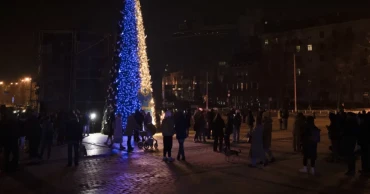
Just a year ago, Sophia Square in Kyiv was all about the big Christmas tree and thousands of lights spreading over the plaza. These final days of 2022, in the middle of a war that has ravaged the country for 10 months, a more modest tree stands there, its blue and yellow lights barely breaking the gloom of the square that is otherwise dark apart from the headlights of cars.
In recent months, Russia has been targeting the energy infrastructure, aiming to cut electricity and heating to Ukrainians, as the freezing winter advances. And although the Ukraine government tries to move as fast as it can, it’s been practically impossible to restore power for every single person in the country, including the more than 3 million residents of the capital.
There are days when streets in Kyiv’s downtown have light, but the authorities have imposed some restrictions and scheduled power cuts, meaning that there’s no traditional gleaming city during the Christmas season.
But even in these gloomy moments, some people have decided to show their determination and rescue whatever they can these holidays — like the Christmas tree, still standing proud even if it doesn’t have the brightness of recent years.
Kyiv’s Mayor, Vitali Klitschko, announced the installation of the Christmas tree, saying it was going to be named the “Tree of Invincibility.”
“We decided that we wouldn’t let Russia steal the celebration of Christmas and New Year from our children,” he said. The name, he added, was “because we Ukrainians cannot be broken.”
Read more: Ukraine president again presses West for advanced weapons
The “Tree of Invincibility” was inaugurated on Dec. 19, the same day that Russia launched a drone attack against Kyiv, but damaged only a power plant that didn’t caused a massive blackout in the city.
Unlike previous years, when along with the tens of thousands of bulbs, Sophia Square was full of music and cheerful people, now the only noise on the plaza is the sound of a generator powering the lights of the 12-meter (40 foot) tree. On top of it, there is no star of Bethlehem’s but instead a trident, Ukraine’s symbol.
Before Kyiv’s government decided to install the tree, there was some debate about whether it was appropriate in a year that brought so many tragedies and horrors. Similar discussions happened all across the country, and some regions decided not have trees.
But now, some people do like the initiative.
“We are grateful that we can see at least something in such times,” said Oleh Skakun, 56, during the unveiling of the tree on Monday.
He said that every Dec. 19, his wife’s birthday, they used to go to see the Christmas tree in the southern city of Kherson, not far from their home. Not this year, because their house, on the left bank of the Dnieper river, is occupied by Russian forces, and they had to flee in August to Kyiv.
But despite their sadness, Skakun said that they wanted to keep the tradition of visiting a Christmas tree.
“Twenty Russians live in my house now; they tortured people, they tortured my son,” said Larysa Skakun, 57. “But we came here to cheer up a bit, to see the people, the celebration”, she added in tears.
Among other cities that also decided to install a Christmas tree is Kharkiv, Ukraine’s second-largest city that for months was on the edges of the front line and constantly attacked by Russian missiles. There, instead of placing it on a square, it has been erected inside the main subway station.
But for some Ukrainians, it’s hard to celebrate anything this Christmas.
Read more: Putin in Belarus, eyeing next steps in Ukraine war
Anna Holovina, 27, came to Sophia Square to see the tree, but said that she keeps thinking of her hometown in the Luhansk region, occupied by Russian forces since 2014.
“I feel sadness. I feel pain. I don’t feel the holiday at all,” she said. “My family is in Kyiv, but my hometown has been occupied for the eighth year now.”
3 years ago

3 dead in Paris shooting; suspect arrested
A shooting targeting a Kurdish cultural center in a bustling Paris neighborhood Friday left three people dead and three others wounded, authorities said. A 69-year-old suspect was wounded and arrested.
The Paris prosecutor said the suspect had recently been released from prison after attacking migrants living in tents, and that investigators are considering a possible racist motive for the shooting.
Skirmishes erupted in the neighborhood a few hours after the shooting, as members of the Kurdish community shouted slogans against the Turkish government, and police fired tear gas to disperse the increasingly agitated crowd. Some garbage bins were set on fire.
The tensions occurred as Interior Minister Gerald Darmanin was speaking to reporters nearby. Darmanin said the attacker was clearly targeting foreigners, but that police don’t have evidence at this stage that he was specifically aiming to hurt Kurds. Darmanin is holding a special meeting Friday night to assess threats targeting the Kurdish community in France.
Shocked members of the Kurdish community in Paris said they had been recently warned by police of threats to Kurdish targets, and demanded justice after the shooting.
Nearby residents and merchants were deeply rattled by the attack, which came as Paris is buzzing with festive activity before the Christmas weekend.
The shooting occurred at midday at a Kurdish cultural center and a restaurant and hairdresser nearby, according to the mayor for the 10th arrondissement, Alexandra Cordebard.
As she spoke, a crowd nearby chanted, “Erdogan, terrorist” — referring to Turkish President Recep Tayyip Erdoğan — and “Turkish state, assassin.”
A construction worker who was on a job nearby described seeing the assailant go first to the cultural center, then to the restaurant and then the hairdresser. The construction worker told The Associated Press that he saw the assailant injure three people, then two passersby intervened and stopped the attacker.
The worker, who spoke on condition his name not be published because he was concerned for his security, described the attacker as silent and calm as he wielded a small-caliber pistol.
Police cordoned off the area in the 10th arrondissement of the French capital, on a busy street with shops and restaurants near the Gare de l’Est train station.
Paris Prosecutor Laure Beccuau said three people hit in the shooting have died, one is in critical condition and two others are hospitalized with less serious injuries. The attacker was also wounded in the face, she said.
She said anti-terrorism prosecutors are in contact with investigators, but haven’t indicated any sign of a terrorist motive.
The prosecutor said the suspect had at least two prior run-ins with police: the attack on migrants in tents in eastern Paris in 2021, and a recent conviction in another case in a Paris suburb. She didn’t elaborate on details of either case.
The attacker attended a shooting range in a sports club, and had several registered weapons, Darmanin said. He added that the attacker is French and was not on any radicalism watch lists, or known for involvement in any extreme-right or other political movements.
In the attack on migrants, the suspect wielded a saber and wounded some people in a makeshift camp, said Yann Manzi of aid group Utopia 54.
He lamented the suspect’s recent release, as did Kurds who gathered at the scene of Friday’s shooting.
“We do not at all feel protected in Paris,” activist Murat Roni told The AP. “We don’t feel defended by the French justice system.” “It’s clearly the Kurds who were targeted.”
He described the cultural center “like the embassy for Kurds in Paris,” a gathering place for cultural events, political discussion, assistance with immigration procedures, “a house where all Kurds get together.”
In 2013, three women Kurdish activists, including Sakine Cansiz — a founder of the Kurdistan Workers’ Party, or PKK — were found shot dead at a Kurdish center in Paris. A Turkish citizen was charged with their killing, although suspicion also fell on the Turkish intelligence service.
Turkey’s army has been battling against Kurdish militants affiliated with the banned PKK, in southeast Turkey as well as in northern Iraq. Turkey’s military has also recently launched a series of strikes from the air and with artillery against Syrian Kurdish militant targets in northern Syria. The PKK is considered a terrorist organization in Turkey, Europe and the United States, and has led an armed insurgency against the Turkish state since 1984.
France was hit by a string of deadly attacks by Islamic extremists in 2015-2016 and remains on alert for terrorism-related violence.
3 years ago

Zelenskyy thanks 'every American,' sees 'turning point'
Ukraine’s Volodymyr Zelenskyy told cheering U.S. legislators during a defiant wartime visit to the nation’s capital on Wednesday that against all odds his country still stands, thanking Americans for helping to fund the war effort with money that is “not charity,” but an “investment” in global security and democracy.
The whirlwind stop in Washington — his first known trip outside his country since Russia invaded in February — was aimed at reinvigorating support for his country in the U.S. and around the world at a time when there is concern that allies are growing weary of the costly war and its disruption to global food and energy supplies.
Zelenskyy called the tens of billions of dollars in U.S. military and economic assistance provided over the past year vital to Ukraine’s efforts to beat back Russia and appealed for even more in the future.
Read more: Russia scrubs Mariupol's Ukraine identity, builds on death
“Your money is not charity,” he sought to reassure both those in the room and those watching at home. “It’s an investment in the global security and democracy that we handle in the most responsible way.”
Just before his arrival, the U.S. announced a new $1.8 billion military aid package, including for the first time Patriot surface-to-air missiles. And Congress planned to vote this week on a fresh spending package that includes about $45 billion in additional emergency assistance to Ukraine.
The speech to Congress came after President Joe Biden hosted Zelenskyy in the Oval Office for strategy consultations, saying the U.S. and Ukraine would maintain their “united defense” as Russia wages a “brutal assault on Ukraine’s right to exist as a nation.” Biden pledged to help bring about a “just peace.”
Zelenskyy told Biden that he had wanted to visit sooner and his visit now demonstrates that the “situation is under control, because of your support.”
The highly sensitive trip came after 10 months of a brutal war that has seen tens of thousands of casualties on both sides and devastation for Ukrainian civilians.
Zelenskyy traveled to Washington aboard a U.S. Air Force jet. The visit had been long sought by both sides, but the right conditions only came together in the last 10 days, U.S. officials said, after high-level discussions about the security both of Zelenskyy and of his people while he was outside of Ukraine. Zelenskyy spent less than 10 hours in Washington before beginning the journey back to Ukraine.
In his remarks to lawmakers, Zelenskky harked back to U.S. victories in the Battle of the Bulge, a turning point against Nazi Germany in World War II, and the Revolutionary War Battle of Saratoga, an American victory that helped draw France’s aid for U.S. independence. The Ukrainian leader predicted that next year would be a “turning point” in the conflict, “when Ukrainian courage and American resolve must guarantee the future of our common freedom — the freedom of people who stand for their values.”
Zelenskyy received thunderous applause from members of Congress and presented lawmakers with a Ukrainian flag autographed by front-line troops in Bakhmut, in Ukraine’s contested Donetsk province. The flag was displayed behind him on the rostrum by House Speaker Nancy Pelosi and Vice President Kamala Harris. Pelosi, in turn, presented Zelenskyy with an American flag that had flown over the Capitol that day, and Zelenskyy pumped it up and down as he exited the chamber.
Declaring in his speech that Ukraine “will never surrender,” Zelenskyy warned that the stakes of the conflict were greater than just the fate of his nation — that democracy worldwide is being tested.
“This battle cannot be ignored, hoping that the ocean or something else will provide protection,” he said, speaking in English for what he had billed as a “speech to Americans.”
Read more: Russia warns increasing supply of US arms to Ukraine will aggravate war
Earlier, in a joint news conference with Biden, Zelenskyy was pressed on how Ukraine would try to bring an end to the conflict. He rejected Biden’s framing of finding a “just peace,” saying, “For me as a president, ‘just peace’ is no compromises.” He said the war would end once Ukraine’s sovereignty, freedom and territorial integrity were restored, and Russia had paid back Ukraine for all the damage inflicted by its forces.
“There can’t be any ‘just peace’ in the war that was imposed on us,” he added.
Biden, for his part, said Russia was “trying to use winter as a weapon, but Ukrainian people continue to inspire the world." During the news conference, he said Russian President Vladimir Putin had “no intention of stopping this cruel war.”
The two leaders appeared to share a warm rapport, laughing at each other's comments and patting each other on the back throughout the visit, though Zelenskyy made clear he will continue to press Biden and other Western leaders for ever more support.
He said that after the Patriot system was up and running, “we will send another signal to President Biden that we would like to get more Patriots."
“We are in the war," Zelenskyy added with a smile, as Biden chuckled at the direct request. “I’m sorry. I’m really sorry."
Biden told Zelenskyy that it was “important for the American people, and for the world, to hear directly from you, Mr. President, about Ukraine’s fight, and the need to continue to stand together through 2023."
Zelenskyy had headed to Washington after making a daring and dangerous trip Tuesday to what he called the hottest spot on the 1,300-kilometer (800-mile) front line of the war, the city of Bakhmut.
Poland’s private broadcaster, TVN24, said Zelenskyy crossed into Poland early Wednesday on his way to Washington. The station showed footage of what appeared to be Zelenskyy arriving at a train station and being escorted to a motorcade of American SUVs. TVN24 said the video, partially blurred for security reasons, was shot in Przemysl, a Polish border town that has been the arrival point for many refugees fleeing the war.
Read more: Zelenskyy to meet Biden, address Congress as war rages on
Officials, citing security concerns, were cagey about Zelenskyy's travel plans, but a U.S. official confirmed that Zelenskyy arrived on a U.S. Air Force jet that landed at Joint Base Andrews, just outside the capital, from the Polish city of Rzeszow.
Biden told Zelenskyy, who wore a combat-green sweatshirt and boots, that ”it’s an honor to be by your side.”
U.S. and Ukrainian officials have made clear they do not envision an imminent resolution to the war and are preparing for fighting to continue for some time. The latest infusion of U.S. money would be the biggest yet — and exceed Biden’s $37 billion request.
Biden repeated that while the U.S. will arm and train Ukraine, American forces will not be directly engaged in the war.
The latest U.S. military aid package includes not only a Patriot missile battery but precision guided bombs for fighter jets, U.S. officials said. It represents an expansion in the kinds of advanced weaponry intended to bolster Ukraine's air defenses against what has been an increasing barrage of Russian missiles.
Russia’s Foreign Ministry has said the delivery of the advanced surface-to-air missile system would be considered a provocative step and that the system and any crews accompanying it would be a legitimate target for Moscow’s military.
“It’s a defensive system," Biden said of sending the missile system. "It’s not escalatory — it’s defensive.”
The visit comes at an important moment, with the White House bracing for greater resistance when Republicans take control of the House in January and give more scrutiny to aid for Ukraine. GOP leader Kevin McCarthy of California has said his party will not write a “blank check” for Ukraine.
Zelenskky appeared well aware of political divisions in the U.S. over prolonged overseas spending, and called on the House and Senate lawmakers to ensure American leadership remains “bicameral and bipartisan.”
Senate Majority Leader Chuck Schumer opened the chamber's session on Wednesday by saying that passage of the aid package and confirmation of the new U.S. ambassador to Russia, Lynne M. Tracy, would send a strong signal that Americans stand “unequivocally” with Ukraine. Tracy was confirmed later on a 93-2 vote.
The Senate's top Republican, Kentucky Sen. Mitch McConnell, said “the most basic reasons for continuing to help Ukraine degrade and defeat the Russian invaders are cold, hard, practical American interests.” He said "defeating Russia’s aggression will help prevent further security crises in Europe."
Russia’s invasion, which began Feb. 24, has lost momentum. The illegally annexed provinces of Donetsk, Kherson, Luhansk and Zaporizhzhia remain fiercely contested.
With the fighting in the east at a stalemate, Moscow has used missiles and drones to attack Ukraine’s power equipment, hoping to leave people without electricity as freezing weather sets in.
3 years ago

Russia scrubs Mariupol's Ukraine identity, builds on death
Throughout Mariupol, Russian workers are tearing down bombed-out buildings at a rate of at least one a day, hauling away shattered bodies with the debris.
Russian military convoys are rumbling down the broad avenues of what is swiftly becoming a garrison city, and Russian soldiers, builders, administrators and doctors are replacing the tens of thousands of Ukrainians who have died or left.
Many of the city’s Ukrainian street names are reverting to Soviet ones, with the Avenue of Peace that cuts through Mariupol to be labeled Lenin Avenue. Even the large sign that announces the name of the city at its entrance has been Russified, repainted with the red, white and blue of the Russian flag and the Russian spelling.
Eight months after Mariupol fell into Russian hands, Russia is eradicating all vestiges of Ukraine from it – along with the evidence of war crimes buried in its buildings, such as the famed Drama Theater where demolition started Thursday. The few open schools teach a Russian curriculum, phone and television networks are Russian, the Ukrainian currency is dying out, and Mariupol is now in the Moscow time zone. On the ruins of the old Mariupol, a new Russian city is rising, with materials from at least one European company, The Associated Press found.
But the AP investigation into life in occupied Mariupol also underlines what its residents already know all too well: No matter what the Russians do, they are building upon a city of death. More than 10,000 new graves now scar Mariupol, the AP found, and the death toll might run three times higher than an early estimate of at least 25,000. The former Ukrainian city has also hollowed out, with Russian plans to demolish well over 50,000 homes, the AP calculated.
Associated Press journalists were the last international media in Mariupol to escape heavy shelling in March, before Russian forces took the city over. This is the story of what has happened since. AP reconnected with many people whose tragedies were captured in photos and video during the deadliest days of the Russian siege.
Death surrounds Mariupol in the rapidly growing cemeteries on its outskirts, and its stench lingered over the city into the autumn. It haunts the memories of survivors, both in Mariupol and in exile.
Every one of the dozens of residents the AP spoke with knew someone killed during the siege of Mariupol, which began with the Feb. 24 invasion. As many as 30 people arrive at the morgue each day in hopes of tracking down a loved one.
Lydya Erashova watched her 5-year-old son Artem and her 7-year-old niece Angelina die after a Russian shelling in March. The family hastily buried the young cousins in a makeshift grave in a yard and fled Mariupol.
They returned in July to rebury the children, only to learn while on the road that the bodies had already been dug up and taken to a warehouse. As they approached the city center, each block was bleaker than the last.
“It is horror. Wherever you look, whichever way you look,” said Erashova. “Everything is black, is destroyed.”
Neither she nor her sister-in-law could bear to go inside the warehouse to identify the bodies of their children. Their husbands, who are brothers, chose the tiny coffins – one pink and one blue – to be placed together in a single grave.
Erashova, who is now in Canada, said no Russian rebuilding plan could possibly bring back what Mariupol lost.
“Our lives have been taken from us. Our child was taken from us,” she said. “It’s so ridiculous and stupid. How do you restore a dead city where people were killed at every turn?”
Read more: Russia warns increasing supply of US arms to Ukraine will aggravate war
RECKONING WITH DEATH
The AP investigation drew on interviews with 30 residents from Mariupol, including 13 living under Russian occupation; satellite imagery; hundreds of videos gathered from inside the city, and Russian documents showing a master plan. Taken together, they chronicle a comprehensive effort to suppress Mariupol’s collective history and memory as a Ukrainian city.
Mariupol was in the crosshairs of the Kremlin from the first day of the invasion. Just 40 kilometers (25 miles) from the Russian border, the city is a port on the Sea of Azov and crucial for Russian supply lines.
The city was hit relentlessly with airstrikes and artillery, its communications severed, its food and water cut off. Yet Mariupol refused to give in for 86 days. By the time the last Ukrainian fighters holed up in the Azovstal steel mill surrendered in May, Mariupol had become a symbol of Ukrainian resistance.
That resistance came at a high price. The thoroughness of Russia’s destruction of Mariupol can still be seen today. Videos taken across the city and satellite images show that munitions have left their mark on nearly every building across its 166 square kilometers (64 square miles).
Large swaths of the city are devoid of color and life, with fire-blackened walls, grey demolition dust and dead trees with shredded foliage. But the worst destruction Mariupol suffered may be measured in its death toll, which will never be fully known.
An AP analysis of satellite imagery taken over the past eight months of occupation shows 8,500 new graves in the outlying Staryi Krym cemetery alone, with possibly multiple bodies beneath each mound. There are at least three other trench gravesites around the city, including one created by Ukrainians themselves at the beginning of the siege.
In all, a total at least 10,300 new graves are scattered around Mariupol, according to AP’s methodology, confirmed by three forensic pathologists with expertise in mass graves. Thousands more bodies likely never even made it to the graveyard.
Back in May, when the city finally fell, the municipal government in exile estimated 25,000 people at a minimum had died. But at least three people in the city since June say the number killed is triple that or more, based on conversations with workers documenting body collection from the streets for the Russian occupation authorities.
Svitlana Chebotareva, a Mariupol resident who fled in March, said her neighbor died in a flat nearby, and the body is still there. Chebotareva returned home this autumn for just long enough to retrieve her belongings, since residents are free to come and go so long as they pass checkpoints. She said the Russians expect gratitude with their offer of a few new apartments.
“I don’t know how it’s possible now to give us ‘candies’ in exchange for destroyed homes and killed people,” she said in Kyiv. “As if there’s something to believe in.”
ERASING A UKRAINIAN CITYThe notices are taped to peeling, pockmarked walls by the entry, and addressed to “DEAR RESIDENTS.”
This is how those who remained in Mariupol learn their buildings are scheduled for imminent demolition. Often, despite shattered windows, frozen pipes and no electricity, they are still living inside because they have nowhere else to go.
In a review of hundreds of photos and video clips along with documents from occupation authorities, the AP found that more than 300 buildings in Mariupol have been or are about to be demolished. Some are individual homes, but most are multistory apartment blocks in the khrushchyovka style, launched by Soviet leader Nikita Khrushchev in a housing crisis in the 1960s. With around 180 apartments inside or more, each building was designed to house as many families as possible.
That means in all, the demolitions will remove well over 50,000 homes, according to AP calculations.
“There is no discussion, people aren’t prepared,” said an activist in Mariupol, who like all inside Mariupol requested anonymity for fear of retribution. “People still live in the basements. Where they can go is unclear.”
Only Russians handle the debris itself, according to another resident still in the city who works on the sites. The stated reason is to avoid accidents, he said.
But Petro Andryushchenko, an aide to Mariupol’s mayor who is exiled in Dnipro, believes the real reason is to ensure that people don’t see the rotting corpses being hauled away. He said many of the buildings, especially in the neighborhood around Azovstal , contain 50 to 100 bodies each that will never get a decent burial. Those deaths will go unrecorded.
110 Mytropolytska is one of the buildings on Russia’s demolition list, scheduled to come down any day.
The smell of fresh-baked bread still brings Inna Nepomnyshaya, a doctor, back to her last night in March in her sixth-floor apartment there. When she saw the street price of bread in her besieged city, she decided to bake her own.
The smell warmed the air the next morning when her son-in-law arrived. It was time to leave, he insisted. Russian forces were closing in.
Nepomnyshaya was at her daughter’s building when Russian tanks rolled up to her own at dusk on March 11. As AP journalists watched and recorded from the upper floor of nearby Hospital No. 2, one tank raised its gun at 110 Mytropolytska and fired.
The shell shattered the walls of Nepomnyshaya’s apartment and obliterated those of the neighbors above, below and behind her. Most of the neighbors were huddled in the basement, but two elderly women, Lydya and Nataliya, couldn’t make the trip up and down the stairs.
Their bodies would be buried in the courtyard soon after. Weeks later, AP video showed the rough graves still there.
With communications to the city cut, Nepomnyshaya did not learn of the fate of her apartment until her family had escaped to Ukrainian-held territory. Like many who left Mariupol, she still speaks of the city in the present tense.
“I live in Mariupol, this is my home,” she said, speaking by candlelight in a café in Dnipro, another city that had lost power. “This house was my fortress, and they took it away from me.”
Also on the demolition list are the buildings on either side. One was hit by at least one airstrike on March 11; the walls of another are in ruins.
Russia is now moving into the historic city center. Russian authorities in October dismantled Mariupol’s memorial to victims of the Holodomor, the Soviet-engineered famine in the 1930s that killed millions of Ukrainians, according to video posted on Russian television. They also painted over two murals commemorating victims of Russia’s 2014 attack on Ukraine, images obtained by the AP show.
“They spend an inordinate amount of time focusing on things like erasing demonstrations of Ukrainian identity and very little time tending to the needs of the Mariupol people,” said Michael Carpenter, U.S. ambassador to the Organization for Security and Cooperation in Europe, which for years monitored eastern Ukraine. “It’s really a very brutal inhuman colonial experiment unfolding before our eyes.”
Read more: Russian military to reach 1.5M; Putin vows to win in Ukraine
BUILDING A RUSSIAN CITY
As it tries to raze the remains of Ukraine, Russia has laid out a plan for a new city with a new population. At its heart will lie the historic Mariupol theater, according to the master plan first reported by the Russian site The Village in August and seen by The Associated Press.
The majestic Drama Theater became the city’s main bomb shelter until twin Russian airstrikes hit on March 16. Hundreds died, an AP investigation found, and residents said the site reeked of bodies all summer. To mask the ruins, Russian authorities put up a screen so tall it can be seen from space, etching the theater’s outline on the paneling in a ghostly reminder of its previous life.
On Thursday, the theater itself fell victim to the demolition campaign, according to video from the city seen by The Associated Press.
Also in the Russian documents are plans to restore the ruins of the obliterated Azovstal steel mill, the last Ukrainian holdout. The site is slated to be transformed into an industrial park by the end of next year, though there are no signs that any work has begun.
But a Russian military compound went up in record time, according to satellite imagery from Maxar Technologies that showed the vast U-shaped building with the Russian Army slogan emblazoned on the rooftop.
Russia already has constructed at least 14 new apartment buildings — a small fraction of the number coming down — and is repairing at least two of the hospitals it damaged by shelling. Video obtained by The Associated Press showed rows of pallets stacked with insulation from the Danish company Rockwool, which maintains its division in Russia despite criticism. Construction materials are not subject to sanctions.
In a statement, Rockwool’s Vice President of Communications Michael Zarin said the insulation panels were distributed without the company’s “knowledge or consent,” and that he hopes its products help restore health care, warmth and shelter to Ukrainians.
Videos show no furniture visible in the windows of the new apartments and few people on the sidewalks outside. Only pensioners, the disabled and those affiliated with the occupation seem to be getting them, according to multiple people still in Mariupol.
One man applied to the list in September and found himself in 11,700th place. He has friends in the 2,000 range who are still waiting, like him. And an old man he knows, whose number was in the 9,000s has already moved into one of the new buildings.
“I don’t know how it happens. I won’t speculate,” he said.
However, the man said he has no issue with the demolition of buildings that aren’t fit to live in. He is cautiously relaunching his own company in the new city.
But the plans for a Russian Mariupol depend on a population that simply no longer exists.
Thousands of Mariupol’s former residents were sent to Russia with little or no choice, and thousands more fled into other areas of Ukraine. Of Mariupol’s former population of around 425,000, just over a quarter stayed, according to estimates from Andryushchenko.
The Russian master plan for Mariupol calls for a population of 212,000 in 2022, and back to 425,000 by 2030. Right now, about 15,000 of the people in Mariupol people are Russian troops, said Andryushchenko, who drew his estimate from information about the soldiers taking over homes and public buildings. He said Russian riot police have begun patrolling the city to head off protests over the lack of heat, electricity and water.
Videos seen by the AP showed military convoys, along with construction trucks, clogging the streets. The activist the AP spoke with also confirmed an increase in the number of soldiers since Russian forces retreated from the Kharkiv and Kherson regions.
Construction workers from Russia show no signs of leaving, and tents were visible outside the Port City mall until the winter. Doctors and city administrators also have come in from Russia, according to Russian government announcements and physicians who left the city after refusing to work for the occupation authorities.
“There is no more Russian city now than Mariupol,” Dmitry Sablin, a Russian lawmaker born in Mariupol, said in an interview with Russian media in June after visiting the city.
The Kremlin is moving as swiftly as it can to ensure that those Ukrainians who stay see their future as Russians.
On Nov. 15, Russian President Vladimir Putin awarded Mariupol the title of “City of Military Glory” for the heroism of people he described as its defenders. On Dec. 7, Putin said his war against Ukraine had turned the Sea of Azov into “Russia’s internal sea.”
This suits many of those who remained behind just fine. Mariupol has always had some residents who considered themselves Russian.
“Whoever doesn’t like it, doesn’t come back,” one woman said.
Read more: Wartime Ukraine erasing Russian past from public spaces
NO FUTURE IN SIGHT
Russia’s occupation of Mariupol has divided families and friends into two categories: Those who stayed and those who fled. Both grapple with what Mariupol once was and will be.
When Ivan Kalinin escaped, he left behind the body of his wife Iryna and their unborn first child, both killed in the March 9 Russian airstrike on the maternity hospital. His parents and hers stayed in Mariupol.
He last saw his wife that morning when her labor began, and she sent him to fetch clothes and diapers. He learned about the airstrike at a military blockade on the way to the hospital. He and his father found her body the next day at another hospital.
“I do not even know how I survived it,” he said quietly. “I was drinking every day to fall asleep.”
Kalinin, who now lives in Wales, cannot imagine going home. Nor can he imagine life anywhere else.
“It is too painful for me to be there. I might return at some point — it is my hometown, after all,” he said. “I fall asleep every day hoping this is a dream. And I wake up with understanding that it is a reality.”
Mariupol is now torn between Russia and Ukraine. Some people who stayed are waiting for Russian citizenship just to get on with their lives. Yet the Ukrainian letter ï , which is not found in Russian, is appearing as graffiti around the city — a small act of defiance in a place many described as full of fear.
Nepomnyshaya, whose apartment was struck by a Russian shell, dreamed recently that she’d returned home and smelled bread. But she is not sure if she ever can or will go back.
“I believe that Mariupol will be rebuilt, that it will be Ukraine after all,” she said. “But I know that this smell is just a memory.”
3 years ago
Russia warns increasing supply of US arms to Ukraine will aggravate war
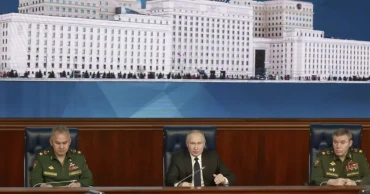
The Kremlin warned Wednesday that increasing the supply of U.S. arms to Ukraine would aggravate the devastating 10-month war ignited by Russia’s invasion, and Russia’s defense minister called for expanding Moscow’s military by at least 500,000 troops.
Speaking during a meeting with his top military brass, Russian President Vladimir Putin said Moscow would use lessons learned in the conflict to “develop our armed forces and strengthen the capability of our troops.” He said special emphasis would go to developing nuclear forces, which he described as “the main guarantee of Russia’s sovereignty.”
Putin also said the Russian military’s new Sarmat intercontinental ballistic missile would enter service shortly. The Sarmat is intended to replace aging Soviet-built ballistic missiles and form the core of Russia’s nuclear forces. Putin has hailed its capacity to dodge missile defenses.
The bullish rhetoric from Moscow came as Ukrainian President Volodymyr Zelenskyy met with President Joe Biden in Washington, where U.S. officials announced a huge new military aid package for Kyiv. The $1.8 billion package includes for the first time a Patriot missile battery and precision guided bombs for fighter jets, U.S. officials said.
Defense Minister Sergei Shoigu said the beefed-up Russian military will include 695,000 volunteer contract soldiers, 521,000 of whom would be recruited by the end of 2023. The Russian military had about 400,000 contract soldiers as part of its 1 million-member military before the fighting in Ukraine began.
All Russian men ages 18 to 27 are obliged to serve in the military for one year, but many use college deferments and health exemptions to avoid the draft. Shoigu said the draft age range would be changed to 21- to 30-years-old, and the recruits would be offered a choice of serving for one year as draftees or signing a contract with the military as volunteers.
He also said Russia would form new units in the country’s west in view of ambitions by Finland and Sweden to join NATO.
The Kremlin’s plans marked a return to the Soviet-era military structure, which Russia abandoned during recent reforms that saw the creation of smaller units. Some Russian military experts have argued the more compact units intended for use in local conflicts were undermanned and underequipped for a massive conflict like the action in Ukraine.
Kremlin spokesman Dmitry Peskov said the expansion of Western weapon supplies to Ukraine has led to “an aggravation of the conflict and, in fact, does not bode well for Ukraine.”
Peskov’s comments were the first official Russian reaction to news that Zelenskyy was in Washington for his first known foreign trip since Russia’s Feb. 24 invasion triggered the war that has killed thousands and laid waste to towns and cities across Ukraine.
The announcement of the new U.S. military aid came just hours before Zelenskyy paid a visit to the White House to thank U.S. leaders and “ordinary Americans” for their support in fighting off the invaders and to press for continued aid.
Read more: Russia-Ukraine War: US estimates 200,000 military deaths, injuries on both sides
Biden said the U.S. and Ukraine would continue to project a “united defense” as Russia wages a “brutal assault on Ukraine’s right to exist as a nation.”
Later, in a historic address to Congress aimed at sustaining U.S. and allied aid for Ukraine’s defense, Zelenskyy thanked “every American” for their support of his country.
Zelenskyy called U.S. support vital to Ukraine’s efforts to beat back Russia, and thanked lawmakers and everyday citizens for tens of billions of dollars in military and economic assistance over the last year.
The Ukrainian leader predicted that next year would be a “turning point” in the conflict, “when Ukrainian courage and American resolve must guarantee the future of our common freedom — the freedom of people who stand for their values.”
Moscow also was involved in high-level diplomacy. The deputy head of Russia’s Security Council, Dmitry Medvedev, met Wednesday with Chinese President Xi Jinping. Medvedev, a former Russian president, said in a video statement that he and Xi discussed an array of topics, including “the conflict in Ukraine.” Medvedev did not elaborate.
China has refused to condemn Russia’s invasion of Ukraine and criticized sanctions against Moscow. Beijing has only referred to the invasion as the “Ukraine situation” in deference to Moscow, and accused the U.S. and NATO of provoking Putin by expanding into eastern Europe.
In other developments Wednesday, Dmitry Rogozin, the former Russian deputy prime minister and one-time head of the state space agency Roscosmos, was wounded during Ukrainian shelling of a hotel in the Russian-controlled city of Donetsk.
Rogozin, who joined the Russian troops in Ukraine as a volunteer, told Russian state-controlled RT that a shell fragment missed his spine by just a centimeter (0.4 inches). Russian news agencies quoted Rogozin’s aide as saying that he was hospitalized, but his life wasn’t in danger.
Russian messaging app channels said Rogozin was celebrating his birthday at a restaurant when it was hit. Several other people, including the Moscow-appointed head of the regional government in Donetsk, were also wounded.
Russia annexed the Donetsk region along with three other regions of Ukraine in September.
Elsewhere, Russian forces pounded populated areas with more missiles and artillery. They shelled areas around the city of Nikopol in Ukraine’s southeastern Dnipropetrovsk region, its governor, Valentyn Reznichenko, said Wednesday on Telegram.
Nikopol is across the Dnieper River from the Zaporizhzhia Nuclear Power Plant. Russian forces currently occupy the plant, Europe’s largest nuclear power station.
The Ukrainian president’s office reported Wednesday that Russian attacks on Tuesday killed five civilians and wounded 17. The General Staff of the Armed Forces of Ukraine said Russia unleashed five missiles and 16 airstrikes on Ukrainian territory and 61 attacks from multiple-launch rocket systems.
General Staff spokesperson Oleksandr Shtupun said Ukrainian forces repelled attacks around more than 25 populated areas in eastern Ukraine’s Kharkiv, Donetsk and Luhansk provinces, with the cities of Bakhmut and Avdiivka continuing to be key targets of Russia’s grinding offensive.
The bodies of seven civilians, including a teenage girl, were found in a mass grave in the village of Pravdyne in southern Ukraine’s Kherson province, the Ukrainian defense minister said Wednesday. The village was held by Russian forces from March until early November.
Read more: Impact of Russia-Ukraine War on Asia’s climate goals
“They simply kill,” Oleksii Reznikov wrote on Twitter. He said that as, of Dec. 21, the bodies of about 500 civilians who died during the Russian occupation have been found in the country’s northeastern Kharkiv province.
3 years ago