europe
Why Greenland? Remote but resource-rich island occupies a key position in a warming world
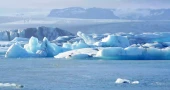
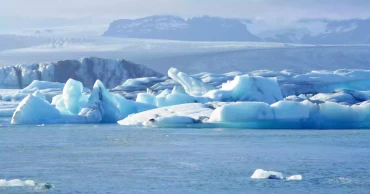
Remote, icy and mostly pristine, Greenland plays an outsized role in the daily weather experienced by billions of people and in the climate changes taking shape all over the planet.
Greenland is where climate change, scarce resources, tense geopolitics and new trade patterns all intersect, said Ohio University security and environment professor Geoff Dabelko.
The world's largest island is now "central to the geopolitical, geoeconomic competition in many ways," partly because of climate change, Dabelko said.
Since his first term in office, President-elect Donald Trump has expressed interest in acquiring Greenland, which is a semiautonomous territory of Denmark, a longtime U.S. ally and a founding member of NATO. It is also home to a large U.S. military base.
Why is Greenland coveted?
Think of Greenland as an open refrigerator door or thermostat for a warming world, and it's in a region that is warming four times faster than the rest of the globe, said New York University climate scientist David Holland.
Locked inside are valuable rare earth minerals needed for telecommunications, as well as uranium, billions of untapped barrels of oil and a vast supply of natural gas that used to be inaccessible but is becoming less so.
Many of the same minerals are currently being supplied mostly by China, so other countries such as the United States are interested, Dabelko said. Three years ago, the Denmark government suspended oil development offshore from the territory of 57,000 people.
But more than the oil, gas or minerals, there's ice — a "ridiculous” amount, said climate scientist Eric Rignot of the University of California, Irvine.
If that ice melts, it would reshape coastlines across the globe and potentially shift weather patterns in such a dramatic manner that the threat was the basis of a Hollywood disaster movie. Greenland holds enough ice that if it all melts, the world's seas would rise by 24 feet (7.4 meters). Nearly a foot of that is so-called zombie ice, already doomed to melt no matter what happens, a 2022 study found.
Since 1992, Greenland has lost about 182 billion tons (169 billion metric tons) of ice each year, with losses hitting 489 billion tons a year (444 billion metric tons) in 2019.
Greenland will be “a key focus point” through the 21st century because of the effect its melting ice sheet will have on sea levels, said Mark Serreze, director of the National Snow and Ice Data Center in Boulder, Colorado. "It will likely become a bigger contributor in the future.”
That impact is “perhaps unstoppable,” NYU's Holland said.
Are other climate factors at play?
Greenland also serves as the engine and on/off switch for a key ocean current that influences Earth's climate in many ways, including hurricane and winter storm activity. It's called the Atlantic Meridional Overturning Circulation, or AMOC, and it's slowing down because more fresh water is being dumped into the ocean by melting ice in Greenland, Serreze said.
A shutdown of the AMOC conveyor belt is a much-feared climate tipping point that could plunge Europe and parts of North America into prolonged freezes, a scenario depicted in the 2004 movie “The Day After Tomorrow.”
“If this global current system were to slow substantially or even collapse altogether — as we know it has done in the past — normal temperature and precipitation patterns around the globe would change drastically,” said climate scientist Jennifer Francis of the Woodwell Climate Research Center. “Agriculture would be derailed, ecosystems would crash, and ‘normal’ weather would be a thing of the past.”
Greenland is also changing color as it melts from the white of ice, which reflects sunlight, heat and energy away from the planet, to the blue and green of the ocean and land, which absorb much more energy, Holland said.
Greenland plays a role in the dramatic freeze that two-thirds of the United States is currently experiencing. And back in 2012, weather patterns over Greenland helped steer Superstorm Sandy into New York and New Jersey, according to winter weather expert Judah Cohen of the private firm Atmospheric and Environmental Research.
Because of Greenland's mountains of ice, it also changes patterns in the jet stream, which brings storms across the globe and dictates daily weather. Often, especially in winter, a blocking system of high pressure off Greenland causes Arctic air to plunge to the west and east, smacking North America and Europe, Cohen said.
Why is Greenland's location so important?
Because it straddles the Arctic circle between the United States, Russia and Europe, Greenland is a geopolitical prize that the U.S. and others have eyed for more than 150 years. It's even more valuable as the Arctic opens up more to shipping and trade.
None of that takes into consideration the unique look of the ice-covered island that has some of the Earth's oldest rocks.
“I see it as insanely beautiful. It's eye-watering to be there,” said Holland, who has conducted research on the ice more than 30 times since 2007. "Pieces of ice the size of the Empire State Building are just crumbling off cliffs and crashing into the ocean. And also, the beautiful wildlife, all the seals and the killer whales. It’s just breathtaking.”
1 year ago
Nicolas Sarkozy faces trial over alleged Gadhafi-funded campaign financing
France's former President Nicolas Sarkozy is standing trial on allegations of receiving illegal campaign funding from the late Libyan leader Moammar Gadhafi during his 2007 presidential campaign, reports AP.
Known as the "Libyan case," this trial is the most high-profile scandal involving Sarkozy, and it is scheduled to run until April 10, with a verdict to follow later.
Former French President Sarkozy loses appeal on corruption conviction; prison sentence upheld
Sarkozy, now 69, faces charges of passive corruption, illegal campaign financing, concealment of embezzled public funds, and criminal association—offences carrying a maximum sentence of 10 years in prison. The former president, who served from 2007 to 2012, denies any wrongdoing, it said.
The trial includes 11 other defendants, among them three former ministers. Notably, Franco-Lebanese businessman Ziad Takieddine, accused of acting as an intermediary, has fled to Lebanon and is not expected to attend the proceedings in Paris. Sarkozy’s lawyer, Christophe Ingrain, expressed confidence in a statement, asserting that there was no Libyan financing of the campaign and urging the court to examine the facts objectively, the report added.
Gadhafi’s Alleged Agreement
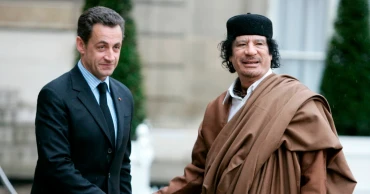
The case originated in March 2011 when a Libyan news agency claimed that Gadhafi’s government had funded Sarkozy’s campaign. Gadhafi himself publicly stated, “It’s thanks to us that he reached the presidency,” though he provided no specifics. Despite Sarkozy’s initial welcome of Gadhafi to Paris in 2007, the French leader later became a strong proponent of military intervention in Libya during the Arab Spring in 2011, culminating in Gadhafi’s death in October that year.
In 2012, the French news site Mediapart published a purported Libyan secret service document suggesting Gadhafi had approved €50 million in campaign funding for Sarkozy. While Sarkozy dismissed the document as a forgery, French investigative magistrates later deemed it authentic in nature, though conclusive evidence of the alleged transaction remains absent. Official records show Sarkozy’s 2007 campaign cost €20 million, the report also said.
Ex-Italian PM says French missile downed an airliner in 1980 by accident in bid to kill Gadhafi
Witness Tampering Allegations
French investigators delved into numerous trips to Libya made by Sarkozy’s associates, including his then-chief of staff Claude Guéant, between 2005 and 2007. They also examined frequent meetings between Guéant and Takieddine. In 2016, Takieddine claimed to have delivered suitcases containing millions in cash from Libya to the French Interior Ministry, though he retracted this statement in 2020.
A separate investigation into alleged witness tampering followed, with prosecutors suspecting efforts to pressure Takieddine into clearing Sarkozy. Both Sarkozy and his wife, Carla Bruni-Sarkozy, faced preliminary charges for allegedly influencing Takieddine.
Additional Defendants
The trial also involves high-profile figures, including three former French ministers, Sarkozy’s adviser, Franco-Algerian businessman Alexandre Djouhri, and Gadhafi’s former chief of staff Bashir Saleh. Saleh, who survived a shooting in 2018 and now resides in the UAE, was previously a key figure in Libya’s financial dealings. Other defendants include Saudi billionaires, a former Airbus executive, and a banker accused of facilitating the alleged money transfers.
Shukri Ghanem, Gadhafi’s former oil minister, who reportedly documented payments to Sarkozy in a notebook, was found dead under unclear circumstances in the Danube River in 2012. Additionally, Gadhafi’s spy chief, Abdullah al-Senoussi, now imprisoned in Libya, has corroborated claims that millions were funneled into Sarkozy’s campaign.
Sarkozy’s Past Convictions
This trial follows two prior convictions for Sarkozy. In 2023, France’s highest court upheld his conviction for corruption and influence peddling during his presidency, resulting in a one-year house arrest sentence with an electronic bracelet. In 2022, an appeals court found him guilty of illegal campaign financing for his failed 2012 reelection bid.
The Libyan case, however, is widely regarded as the most damaging to Sarkozy’s legacy, given its international implications and the gravity of the accusations.
1 year ago
Ukraine presses attacks in Russia's Kursk region
President Volodymyr Zelenskyy says he will urge allies to boost Ukraine’s air defenses at a meeting this week in Germany, while both sides said Kyiv’s forces pressed new attacks Sunday in Russia’s Kursk region.
Russian shelling, meanwhile, killed at least one person and wounded another in Ukraine's Dnipropetrovsk region, local officials said.
Dozens of partner countries will participate in the meeting of the Ramstein group at Ramstein Air Base in Germany on Thursday, Zelenskyy said, “including those who can help boost our capabilities not only to defend against missiles but also against guided bombs and Russian aviation.”
“We will discuss this with them and continue to persuade them,” Zelenskyy said in his nightly address on Saturday. “The task remains unchanged: strengthening our air defense.”
U.S. Defense Secretary Lloyd J. Austin will attend the meeting, which originally had been scheduled for October with U.S. President Joe Biden present. The session was postponed in the aftermath of Hurricane Milton striking the state of Florida.
The Biden administration is pressing to send as much military aid as possible to Ukraine before Trump is sworn in Jan. 20. Trump claimed during his election campaign that he could end the nearly 3-year-old war in one day, and his comments have raised questions over whether Washington will continue to be Ukraine’s biggest — and most important — military backer.
Zelenskyy said last week that Trump is "strong and unpredictable,” and those qualities can be a decisive factor in his policy approach to the war.
Russia controls about a fifth of Ukraine and last year advanced slowly in eastern areas despite high losses of troops and equipment. The war’s trajectory isn’t going in Ukraine’s favor, with the country shorthanded on the front line and in need of more support from its Western partners.
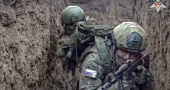
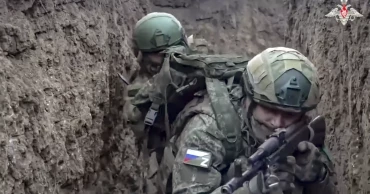
In Ukraine's incursion in the Kursk region, Zelenskyy said Russian and North Korean troops had suffered heavy losses in fighting in Russia’s Kursk region.
“In battles yesterday and today near just one village, Makhnovka, in the Kursk region, the Russian army lost up to a battalion of North Korean infantry soldiers and Russian paratroopers,” he said. “This is significant.”
Russia launches massive aerial attack against Ukraine
Zelenskyy said last month that 3,000 North Korean troops had been killed or wounded in Kursk, where Ukrainian forces launched an incursion in August, dealing a blow to Russia’s prestige and forcing it to deploy some of its troops from eastern Ukraine.
The incursion didn’t significantly change the dynamic of the war, and military analysts say Ukraine has lost around 40% of the land it initially captured.
Russia’s Defense Ministry said Sunday that Ukraine launched a fresh offensive in the Kursk region. It claimed its forces pushed back Ukrainian troops, but some reports from Russian military bloggers indicated that Moscow's forces faced significant pressure.
A ministry statement said Ukrainian forces attacked about 9 a.m. local time (0600 GMT, 1 a.m. EST) near the village of Berdin with two tanks, a mine-clearing vehicle and 12 armored combat vehicles with paratroopers. Two Ukrainian attacks were repelled, it said.
Ukrainian presidential adviser Andriy Yermak said there was “good news” from Kursk and that Russia was “getting what it deserves,” while Andriy Kovalenko, head of Ukraine’s official Centre Against Disinformation, said on Telegram that Russian troops were attacked in several places.
The Associated Press was not immediately able to verify the reports.
In other developments, local officials said one person was killed and another wounded in Russian shelling of the city of Nikopol in Ukraine's Dnipropetrovsk region on Sunday. Downstream along the Dnieper River, at least six people were wounded when Russian troops shelled the city of Kherson, capital of the region of the same name. Settlements along the west bank of the river come under regular shelling from Russian-controlled territory on the opposite bank.
Nine people were wounded in a Russian guided bomb attack on the border town of Semenivka in Ukraine’s northern Chernihiv region on Saturday evening, local officials said.
Ukraine's new procurement agency aims to boost NATO ambitions
Moscow sent 103 drones into Ukraine overnight Sunday, Ukrainian officials said. According to Ukraine’s air force, 61 drones were destroyed and 42 were lost, likely due to electronic jamming.
The Russian Defense Ministry said that 61 Ukrainian drones were shot down overnight Sunday in western Russia. No casualties were reported but Rostov regional Gov. Yuri Slyusar said residential buildings and cars were damaged by falling drone debris.
1 year ago
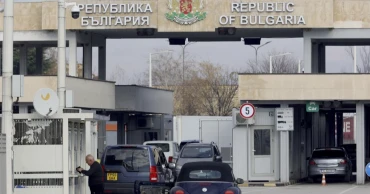
Romania and Bulgaria celebrate full Schengen membership with ceremonies
Ceremonies were held just before midnight Tuesday to mark Bulgaria’s and Romania’s full membership in Europe’s Schengen area, the culmination of years of negotiations by the Eastern European countries to join the ID check-free travel zone.
Identification checks at the land borders between Bulgaria and Romania and their neighboring European Union-member countries were officially ceased at midnight, providing travelers free access to the rest of the 27-member EU bloc. The two countries partially joined the Schengen area in March, but open travel was restricted to those arriving only by air or sea.
Late on Tuesday, the interior ministers of Bulgaria and Romania met at the Ruse-Giurgiu border crossing between the two countries to mark the opening of the frontier. Another short ceremony was held at a border crossing between Hungary and Romania with a meeting between Hungary’s national chief of police and the chief inspector of Romania’s border police.
The expansion of Schengen came after months of efforts to integrate Bulgaria and Romania into the zone by Hungary’s government as it held the six-month rotating presidency of the EU.
Some 1 million ethnic Hungarians live in the Transylvania region of Romania, a legacy of the partition of Hungary following World War I. Relations have been historically rocky between the two countries, but the opening of the border will ease travel and strengthen links between the regions.
The Schengen Area, one of the main achievements of the European project, was established in 1985 as an intergovernmental project between five EU countries — France, Germany, Belgium, the Netherlands and Luxembourg. It has gradually expanded to become the largest free travel area in the world.
However, several Schengen member countries, including the Netherlands, Austria and Germany, this year reinstated some land border checks over concerns ranging from migration to security. Some EU officials warned the re-imposed checks could undermine the scheme’s goals.
Before Bulgaria and Romania’s partial admission, Schengen was comprised of 23 of the 27 EU member countries, along with Switzerland, Norway, Iceland and Liechtenstein. Around 3.5 million people cross an internal border each day, and more than 420 million people live within the Schengen area.
The two Balkan countries joined the EU in 2007 but were not integrated into the borderless zone until March, when border checks were lifted from maritime and air travel. Land border checks remained in place due to opposition, chiefly from Austria, over concerns that the two countries were not doing enough to prevent migrants from entering without authorization.
Romanian President Klaus Iohannis earlier called Romania’s full membership in the Schengen area a “natural and necessary step” that will significantly reduce wait times at borders, lower logistical costs for businesses and attract foreign investors. Economists from the Bulgarian Academy of Sciences calculated that with membership, the total positive financial effect for Bulgaria would amount to 800 million euro ($840 million) per year.
1 year ago
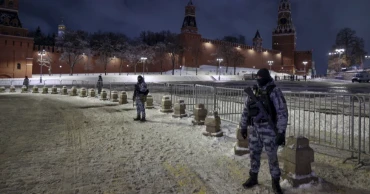
US restricts Russian and Iranian groups over disinformation targeting American voters
The United States has imposed sanctions on two groups linked to Iranian and Russian efforts to target American voters with disinformation ahead of this year's election.
Treasury officials announced the sanctions Tuesday, alleging that the two organizations sought to stoke divisions among Americans before November's vote. U.S. intelligence has accused both governments of spreading disinformation, including fake videos, news stories and social media posts, designed to manipulate voters and undermine trust in U.S. elections.
“The governments of Iran and Russia have targeted our election processes and institutions and sought to divide the American people through targeted disinformation campaigns,” Bradley T. Smith, Treasury's acting undersecretary for terrorism and financial intelligence, said in a statement.
Authorities said the Russian group, the Moscow-based Center for Geopolitical Expertise, oversaw the creation, financing and dissemination of disinformation about American candidates, including deepfake videos created using artificial intelligence.
In addition to the group itself, the new sanctions apply to its director, who authorities say worked closely with Russian military intelligence agents also overseeing cyberattacks and sabotage against the West.
Read: EU imposes sanctions on Putin’s daughters
Authorities say the center used AI to quickly manufacture fake videos about American candidates created scores of fake news websites designed to look legitimate and even paid U.S. web companies to create pro-Russian content.
The Iranian group, the Cognitive Design Production Center, is a subsidiary of Iran’s paramilitary Revolutionary Guard, U.S. officials said, which the United States has designated a foreign terrorist organization. Officials say the center worked since at least 2023 to incite political tensions in the United States.
U.S. intelligence agencies have blamed the Iranian government for seeking to encourage protests in the U.S. over Israel’s war against Hamas in Gaza. Iran also has been accused of hacking into the accounts of several top current and former U.S. officials, including senior members of Donald Trump’s campaign.
In the months ahead of the election, U.S. intelligence officials said Russia, Iran and China all sought to undermine confidence in U.S. democracy. They also concluded that Russia sought to prop up the ultimate victor Trump, who has praised Russian President Vladimir Putin, suggested cutting funds to Ukraine and repeatedly criticized the NATO military alliance.
Read more: US imposes sanctions on RAB, 7 individuals
Iran, meanwhile, sought to oppose Trump's candidacy, officials said. The president-elect's first administration ended a nuclear deal with Iran, reimposed sanctions and ordered the killing of Iranian Gen. Qassem Soleimani, an act prompting Iran’s leaders to vow revenge.
Russian and Iranian officials have rejected claims that they sought to influence the outcome of the 2024 election.
“Russia has not and does not interfere with the internal affairs of other countries,” a spokesperson for Russia's embassy in Washington wrote in an email Tuesday.
A message left with officials from Iran was not immediately returned Tuesday.
1 year ago

Kavelashvili sworn in as Georgia’s president, tensions rise over EU ambitions
Former soccer star Mikheil Kavelashvili was inaugurated as Georgia’s president on Sunday, a move that critics argue weakens the country's European Union ambitions and strengthens its ties with Russia.
The opposition condemned the inauguration, accusing Kavelashvili's Georgian Dream party of consolidating power, while outgoing pro-Western President Salome Zourabichvili labeled the event a “parody.”
Zourabichvili, who served as president since 2018, vacated the presidential residence at the Orbeliani Palace in Tbilisi but maintained that she remained the legitimate officeholder. Speaking to supporters, she emphasized that she would carry “legitimacy” with her despite stepping down.
Kavelashvili, 53, was the only candidate in December’s election, which was determined by an electoral college dominated by Georgian Dream members. In his inaugural speech, he promised to serve as a president for all Georgians, urging unity and cooperation.
Kim vows toughest anti-US policy before Trump takes office
The Georgian Dream party, which won parliamentary elections in October, has faced accusations of growing authoritarianism and closer alignment with Russia. Critics claim the party is suppressing opposition, especially after controversial laws limiting free speech and LGBTQ+ rights were passed.
The party’s decision to pause talks on joining the EU, compounded by protests against the government, has intensified tensions with the opposition.
Zourabichvili, a former diplomat, demanded new elections, accusing the ruling party of manipulating the electoral process.
Kavelashvili, previously a soccer player in the UK and Switzerland, entered politics in 2016. He co-founded the People’s Power movement, which has voiced strong anti-Western rhetoric.
He is also known for his role in drafting a contentious law requiring organizations funded by foreign sources to register as foreign agents, a measure that has been criticized by the EU.
The protests against the government have intensified, with daily demonstrations outside the parliament, resulting in clashes with riot police and numerous arrests.
The EU has frozen financial aid and put Georgia’s accession bid on hold, citing concerns over democratic backsliding.
1 year ago

Russia's Gazprom to stop supplying gas to Moldova from Jan. 1
Russia’s state-owned energy giant Gazprom said Saturday it will halt gas supplies to Moldova starting on Jan. 1, citing alleged unpaid debt by the European Union candidate country, which has brought in emergency measures as it braces for power cuts.
Gazprom said in an online statement that it reserved the right to take further action, including terminating its contract with Moldovagaz, Moldova's main gas operator, in which the Russian company owns a majority stake. The cessation of gas will stop supplies to the Kuciurgan power plant, the country’s largest, which is situated in the separatist pro-Russian Transnistria region.
Moldova reacted by accusing Moscow of weaponizing energy supplies.
Gazprom supplies the gas-operated Kuciurgan plant, which generates electricity that powers a significant portion of Moldova proper. The plant was privatized in 2004 by Transnistrian officials and later sold to a Russian state-owned company. Moldova, which has a West-leaning central government and has repeatedly complained of Russian interference, doesn’t recognize the privatization.
Earlier this month, Moldova's parliament voted in favor of imposing a state of emergency in the energy sector over fears that Russia could leave Moldova without sufficient energy this winter.
A special commission was also set up to manage “imminent risks” if Moscow fails to supply gas to the Kuciurgan plant and on Friday approved a series of measures aimed at saving energy.
Gazprom has said Moldova owes close to $709 million for past gas supplies, a figure fiercely disputed by the government in the capital Chisinau.
Read: Russia's Gazprom stops flow of natural gas to Austria
Moldovan Prime Minister Dorin Recean on Saturday condemned the move, saying that his government does not recognize the debt cited by Gazprom, which has been “invalidated by an international audit.”
Moldova claims, citing findings by British and Norwegian audit firms, that its debt stands close to $8.6 million, a small fraction of that claimed by Gazprom.
Recean added that Chisinau has pushed to diversify its natural gas supplies to reduce dependence on the Kuciurgan plant, and said the government will “carefully analyze legal options, including resorting to international arbitration” to protect Moldova’s national interests.
“Our country is prepared to handle any situation that arises following the Kremlin’s decision,” he said.
Moldova’s government on Friday announced it would implement a series of measures starting Jan. 1 to reduce energy consumption. These include limiting lighting in public and commercial buildings by at least 30%, and energy-intensive businesses operating during off-peak hours.
In late 2022, Moldova suffered major power outages following Russian strikes on neighboring Ukraine, which is interconnected to the Kuciurgan plant.
Transnistria, which broke away after a short war in 1992 and is not recognized by most countries, also declared its own state of emergency earlier this month, in case the region does not receive gas supplies.
When Russia fully invaded Ukraine in 2022, Moldova, a former Soviet republic of about 2.5 million people, was entirely dependent on Moscow for natural gas but has since pushed to diversify and expand its energy sources.
Read more: Gazprom keen on exploring 5 more gas wells in Bhola; Russia will continue to support Bangladesh: Ambassador
In October, Moldova’s pro-Western President Maia Sandu won a second term in office, and a referendum voted in favor of securing the country’s path toward the EU, in two votes overshadowed by ongoing claims of Russian interference to derail the country’s westward shift in recent years. Russia denies it is meddling in Moldova.
Russia cut off most natural gas supplies to Europe in 2022, citing disputes over payment in rubles, a move European leaders described as energy blackmail over their support for Ukraine against Russia’s invasion.
European governments had to scramble to line up alternative supplies at higher prices, much of it liquefied natural gas brought by ship from the U.S. and Qatar.
1 year ago
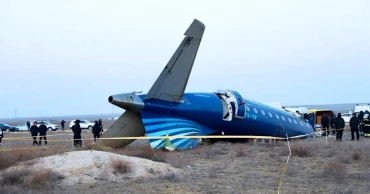
Putin apologizes for 'tragic incident' but stops short of saying Azerbaijani plane shot down
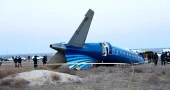
Russian President Vladimir Putin on Saturday apologized to his Azerbaijani counterpart for what he called a “tragic incident” following the crash of an Azerbaijani airliner in Kazakhstan that killed 38 people, but stopped short of acknowledging that Moscow was responsible.
Putin's apology came as allegations mounted that the plane had been shot down by Russian air defenses attempting to deflect a Ukrainian drone strike near Grozny, the regional capital of the Russian republic of Chechnya.
An official Kremlin statement issued Saturday said that air defense systems were firing near Grozny airport as the airliner “repeatedly” attempted to land there on Wednesday. It did not explicitly say one of these hit the plane.
The statement said Putin apologized to Azerbaijani President Ilham Aliyev “for the fact that the tragic incident occurred in Russian airspace.”
The readout said Russia has launched a criminal probe into the incident, and Azerbaijani state prosecutors have arrived in Grozny to participate. The Kremlin also said that “relevant services” from Russia, Azerbaijan and Kazakhstan are jointly investigating the crash site near the city of Aktau in Kazakhstan.
The plane was flying from Azerbaijan’s capital, Baku, to Grozny when it turned toward Kazakhstan, hundreds of kilometers (miles) across the Caspian Sea from its intended destination, and crashed while making an attempt to land. There were 29 survivors.
According to a readout of the call provided by Aliyev’s press office, the Azerbaijani president told Putin that the plane was subject to "external physical and technical interference," although he also stopped short of blaming Russian air defenses.
Aliyev noted that the plane had multiple holes in its fuselage and that the occupants had sustained injuries “due to foreign particles penetrating the cabin mid-flight.”
Read: Ukrainian drone attack linked to Azerbaijani plane crash, says Russian aviation chief
He said that a team of international experts had begun probing the incident at Azerbaijan's initiative, but provided no details. Earlier this week, the Azerbaijani Prosecutor General's office confirmed that investigators from Azerbaijan are working in Grozny.
On Friday, a U.S. official and an Azerbaijani minister made separate statements blaming the crash on an external weapon, echoing those made by aviation experts who blamed the crash on Russian air defense systems responding to a Ukrainian attack.
President Joe Biden, responding on Saturday to a reporter asking whether he thought Putin should take responsibility for the crash, said: “Apparently he did but I haven’t spoken to him.” Biden made the comment after leaving church in St. Croix, U.S. Virgin Islands.
Passengers and crew who survived the crash told Azerbaijani media that they heard loud noises on the aircraft as it was circling over Grozny.
Dmitry Yadrov, head of Russia’s civil aviation authority Rosaviatsia, said Friday that as the plane was preparing to land in Grozny in deep fog, Ukrainian drones were targeting the city, prompting authorities to close the area to air traffic.
Yadrov said that after the captain made two unsuccessful attempts to land, he was offered other airports but decided to fly to Aktau.
Earlier in the week, Rosaviatsia had cited unspecified early evidence as showing that a bird strike led to an emergency on board.
In the days following the crash, Azerbaijan Airlines blamed “physical and technical interference” and announced the suspension of flights to several Russian airports. It didn’t say where the interference came from or provide any further details.
If proven that the plane crashed after being hit by Russian fire, it would be the second deadly civil aviation accident linked to fighting in Ukraine. Malaysia Airlines Flight 17 was downed with a Russian surface-to-air missile, killing all 298 people aboard, as it flew over the area in eastern Ukraine controlled by Moscow-backed separatists in 2014.
Read more: Kazakhstan Reports 42 Feared Dead in Azerbaijan Airlines Plane Crash
Russia has denied responsibility, but a Dutch court in 2022 convicted two Russians and a pro-Russia Ukrainian man for their role in downing the plane with an air defense system brought into Ukraine from a Russian military base.
Following Wednesday’s suspension of flights from Baku to Grozny and nearby Makhachkala, Azerbaijan Airlines announced Friday that it would also halt service to eight more Russian cities.
Several other airlines have made similar announcements since the crash. Kazakhstan’s Qazaq Air on Friday said it would stop flying from Astana to the Russian city of Yekaterinburg in the Ural Mountains for a month.
Turkmenistan Airlines, the Central Asian country’s flagship carrier, on Saturday halted flights to Moscow for at least a month, citing safety concerns. Earlier this week, Israel’s El Al carrier suspended service from Tel Aviv to the Russian capital, citing “developments in Russia’s airspace.”
1 year ago
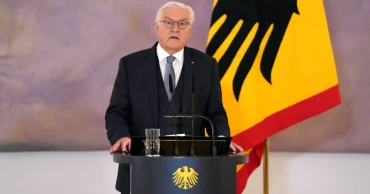
Germany's president dissolves parliament, sets national election for Feb 23
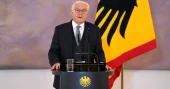
German President Frank-Walter Steinmeier on Friday ordered parliament dissolved and set new elections for Feb. 23 in the wake of the collapse of Chancellor Olaf Scholz's coalition, saying it was the only way to give the country a stable government capable of tackling its problems.
Scholz lost a confidence vote on Dec. 16 and leads a minority government after his unpopular and notoriously rancorous three-party coalition collapsed on Nov. 6 when he fired his finance minister in a dispute over how to revitalize Germany’s stagnant economy.
Steinmeier said he made the decision because it was clear after consultation with party leaders that there was no agreement among Germany's political parties on a majority for a new government in the current parliament.
“It is precisely in difficult times like these that stability requires a government capable of taking action and a reliable majority in parliament,” he said as he made the announcement in Berlin.
"Therefore I am convinced that for the good of our country new elections are the right way.”
China sanctions 7 companies over US military assistance to Taiwan
Since the post-World War II constitution doesn’t allow the Bundestag to dissolve itself, it was up to Steinmeier to decide whether to dissolve parliament and call an election. He had 21 days to make that decision. Once parliament is dissolved, the election must be held within 60 days. Leaders of several major parties agreed earlier on the election date of Feb. 23, seven months earlier than originally planned.
Steinmeier warned about outside interference in the poll, saying it is “a danger to democracy, whether it is covert, as was evidently the case recently in the Romanian elections, or open and blatant, as is currently being practiced particularly intensively on platform X.”
A top Romanian court annulled the first round of the country’s presidential election, days after allegations emerged that Russia ran a coordinated online campaign to promote the far-right outsider who won the first round.
The campaign is already well underway. Polls show Scholz’s party trailing the conservative opposition Union bloc led by Friedrich Merz. Vice Chancellor Robert Habeck of the environmentalist Greens, the remaining partner in Scholz’s government, is also bidding for the top job — though his party is further back. If recent polls hold up, the likely next government would be led by Merz as chancellor in coalition with at least one other party.
Key issues include immigration, how to get the sluggish economy going, and how best to aid Ukraine in its struggle against Russia.
The populist, anti-immigration Alternative for Germany, or AfD, which is polling strongly, has nominated Alice Weidel as its candidate for chancellor but has no chance of taking the job because other parties refuse to work with it.
Germany’s electoral system traditionally produces coalitions, and polls show no party anywhere near an absolute majority on its own. The election is expected to be followed by weeks of negotiations to form a new government.
It’s only the fourth time that the Bundestag has been dissolved ahead of schedule under Germany’s post-World War II constitution. It happened under Chancellor Willy Brandt in 1972, Helmut Kohl in 1982 and Gerhard Schroeder in 2005. Schroeder used the confidence vote to engineer an early election narrowly won by center-right challenger Angela Merkel.
1 year ago

North Korean troops suffering heavy battlefield losses: Ukraine's military
North Korean troops are suffering heavy losses in the fighting in Russia's Kursk region and facing logistical difficulties as a result of Ukrainian attacks, Ukraine’s military intelligence said Thursday.
The intelligence agency, known under its acronym GUR, said Ukrainian strikes near Novoivanovka inflicted heavy casualties on North Korean units. It said North Korean troops also faced supply issues and even shortages of drinking water.
Ukrainian President Volodymyr Zelenskyy said earlier this week that 3,000 North Korean troops have been killed and wounded in the fighting in the Kursk region. It marked the first significant estimate by Ukraine of North Korean casualties several weeks after Kyiv announced that North Korea had sent 10,000 to 12,000 troops to Russia to help it in the almost 3-year war.
The casualty disclosure came as the Biden administration was pressing to send as much military aid as possible to Ukraine before President-elect Donald Trump takes over in January.
Ukrainian forces launched an incursion into the Kursk region in August, dealing a significant blow to Russia's prestige and forcing it to deploy some of its troops from eastern Ukraine, where they were pressing a slow-moving offensive.
The Russian army has been able to reclaim some territory in the Kursk region from Ukrainian forces, but has failed to fully dislodge them.
At the same time, Russia has sought to break Ukraine's resistance with waves of strikes with cruise missiles and drones against Ukraine's power grid and other infrastructure.
The latest attack on Christmas morning involved 78 missiles and 106 drones, striking power facilities, Ukraine’s air force said. It claimed to have intercepted 59 missiles and 54 drones and jammed 52 other drones.
Read: North Korea's Kim vows steadfast support for Russia’s war in Ukraine
On Thursday, Russia attacked Ukraine with 31 exploding drones. Twenty were shot down and another 11 didn’t reach their target due to jamming, the Ukrainian air force said.
As part of the daily barrage, Russian forces also struck a central market in Nikopol in the Dnipropetrovsk region with a drone, wounding eight people, according to local authorities.
Russian President Vladimir Putin threatened Thursday that Russia could again hit Ukraine with the new Oreshnik hypersonic ballistic missile that was first used in a Nov. 21 strike on the Ukrainian city of Dnipro.
Speaking to reporters, Putin said Russia has just a few Oreshnik missiles, but added that it wouldn't hesitate to use them on Ukraine.
“We aren't in a rush to use them, because those are powerful weapons intended for certain tasks,” he said. “But we wouldn't exclude their use today or tomorrow if necessary.”
Putin said Russia has launched serial production of the new weapon and reaffirmed a plan to deploy some of Oreshnik missiles to Russia's neighbor and ally Belarus. Belarus' authoritarian President Alexander Lukashenko told reporters Thursday that his country could host 10 or more.
Ukraine struck back with drone strikes of its own. Ukraine’s Center for Strategic Communications said the military struck a plant in Kamensk-Shakhtynsky in Russia’s southern Rostov region that produces propellant for ballistic missiles.
Read more: North Korean leader calls for expanding his nuclear forces in the face of alleged US threats
“This strike is part of a comprehensive campaign to weaken the capabilities of the Russian armed forces to carry out terrorist attacks against Ukrainian civilians,” it said in a statement.
1 year ago