europe

More than 4,000 migrants in the Lampedusa hotspot in Italy
There were 63 landings recorded yesterday, in the span of 24 hours, with a total of 1,826 people, in Italy's Lampedusa .
A record, for the number of rescues and for the total number of migrants landed, never reached before on the largest of the Pelagie islands where from midnight to now there have already been another 17 landings with another 519 people.
There are currently 4,121 people present in the Lampedusa hotspot and given the favorable weather conditions, landings are expected, between today and tomorrow, for at least another two thousand migrants.
Cyprus rescues 115 Syrian migrants aboard 3 separate boats over the last three days
The transfers that will be made with the scheduled ferries to Porto Empedocle appear to be insufficient , the pre-identification area of which would not be able to bear the huge amount ofmigrants who are in Lampedusa.
The prefecture and police headquarters of Agrigento are mobilizing to ensure that ships and military aircraft are made available to Lampedusa .
You also land on the mainland
Not only rescued in the waters in front of, or off, Lampedusa.
But also arrivals directly on the mainland : 6 groups of migrants who were found and blocked by the military of the finance police and carabinieri.
Rights group says Saudi Arabian border guards fired on and killed hundreds of Ethiopian migrants
As many as 33 were in Porto 'Nonti where the cart used for the crossing was not found, 42 and 8 arrived, with boats of 7 and 5 meters, at the commercial pier, 44 were blocked in Cala Croce where the boat, 38 were near the Sanctuary of the Madonna dell'Aiuto and reported that they had left the small boat adrift. A patrol boat from the Captaincy instead intervened near the cliff of Cala Galera where there were 47 people, they too had left the boat adrift.
During the night there was also a transfer of Guineans from the NGO ship Ocean Viking which carried out the rescue, on the
CP327 patrol boat of the Coast Guard. In the meantime, not only the patrols of the Lampedusan coast continue, but also the counts of those who have landed: yesterday , in the space of 34 hours, there were 65 (and not 63) landings, with a total of 1,918 migrants.
Operations in the transit area of Porto Empedocle
There are 258 migrants present in the transit area, for pre-identification, created in Porto Empedocle. The police officers of the Immigration office of the Agrigento Police Headquarters are completing the photo reports and almost all of them will be transferred by 11 am. According to provisions of the Prefecture of Agrigento, in agreement with the Viminale, the police will escort 130 migrants, on 3 different buses, to Pozzallo; 30 on a bus in Messina, 80, on two vehicles, in Abruzzo; 20 at the Cara of Caltanissetta.
More than 60 Senegalese migrants are feared dead on a monthlong voyage to Spain
In the evening, when the Galaxy ferry arrives, the 740 migrants who are about to be transferred from Lampedusa will be disembarked. Some movements have already been planned by the territorial office of the government: with 3 buses, 150 migrants will leave for Veneto at around 8 pm, 40 for Umbria, 150, with three buses, for Emilia and 100, with 2 means, for Vibo Valentia. The total 440 have already been identified by the police, who manages together with the Red Cross to keep up the infernal rhythms imposed by the continuous landings, at the Lampedusa hotspot.
2 years ago

US intelligence says an intentional explosion brought down Wagner chief Prigozhin's plane
A preliminary U.S. intelligence assessment concluded that an intentional explosion caused the plane crash presumed to have killed a mercenary leader who was eulogized Thursday by Vladimir Putin, even as suspicions grew that the Russian president was the architect of the assassination.
One of the U.S. and Western officials who described the initial assessment said it determined that Yevgeny Prigozhin was "very likely" targeted and that the explosion falls in line with Putin's "long history of trying to silence his critics."
The officials, who spoke on the condition of anonymity because they were not authorized to comment, did not offer any details about what caused the explosion, which was widely believed to be vengeance for the mutiny in June that posed the biggest challenge to the Russian leader's 23-year rule. Several of Prigozhin's lieutenants were also presumed dead.
Also read: Plane crash believed to have killed Wagner chief Prigozhin seen as Kremlin's revenge
Pentagon spokesman Gen. Pat Ryder said press reports that a surface-to-air missile took down the plane were inaccurate. He declined to say whether the U.S. suspected a bomb or believed the crash was an assassination.
Details of the intelligence assessment surfaced as Putin expressed his condolences to the families of those who were reported to be aboard the jet and referred to "serious mistakes" by Prigozhin.
The jet carrying the founder of the Wagner military company and six other passengers crashed Wednesday soon after taking off from Moscow with a crew of three, according to Russia's civil aviation authority. Rescuers found 10 bodies, and Russian media cited anonymous sources in Wagner who said Prigozhin was dead. But there has been no official confirmation.
Also read: Russian mercenary leader Prigozhin's commanders met Putin after short-lived mutiny, pledged loyalty
President Joe Biden, speaking to reporters Wednesday, said he believed Putin was behind the crash, though he acknowledged that he did not have information verifying his belief.
"I don't know for a fact what happened, but I'm not surprised," Biden said. "There's not much that happens in Russia that Putin's not behind."
The passenger manifest also included Prigozhin's second-in-command, who baptized the group with his nom de guerre, as well as Wagner's logistics chief, a fighter wounded by U.S. airstrikes in Syria and at least one possible bodyguard.
It was not clear why several high-ranking members of Wagner, including top leaders who are normally exceedingly careful about their security, were on the same flight. The purpose of their joint trip to St. Petersburg was unknown.
Also read: Prigozhin, the mercenary chief urging an uprising against Russia's generals, has long ties to Putin
At Wagner's headquarters in St. Petersburg, lights were turned on in the shape of a large cross, and Prigozhin supporters built a makeshift memorial, piling red and white flowers outside the building Thursday, along with company flags and candles.
In this first comments on the crash, Putin said the passengers had "made a significant contribution" to the fighting in Ukraine.
"We remember this, we know, and we will not forget," he said in a televised interview with the Russian-installed leader of Ukraine's partially occupied Donetsk region, Denis Pushilin.
Putin recalled that he had known Prigozhin since the early 1990s and described him as "a man of difficult fate" who had "made serious mistakes in life, and he achieved the results he needed — both for himself and, when I asked him about it, for the common cause, as in these last months. He was a talented man, a talented businessman."
Russian state media have not covered the crash extensively, instead focusing on Putin's remarks to the BRICS summit in Johannesburg via video link and Russia's invasion of Ukraine.
Several Russian social media channels reported that the bodies were burned or disfigured beyond recognition and would need to be identified by DNA. The reports were picked up by independent Russian media, but The Associated Press was not able to independently confirm them.
Prigozhin supporters claimed on pro-Wagner messaging app channels that the plane was deliberately downed.
Sergei Mironov, the leader of the pro-Kremlin Fair Russia party and former chairman of the upper house of the Russian parliament, said on his Telegram channel that Prigozhin had "messed with too many people in Russia, Ukraine and the West."
"It now seems that at some point, his number of enemies reached a critical point," Mironov wrote.
Russian authorities have said the cause of the crash is under investigation.
Anastasia Bukharova, 27, said she was walking with her children Wednesday when she saw the jet, "and then — boom! — it exploded in the sky." She said she was scared it would hit houses in her village of Kuzhenkino and ran with the children. But the plane ended up crashing into a field.
"Something sort of was torn from it in the air," she added.
Numerous opponents and critics of Putin have been killed or gravely sickened in apparent assassination attempts, and U.S. and other Western officials long expected the Russian leader to go after Prigozhin, despite promising to drop charges in a deal that ended the June 23-24 mutiny.
"It is no coincidence that the whole world immediately looks at the Kremlin when a disgraced ex-confidant of Putin suddenly falls from the sky, two months after he attempted an uprising," said German Foreign Minister Annalena Baerbock, while acknowledging that the facts were still unclear.
"We know this pattern … in Putin's Russia — deaths and dubious suicides, falls from windows that all ultimately remain unexplained," she added.
Ukrainian President Volodymyr Zelenskyy also pointed the finger: "We have nothing to do with this. Everyone understands who does."
Soon after the plane went down, people on social media and news outlets began to report that it was a Wagner plane. Minutes after Russian state news agencies confirmed the crash, they cited the civil aviation authority as saying Prigozhin's name was on the mainfest.
Prigozhin was long outspoken and critical of how Russian generals were waging the war in Ukraine, where his mercenaries were some of the fiercest fighters for the Kremlin. For a long time, Putin appeared content to allow such infighting — and Prigozhin seemed to have unusual latitude to speak his mind.
But Prigozhin's brief revolt raised the ante. His mercenaries swept through the southern Russian city of Rostov-on-Don and captured the military headquarters there without firing a shot. They then drove to within about 200 kilometers (125 miles) of Moscow and downed several military aircraft, killing more than a dozen Russian pilots.
Putin first denounced the rebellion as "treason" and a "stab in the back." He vowed to punish its perpetrators, and the world waited for his next move, particularly since Prigozhin had publicly questioned the Russian leader's justifications for the war in Ukraine.
Instead Putin made a deal that saw an end to the mutiny in exchange for an amnesty for Prigozhin and his mercenaries and permission for them to move to Belarus.
Now many are suggesting the punishment has finally come.
The Institute for the Study of War argued that Russian authorities likely moved against Prigozhin and his top associates as "the final step to eliminate Wagner as an independent organization."
Abbas Gallyamov, a former speechwriter for Putin turned political consultant, said by carrying out the mutiny and remaining free, Prigozhin "shoved Putin's face into the dirt front of the whole world."
Failing to punish Prigozhin would have offered an "open invitation for all potential rebels and troublemakers," so Putin had to act, Gallyamov said.
Videos shared by the pro-Wagner Telegram channel Grey Zone showed a plane dropping like a stone from a large cloud of smoke, twisting wildly as it fell, one of its wings apparently missing. A free fall like that typically occurs when an aircraft sustains severe damage. A frame-by-frame AP analysis of two videos was consistent with some sort of midflight explosion.
2 years ago

UK political watchdog says Prime Minister Rishi Sunak ‘inadvertently’ broke ethics rules
British Prime Minister Rishi Sunak was chided by Parliament’s standards guardian on Thursday for failing to declare his wife’s financial interest in a childcare firm that stood to benefit from government policy.
Standards Commissioner Daniel Greenberg said Sunak broke the code of conduct for government ministers, but said the mistake was “inadvertent” and that the prime minister should not be sanctioned for the error.
Read: Nearly 2,000 unaccompanied immigrant minors landed in Rome over the weekend
Greenberg opened an investigation in April over Sunak’s failure to declare when questioned by a committee of lawmakers that his wife. Akshata Murthy, held shares in the company Koru Kids, which had been selected to receive government support for childcare firms.
Greenberg said Murthy’s shareholding “was a relevant interest that should have been declared.” But he said the failure stemmed from confusion about the rules rather than an intent to deceive.
“I confirm that the matter is now closed,” he said.
Sunak apologized for the mistake.
Read: Europe gripped by extreme weather as 'era of global boiling' arrives
The finding follows a string of ethics breaches by members of Britain’s Conservative government.
Former Prime Minister Boris Johnson was driven from office in mid-2022 when his own Cabinet turned on him after a string of scandals over his judgment and finances.
Read: Putin profits off US and European reliance on Russian nuclear fuel
Sunak vowed to restore order and integrity to government after three years of turmoil under Johnson and briefly serving successor Liz Truss, who quit within weeks after her policies rocked the U.K. economy. But Sunak, a former investment banker, has faced questions about his wealth and the financial arrangements of his wife, the daughter of an Indian billionaire.
Last year, it was revealed that Murthy didn’t pay U.K. tax on her overseas income, including 11.5 million pounds ($15 million) a year in dividends from Infosys, the Indian IT company founded by her father.
2 years ago

Plane crash believed to have killed Wagner chief Prigozhin seen as Kremlin's revenge
Russian mercenary chief Yevgeny Prigozhin and top officers of his private military were presumed dead in a plane crash that was widely seen as an assassination, two months after they staged a mutiny that dented Russian President Vladimir Putin's authority.
Russia's civil aviation agency said that Prigozhin and six top lieutenants were on a business jet that crashed Wednesday, soon after taking off from Moscow, with a crew of three. Rescuers quickly found all 10 bodies, and Russian media cited sources in Prigozhin's Wagner private military company who confirmed his death.
U.S. and other Western officials long expected Putin to go after Prigozhin, despite promising to drop charges in a deal that ended the June 23-24 mutiny.
Also read: Belarus says Wagner chief who staged mutiny is in Russia, raising questions about Kremlin's strategy
"I don't know for a fact what happened but I'm not surprised," U.S. President Joe Biden said. "There's not much that happens in Russia that Putin's not behind."
Prigozhin supporters claimed on pro-Wagner messaging app channels that the plane was deliberately downed and offered different theories for how.
Police cordoned off the field where the plane crashed as investigators studied the site. Vehicles were seen driving in to take the bodies, reportedly badly charred, for a forensic exam.
At Wagner's headquarters in St. Petersburg, lights were turned on in the shape of a large cross. Prigozhin's supporters brought flowers to the building in an improvised memorial.
Also read: Wagner and Putin: What really happened?
While countless theories about the events swirled, most observers saw Prigozhin's death as Putin's punishment for the most serious challenge to his authority of his 23-year rule.
Tatiana Stanovaya, a senior fellow at the Carnegie Russia Eurasia Center, said on Telegram that "no matter what caused the plane crash, everyone will see it as an act of vengeance and retribution" by the Kremlin, and "the Kremlin wouldn't really stand in the way of that."
"From Putin's point of view, as well as the security forces and the military — Prigozhin's death must be a lesson to any potential followers," Stanovaya said in a Telegram post.
Also read: After day of drama, Wagner chief orders troops to halt march on Moscow
In the revolt that started on June 23 and lasted less than 24 hours, Prigozhin's mercenaries swept through the southern Russian city of Rostov-on-Don and captured the military headquarters there without firing a shot, before driving to within about 200 kilometers (125 miles) of Moscow in what Prigozhin called a "march of justice" to oust the top military leaders who demanded that the mercenaries sign contracts with the Defense Ministry. They downed several military aircraft, killing more than a dozen Russian pilots.
Putin first denounced the rebellion as "treason" and a "stab in the back" and vowed to punish its perpetrators, but hours later made a deal that saw an end to the mutiny in exchange for an amnesty for Prigozhin and his mercenaries and a permission for them to move to Belarus.
Details of the deal have remained murky, but Prigozhin has reportedly shuttled between Moscow, St. Petersburg, Belarus and Africa where his mercenaries have continued their activities despite the rebellion. He was quickly given back truckloads of cash, gold bars and other items that police seized on the day of the rebellion.
Earlier this week, the mercenary chief published his first video since the mutiny, declaring that he was speaking from an undisclosed location in Africa where Wagner is "making Russia even greater on all continents, and Africa even more free."
Prigozhin's overseas activities reportedly have irked Russia's military leadership, who have sought to replace Wagner with Russian military personnel in Africa.
2 years ago

Yevgeny Prigozhin believed to be on plane that crashed near Moscow, says Russia
A business jet en route from Moscow to St. Petersburg crashed Wednesday, killing all 10 people on board, Russian emergency officials said. Mercenary chief Yevgeny Prigozhin was on the passenger list, officials said, but it wasn't immediately clear if he was on board.
Unconfirmed media reports said the jet belonged to Prigozhin, founder of the Wagner private military company.
Russia's civilian aviation regulator, Rosaviatsia, said Prigozhin was on the passenger list. However, it was not immediately clear if he had boarded the flight.
Russia's state news agency Tass cited emergency officials as saying that the plane carried three pilots and seven passengers. The authorities said they were investigating the crash, which occurred in the Tver region more than 100 kilometers (60 miles) north of Moscow.
Prigozhin, whose private military force Wagner fought alongside Russia's regular army in Ukraine, mounted a short-lived armed mutiny against Russia's military leadership in late June. The Kremlin said he would be exiled to Belarus, and his fighters would either retire, follow him there, or join the Russian military.
2 years ago
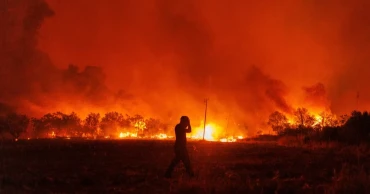
Firefighters in Greece have discovered the bodies of 18 people in an area with a major wildfire
Firefighters found the burnt bodies of 18 people, believed to have been migrants who had crossed the nearby border with Turkey, in an area of northeastern Greece ravaged by a major wildfire that raged for a fourth day Tuesday.
The discovery in the Avantas area near the city of Alexandroupolis came as hundreds of firefighters battled dozens of wildfires across the country amid gale-force winds. On Monday, two people died and two firefighters were injured in separate fires in northern and central Greece.
With their hot, dry summers, southern European countries are particularly prone to wildfires. Another major blaze was burning across Tenerife in Spain's Canary Islands for a week, although no injuries or damage to homes was reported.
Also read: Heat, wildfires and floods make summer of 2023 "a summer of extremes"
European Union officials have blamed climate change for the increasing frequency and intensity of wildfires in Europe, noting that 2022 was the second-worst year for wildfire damage on record after 2017.
In Greece, police activated the country's Disaster Victim Identification Team to identify the 18 bodies, which were found near a shack in the Avantas area, fire department spokesman Ioannis Artopios said.
"Given that there have been no reports of a missing person or missing residents from the surrounding areas, the possibility is being investigated that these are people who had entered the country illegally," Artopios said.
Also read: Death toll from devastating Maui fire reaches 101, Hawaii governor says
Alexandroupolis is near the border with Turkey, along a route often taken by people fleeing poverty and conflict in the Middle East, Asia and Africa and seeking to enter the European Union.
Greek President Katerina Sakellaropoulou voiced deep sorrow at the deaths.
"We mourn their loss ... (and) the destruction of nature, (and) we are saddened by our inability to avert it," she said in a statement. "We must urgently take effective initiatives to ensure that this bleak reality does not become the new normality."
Avantas, like many nearby villages and settlements, had been under evacuation orders, with push alerts in Greek and English sent to all mobile phones in the region.
Also read: Climate change keeps making wildfires and smoke worse. Scientists call it the 'new abnormal'
Overnight, a massive wall of flames raced through forests toward Alexandroupolis, prompting authorities to evacuate eight more villages and the city's hospital as flames reddened the sky.
About 65 of the more than 100 patients in the hospital were transported to a ferry boat in the city's port, while others were taken to other hospitals in northern Greece. The ferry later took 26 the patients to the port town of Kavala, to be transferred to another hospital.
Deputy Health Minister Dimitris Vartzopoulos, speaking on Greece's Skai television, said smoke and ash in the air around the Alexandrouplolis hospital were the main reasons behind the decision to evacuate the facility.
"We evacuated within four hours," he said.
The coast guard said patrol boats and private vessels evacuated an additional 40 people by sea from beaches near Alexandroupolis.
In the northeastern Evros border region, a fire was burning through forest in a protected national park, with satellite imagery showing smoke blanketing much of northern and western Greece.
New fires broke out in several parts of the country Tuesday, including in woodland northwest of Athens and an industrial area on the capital's western fringes.
Also read: PM Hasina writes to US President Biden expressing deep sadness over Maui wildfire devastation
Small explosions echoed from the industrial area of Aspropyrgos as flames reached warehouses and factories. Authorities shut down a highway and ordered the evacuation of nearby settlements.
With firefighting forces stretched to the limit, Greece appealed for help from the European Union's civil protection mechanism.
Five water-dropping planes from Croatia, Germany and Sweden, and a helicopter, 58 firefighters and nine water tanks from the Czech Republic flew to Greece Tuesday, while 56 Romanian firefighters and two aircraft from Cyprus arrived Monday. French firefighters helped tackle a blaze on the island of Evia on Monday.
"We are mobilizing actually almost one-third of the aircraft we have in the rescEU fleet," said EU spokesman Balazs Ujvari.
The fire risk level for several regions, including the wider Athens area, was listed as "extreme" for a second day Tuesday. Authorities banned public access to mountains and forests in those regions until at least Wednesday morning and ordered military patrols.
Also read: Out-of-control wildfires cause evacuations in western Canada
In Spain, firefighters battled to control a wildfire burning for a week on the popular Canary Islands tourist destination of Tenerife. It is estimated that the blaze, which has scorched 150 square kilometers (59 square miles), has already burnt a third of Tenerife's woodlands.
More than 12,000 people were evacuated during the past week. Authorities said Tuesday that 1,500 have been able to return to their homes. Authorities have described the fire as the worst in decades on the Atlantic archipelago.
Large parts of Spain were under alert for wildfires as temperatures reached more than 38 degrees Celsius (100 degrees Fahrenheit). While Spain's south often has extremely high temperatures, the country's weather agency issued an alert for the northern Basque Country, where temperatures were forecast to reach 42 degrees Celsius (107 degrees Fahrenheit) Wednesday.
Greece's deadliest wildfire killed 104 people in 2018, at a seaside resort near Athens that residents had not been warned to evacuate. Authorities have since erred on the side of caution, issuing swift mass evacuation orders whenever inhabited areas are threatened.
Last month, a wildfire on the island of Rhodes forced the evacuation of some 20,000 tourists. Days later, two air force pilots were killed when their water-dropping plane crashed while diving low to tackle a blaze on Evia.
In Italy, authorities evacuated 700 people from homes and a campsite on the Tuscan island of Elba after a fire broke out late Monday, while in Turkey authorities evacuated nine villages in northwestern Canakkale province.
According to the Italian Society of Environmental Geology, more than 1,100 fires in Europe this summer have consumed 2,842 square kilometers (about 1,100 square miles), well above an average of 724 fires a year recorded from 2006-2022. The fires have removed wooded areas capable of absorbing 2.5 million tons of carbon dioxide a year.
"When we add the fires in Canada, the United States, Africa, Asia and Australia to those in Europe, it seems that the situation is getting worse every year," said SIGEA president Antonello Fiore.
2 years ago

Europe's sweeping rules for tech giants are about to kick in
Google, Facebook, TikTok and other Big Tech companies operating in Europe are facing one of the most far-reaching efforts to clean up what people encounter online.
The first phase of the European Union’s groundbreaking new digital rules will take effect this week. The Digital Services Act is part of a suite of tech-focused regulations crafted by the 27-nation bloc — long a global leader in cracking down on tech giants.
Read: Putin profits off US and European reliance on Russian nuclear fuel
The DSA, which the biggest platforms must start following Friday, is designed to keep users safe online and stop the spread of harmful content that's either illegal or violates a platform's terms of service, such as promotion of genocide or anorexia. It also looks to protect Europeans' fundamental rights like privacy and free speech.
Some online platforms, which could face billions in fines if they don't comply, have already started making changes.
Here's a look at what's happening this week:
WHICH PLATFORMS ARE AFFECTED?So far, 19. They include eight social media platforms: Facebook, TikTok, Twitter, YouTube, Instagram, LinkedIn, Pinterest and Snapchat.
There are five online marketplaces: Amazon, Booking.com, China's Alibaba AliExpress and Germany's Zalando.
Read: July was the hottest month on record by far, European scientists confirm
Mobile app stores Google Play and Apple's App Store are subject, as are Google's Search and Microsoft's Bing search engine.
Google Maps and Wikipedia round out the list.
WHAT ABOUT OTHER ONLINE COMPANIES?The EU’s list is based on numbers submitted by the platforms. Those with 45 million or more users — or 10% of the EU’s population — will face the DSA’s highest level of regulation.
Brussels insiders, however, have pointed to some notable omissions from the EU's list, like eBay, Airbnb, Netflix and even PornHub. The list isn't definitive, and it's possible other platforms may be added later on.
Any business providing digital services to Europeans will eventually have to comply with the DSA. They will face fewer obligations than the biggest platforms, however, and have another six months before they must fall in line.
Citing uncertainty over the new rules, Meta Platforms has held off launching its Twitter rival, Threads, in the EU.
WHAT'S CHANGING?Platforms have started rolling out new ways for European users to flag illegal online content and dodgy products, which companies will be obligated to take down quickly and objectively.
Read: ‘Made in Bangladesh’ to be showcased in Europe
Amazon opened a new channel for reporting suspected illegal products and is providing more information about third-party merchants.
TikTok gave users an “additional reporting option” for content, including advertising, that they believe is illegal. Categories such as hate speech and harassment, suicide and self-harm, misinformation or frauds and scams, will help them pinpoint the problem.
Then, a “new dedicated team of moderators and legal specialists” will determine whether flagged content either violates its policies or is unlawful and should be taken down, according to the app from Chinese parent company ByteDance.
TikTok says the reason for a takedown will explained to the person who posted the material and the one who flagged it, and decisions can be appealed.
TikTok users can turn off systems that recommend videos based on what a user has previously viewed. Such systems have been blamed for leading social media users to increasingly extreme posts. If personalized recommendations are turned off, TikTok's feeds will instead suggest videos to European users based on what's popular in their area and around the world.
The DSA prohibits targeting vulnerable categories of people, including children, with ads.
Snapchat said advertisers won't be able to use personalization and optimization tools for teens in the EU and U.K. Snapchat users who are 18 and older also would get more transparency and control over ads they see, including "details and insight" on why they're shown specific ads.
TikTok made similar changes, stopping users 13 to 17 from getting personalized ads “based on their activities on or off TikTok.”
IS THERE PUSHBACK?Zalando, a German online fashion retailer, has filed a legal challenge over its inclusion on the DSA's list of the largest online platforms, arguing that it's being treated unfairly.
Nevertheless, Zalando is launching content flagging systems for its website even though there's little risk of illegal material showing up among its highly curated collection of clothes, bags and shoes.
Read: Europe gripped by extreme weather as 'era of global boiling' arrives
The company has supported the DSA, said Aurelie Caulier, Zalando's head of public affairs for the EU.
“It will bring loads of positive changes” for consumers, she said. But “generally, Zalando doesn’t have systemic risk (that other platforms pose). So that’s why we don’t think we fit in that category."
Amazon has filed a similar case with a top EU court.
WHAT HAPPENS IF COMPANIES DON'T FOLLOW THE RULES?Officials have warned tech companies that violations could bring fines worth up to 6% of their global revenue — which could amount to billions — or even a ban from the EU. But don't expect penalties to come right away for individual breaches, such as failing to take down a specific video promoting hate speech.
Instead, the DSA is more about whether tech companies have the right processes in place to reduce the harm that their algorithm-based recommendation systems can inflict on users. Essentially, they'll have to let the European Commission, the EU's executive arm and top digital enforcer, look under the hood to see how their algorithms work.
Read: A cause whose time has come: Conference calls for European Parliament’s recognition of 1971 Bangladesh Genocide
EU officials “are concerned with user behavior on the one hand, like bullying and spreading illegal content, but they’re also concerned about the way that platforms work and how they contribute to the negative effects,” said Sally Broughton Micova, an associate professor at the University of East Anglia.
That includes looking at how the platforms work with digital advertising systems, which could be used to profile users for harmful material like disinformation, or how their livestreaming systems function, which could be used to instantly spread terrorist content, said Broughton Micova, who's also academic co-director at the Centre on Regulation in Europe, a Brussels-based think tank.
Under the rules, the biggest platforms will have to identify and assess potential systemic risks and whether they're doing enough to reduce them. These risk assessments are due by the end of August and then they will be independently audited.
The audits are expected to be the main tool to verify compliance — though the EU's plan has faced criticism for lacking details that leave it unclear how the process will work.
WHAT ABOUT THE REST OF THE WORLD?Europe's changes could have global impact. Wikipedia is tweaking some policies and modifying its terms of service to provide more information on “problematic users and content.” Those alterations won’t be limited to Europe, said the nonprofit Wikimedia Foundation, which hosts the community-powered encyclopedia.
“The rules and processes that govern Wikimedia projects worldwide, including any changes in response to the DSA, are as universal as possible. This means that changes to our Terms of Use and Office Actions Policy will be implemented globally,” it said in a statement.
It's going to be hard for tech companies to limit DSA-related changes, said Broughton Micova, adding that digital ad networks aren’t isolated to Europe and that social media influencers can have global reach.
The regulations are “dealing with multichannel networks that operate globally. So there is going to be a ripple effect once you have kind of mitigations that get taken into place," she said.
2 years ago

Nearly 2,000 unaccompanied immigrant minors landed in Rome over the weekend
Nearly 2,000 unaccompanied migrant minors landed in Italy at the weekend, the interior ministry said Monday.
Some 1,902 migrant children without any parent came to Italy's southern shores, it said.
Read: All Alpine glaciers above zero, says CNR
Some 12,188 of them have arrived since the start of the year, the ministry said, adding that overall migrant arrivals have been 105,449, over double the 50,759 of the same period last year.
Read: Migrant sea arrivals more than double so far in 2023
In August alone, it said, some 16,512 migrants have landed in Italy. (ANSA).
2 years ago
British nurse imprisoned for life for the murders of 7 babies and attempted murders of 6
A former neonatal nurse convicted of murdering seven babies in her care and trying to kill six others at a hospital in northern England was sentenced Monday to life in prison with no chance of release by a judge who highlighted "the cruelty and calculation" of her actions.
Lucy Letby, who refused to appear in court to face her sentencing or to hear grieving parents share their anger and anguish, was given the most severe punishment possible under British law, which does not allow the death penalty.
Justice James Goss said the number of killings and attempts and the nature of the murders by a nurse entrusted with caring for the most fragile infants provided the "exceptional circumstances" required to impose a rare "whole-life order."
"There was a malevolence bordering on sadism in your action," Goss said, addressing the absent defendant. "During the course of this trial, you have coldly denied any responsibility for your wrongdoing. You have no remorse. There are no mitigating factors."
A Manchester Crown Court jury that deliberated 22 days convicted Letby, 33, of murdering the seven babies over a yearlong period that saw her prey on the vulnerabilities of sick newborns and their anxious parents.
The victims, who were given anonymity and listed only by letters, such as Child A and Child B, died in the neonatal unit at the Countess of Chester Hospital in northwest England between June 2015 and June 2016.
"I don't think we will ever get over the fact that our daughter was tortured till she had no fight left in her and everything she went through over her short life was deliberately done by someone who was supposed to protect her and help her come home where she belonged," the mother of a girl identified as Child I said in a statement read in court.
Prosecutor Nicholas Johnson said Letby deserved a "whole-life tariff" for "sadistic conduct" and premeditated crimes.
Defense lawyer Ben Myers said Letby maintained her innocence and that there was nothing he could add that would be able to reduce her sentence.
Some families suffered multiple tragedies, as Letby targeted three sets of twins and a set of triplets.
A mother of twins was left to grieve the loss of a son and blame herself when her family — vigilant to watch over the second infant after the first one's death — let their guard down and Letby struck again, harming the boy's sister, who survived.
"Little did we know you were waiting for us to leave so you could attack the one thing that gave us a reason to carry on in life," the mother said.
The parents of triplets lost two of their babies, and the third survived after being transferred to another hospital. The couple said in a video played in court that Letby had ruined their lives.
"The anger and the hatred I have towards her will never go away," the father said. "It has destroyed me as a man and as a father."
One father called Letby "the devil" and said she had tried to kill his daughter twice. The nurse didn't succeed but the girl was left blind, with brain damage and having to be fed through a tube.
"Every day I would sit there and pray. I would pray for God to save her," the father of Child G said. "He did. He saved her, but the devil found her."
Letby's absence, which is allowed in British courts during sentencing, fueled anger from the families of the victims, who wanted her to listen to statements about the devastation caused by her crimes.
Politicians and victim advocates have called for changes in the law to force criminals to appear for sentencing after several high-profile convicts chose not to face their victims in recent months.
Prime Minister Rishi Sunak, who called the crimes "shocking and harrowing," said his government would bring forward in "due course" its plan to require convicts to attend their sentencings.
"It's cowardly that people who commit such horrendous crimes do not face their victims and hear first-hand the impact that their crimes have had on them and their families and loved ones," Sunak said.
An independent inquiry will be conducted into what happened at the hospital and how staff and management responded to the spike in deaths. However, there are calls for a more formal inquiry led by a judge who could order people to testify.
During Letby's 10-month trial, prosecutors said that in 2015 the hospital started to see a significant rise in the number of babies who were dying or suffering sudden declines in their health for no apparent reason.
Some suffered "serious catastrophic collapses" but survived after getting help from medical personnel.
Letby was on duty in all of the cases, with prosecutors describing her as a "constant malevolent presence" in the neonatal unit when the children experienced medical distress or died. The nurse harmed babies in ways that were difficult to detect, and she persuaded colleagues that their collapses and deaths were normal, they said.
Senior doctors said over the weekend that they had raised concerns about Letby as early as October 2015 and that children might have been saved if managers had taken their concerns seriously.
Dr. Stephen Brearey, the head consultant at the Countess of Chester Hospital's neonatal unit, told the Guardian newspaper that deaths could arguably have been avoided as early as February 2016 if executives had "responded appropriately" to an urgent meeting request from concerned doctors.
Letby was finally removed from front-line duties in late June 2016. She was arrested at her home in July 2018.
After Letby was arrested, police found a note in her home that served as a chilling confession: "I killed them on purpose because I'm not good enough to care for them," she wrote. "I am a horrible evil person."
The mother of Child C wept on the witness stand as she spoke of the loss of her firstborn, a "feisty" and "defenseless baby boy."
She had worn her son's hand and foot prints around her neck to remember him. The later realization that the person who took those prints — Letby — was the same person who took his life tainted the memory, she said.
"There is no sentence that will ever compare to the excruciating agony that we have suffered as a consequence of your actions," she said. "At least now there is no debate that, in your own words, you killed them on purpose. You are evil. You did this."
2 years ago

All Alpine glaciers above zero, says CNR
Italy's National Research Council (CNR) said Sunday that all of Italy's Alpine glaciers were current above zero degrees amid an ongoing string of heatwaves and as a result of the climate crisis.
Read: Putin profits off US and European reliance on Russian nuclear fuel "All the Alpine glaciers, at all altitudes, are above zero and the situation is quite critical", said Claudio Tei, researcher and meteorologist at the CNR and the Lamma Consortium, on the heat wave that is sweeping Central and Northern Italy, due to a sub-tropical anticyclone coming from Africa.
Read: A bus crashes off the road in central Turkey, leaving 12 passengers dead
"The hottest days predicted by the models are Monday 21 and Tuesday 22 August, with peaks of 38 degrees in some cities and more than 7 degrees above this season's average, even 10 degrees above seasonal values in the western Alps," Tei explains, "while the zero temperature at altitude is expected to rise up to 5,000 metres..
2 years ago