Tech-News

Don’t use rice for your device. Here’s how to dry out your smartphone
You were walking next to a swimming pool when you slipped and dropped your phone into the water. Or it slipped out of your hand when you were next to a filled bathtub or toilet.
However your smartphone got wet, you now need to dry it. But what do you do? There’s lots of advice on the internet, some of it conflicting. Apple inserted itself into the debate recently when it put out an advisory that included a warning against using rice.
Here are some things to keep in mind next time your phone has an unintended encounter with a liquid.
What you should do
Dry off the exterior with a towel or clean cloth, even your shirtsleeve — anything that’s absorbent. Take out the SIM card and holder. If possible, remove the back housing and battery to wipe them dry. Also, if possible, turn the phone off.
Pros & Cons of Flagship Smartphones
iPhones can’t be disassembled so Apple recommends tapping it gently against your hand with the connector ports facing down so liquid can flow out.
Samsung, which is the biggest maker of Android phones, recommends using a cotton bud to get moisture out of the earphone jack and charging port. In contrast, Apple says cotton buds shouldn’t be inserted into iPhone openings.
If it’s not water but another liquid — a drink, seawater or chlorinated pool water — Samsung advises soaking the phone in clean water for a few minutes then rinsing it to get rid of any impurities or salinity that could speed up corrosion of the circuitry inside.
Both companies say it’s best to leave the phone out in a well ventilated area (perhaps with a fan) to dry it out. Google says leave the device to dry at room temperature.
What you shouldn’t doDon’t use a hair dryer or compressed air on your phone. Don’t put it in a freezer - this might stop your device from short-circuiting but the problem will be back once you try to thaw it. And while this might seem obvious, don’t put your device in a tumble dryer or on top of a radiator.
Don’t power it up or try to charge it with a cable — although wireless charging is OK if your phone has it and you really need to turn it on in an emergency.
Microsoft's new deal with France's Mistral AI is under scrutiny from the European Union
So what about using rice to dry your device? You may have heard that putting a phone in a bowl of rice will help draw out moisture. It’s been a tip that’s been out there for years.
Apple, however, says that’s a no-no. The company warned against it in an advisory published in early January. It drew little attention at the time, but then people noticed the line that said: “Don’t put your iPhone in a bag of rice. Doing so could allow small particles of rice to damage your iPhone.”
Is there anything I can use besides rice?The best option is silica gel, a drying agent that can absorb lots of moisture. Silica gel beads are typically found in packets that are included with products like beef jerky, seaweed sheets or sneakers to keep them dry. You can also buy them in bulk online. This works best if you put them in an airtight box with your phone.
When do I know it’s dry?It’s hard to tell but it’s best to wait as long as possible — at least a few days. Samsung advises bringing your device into a service center for inspection even after it’s been air-dried.
Aren’t phones waterproof nowadays?Most phones nowadays are designed to be water-resistant, which means they can resist water entering critical areas for a certain amount of time. But beware, this isn’t the same as being waterproof.
Apple says the iPhone 7 and and newer models are splash and water resistant. iPhone XS devices and up have the IP68 rating, which means they can be submerged for as long as 30 minutes and, depending on the model, as deep as 6 meters (20 feet). These models also pop up a warning if there’s liquid detected in key ports, and warn against charging. Samsung says most of its Galaxy Android phones feature the same rating, though the maximum depth is about 5 meters (16 feet).
Google’s newer Pixel phones carry the same water resistance ratings, but Google warns that they aren’t waterproof and the water resistance will diminish over time because of “normal wear and tear, device repair, disassembly or damage.”
2 years ago

Pros & Cons of Flagship Smartphones
The smartphone market brings diverse types of devices to cater to the needs of people seeking diverse price levels. The most advanced smartphones that belong to the top tier are called the “flagship phones”. But not everyone can afford these high-end phones. Like other segments, flagship phones have a particular fan base around the world. Now the question arises, is it necessary to buy flagship phones while breaking the bank? Let’s take a look at the advantages and drawbacks of flagship smartphones.
What is a Flagship Phone?
The word “flagship” represents a conventional term in the technology industry. A product becomes a flagship item when it comes packed with updates, features, and technologies incomparable to other items of the same product line. For presenting the highest-end features, a flagship device usually tags itself with the highest price, too.
Most of the popular smartphone manufacturing brands have a flagship phone series; for instance, ‘The Mi series by Xiaomi, the iPhone series by Apple, the Galaxy S series by Samsung, etc. These flagship phones boast some exclusive features that are unavailable in the mid-range or budget phones.
Read more: Samsung Galaxy S24 Ultra Review: The Flagship Benchmark for 2024
Pros of a Flagship Phone
As flagship phones come with the highest price range, they, therefore, come with the most convenient features and powerful abilities. When you are set for a flagship phone, usually you can expect it to offer a few privileges over other general phone models. Like:
Cutting-edge hardware
First and foremost, a flagship smartphone is designed to appear as the latest and most updated product of a company. From robust processors to ingenious camera systems, flagship smartphones aim to convince even the most doubtful tech enthusiasts of having the best product from the manufacturing company.
User experience
Of course, a flagship is not all about the unparalleled hardware. A flagship phone is also about getting the best possible user experience. These phones are faster, more responsive, and easier to use. Manufacturers implement the latest UI and newest version of the operating system to give the smoothest and most efficient interactivity.
Read more: ZTE Nubia Z60 Ultra Review: A Heavy-Duty Flagship Gaming Device
2 years ago

What Is Google Gemini AI? How to Use the New Chatbot Model
The age of generative AI started its journey in 2023. Day by day, the features of generative AI like chatbots are being improved to enhance user experience around the world. Google's Bard made waves with its capabilities, but now, a new era dawns with Gemini. This innovative chatbot boasts enhanced intelligence and functionality. Join us as we explore Gemini's features, capabilities, and impact on the future of conversational AI.
What Is Google Gemini AI?
Google Gemini is the newest and most advanced artificial intelligence made by Google. It understands images, videos, text, and even sounds. What makes Gemini stand out is how it acts almost like a human. Gemini AI is good at understanding information, solving problems, and planning for the future.
Gemini has three versions: Pro, Ultra, and Nano. The Pro version has been released already, and the Ultra version will be available next year. It is expected that Gemini will play a crucial role in the latest chatbot technology, pushing the boundaries of what AI can do.
Read more: AI Robot Chefs: Automated Cooking Could Redefine Food Industry
How to Use the New Chatbot Model of Google
Gemini AI is a type of computer system called a neural network. It has been trained using a huge amount of text and code from various sources like books, articles, and code repositories. This training helps the neural network understand the patterns and connections between words and phrases in this data. As a result, Gemini AI can do things like generate text, translate languages, create different types of content, and provide informative answers to questions.
How to Use Gemini AI
If you have a Google account already, using Gemini is easy. Just go to the website using your internet browser and log in with your Google details. But remember, you need to have a Google account.
If you use a Google Workspace account, you might need to switch to your email to try Gemini.
Read more: How to Make Money with AI for Beginners and Professionals
2 years ago

Microsoft's new deal with France's Mistral AI is under scrutiny from the European Union
The European Union is looking into Microsoft's partnership with French startup Mistral AI as part of its broader review of the booming generative artificial intelligence sector to see if it raises any competition concerns.
The 27-nation bloc's executive commission said Tuesday in a brief statement that it's analyzing the agreement between the two companies announced a day earlier. Microsoft declined to comment. Mistral did not respond to a request for comment.
Microsoft said Monday it was teaming up with Mistral through a 15 million euro ($16 million) investment in the French company, which emerged less than a year ago. The agreement could cut the U.S. software giant's reliance on ChatGPT-maker OpenAI for supplying the next wave of chatbots and other generative AI products.
The commission, the EU's top antitrust enforcer, said it's including the deal as part of its broader review of the generative AI market. It's examining agreements between digital tech giants and generative AI developers and providers.
The EU last month started looking into Microsoft’s multibillion deal with San Francisco-based OpenAI, which could lead to a formal merger investigation.
2 years ago

Why Are We Asked to Put Our Phones on Airplane Mode During Flights?
Ever wondered why you're asked to put your phone on airplane mode during flights? It's a common request once the plane doors close and the flight attendants start their safety instructions. While it might be tough to disconnect, especially on longer flights, airplane mode is necessary. But what exactly is it, and why do airlines insist on it? Let's dive into the science behind this familiar practice and why it's still essential for your phone use during air travel.
What is Airplane Mode?
Airplane mode is a setting available on smartphones that disables all wireless communication features. When activated, it turns off the phone's ability to connect to cellular networks, Wi-Fi signals, and Bluetooth devices. This means that calls, text messages, and notifications will not be received or sent while airplane mode is active. The purpose of airplane mode is to prevent potential interference with aircraft communication systems during flight, making it a requirement for many airlines during the journey.
Why Must Passengers Put Their Phones on Airplane Mode During Flights?
Airplane mode is crucial during flights to prevent any potential interference with sensitive airplane systems. These systems, including communication and navigation systems, rely on radio frequencies emitted from the ground. However, cell phones and tablets also use these frequencies for various functions like Wi-Fi, Bluetooth, and data transmission. The problem arises when crosstalk or adjacent-channel interference occurs, where one radio receiver picks up transmissions from nearby frequencies, disrupting the intended signals. This interference can be compared to tuning into a radio station and hearing another station's transmission on a nearby frequency.
Read more: Can Earthquakes Really be Predicted?
Particularly during crucial moments like landing or emergencies, clear communication between the aircraft and ground control is vital. Airplane mode ensures that these communication lines remain open and interference-free. Additionally, with the advent of 5G technology, the risk of interference has increased, as signals from ground antennas and 5G devices might interfere with the airplane's radio altimeters, which gauge the distance from the ground during descent and landing. Therefore, using airplane mode helps ensure safe and uninterrupted communication during flights.
2 years ago

OpenAI, Intel CEOs cite artificial intelligence’s voracious appetite for processing powe
Two tech CEOs scrambling to produce more of the sophisticated chips needed for artificial intelligence met for a brainstorming session Wednesday while the booming market’s early leader reported another quarter of eye-popping growth.
The on-stage conversation between Intel CEO Pat Gelsinger and OpenAI CEO Sam Altman unfolded in a San Jose, California, convention center a few hours after Nvidia disclosed its revenue for the November-January period nearly quadrupled from the previous year.
Intel, a Silicon Valley pioneer that has been struggling in recent years, laid out its plans for catching up to Nvidia during a daylong conference. Gelsinger kicked things off with a opening speech outlining how he envisions the feverish demand for AI-equipped chips revitalizing his company in a surge he dubbed the “Siliconomy.”
“It’s just magic the way these tiny chips are enabling the modern economic cycle we are in today,” Gelsinger said.
OpenAI, a San Francisco startup backed by Microsoft, has become one of technology’s brightest stars since unleashing its most popular AI innovation, ChatGPT, in late 2022. Altman is now eager to push the envelope even further while competing against Google and other companies such as Anthropic and Inflection AI. But the next leaps he wants to make will take far more processing power than what’s currently available.
Donald Trump again compares his criminal indictments to imprisonment and death of Putin’s top rival
The imbalance between supply and the voracious appetite for AI chips explains why Altman is keenly interested in securing more money to help expand the industry’s manufacturing capacity. During his talk with Gelsinger, he dodged a question about whether he is trying to raise as much as $7 trillion — more the combined market value of Microsoft and Apple — as was recently reported by The Wall Street Journal.
“The kernel of truth is we think the world is going to need a lot more (chips for) AI compute,” Altman said. “That is going to require a global investment in a lot of stuff beyond what we are thinking of. We are not in a place where we have numbers yet.”
Altman emphasized the importance of accelerating the AI momentum of the past year to advance a technology that he maintains will lead to a better future for humanity, although he acknowledged there will be downsides along the way.
“We are heading to a world where more content is going to be generated by AI than content generated by humans,” Altman said. “This is not going to be only a good story, but it’s going to be a net good story.”
Perhaps no company is benefiting more from the AI gold rush now than Nvidia. The 31-year-old chipmaker has catapulted to the technological forefront because of its head start in making the graphics processing units, or GPUs, required to fuel popular AI products such as ChatGPT and Google’s Gemini chatbot.
Over the past year, Nvidia has been a stunning streak of growth that has created more than $1.3 trillion in shareholder wealth in less than 14 months. That has turned it into the fifth most valuable U.S. publicly traded company behind only Microsoft, Apple, Amazon and Google’s corporate parent, Alphabet Inc.
Intel, in contrast, has been trying to convince investors that Gelsinger has the Santa Clara, California, company on a comeback trail three years after he was hired as CEO.
Since his arrival, Gelsinger already has pushed the company into the business of making chips for other firms and has committed $20 billion to building new factories in Ohio as part of its expansion into running so-called “foundries” for third parties.
Kolpolok starts providing Odoo ERP software solution in Bangladesh
During Wednesday’s conference, Gelsinger predicted that by 2030 Intel would be overseeing the world’s second largest foundry business, presumably behind the current leader, Taiwan Semiconductor Manufacturing Co., or TMSC, largely by meeting the demand for AI chips.
“There’s sort of a space race going on,” Gelsinger told reporters Wednesday after delivering the conference’s keynote speech. “The overall demand (for AI chips) appears to be insatiable for several years into the future.”
Gelsinger’s turnaround efforts haven’t impressed investors so far. Intel’s stock price has fallen by 30% under his reign while Nvidia’s shares have increased by roughly fivefold during the same span.
Intel also is angling for a chunk of the $52 billion that the U.S. Commerce Department plans to spread around in an effort to increase the country’s manufacturing capacity in the $527 billion market for processors, based on last year’s worldwide sales.
Less than $2 billion of the funds available under the 2022 CHIPs and Science Act has been awarded so far, but Commerce Secretary Gina Raimondo, in a video appearance at Wednesday’s conference, promised “a steady drumbeat” of announcements about more money being distributed.
Raimondo also told Gelsinger that she emerged from recent discussions with Altman and other executives leading the AI movement having a difficult time processing how big the market could become.
“The volume of chips they say they need is mind-boggling,” she said.
2 years ago
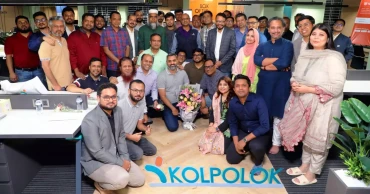
Kolpolok starts providing Odoo ERP software solution in Bangladesh
Kolpolok Technologies has become a partner of Odoo ERP that empowers 12 million users globally in enterprise resource planning.
Odoo is a Belgian suite of business management software tools, including customer relationship management, e-commerce, accounting, and inventory management.
Kolpolok chief executive officer SM Nazmul Hasan made this announcement at a function at its head office in the capital’s Shyamoli.
Some 70 members of BASIS were present on the occasion. Odoo ERP has an app store with thousands of business solutions. The software has no vendor lock-in and is open source. Customers can easily buy software from one vendor and get software services from another.
Infinix Hot 40 Pro Review: Budget-friendly Phone with Premium Features
The software can be easily customised as per your convenience, which is time-consuming for most of the ERP software in the market. Odoo ERP has gained popularity due to its open-source mode, modularity, easy integration, scalability, user-friendly interface, mobile accessibility, low cost, and active community.
Regarding the new solutions, Kolpolok CEO SM Nazmul Hasan hoped that Odoo ERP software will play an essential role in building a smart Bangladesh. “As Odoo has a global reputation, it will be possible to earn a lot of foreign currency in the near future with the functional and development support of ERP work,” he said.
Kolpolok Software has announced the partnership with Odoo ERP that is already connected to over 5000 partners across the world. To ensure maximum service in the Bangladesh market, the Kolpolok developers will provide module-based skills and are ready to provide customer relationship management, inventory management, and human resource management on Odoo platforms. Kolpolok is serving clients in both enterprise and community versions.
Best of Consumer Electronics Show 2024: The Top Picks
Hundreds of applications in both versions are capable of automating any business organization. The company has already uploaded customised modules of both hotel management and hospital management software on the Odoo app store, which are currently available for free.
Kolpolok has its own experienced Odoo developers and consultants who provide application customization and consultation services as per customer requirements. They also provide necessary assistance in database migration.
2 years ago

Grameenphone launches ‘AppCity,’ Bangladesh's first cross-platform marketplace
Telecom operator Grameenphone has introduced the country’s first cross-platform app marketplace “AppCity”, aiming to transform the digital landscape.
This platform connects app developers and publishers with both B2C and B2B customers, promoting innovation, smart solutions, and accessibility in Bangladesh's pursuit of a "Smart Bangladesh," according to a press release.
Zunaid Ahmed Palak MP, State Minister of the Ministry of Posts, Telecommunications, and Information Technology, graced the event as the Chief Guest, held at a hotel in Dhaka on Tuesday.
Read: Asus ROG Phone 8 Pro Review: A High-end Gaming Device
Also, present during the event were Petter-Børre Furberg, Chairman of Grameenphone Ltd. and Head of Telenor Asia, Yasir Azman, Chief Executive Officer (CEO) of Grameenphone and other key management members of the organization, it said.
App marketplace “AppCity”, a pivotal part of Grameenphone's telco-tech journey, is a unified platform offering a diverse range of applications and Software as a Service (SaaS) solutions. Functioning as both an App Store and API hub, this marketplace connects content providers and application developers with individual and corporate customers.
One of the distinctive features of “AppCity” is its built-in Android, iOS, and telco API capabilities offered seamlessly to B2C and B2B platforms, making it the first cross-platform app marketplace in Bangladesh. This development opens new avenues for non-coders to engage in app development, aligning with the platform's guided UI for easy app creation—comparable to some existing renowned platforms, said the release.
“AppCity” also claimed the title of being the first comprehensive B2B app marketplace in Bangladesh. Distinguishing itself from conventional app marketplaces, “AppCity” introduces curated expert ratings alongside conventional user ratings. Furthermore, to enhance accessibility, it integrates with Mobile Financial Services (MFS) in addition to telco billing and conventional payment methods. The platform also offers a broader range of payment channels compared to other market players, the release also said.
Read: Walton NEXG N25 Review: A Budget-friendly Smartphone with Standard Features
“AppCity is a significant leap towards a smart future for the smart nation, reflecting our national aspirations. Integrating the innovations, the platform creates diverse opportunities for young entrepreneurs to actively contribute and thrive in shaping the ‘Smart Bangladesh,” said Palak.
“AppCity is for the people of Bangladesh and will be built by the people of Bangladesh. I invite and encourage everyone, to participate in the hackathon that will be arranged to contribute to build AppCity, for a smarter nation," he added.
“We are pleased to see Grameenphone stepping up and building AppCity, which not only empowers developers but ultimately enhances the digital experience for customers and businesses. In line with our commitment to a Smart Bangladesh, this industry-first initiative reflects our ongoing efforts to contribute to the country's technological advancement and digital transformation,” said Petter-Børre Furberg
"With AppCity, we are laying the foundation for a more connected and accessible smart future. This platform encapsulates our vision of creating a smarter, inclusive, safer, and sustainable ecosystem. Fostering connectivity that empowers society and propelling the ‘Smart Bangladesh’, our dedication goes beyond conventional telecom services. Grameenphone is reshaping its portfolio to include state-of-the-art ICT and IoT solutions, ensuring we stay ahead in meeting the dynamic needs of an interconnected world,” said Yasir Azman.
2 years ago

Samsung Electronics Chairman acquitted of financial crimes
A South Korean court on Monday acquitted Samsung Electronics Chairman Lee Jae-yong of financial crimes involving a contentious merger between Samsung affiliates in 2015 that tightened his grip over South Korea’s biggest company.
The ruling by the Seoul Central District Court could ease the legal troubles surrounding the Samsung heir less than two years after he was pardoned of a separate conviction of bribery in a corruption scandal that toppled a previous South Korean government.
Read: Wanbo Mozart 1 Projector Review: A Smart Home Theatre Experience
The court said the prosecution failed to sufficiently prove the merger between Samsung C&T and Cheil Industries was unlawfully conducted with an aim to strengthen Lee’s control over Samsung Electronics.
Prosecutors had sought a five-year jail term for Lee, who was accused of stock price manipulation and accounting fraud. It wasn’t immediately clear whether they would appeal. Lee had denied wrongdoing in the current case, describing the 2015 merger as “normal business activity.”
Lee, 56, did not answer questions from reporters as left the court. You Jin Kim, Lee's lawyer, praised the court for confirming that the merger was legal.
Lee, a third-generation corporate heir who was officially appointed as the chairman of Samsung Electronics in October 2022, has led the Samsung group of companies since 2014, when his late father, former chairman Lee Kun-hee, suffered a heart attack.
Lee Jae-yong served 18 months in prison after being convicted in 2017 over separate bribery charges related to the 2015 deal. He was originally sentenced for five years in prison for offering 8.6 billion won ($6.4 million) worth of bribes to then-President Park Geun-hye and her close confidante to win government support for the 2015 merger, which was key to strengthening his control over the Samsung business empire and solidifying the father-to-son leadership succession.
Lee was released on parole in 2021 and pardoned by South Korean President Yoon Suk Yeol in August 2022, in moves that extended a history of leniency toward major white-collar crime in South Korea and preferential treatment for convicted tycoons.
Some shareholders had opposed the 2015 merger, saying that it unfairly benefited the Lee family while hurting minority shareholders. There was also public anger over how the national pension fund’s stake in Samsung C&T, the merged entity, fell by an estimated hundreds of millions of dollars, after Park had pressured the National Pension Service to support the deal.
Read: Walton NEXG N25 Review: A Budget-friendly Smartphone with Standard Features
Park and her confidante were also convicted in the scandal and enraged South Koreans staged massive protests for months demanding an end to the shady ties between business and politics. The demonstrations eventually led to Park’s ouster from office.
Lee has been navigating one of his toughest stretches as the leader of one of the world’s largest makers of computer chips and smartphones, with Russia’s war on Ukraine and other geopolitical turmoil hurting the world economy and deflating technology spending.
The company last week reported an annual 34% decline in operating profit for October-December quarter as sluggish demands for its TVs and other consumer electronics products offset hard-won gains from a slowly revering memory chip market.
2 years ago

Why iPhone users should turn on the new Stolen Device Protection
You’re in a crowded bar when a thief watches you unlock your iPhone with your passcode, then swipes it. That sinking feeling hits when you realize it’s gone, along with priceless photos, important files, passwords on banking apps and other vital parts of your digital life.
Apple rolled out an update to its iOS operating system this week with a feature called Stolen Device Protection that makes it a lot harder for phone thieves to access key functions and settings. Users are being urged to turn it on immediately.
Here’s how to activate the new security option and why it’s so important:
The software update for iPhones and iPads includes the essential new feature designed to foil thieves from wiping phones for resale or accessing Apple ID or other important accounts. Stolen Device Protection is a new setting that’s included with the latest iOS release, version 17.3.
Apple says the feature, buried in your iPhone’s settings, adds an extra layer of security for users. It addresses a vulnerability that thieves have discovered and exploited: allowing them to lock victims out of their Apple accounts, delete their photos and other files from their iCloud accounts and empty their bank accounts by accessing passwords kept in the Keychain password manager.
Apple is introducing the feature as anecdotal evidence suggests phone thefts are surging. Stories of stolen phones abound on Reddit groups and in news articles in places from Los Angeles to London, where police say pickpocketing, “table surfing” and moped snatching are common tactics.
The Wall Street Journal reported last year how criminals watched people use their passcodes to gain access to their personal information after stealing their phones.
HOW DOES STOLEN DEVICE PROTECTION WORK?
Stolen Device Protection keeps track of a user’s “familiar locations,” such as their home or workplace, and adds extra biometric security hoops to jump through if someone tries to use the device to do certain things when it’s away from those places.
It also reduces the importance of passcodes, which thieves can steal by peering over someone’s shoulder or threatening and forcing victims to hand them over, in favor of “biometric” features such as faces or fingerprints that are a lot harder to duplicate.
Let’s say the bar thief that snatched your iPhone tries to erase its contents and settings to sell it. With Stolen Device Protection turned on, the phone will now require a Face ID or Touch ID scan to verify that person is the rightful owner.
And that’s the only way — the new feature doesn’t let someone use the passcode or any other backup method.
Other actions that will trigger this feature if it’s not at a familiar place include using passwords saved in Keychain or payment methods saved in Safari, turning off Lost Mode, applying for a new Apple Card or using the iPhone to set up a new device.
There’s also a second layer designed to slow down thieves trying to access critical security settings. If someone tries to, say, sign out of an Apple ID account, change the passcode or reset the phone while it’s in an unfamiliar location, they’ll have to authenticate using Face ID or Touch ID, wait an hour, then do a second facial or fingerprint scan.
Changing an Apple ID password, updating Apple ID security settings, adding or removing Face or Touch ID, and turning off the Find My device feature or Stolen Device Protection also will trigger this feature.
“The security delay is designed to prevent a thief from performing critical operations so that you can mark your device as lost and make sure your Apple account is secure,” the company said. “When your iPhone is in a familiar location, these additional steps will not be required and you can use your device passcode like normal.”
2 years ago