Tech-News

Airlines roll out software update for Airbus A320 following sudden altitude drop incident
Airbus and European aviation regulators announced Friday that airlines must install a software update on Airbus A320 aircraft after a JetBlue plane experienced a sudden altitude drop last month. The required fix could lead to some delays as Thanksgiving travelers head home.
Airbus said its investigation into the JetBlue incident found that strong solar radiation can corrupt essential flight-control data on A320-series jets. The European Union Aviation Safety Agency issued a directive ordering carriers to apply the software correction, warning that it could cause temporary disruptions to flight schedules.
American Airlines, which operates roughly 480 aircraft in the A320 family, said 209 of its planes need the update. Most will be fixed by Friday, with the remaining few completed on Saturday. The airline anticipates some delays but aims to avoid cancellations, emphasizing that passenger safety comes first.
Delta expects fewer than 50 of its A321neo jets to be affected. United said only six aircraft in its fleet require the update and any resulting flight impacts should be minimal. Hawaiian Airlines reported that none of its planes are affected.
Mike Stengel, an aviation industry consultant with AeroDynamic Advisory, said the update can usually be completed between flights or during overnight maintenance. He acknowledged the poor timing but noted that the software patch only takes a few hours to install.
The JetBlue incident occurred on Oct. 30 during a flight from Cancun to Newark, forcing the aircraft to divert to Tampa, Florida, after at least 15 passengers were injured and taken to hospitals.
Airbus, headquartered in France and registered in the Netherlands, is one of the world’s largest aircraft makers alongside Boeing. The A320 family—whose updated version is known as the A320neo—is the main competitor to Boeing’s 737 and is currently the world’s best-selling single-aisle jet, according to Airbus.
3 months ago

US-Russian trio begins 8-month stay aboard International Space Station
A crew of three from the United States and Russia began their long-duration mission on the International Space Station (ISS) after launching Thursday aboard a Russian Soyuz spacecraft.
The Soyuz MS-28 spacecraft was sent into orbit at 2:27 p.m. local time from the Baikonur Cosmodrome in Kazakhstan, which Russia operates under lease. On board were NASA astronaut Chris Williams and Russian cosmonauts Sergei Mikaev and Sergei Kud-Sverchkov. The capsule successfully docked with the ISS at 5:34 p.m.
The team will remain on the orbiting laboratory for roughly eight months. According to NASA, both Williams — a physicist — and Mikaev — a military aviator — are making their first journey to space. Kud-Sverchkov is on his second mission.
They join the station’s current occupants: NASA astronauts Mike Fincke, Zena Cardman and Jonny Kim; Japan’s Kimiya Yui; and Russian cosmonauts Sergei Ryzhikov, Alexei Zubritsky and Oleg Platonov.
China launches Shenzhou 22 to support return of Astronauts left without backup craft
NASA said Williams’ main responsibilities will include conducting scientific experiments and technology demonstrations that support future deep-space missions and offer benefits for people on Earth.
Roscosmos reported Thursday evening that the newly arrived crew was “in good health” following the flight. However, engineers inspecting the Baikonur launch pad after liftoff found “damage to several components.”
The agency noted that assessments were underway but added that replacement parts were available and repairs would be completed soon.
Source: AP
3 months ago
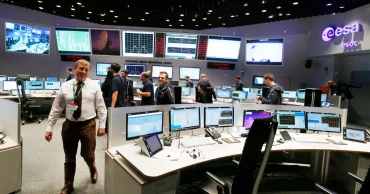
Europe ramps up pace investment as competition intensifies
The European Space Agency said Thursday it would increase its budget for the next three years to almost 22.1 billion euros ($25.6 billion).
Ahead of two-day agency conference starting Thursday in the German city of Bremen, ESA Director General Josef Aschbacher had expressed concern that Europe could be left behind in space travel if it didn't invest more money, German news agency dpa reported.
On Thursday, Aschbacher thanked ESA's 23 European member states for their contributions.
“I think the message that Europe must catch up and get involved in order to literally give wings to Europe’s future through space travel was taken very seriously by our ministers,” he said.
Germany, one of ESA's main financial contributors, said it plans to significantly increase its budget for the agency to more than 5 billion euros.
“Last time it was just under 3.5 billion, this time we have set ourselves a target of 5 billion,” German Space Minister Dorothee Bär said at a meeting of the agency's ministerial council.
On the sidelines of the meeting, Aschbacher also said that ESA was hoping that a European could fly to the moon in the future as part of the U.S. space agency NASA's Artemis program, dpa reported.
“I have decided that the first Europeans to fly on a lunar mission will be ESA astronauts of German, French, and Italian nationality," Aschbacher said, according to dpa.
ESA also signed a letter of intent with Norway to advance the prospect of a new ESA Arctic Space Centre to be hosted in the country's northern city of Tromsø.
“The Arctic is an important scientific ecosystem as well as being significant economically and geopolitically,” ESA said in a statement, adding that space-based technologies can help monitor climate change, support sustainable development, civil safety and security and regional energy management.
ESA is an intergovernmental organization including 23 European member states with the mission to shape the development of Europe’s space capability.
3 months ago

Australia to proceed with under-16 social media ban despite court challenge
Australia confirmed Wednesday that its upcoming ban on social media accounts for children under 16 will roll out next month as planned, even as a rights group launches a legal fight against the landmark law.
The Sydney-based Digital Freedom Project announced it has filed a constitutional challenge in the High Court targeting the legislation, which is set to come into force on Dec. 10 and would bar Australians under 16 from creating accounts on designated social media platforms.
Communications Minister Anika Wells acknowledged the legal action while telling Parliament the government would not back down.
“We will not be intimidated by Big Tech or by court challenges. We stand firm on behalf of Australian parents,” Wells said.
Digital Freedom Project president John Ruddick, a New South Wales state MP from the Libertarian Party, criticized the law as overreach.
“Monitoring children’s online activity is the most important parental duty today. We don’t want that handed over to the government or unelected officials,” Ruddick said. He added that the ban infringes on young people’s right to political expression.
The case is being led by Pryor, Tzannes and Wallis Solicitors on behalf of two 15-year-olds. Spokesperson Sam Palmer said it was unclear whether the group would seek an injunction to pause the law before the hearing.
Meanwhile, Meta has already started notifying thousands of Australian users believed to be under 16, urging them to download their data and remove their accounts from Facebook, Instagram and Threads ahead of the deadline.
Mobile internet shutdowns spark rising public frustration across Russia
Under the new rules, Meta’s platforms, along with Snapchat, TikTok, X and YouTube, must take reasonable measures to prevent users under 16 from accessing their services or face penalties of up to 50 million Australian dollars ($32 million).
Malaysia has announced a similar plan to restrict social media access for children under 16 beginning in 2026. Communications Minister Fahmi Fadzil said the policy aims to protect minors from threats such as cyberbullying, fraud and sexual exploitation. The government is reviewing Australia’s model and may incorporate ID card or passport-based age verification.
Source: AP
3 months ago

China launches Shenzhou 22 to support return of Astronauts left without backup craft
China on Tuesday launched the Shenzhou 22 spacecraft to provide a safe return option for three astronauts on its Tiangong space station after their original craft was deemed unfit for use.
Shenzhou 22 successfully docked with Tiangong the same day and will serve as the return vehicle for the crew that arrived on November 1, though they are not scheduled to come home until 2026.
The move follows an incident earlier this month involving the Shenzhou 20 mission. That crew’s return to Earth was delayed by nine days after their spacecraft suffered window damage. They ultimately came back aboard the newly arrived Shenzhou 21, which had ferried their replacements to the station.
While the Shenzhou 20 astronauts landed safely, the damage meant the new three-member team stationed at Tiangong had no emergency return craft available until Shenzhou 22’s arrival.
According to state broadcaster CCTV, the damaged Shenzhou 20 capsule will be brought back to Earth later for inspection, as it no longer meets safety requirements for crewed reentry.
Mobile internet shutdowns spark rising public frustration across Russia
China has been steadily expanding its space program with continuous missions to Tiangong, which was built after Beijing was barred from participating in the International Space Station due to U.S. security concerns over China’s military-run space program.
Tiangong — meaning “Heavenly Palace” — welcomed its first crew in 2021 and is smaller than the ISS, which has been in orbit for 25 years.
Source: AP
3 months ago

Trump launches “Genesis Mission” AI initiative to accelerate scientific breakthroughs
President Donald Trump has ordered the federal government to work with technology companies and universities to transform government data into new scientific discoveries, advancing his plan to make artificial intelligence a central driver of U.S. economic growth.
On Monday, Trump announced the “Genesis Mission” through an executive order directing the Department of Energy and national laboratories to create a unified digital platform that will consolidate the nation’s scientific data.
The initiative invites private companies and universities to apply their AI capabilities to federal challenges in engineering, energy, and national security—such as improving the efficiency of the U.S. electric grid—according to White House officials who briefed reporters anonymously ahead of the order’s signing. They did not suggest that medical research was a focus of the program.
According to the executive order, the Genesis Mission will unite America’s research assets—national lab scientists, private industry, universities, and existing data and infrastructure—to dramatically speed up AI innovation and deployment.
The White House described the undertaking as the largest mobilization of federal scientific resources since the Apollo missions, even as the administration has reduced billions in research funding and many scientists have lost jobs and grants.
Trump is increasingly relying on the tech industry and AI development to fuel economic growth. That strategy was highlighted during his recent meeting with Saudi Crown Prince Mohammed bin Salman, who has pledged $1 trillion—largely from oil and gas revenues—to transform Saudi Arabia into a major AI data hub.
Funding for the U.S. portion of the initiative was included in the tax and spending package Trump signed in July, officials said.
Although AI’s high electricity usage has sparked concerns about rising energy bills—an issue that could pose political risks for Trump—administration officials argued that costs should fall over time. They said growing demand will expand transmission capacity and ultimately lower the cost per unit of electricity.
Data centers powering AI consumed roughly 1.5% of global electricity last year, and their energy use is expected to more than double by 2030, the International Energy Agency reports. This growth could result in increased burning of fossil fuels like coal and natural gas, which produce greenhouse gases linked to climate change.
The Genesis Mission will draw on both national laboratory supercomputers and private-sector high-performance computing systems. Because the project involves public data—including national security information—used alongside private computing resources, officials emphasized that safeguards would be in place to protect sensitive information.
3 months ago

Mobile internet shutdowns spark rising public frustration across Russia
Russia has been experiencing widespread mobile internet outages, causing daily disruptions — from payment failures on public transport to parents being unable to remotely monitor diabetic children.
Authorities claim the shutdowns help prevent Ukrainian drones from navigating, but experts say the measure hasn’t reduced attacks.
During these blackouts, only a limited set of government-approved “white-listed” websites and services remain accessible, raising public concern about growing state control and loss of digital freedom.
New restrictions also block SIM cards that were recently abroad or inactive, creating problems for devices like utility meters and cars that rely on mobile networks.
Popular messaging apps WhatsApp and Telegram face throttling or partial blocking, while the state promotes its own app, MAX, which critics warn lacks privacy protections and can share user data with authorities.
Although many Russians use VPNs to bypass restrictions, they are routinely blocked. Analysts say the government aims to gradually push people toward state-approved platforms, suggesting that even tighter internet controls may be coming.
3 months ago

OpenAI, Foxconn partner to build AI hardware in US
OpenAI and Taiwanese electronics giant Foxconn have announced a new partnership to jointly design and manufacture key hardware for artificial intelligence data centers in the United States, marking a significant step toward strengthening America’s AI infrastructure.
Under the agreement, Foxconn — the world’s largest contract electronics maker and a supplier for Nvidia and Apple — will co-design AI data center racks with OpenAI. The products to be manufactured at Foxconn’s U.S. facilities will include cabling, networking components and power systems, the companies said in separate statements Thursday and Friday. OpenAI will have early access to evaluate and potentially purchase the equipment.Both sides said the initial partnership does not include financial commitments or binding purchase agreements.
Foxconn, formally known as Hon Hai Precision Industry Co., operates factories in Wisconsin, Ohio and Texas. The company has been expanding beyond consumer electronics, investing in electric vehicles and acquiring additional electronics firms. A Model A electric vehicle produced by its affiliate Foxtron was showcased at Friday’s event, with executives emphasizing affordability.
Alexis Bjorlin, a vice president at Nvidia, said the collaboration could also help Taiwan build up its own computing infrastructure while keeping sensitive technology and data secure.
“This partnership is a step toward ensuring the core technologies of the AI era are built here,” OpenAI CEO Sam Altman said, adding that the initiative would reinforce U.S. leadership in the global AI race.
OpenAI has pledged $1.4 trillion to build out AI infrastructure and recently formed multi-billion-dollar alliances with Nvidia and AMD to bolster computing capacity. It is also working with U.S. chipmaker Broadcom to design and produce custom AI chips.
Meta wins landmark FTC antitrust case, won’t be forced to split off Instagram or WhatsApp
Despite rapid revenue growth — Altman says the company expects more than $20 billion in annualized revenue this year — investors have raised concerns over whether OpenAI can sustain its massive spending plans.
Foxconn’s shares have climbed 25% this year amid the global AI boom. Its July–September net profit rose 17% to NT$57.6 billion ($1.8 billion), driven largely by its cloud and networking business, including AI servers.
“We believe the importance of the AI industry is increasing significantly,” Chairman Young Liu said, expressing optimism that partnerships with major clients will deepen next year.
Source: AP
3 months ago

Asian shares surge as Nvidia's strong quarterly earnings lift sentiments
Asian stock markets surged Thursday following Nvidia’s stronger-than-expected quarterly earnings, easing concerns that AI-driven stock valuations had climbed too high. U.S. futures and oil prices also rose.
Japan’s Nikkei 225 jumped as much as 4.2% before easing to 2.6%, closing at 49,801.81, boosted by tech stocks after Nvidia reported $57 billion in quarterly revenue. South Korea’s Kospi gained 3% to 4,047.57, led by technology and energy shares. Samsung Electronics rose 6.1%, while SK Hynix added 3.5%.
Chinese markets saw smaller gains, with Hong Kong’s Hang Seng up 0.1% to 25,867.87 and the Shanghai Composite rising 0.4% to 3,961.71. Taiwan’s Taiex climbed 3.2%. Australia’s S&P/ASX 200 advanced 1.2% to 8,546.10, led by tech stocks.
Wall Street had mixed results Wednesday. The S&P 500 rose 0.4%, ending a four-day losing streak, while the Dow Jones gained 47 points (0.1%) and the Nasdaq added 0.6%. Constellation Energy jumped 5.3% after the U.S. Department of Energy approved a $1 billion loan to restart its Three Mile Island nuclear plant. Lowe’s rose 4% on stronger-than-expected summer profits, offsetting a 2.8% drop for Target.
Nvidia, Wall Street’s largest stock, climbed 2.8% before the earnings release and surged 5.1% in after-hours trading. Analysts note that Nvidia’s results significantly influence the S&P 500 and reflect broader AI-driven market sentiment.
Investors also await the U.S. government’s September jobs report, which could affect Federal Reserve interest rate decisions. While the Fed has cut rates twice this year, some officials suggest a pause due to persistent inflation above the 2% target.
In commodities, U.S. crude rose 16 cents to $59.41 per barrel and Brent crude edged up 16 cents to $63.67. The dollar strengthened to 157.32 Japanese yen, while the euro fell to $1.1520.
3 months ago
Meta wins landmark FTC antitrust case, won’t be forced to split off Instagram or WhatsApp
Meta has emerged victorious in a major antitrust battle that threatened the future of its business and could have compelled the company to divest Instagram and WhatsApp. A federal judge ruled Tuesday that Meta does not currently hold a monopoly in social networking.
The decision from U.S. District Judge James Boasberg follows a historic trial that concluded in late May. His ruling stands in sharp contrast to recent court decisions against Google, which was found to have monopolized both search and digital advertising — significant blows to an industry long accustomed to rapid, unrestricted expansion.
Boasberg wrote that the Federal Trade Commission “continues to insist that Meta competes with the same old rivals it has for the last decade,” and that it failed to prove Meta still possesses monopoly power. “Whether or not Meta enjoyed monopoly power in the past,” he wrote, “the agency must show that it continues to hold such power now. The FTC has not done so.”
The FTC argued that Meta maintained dominance by following CEO Mark Zuckerberg’s 2008 philosophy that “it is better to buy than compete,” allegedly using acquisitions to neutralize rising threats. During testimony in April, Zuckerberg rejected claims that Facebook bought Instagram to crush competition, downplaying the significance of old internal emails raised by FTC lawyers.
Boasberg emphasized that the core issue was not the decade-old acquisitions — which the FTC approved — but whether Meta is a monopoly today. Prosecutors would need to show a “current or imminent legal violation” to prevail, he wrote.
The FTC also accused Facebook of imposing policies that hindered smaller competitors as the industry transitioned from desktop to mobile platforms.
Meta welcomed the ruling, saying it reflects the “fierce competition” the company faces. Chief Legal Officer Jennifer Newstead said the company’s products “exemplify American innovation” and that Meta hopes to continue collaborating with the Biden administration.
EU finds Meta and TikTok in breach of transparency rules
Boasberg noted that the social media ecosystem has evolved dramatically since the FTC filed the case in 2020. Previous dismissals of the lawsuit didn’t even mention TikTok, which he now described as Meta’s most formidable rival. Citing the philosopher Heraclitus, he wrote that the online world changes too rapidly to be neatly divided into fixed categories like “social networking” and “social media.”
Industry analysts called the ruling expected, noting Meta’s aggressive efforts to counter TikTok. However, they warned the company still faces major regulatory challenges — including upcoming lawsuits over social media’s impact on children’s mental health.
Facebook’s acquisitions of Instagram in 2012 for $1 billion and WhatsApp in 2014 for $22 billion were pivotal in shifting its operations from desktop to mobile and maintaining relevance among younger users. But the FTC’s definition of Meta’s competitive landscape excludes TikTok, YouTube, and Apple’s messaging service as rivals.
Investors reacted calmly to the ruling. Meta shares slipped $1.52 to $600.49 on Tuesday afternoon, mirroring broader market trends.
Source: AP
3 months ago