Social-Media
.jpg)
Plenty of pitfalls await Zuckerberg’s ‘metaverse’ plan
When Mark Zuckerberg announced ambitious plans to build the “metaverse” — a virtual reality construct intended to supplant the internet, merge virtual life with real life and create endless new playgrounds for everyone — he promised that “you’re going to able to do almost anything you can imagine.”
That might not be such a great idea.
Zuckerberg, CEO of the company formerly known as Facebook, even renamed it Meta to underscore the significance of the effort. During his late October presentation, he effused about going to virtual concerts with your friends, fencing with holograms of Olympic athletes and — best of all — joining mixed-reality business meetings where some participants are physically present while others beam in from the metaverse as cartoony avatars.
But it’s just as easy to imagine dystopian downsides. Suppose the metaverse also enables a vastly larger, yet more personal version of the harassment and hate that Facebook has been slow to deal with on today’s internet? Or ends up with the same big tech companies that have tried to control the current internet serving as gatekeepers to its virtual-reality edition? Or evolves into a vast collection of virtual gated communities where every visitor is constantly monitored, analyzed and barraged with advertisements? Or foregoes any attempt to curtail user freedom, allowing scammers, human traffickers and cybergangs to commit crimes with impunity?
Picture an online troll campaign — but one in which the barrage of nasty words you might see on social media is instead a group of angry avatars yelling at you, with your only escape being to switch off the machine, said Amie Stepanovich, executive director of Silicon Flatirons at the University of Colorado.
“We approach that differently — having somebody scream at us than having somebody type at us,” she said. “There is a potential for that harm to be really ramped up.”
Read: Facebook to shut down face-recognition system, delete data
That’s one reason Meta might not be the best institution to lead us into the metaverse, said Philip Rosedale, founder of the virtual escape Second Life, which was an internet craze 15 years ago and still attracts hundreds of thousands of online inhabitants.
The danger is creating online public spaces that appeal only to a “polarized, homogenous group of people,” said Rosedale, describing Meta’s flagship VR product, Horizon, as filled with “presumptively male participants” and a bullying tone. In a safety tutorial, Meta has advised Horizon users to treat fellow avatars kindly and offers tips for blocking, muting or reporting those who don’t, but Rosedale said it’s going to take more than a “schoolyard monitor” approach to avoid a situation that rewards the loudest shouters.
“Nobody’s going to come to that party, thank goodness,” he said. “We’re not going to move the human creative engine into that sphere.”
A better goal, he said, would be to create systems that are welcoming and flexible enough to allow people who don’t know each other to get along as well as they might in a real place like New York’s Central Park. Part of that could rely on systems that help someone build a good reputation and network of trusted acquaintances they can carry across different worlds, he said. In the current web environment, such reputation systems have had a mixed record in curbing toxic behavior.
It’s not clear how long it will take Meta, or anyone else investing in the metaverse, to consider such issues. So far, tech giants from Microsoft and Apple to video game makers are still largely focused on debating the metaverse’s plumbing.
To make the metaverse work, some developers say they are going to have to form a set of industry standards similar to those that coalesced around HTML, the open “markup language” that’s been used to structure websites since the 1990s.
“You don’t think about that when you go to a website. You just click on the link,” said Richard Kerris, who leads the Omniverse platform for graphics chipmaker Nvidia. “We’re going to get to the same point in the metaverse where going from one world to another world and experiencing things, you won’t have to think about, ‘Do I have the right setup?’”
Nvidia’s vision for an open standard involves a structure for 3D worlds built by movie-making studio Pixar, which is also used by Apple. Among the basic questions being resolved are how physics will work in the metaverse — will virtual gravity cause someone’s glass to smash into pieces if they drop it? Will those rules change as you move from place to place?
Bigger disagreements will center on questions of privacy and identity, said Timoni West, vice president of augmented and virtual reality at Unity Technologies, which builds an engine for video game worlds.
“Being able to share some things but not share other things” is important when you’re showing off art in a virtual home but don’t want to share the details of your calendar, she said. “There’s a whole set of permission layers for digital spaces that the internet could avoid but you really need to have to make this whole thing work.”
Read: In the middle of a crisis, Facebook Inc. renames itself Meta
Some metaverse enthusiasts who’ve been working on the concept for years welcome the spotlight that could attract curious newcomers, but they also want to make sure Meta doesn’t ruin their vision for how this new internet gets built.
“The open metaverse is created and owned by all of us,” said Ryan Gill, founder and CEO of metaverse-focused startup Crucible. “The metaverse that Mark Zuckerberg and his company want is created by everybody but owned by them.”
Gill said Meta’s big splash is a reaction to ideas circulating in grassroots developer communities centered around “decentralized” technologies like blockchain and non-fungible tokens, or NFTs, that can help people establish and protect their online identity and credentials.
Central to this tech movement, nicknamed Web 3, for a third wave of internet innovation, is that what people create in these online communities belongs to them, a shift away from the Big Tech model of “accumulating energy and attention and optimizing it for buying behavior,” Gill said.
Evan Greer, an activist with Fight for the Future, said it’s easy to see Facebook’s Meta announcement as a cynical attempt to distance itself from all the scandals the company is facing. But she says Meta’s push is actually even scarier.
“This is Mark Zuckerberg revealing his end game, which is not just to dominate the internet of today but to control and define the internet that we leave to our children and our children’s children,” she said.
The company recently abandoned its use of facial recognition on its Facebook app, but metaverse gadgetry relies on new forms of tracking people’s gaits, body movements and expressions to animate their avatars with real-world emotions. And with both Facebook and Microsoft pitching metaverse apps as important work tools, there’s a potential for even more invasive workplace monitoring and exhaustion.
Activists are calling for the U.S. to pass a national digital privacy act that would apply not just to today’s platforms like Facebook but also those that might exist in the metaverse. Outside of a few such laws in states such as California and Illinois, though, actual online privacy laws remain rare in the U.S.
4 years ago

Facebook to shut down face-recognition system, delete data
Facebook said it will shut down its face-recognition system and delete the faceprints of more than 1 billion people amid growing concerns about the technology and its misuse by governments, police and others.
“This change will represent one of the largest shifts in facial recognition usage in the technology’s history,” Jerome Pesenti, vice president of artificial intelligence for Facebook’s new parent company, Meta, wrote in a blog post on Tuesday.
He said the company was trying to weigh the positive use cases for the technology “against growing societal concerns, especially as regulators have yet to provide clear rules.” The company in the coming weeks will delete “more than a billion people’s individual facial recognition templates,” he said.
Facebook’s about-face follows a busy few weeks. On Thursday it announced its new name Meta for Facebook the company, but not the social network. The change, it said, will help it focus on building technology for what it envisions as the next iteration of the internet -- the “metaverse.”
The company is also facing perhaps its biggest public relations crisis to date after leaked documents from whistleblower Frances Haugen showed that it has known about the harms its products cause and often did little or nothing to mitigate them.
Read: Just what are 'The Facebook Papers,' anyway?
Facebook didn’t immediately respond to questions about how people could verify that their image data was deleted, or what it would be doing with the underlying technology.
More than a third of Facebook’s daily active users have opted in to have their faces recognized by the social network’s system. That’s about 640 million people. Facebook introduced facial recognition more than a decade ago but gradually made it easier to opt out of the feature as it faced scrutiny from courts and regulators.
Facebook in 2019 stopped automatically recognizing people in photos and suggesting people “tag” them, and instead of making that the default, asked users to choose if they wanted to use its facial recognition feature.
Facebook’s decision to shut down its system “is a good example of trying to make product decisions that are good for the user and the company,” said Kristen Martin, a professor of technology ethics at the University of Notre Dame. She added that the move also demonstrates the power of public and regulatory pressure, since the face recognition system has been the subject of harsh criticism for over a decade.
Meta Platforms Inc., Facebook’s parent company, appears to be looking at new forms of identifying people. Pesenti said Tuesday’s announcement involves a “company-wide move away from this kind of broad identification, and toward narrower forms of personal authentication.”
“Facial recognition can be particularly valuable when the technology operates privately on a person’s own devices,” he wrote. “This method of on-device facial recognition, requiring no communication of face data with an external server, is most commonly deployed today in the systems used to unlock smartphones.”
Apple uses this kind of technology to power its Face ID system for unlocking iPhones.
Researchers and privacy activists have spent years raising questions about the tech industry’s use of face-scanning software, citing studies that found it worked unevenly across boundaries of race, gender or age. One concern has been that the technology can incorrectly identify people with darker skin.
Another problem with face recognition is that in order to use it, companies have had to create unique faceprints of huge numbers of people – often without their consent and in ways that can be used to fuel systems that track people, said Nathan Wessler of the American Civil Liberties Union, which has fought Facebook and other companies over their use of the technology.
“This is a tremendously significant recognition that this technology is inherently dangerous,” he said.
Facebook found itself on the other end of the debate last year when it demanded that facial recognition startup ClearviewAI, which works with police, stop harvesting Facebook and Instagram user images to identify the people in them.
Concerns also have grown because of increasing awareness of the Chinese government’s extensive video surveillance system, especially as it’s been employed in a region home to one of China’s largely Muslim ethnic minority populations.
Facebook’s huge repository of images shared by users helped make it a powerhouse for improvements in computer vision, a branch of artificial intelligence. Now many of those research teams have been refocused on Meta’s ambitions for augmented reality technology, in which the company envisions future users strapping on goggles to experience a blend of virtual and physical worlds. Those technologies, in turn, could pose new concerns about how people’s biometric data is collected and tracked.
Read:In the middle of a crisis, Facebook Inc. renames itself Meta
Meta’s newly wary approach to facial recognition follows decisions by other U.S. tech giants such as Amazon, Microsoft and IBM last year to end or pause their sales of facial recognition software to police, citing concerns about false identifications and amid a broader U.S. reckoning over policing and racial injustice.
At least seven U.S. states and nearly two dozen cities have limited government use of the technology amid fears over civil rights violations, racial bias and invasion of privacy.
President Joe Biden’s science and technology office in October launched a fact-finding mission to look at facial recognition and other biometric tools used to identify people or assess their emotional or mental states and character. European regulators and lawmakers have also taken steps toward blocking law enforcement from scanning facial features in public spaces.
Facebook’s face-scanning practices also contributed to the $5 billion fine and privacy restrictions the Federal Trade Commission imposed on the company in 2019. Facebook’s settlement with the FTC included a promise to require “clear and conspicuous” notice before people’s photos and videos were subjected to facial recognition technology.
And the company earlier this year agreed to pay $650 million to settle a 2015 lawsuit alleging it violated an Illinois privacy law when it used photo-tagging without users’ permission.
“It is a big deal, it’s a big shift but it’s also far, far too late,” said John Davisson, senior counsel at the Electronic Privacy Information Center. EPIC filed its first complaint with the FTC against Facebook’s facial recognition service in 2011, the year after it was rolled out.
4 years ago
.jpg)
Facebook dithered in curbing divisive user content in India
Facebook in India has been selective in curbing hate speech, misinformation and inflammatory posts, particularly anti-Muslim content, according to leaked documents obtained by The Associated Press, even as its own employees cast doubt over the company’s motivations and interests.
From research as recent as March of this year to company memos that date back to 2019, the internal company documents on India highlights Facebook’s constant struggles in quashing abusive content on its platforms in the world’s biggest democracy and the company’s largest growth market. Communal and religious tensions in India have a history of boiling over on social media and stoking violence.
The files show that Facebook has been aware of the problems for years, raising questions over whether it has done enough to address these issues. Many critics and digital experts say it has failed to do so, especially in cases where members of Prime Minister Narendra Modi’s ruling Bharatiya Janata Party, or the BJP, are involved.
Across the world, Facebook has become increasingly important in politics, and India is no different.
Read: Amid the Capitol riot, Facebook faced its own insurrection
Modi has been credited for leveraging the platform to his party advantage during elections, and reporting from The Wall Street Journal last year cast doubt over whether Facebook was selectively enforcing its policies on hate speech to avoid blowback from the BJP. Both Modi and Facebook chairman and CEO Mark Zuckerberg have exuded bonhomie, memorialized by a 2015 image of the two hugging at the Facebook headquarters.
The leaked documents include a trove of internal company reports on hate speech and misinformation in India. In some cases, much of it was intensified by its own “recommended” feature and algorithms. But they also include the company staffers’ concerns over the mishandling of these issues and their discontent expressed about the viral “malcontent” on the platform.
According to the documents, Facebook saw India as of the most “at risk countries” in the world and identified both Hindi and Bengali languages as priorities for “automation on violating hostile speech.” Yet, Facebook didn’t have enough local language moderators or content-flagging in place to stop misinformation that at times led to real-world violence.
In a statement to the AP, Facebook said it has “invested significantly in technology to find hate speech in various languages, including Hindi and Bengali” which has resulted in “reduced the amount of hate speech that people see by half” in 2021.
“Hate speech against marginalized groups, including Muslims, is on the rise globally. So we are improving enforcement and are committed to updating our policies as hate speech evolves online,” a company spokesperson said.
This AP story, along with others being published, is based on disclosures made to the Securities and Exchange Commission and provided to Congress in redacted form by former Facebook employee-turned-whistleblower Frances Haugen’s legal counsel. The redacted versions were obtained by a consortium of news organizations, including the AP.
Back in February 2019 and ahead of a general election when concerns of misinformation were running high, a Facebook employee wanted to understand what a new user in the country saw on their news feed if all they did was follow pages and groups solely recommended by the platform’s itself.
Read: Facebook unveils new controls for kids using its platforms
The employee created a test user account and kept it live for three weeks, a period during which an extraordinary event shook India — a militant attack in disputed Kashmir had killed over 40 Indian soldiers, bringing the country to near war with rival Pakistan.
In the note, titled “An Indian Test User’s Descent into a Sea of Polarizing, Nationalistic Messages,” the employee whose name is redacted said they were “shocked” by the content flooding the news feed which “has become a near constant barrage of polarizing nationalist content, misinformation, and violence and gore.”
Seemingly benign and innocuous groups recommended by Facebook quickly morphed into something else altogether, where hate speech, unverified rumors and viral content ran rampant.
The recommended groups were inundated with fake news, anti-Pakistan rhetoric and Islamophobic content. Much of the content was extremely graphic.
One included a man holding the bloodied head of another man covered in a Pakistani flag, with an Indian flag in the place of his head. Its “Popular Across Facebook” feature showed a slew of unverified content related to the retaliatory Indian strikes into Pakistan after the bombings, including an image of a napalm bomb from a video game clip debunked by one of Facebook’s fact-check partners.
“Following this test user’s News Feed, I’ve seen more images of dead people in the past three weeks than I’ve seen in my entire life total,” the researcher wrote.
Read:Ex-Facebook manager criticizes company, urges more oversight
It sparked deep concerns over what such divisive content could lead to in the real world, where local news at the time were reporting on Kashmiris being attacked in the fallout.
“Should we as a company have an extra responsibility for preventing integrity harms that result from recommended content?” the researcher asked in their conclusion.
The memo, circulated with other employees, did not answer that question. But it did expose how the platform’s own algorithms or default settings played a part in spurring such malcontent. The employee noted that there were clear “blind spots,” particularly in “local language content.” They said they hoped these findings would start conversations on how to avoid such “integrity harms,” especially for those who “differ significantly” from the typical U.S. user.
Even though the research was conducted during three weeks that weren’t an average representation, they acknowledged that it did show how such “unmoderated” and problematic content “could totally take over” during “a major crisis event.”
The Facebook spokesperson said the test study “inspired deeper, more rigorous analysis” of its recommendation systems and “contributed to product changes to improve them.”
“Separately, our work on curbing hate speech continues and we have further strengthened our hate classifiers, to include four Indian languages,” the spokesperson said.
4 years ago

Likee’s #KnowledgeMonth campaign ends; 5,470 videos uploaded by 1,904 users
Likee Bangladesh’s recent initiative #KnowledgeMonth, organized in partnership with 10 Minute School, has been ended which received wide acclaim from different regions and turned out to be a successful activity owing to its potential to create an enabling and healthy online atmosphere for knowledge sharing.
Likee launched the campaign on September 3 to encourage its users creating and sharing videos focusing on various academic and co-curricular skills, which would not only enlighten people but also help them showcase their creative side.
During the campaign, a total of 5,470 videos were uploaded by 1,904 users, and a staggering number of 35.8 million engagements were recorded. Likee users have uploaded videos on different categories such as English learning, football, art & painting, cooking with a concentrated focus on two streams - #howto and #education.
Read: Likee teams up with 10 Minute School
Many famous figures from different fields such as teachers, researchers, sportspersons, artists, culinary and life-skill enthusiasts and renowned nutritionists have taken part in the campaign and come up with enlightening videos.
Abdullah Al Shihab, 10 Minute School’s PR and Communication Manager, said about managing the overall operations of the collaborative campaign of 10 Minute School and Likee, “We started this #KnowledgeMonth campaign with a goal of ensuring educational value on the short video platform as Likee which people typically use for entertainment purpose.”
The campaign segments were distributed according to the platform users’ need to reach out to each category of them easily.
Read: Likee launches campaign to promote cyber safety
Tamanna Chowdhury, a clinical dietitian and nutritionist, said about this campaign, “Through my short videos I usually talk about diet tips and nutrition. Of late, I have come across Likee Bangladesh's #KnowledgeMonth campaign, which seems to be a quite a gem for me. I have shared many videos portraying different pertinent aspects related to nutritional needs. I hope people will see those and be aware of their health.”
On the other hand, Iffat, another participant, said, “Apart from showcasing my cooking skills, I have also got to learn about different life skills including cooking, art, math, spoken English etc. I am happy as after joining #KnowledgeMonth I was able to create a new cooking account and my cooking account got the verification as well.”
Inspired by the response this campaign has received, Likee is encouraged to arrange such campaigns in the future to provide a platform to the video creators for displaying their personal talents and help them expand their career options as well. This type of campaign is expected to create an ambiance where content creators will be able to acquire and develop knowledge together and add value to the fellow users’ experience.
Read Short video platforms are new way of building communities: Head of Likee Operations in Bangladesh
4 years ago

Facebook unveils new controls for kids using its platforms
Facebook, in the aftermath of damning testimony that its platforms harm children, will be introducing several features including prompting teens to take a break using its photo sharing app Instagram, and “nudging" teens if they are repeatedly looking at the same content that's not conducive to their well-being.
The Menlo Park, California-based Facebook is also planning to introduce new controls for adults of teens on an optional basis so that parents or guardians can supervise what their teens are doing online. These initiatives come after Facebook announced late last month that it was pausing work on its Instagram for Kids project. But critics say the plan lacks details and they are skeptical that the new features would be effective.
The new controls were outlined on Sunday by Nick Clegg, Facebook's vice president for global affairs, who made the rounds on various Sunday news shows including CNN's “State of the Union" and ABC's “This Week with George Stephanopoulos" where he was grilled about Facebook's use of algorithms as well as its role in spreading harmful misinformation ahead of the Jan. 6 Capitol riots.
Read:Could Facebook sue whistleblower Frances Haugen?
“We are constantly iterating in order to improve our products,” Clegg told Dana Bash on “State of the Union" Sunday. “We cannot, with a wave of the wand, make everyone’s life perfect. What we can do is improve our products, so that our products are as safe and as enjoyable to use."
Clegg said that Facebook has invested $13 billion over the past few years in making sure to keep the platform safe and that the company has 40,000 people working on these issues. And while Clegg said that Facebook has done its best to keep harmful content out of its platforms, he says he was open for more regulation and oversight.
“We need greater transparency,” he told CNN’s Bash. He noted that the systems that Facebook has in place should be held to account, if necessary, by regulation so that “people can match what our systems say they’re supposed to do from what actually happens.”
The flurry of interviews came after whistleblower Frances Haugen, a former data scientist with Facebook, went before Congress last week to accuse the social media platform of failing to make changes to Instagram after internal research showed apparent harm to some teens and of being dishonest in its public fight against hate and misinformation. Haugen’s accusations were supported by tens of thousands of pages of internal research documents she secretly copied before leaving her job in the company’s civic integrity unit.
Read:Ex-Facebook manager criticizes company, urges more oversight
Josh Golin, executive director of Fairplay, a watchdog for the children and media marketing industry, said that he doesn't think introducing controls to help parents supervise teens would be effective since many teens set up secret accounts any way. He was also dubious about how effective nudging teens to take a break or move away from harmful content would be. He noted Facebook needs to show exactly how they would implement it and offer research that shows these tools are effective.
“There is tremendous reason to be skeptical," he said. He added that regulators need to restrict what Facebook does with its algorithms.
He said he also believes that Facebook should cancel its Instagram project for kids.
When Clegg was grilled by both Bash and Stephanopoulos in separate interviews about the use of algorithms in amplifying misinformation ahead of Jan. 6 riots, he responded that if Facebook removed the algorithms people would see more, not less hate speech, and more, not less, misinformation.
Read:Whistleblower: Facebook chose profit over public safety
Clegg told both hosts that the algorithms serve as “giant spam filters."
Democratic Sen. Amy Klobuchar of Minnesota, who chairs the Senate Commerce Subcommittee on Competition Policy, Antitrust, and Consumer Rights, told Bash in a separate interview Sunday that it's time to update children's privacy laws and offer more transparency in the use of algorithms.
“I appreciate that he is willing to talk about things, but I believe the time for conversation is done," said Klobuchar, referring to Clegg's plan. “The time for action is now.”
4 years ago
Could Facebook sue whistleblower Frances Haugen?
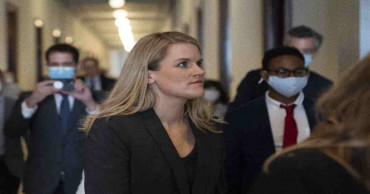
Facebook has recently taken a harsher tone toward whistleblower Frances Haugen, suggesting that the social network could be considering legal retaliation after Haugen went public with internal research that she copied before leaving her job earlier this year.
U.S. law protects whistleblowers who disclose information about potential misconduct to the government. But that protection doesn't necessarily cover taking corporate secrets to the media.
Facebook still has to walk a fine line. The company has to weigh whether suing Haugen, which could dissuade other employees who might otherwise speak out, is worth casting itself as a legal Godzilla willing to stomp on a woman who says she's just doing the right thing.
Haugen may face other consequences. Whistleblowers often put themselves at risk of professional damage — other firms may be reluctant to hire them in the future — and personal attacks from being in the public eye.
Read: Ex-Facebook manager criticizes company, urges more oversight
Facebook did not respond to emailed questions.
WHAT DID HAUGEN DO?
Haugen secretly copied a trove of internal Facebook documents before leaving the company and subsequently had her lawyers file complaints with the Securities and Exchange Commission alleging that Facebook hides what it knows about the negative effects of its platform.
John Tye, her lawyer, said the team gave redacted documents to Congress, where Haugen testified on Tuesday, and also informed officials in California. Haugen also shared documents with the Wall Street Journal, which she started talking to in December, leading to a series of explosive stories that began in mid-September.
WHAT WAS FACEBOOK'S RESPONSE?
The company says it has been mischaracterized. “I think most of us just don’t recognize the false picture of the company that is being painted,” CEO Mark Zuckerberg wrote to employees on Tuesday.
Some company officials have also begun using harsher language to describe Haugen's actions that could be interpreted as threatening.
In an Associated Press interview Thursday, Facebook executive Monika Bickert repeatedly referred to the documents Haugen copied as “stolen,” a word she has also used in other media interviews. David Colapinto, a lawyer for Kohn, Kohn and Colapinto who specializes in whistleblower cases, said that language was threatening.
In the same interview, asked if Facebook would sue or retaliate against the whistleblower, Bickert said only, “I can’t answer that.”
A week earlier, Antigone Davis, Facebook’s head of global safety, testified in the Senate that Facebook “would never retaliate against someone for speaking to Congress,” which left open the possibility that the company might go after her for giving documents to the Journal.
Read:Whistleblower: Facebook chose profit over public safety
IS HAUGEN PROTECTED?
Various laws offer whistleblower protection at both the state and federal levels. The federal laws applicable to Haugen are the Dodd-Frank Act, a 2010 Wall Street reform law, and the Sarbanes Oxley Act, a 2002 law that followed the collapse of Enron and other accounting scandals.
Dodd-Frank expanded protections for whistleblowers and empowered the SEC to take action against a company that threatens a whistleblower. Protections exist for both employees and former employees, experts say.
Asked about her risk because she went to the media, Haugen's lawyer, Tye, maintains that because Haugen went to the SEC, Congress and state authorities, she’s entitled to whistleblower protections. He said any suit from Facebook would be “frivolous" and that Facebook has not been in touch.
WHAT ABOUT HER LEAKS TO THE MEDIA?
Courts haven't tested whether leaking to the media is protected under Dodd-Frank, but Colapinto said the U.S. Secretary of Labor determined decades ago that environmental and nuclear-safety whistleblowers' communications with the media were protected. He argues that the language of Sarbanes-Oxley is modeled on those earlier statutes, and Haugen should have the same protections for any of her communications with reporters.
Read: Ex-Facebook manager alleges social network fed Capitol riot
Facebook could allege that Haugen broke her nondisclosure agreement by sharing company documents with the press, leaking trade secrets or just by making comments Facebook considers defamatory, said Lisa Banks of Katz, Marshall and Banks, who has worked on whistleblower cases for decades. "Like many whistleblowers, she’s extraordinarily brave and puts herself at personal and professional risk in shining a light on these practices,” she said.
Haugen effectively used leaks to the media to turn up the pressure on Congress and government regulators. Colapinto said her disclosures had a public-interest purpose that could complicate enforcing the NDA if Facebook chose to do so.
COULD FACEBOOK FACE BLOWBACK?
Facebook probably wants its veiled threats to unnerve other employees or former employees who might be tempted to speak out. “If they go after her, it won't be because they necessarily think they have a strong case legally, but sending a message to other would-be whistleblowers that they intend to play hardball,” Banks said.
But she said it would be a “disaster” for Facebook to go after Haugen. Regardless of potential legal vulnerabilities, Facebook might look like a bully if it pursued a legal case against her.
“The last thing Facebook needs is to rouse the ire of governmental authorities and the public at large by playing the role of the big bad giant company against the courageous individual whistleblower,” said Neil Getnick, whose firm, Getnick and Getnick, represents whistleblowers.
4 years ago

Ex-Facebook manager criticizes company, urges more oversight
While accusing the giant social network of pursuing profits over safety, a former Facebook data scientist told Congress Tuesday she believes stricter government oversight could alleviate the dangers the company poses, from harming children to inciting political violence to fueling misinformation.
Frances Haugen, testifying to the Senate Commerce Subcommittee on Consumer Protection, presented a wide-ranging condemnation of Facebook. She accused the company of failing to make changes to Instagram after internal research showed apparent harm to some teens and being dishonest in its public fight against hate and misinformation. Haugen’s accusations were buttressed by tens of thousands of pages of internal research documents she secretly copied before leaving her job in the company’s civic integrity unit.
But she also offered thoughtful ideas about how Facebook’s social media platforms could be made safer. Haugen laid responsibility for the company’s profits-over-safety strategy right at the top, with CEO Mark Zuckerberg, but she also expressed empathy for Facebook’s dilemma.
Haugen, who says she joined the company in 2019 because “Facebook has the potential to bring out the best in us,” said she didn’t leak internal documents to a newspaper and then come before Congress in order to destroy the company or call for its breakup, as many consumer advocates and lawmakers of both parties have called for.
Haugen is a 37-year-old data expert from Iowa with a degree in computer engineering and a master’s degree in business from Harvard. Prior to being recruited by Facebook, she worked for 15 years at tech companies including Google, Pinterest and Yelp.
Read: Outage highlights how vital Facebook has become worldwide
“Facebook’s products harm children, stoke division and weaken our democracy,” Haugen said. “The company’s leadership knows how to make Facebook and Instagram safer but won’t make the necessary changes because they have put their astronomical profits before people.”
“Congressional action is needed,” she said. “They won’t solve this crisis without your help.”
In a note to Facebook employees Tuesday, Zuckerberg disputed Haugen’s portrayal of the company as one that puts profit over the well-being of its users, or that pushes divisive content.
“At the most basic level, I think most of us just don’t recognize the false picture of the company that is being painted,” Zuckerberg wrote.
He did, however, appear to agree with Haugen on the need for updated internet regulations, saying that would relieve private companies from having to make decisions on social issues on their own.
“We’re committed to doing the best work we can, but at some level the right body to assess tradeoffs between social equities is our democratically elected Congress,” Zuckerberg wrote.
Democrats and Republicans have shown a rare unity around the revelations of Facebook’s handling of potential risks to teens from Instagram, and bipartisan bills have proliferated to address social media and data-privacy problems. But getting legislation through Congress is a heavy slog. The Federal Trade Commission has taken a stricter stance toward Facebook and other tech giants in recent years.
“Whenever you have Republicans and Democrats on the same page, you’re probably more likely to see something,” said Gautam Hans, a technology law and free speech expert at Vanderbilt University
Haugen suggested, for example, that the minimum age for Facebook’s popular Instagram photo-sharing platform could be increased from the current 13 to 16 or 18.
She also acknowledged the limitations of possible remedies. Facebook, like other social media companies, uses algorithms to rank and recommend content to users’ news feeds. When the ranking is based on engagement — likes, shares and comments — as it is now with Facebook, users can be vulnerable to manipulation and misinformation. Haugen would prefer the ranking to be chronological. But, she testified, “People will choose the more addictive option even if it is leading their daughters to eating disorders.”
Haugen said a 2018 change to the content flow contributed to more divisiveness and ill will in a network ostensibly created to bring people closer together.
Read: Whistleblower: Facebook chose profit over public safety
Despite the enmity that the new algorithms were feeding, she said Facebook found that they helped keep people coming back — a pattern that helped the social media giant sell more of the digital ads that generate the vast majority of its revenue.
Haugen said she believed Facebook didn’t set out to build a destructive platform. “I have a huge amount of empathy for Facebook,” she said. “These are really hard questions, and I think they feel a little trapped and isolated.”
But “in the end, the buck stops with Mark,” Haugen said, referring to Zuckerberg, who controls more than 50% of Facebook’s voting shares. “There is no one currently holding Mark accountable but himself.”
Haugen said she believed that Zuckerberg was familiar with some of the internal research showing concerns for potential negative impacts of Instagram.
The subcommittee is examining Facebook’s use of information its own researchers compiled about Instagram. Those findings could indicate potential harm for some of its young users, especially girls, although Facebook publicly downplayed possible negative impacts. For some of the teens devoted to Facebook’s popular photo-sharing platform, the peer pressure generated by the visually focused Instagram led to mental health and body-image problems, and in some cases, eating disorders and suicidal thoughts, the research leaked by Haugen showed.
One internal study cited 13.5% of teen girls saying Instagram makes thoughts of suicide worse and 17% of teen girls saying it makes eating disorders worse.
She also has filed complaints with federal authorities alleging that Facebook’s own research shows that it amplifies hate, misinformation and political unrest, but that the company hides what it knows.
After recent reports in The Wall Street Journal based on documents she leaked to the newspaper raised a public outcry, Haugen revealed her identity in a CBS “60 Minutes” interview aired Sunday night.
As the public relations debacle over the Instagram research grew last week, Facebook put on hold its work on a kids’ version of Instagram, which the company says is meant mainly for tweens aged 10 to 12.
Read: Ex-Facebook manager alleges social network fed Capitol riot
Haugen said that Facebook prematurely turned off safeguards designed to thwart misinformation and incitement to violence after Joe Biden defeated Donald Trump in last year’s presidential election, alleging that doing so contributed to the deadly Jan. 6 assault on the U.S. Capitol.
After the November election, Facebook dissolved the civic integrity unit where Haugen had been working. That was the moment, she said, when she realized that “I don’t trust that they’re willing to actually invest what needs to be invested to keep Facebook from being dangerous.”
Haugen says she told Facebook executives when they recruited her that she wanted to work in an area of the company that fights misinformation, because she had lost a friend to online conspiracy theories.
Facebook maintains that Haugen’s allegations are misleading and insists there is no evidence to support the premise that it is the primary cause of social polarization.
“Today, a Senate Commerce subcommittee held a hearing with a former product manager at Facebook who worked for the company for less than two years, had no direct reports, never attended a decision-point meeting with (top) executives – and testified more than six times to not working on the subject matter in question. We don’t agree with her characterization of the many issues she testified about,” the company said in a statement.
4 years ago

Outage highlights how vital Facebook has become worldwide
The six-hour outage at Facebook, Instagram and Whatsapp was a headache for many casual users but far more serious for the millions of people worldwide who rely on the social media sites to run their businesses or communicate with relatives, fellow parents, teachers or neighbors.
When all three services went dark Monday, it was a stark reminder of the power and reach of Facebook, which owns the photo-sharing and messaging apps.
Around the world, the breakdown at WhatsApp left many at a loss. In Brazil, the messaging service is by far the most widely used app in the country, installed on 99% of smartphones, according to tech pollster Mobile Time.
WhatsApp has become essential in Brazil to communicate with friends and family, as well as for a variety of other tasks, such as ordering food. Offices, various services and even the courts had trouble making appointments, and phone lines became overwhelmed.
Read: Facebook services restored after worldwide outage
Hundreds of thousands of Haitians in their homeland and abroad fretted over the WhatsApp outage.
Many of the country’s more than 11 million people depend it to alert one another about gang violence in particular neighborhoods or to talk to relatives in the U.S. about money transfers and other important matters. Haitian migrants traveling to the U.S. rely on it to find each other or share key information such as safe places to sleep.
Nelzy Mireille, a 35-year-old unemployed woman who depends on money sent from relatives abroad, said she stopped at a repair shop in the capital of Port-au-Prince because she thought her phone was malfunctioning.
“I was waiting on confirmation on a money transfer from my cousin,” she said. “I was so frustrated.”
“I was not able to hear from my love,” complained 28-year-old Wilkens Bourgogne, referring to his partner, who was in the neighboring Dominican Republic, buying goods to bring back to Haiti. He said he was concerned about her safety because of the violence in their homeland.
“Insecurity makes everyone worry,” he said.
In rebel-held Syria, where the telecommunication infrastructure has been disrupted by war, residents and emergency workers rely mostly on internet communication.
Naser AlMuhawish, a Turkey-based Syrian doctor who monitors coronavirus cases in rebel-held territory in Syria, said WhatsApp is the main communication method used with over 500 workers in the field.
They switched to Skype, but WhatsApp works better when internet service is shaky, he said. If there had been an emergency such as shelling that he needed to warn field workers about, there could have been major problems, he said.
"Luckily this didn’t happen yesterday during the outage,” he said.
But hospitals treating COVID-19 patients in the region were thrown into panic. They lost contact with oxygen suppliers who have no fixed location and are normally reached via WhatsApp. One hospital sent staff member searching for oxygen at nearly two dozen facilities, said Dr. Fadi Hakim of the Syrian American Medical Society.
In Lima, Peru, the breakdown complicated dental technician Mary Mejia’s job. Like most Peruvian medical workers, she uses WhatsApp for a multitude of tasks, including scheduling appointments and ordering crowns.
“Sometimes the doctor will be working on a patient and I need to contact a technician for job,” she said. “To have to step away and make a phone call? It trips us up. We’ve become so accustomed to this tool.”
Millions of Africans use WhatsApp for all their voice calls, so “people felt they were cut off from the world,” said Mark Tinka, a Ugandan who heads engineering at SEACOM, a South Africa-based internet infrastructure company.
Read:Whistleblower: Facebook chose profit over public safety
Many Africans also use WhatsApp to connect with relatives in other countries. Tinka’s stepdaughter lives in Caldwell, Idaho, and lost her father on Sunday, but could not speak with her family back in Dar Es Salaam, Tanzania, to arrange travel for the funeral.
“It’s amazing just how little folks understand the impact of three or four content companies on the utility of the Internet,” Tinka said.
Facebook said the outage was due to an internal error related to a “configuration change” but gave no details.
The outage came amid a crisis at Facebook, accused by a whistleblower on “60 Minutes” and on Capitol Hill of profiting from hate and division and suppressing research showing that Instagram contributes to body-image problems, eating disorders and thoughts of suicide in young women.
For small businesses, the outages meant hundreds or thousands of dollars in lost revenue.
Andrawos Bassous is a Palestinian photographer in the Israeli-occupied West Bank whose Facebook page has more than 1 million followers. He has worked with companies including Samsung and Turkish Airlines to create social media content. He said the social media blackout meant he was unable to book appointments or share videos online for companies that employ him.
“Imagine if you promised one of the companies you work for to share their product at a specific time and there is a blackout,” Bassous said.
Sarah Murdoch runs a small Seattle-based travel company called Adventures with Sarah and relies on Facebook Live videos to promote her tours. She estimated the breakdown cost her thousands of dollars in bookings.
“I’ve tried other platforms because I am wary of Facebook, but none of them are as powerful for the type of content I create,” Murdoch said. As for her losses, “it may only be a few people, but we are small enough that it hurts.”
Heather Rader runs How Charming Photography in Linton, Indiana. She takes photographs for schools and sports teams and makes yard signs with the photos. She has her own website but said parents and other customers mostly try to reach her through social media.
She said she might have lost three or four bookings for photo sessions at $200 a client.
“A lot of people only have a specific window when they can do ordering and booking and things like that,” she said. “If they can’t get a direct answer, they go to someone else.”
Read: Facebook, WhatsApp, Instagram suffer worldwide outage
Tarita Carnduff of Alberta, Canada, said she connects with other parents on Facebook just about every day, and the outage drove home for her how crucial that support is.
“As a parent with special needs kids, it is the only space I found others in similar positions,” she said. “There’s a lot of us that would be lost without it.”
But for others, the breakdown led them to conclude they need less Facebook in their lives.
Anne Vydra said she realized she was spending too much free time scrolling and commenting on posts she disagreed with. She deleted the Facebook app on Tuesday.
“I didn’t want it to come back,” said Vydra, who lives in Nashville, Tennessee, and does voiceover work. She added: “I realized how much of my time was wasted.”
4 years ago
Facebook services restored after worldwide outage
Facebook services were restored Monday afternoon after global users experienced outages on social networks Facebook owns, such as Messenger, Instagram and WhatsApp for hours during the day.
"We've been working hard to restore access to our apps and services and are happy to report they are coming back online now," Facebook said in a post.
Read: Ex-Facebook manager alleges social network fed Capitol riot
During the outage, Facebook said, "Sorry, something went wrong. We're working on it and we'll get it fixed as soon as we can." Instagram showed a "5xx server error."
It appeared that the outage was caused by a DNS (domain name server) fail, a report by TechCrunch said.
"Not only are Facebook's services and apps down for the public, its internal tools and communications platforms, including Workplace, are out as well. No one can do any work," Ryan Mac, a technology reporter for The New York Times, said earlier in a tweet.
4 years ago
.jpg)
Likee teams up with 10 Minute School
Short-video app Likee has partnered with the online educational platform 10 Minute School to encourage users to create and share videos on academic and co-curricular skills.
Likee launched the knowledge community development initiative #KnowledgeMonth recently.
The campaign, which will run until September 30, aims to create an encouraging community sphere, where a healthy and competitive spirit will boost the users' learning. It will award several lucky winners at the end of the month-long activities.
Also read: Learning together with Likee’s #Steps2learn
This collaboration of Likee and 10 minute School is set to encourage teachers, researchers, sportspersons, artists; culinary, life-skill and other academic and non-academic skills enthusiasts to come together as a community and share their knowledge.
Users can create interesting videos to share their learning, tips, and tricks on different topics like Bengali, Bengali dialect, spoken English, science, puzzle, trivia, economy, culture, humanity, health, medicine, mathematics, physics, chemistry, and biology.
These videos will have to be uploaded using the hashtag #AcademicKnowledge, #ArtisticKnowledge, #LifeKnowledge and #UnpopularKnowledge. The videos need to be original and more than 10 seconds in length, according to a media statement.
Also read: Likee launches campaign to promote cyber safety
"In this era of online learning, Likee believes that it has the power to connect learners through educational video content. Our #KnowledgeMonth campaign is already seeing enthusiastic traffic, and we thank our partner 10 Minute School for their cooperation," said a Likee spokesperson.
Ayman Sadiq, owner of 10 Minute School said, "We are glad to have partnered with Likee as together, we can positively use this opportunity to encourage millions of Likee users to share valuable knowledge."
Read CID arrests five, inc. Bigo and Likee executives, for app-based crimes
4 years ago